The Narrator admits that it wasn’t until well after the end of his stay on Shady that he first came to think of the place as haunted.
“Drug-induced trances revived my writing practice during the years of my tenancy,” confesses the Narrator. “It was as if a voice spoke to me,” he says, “telling me what to write.”
“The Text I produced during those years,” exclaims the Narrator, “was in all sincerity written by the home itself, was it not?”
“I should think so,” opines the Traveler, “though I know neither the how nor the why, neither the here nor the there of it. It was written by the home…or by the spirits who dwell therein.”
“Spirits, then, if you must,” nods the Narrator, with what may in hindsight seem a touch too much vigor. “Yes, perhaps! The one explanation makes near as much sense as the other. Let us see!”
Some of us are wondering: Who is the Narrator? Who tells the story, and to whom?
Is the tale told at a remove by a skeptic? By a future occupant who, moved into the home at a distant date, discovers a former occupant’s trance-scripts, the latter having been stored either in a box in the attic or in a time capsule in the yard?
Does the home make similar events occur as these terma or “treasure-texts” reenter history?
Is the story a cautionary tale? A warning? A case study?
Is the Narrator a time detective? Has he been sent from the future to investigate a Text written by one of the home’s former occupants: a wizard who went missing from known timelines after claiming to have devised a working means of time travel?
Is the Narrator a postmodern schizophrenic? Twenty-first Century Schizoid Man? Is part of him a time traveler wanting to go back to live his past differently? What would he change?
The act of retrospection must be dramatized. Let us assume first, then, that the House on Shady Boulevard is a time loop. People who live in the home oscillate to its frequencies. They relive its ecstasies and traumas — though always with a difference. The tale, then, is one told by someone who, years after his time living in the home on Shady, attempts, through writing, to avoid the past’s recurrence.
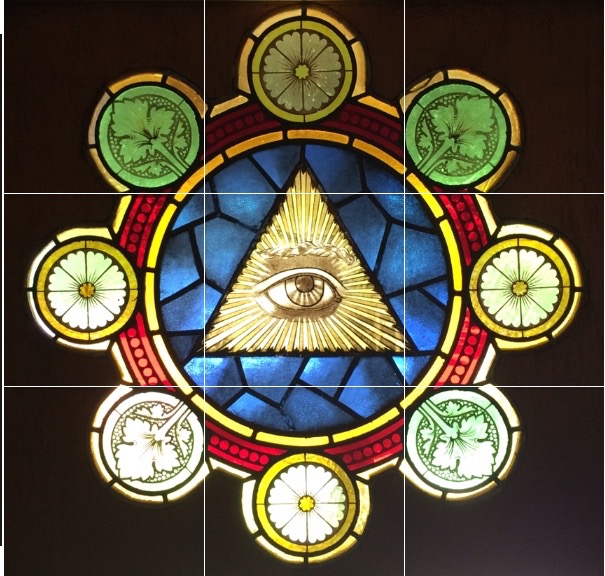
In design terms, the Wizard’s tastes skewed toward the epic, the ornate — total art! cosmic syncretism! He hung large antique mirrors on walls in three of the home’s rooms; he filled most of the home’s windows with stained glass, including a large window at the front of the house featuring an image of the Eye of Providence — the latter retrieved, I’m told, from either a former church or a former Masonic Temple. From the ceilings of those of the home’s rooms adorned with foxed mirrors, he added dazzling, many-armed, many-bulbed chandeliers — beautiful, gaudy, dusty old things! The home’s several built-in bookcases may have been of his making as well — as were one room’s shelves sized for storage of records. The most characteristic of his contributions, though, was the imp crouched atop the home’s door bell, or the pair of werewolves carved into the corners of a mantle atop one room’s fireplace.
When Sarah and I first moved in, we hired a team of local movers to help us unload. One of the movers took one look at the werewolves, and one look at the Eye of Providence, and said, “Y’all ought to have a preacher come and bless this place.”
Suffice to say, we had some weird occurrences there at the home we rented on Shady. None of it seemed malevolent in intent — just a bit weird. I developed a writing practice during my time there involving self-induced trance states, similar to the surrealist practice of “automatic writing.” I experienced auditory hallucinations, where it felt like I was hearing voices. Some of this was admittedly disconcerting at first. I realized almost immediately, however, that I could write some of it down. I could take notes like a kind of sleuth. And so, a Text began to germinate — one I transcribed gratefully, in a state of silent absorption as I listened.
Hence these trance-scripts.
As for the house, Frank sold it when we moved out — and from what I’ve heard, he tempered the decor when preparing to put the place on the market. Thankfully, however, I have some photos of how it looked when I was there.
I know what you’re thinking, says the Narrator: Can I trust an author who calls one of his characters “The Gay Wizard”? I use that name not to offend, but because that was how he was known about town.
People knew the Gay Wizard. He was a local personality, a figure in the community. I remember Sarah and I speaking to our neighbor Sue one afternoon. Sue lived up the street from us, in a cream-colored home. Ferns hung in baskets from her porch. By the time we met her, Sue was already decades into her time on Shady. She spoke fondly of the wizard: his parties, his Studebaker, his boat.
Atop skeletal details of that sort, gathered haphazardly in the course of my tenancy, I crafted a character: someone I fancied meeting one day via time machine. Like an egregore of sorts, he entered first into my imaginings via the spirit of books of an earlier era. The books started turning up in the bins at Goodwill, as if he’d sent them: rare, obscure screeds like Arthur Evans’s Witchcraft and the Gay Counterculture and Mitch Walker’s Visionary Love: A Spirit Book of Gay Mythology and Trans-mutational Faerie. From them and others like them I culled a portrait of a loving psychedelic animist: a gardener like Derek Jarman. That’s how I see him now, in fact: poised there in the sunlit grove at the center of the home’s back yard, spade in hand amid the growth of his garden.
In picturing him thus, I resist the story’s pull toward horror. If this were a work of horror, notes the Narrator, he’d have been a shadier dude. Play the horror factor one way, and he’d have been a Crowleyan sex magician. A Thelemite; a Satanist: a practitioner of black magic. Play it another way, as might, say, Jordan Peele or P. Djèlí Clark, and he’d have been a wizard of an even deadlier sort: the kind who go around in white, terrorizing people of color.
If he’s ours to imagine, says the Narrator, let us imagine him otherwise. In our choosing of genre, let us act with hope.
Conversations with Frank are always lovely, sprawling, rangy things. Early on in the course of one (perhaps even our first), he disclosed to us that several of the Shady home’s occupants prior to our renting it had been musicians in local bands. “Oh yeah? What bands?” I’d asked, hoping to learn more. That was my first hint, I suppose: Frank, rehearsing the names of those bands. “Golden Dawn,” he’d said. “Tetragrammaton.” The latter, I knew, referred to the sacred name of god in Hebrew. I knew, too, of the longstanding prohibition in some quarters on saying that name aloud. And with that, I suppose, I began to suspect, at least on an intuitive level, that there was something odd about the home’s history, some sympathy for occult or forbidden things retained between roof and ground.
But the oddness, I soon learned, was one that preceded Frank and his musician-friends. Well before any of them had arrived on the scene, the home’s occupant was someone known around town as the Gay Wizard. If the place has a whatever-you-wanna-call-it — an ectoplasmic charge; an occult presence of some sort — that dude is, at minimum, a key link in that charge’s chain of transmission, if not its source.
I myself was a latecomer, fresh on the scene thanks to a Craigslist ad posted once upon a morning in the spring of 2013, says the Narrator. Sarah had taken a job at a university in town, and we needed a place to rent. By then, Shady had lost some of its fame. Much had changed. The garage behind the Easter house had already been torn down years before our arrival. All that remained was its stone foundation. And Mitch himself had moved away to nearby Kernersville. In all likelihood, then, the story of Drive-In Studio might have gone undetected, might have remained part of Shady’s secret history, hidden away, occulted by the passage of time, had it not been for Frank, our landlord: a goateed documentarian with a film degree from UNC School of the Arts, fixture of sorts in the local music scene, and amateur collector of fossils. Frank and some fellow students at UNCSA had been part of an artists’ collective that had squatted an old, deactivated meat-packing plant in the late 1990s, on what was then the edge of downtown. Through legal and financial machinations that, I admit, were never entirely clear to me, Frank and his fellow squatters had achieved the impossible. Despite the odds, they’d gained control of the building; they’d transformed it into some other kind of thing. There it stood, suddenly, teeth and claws gleaming: an art space and show venue called The Werehouse.
“So this home,” begins the Narrator. “It’s the cute little craftsman — the one with the stained glass, correct?”
“Yes — inasmuch as the Ship of Theseus is the Ship of Theseus,” replies the Traveler. “Yet don’t be fooled by its current guise. A subsequent owner repainted the home’s exterior with colors that don’t suit it. To properly understand its appeal, one must picture it now as it appeared then: a charming brown-and-yellow bungalow, two houses in from the corner, cyclopean stained-glass Eye of Providence fitted into the frame of the front window, staring intently at all who pass, on land that used to belong to the city’s waterworks.”
Narrator meets the Traveler’s gaze for a moment, then jots a few words in his journal. “And the musician / record producer Mitch Easter,” murmurs the Narrator, as if reading from a dossier. “Frontman for 80s alt-rock / jangle-pop group Let’s Active: he lived there too, did he not?”
“Yes, Easter grew up there, too. Not in the same house, mind you,” hastens the Traveler. “The Easter home was two doors down. But yeah, that was Drive-In Studio. That’s where Mitch recorded R.E.M.’s first single, ‘Radio Free Europe’ — there in his parents’ garage.”
“And Mitch would go on to produce Brighten the Corners, is that right?” asks the Narrator.
“Yes, precisely—the Pavement album,” says the Traveler, lips pursed.
“On which appears…?” adds the Narrator, as if coaching the Traveler through an as-yet unmemorized script.
When I listen again to “Shady Lane,” ears like Adam’s on the morning of his creation, I hear Pavement songwriter Stephen Malkmus sounding not like himself, but like a persona worn by a faraway you. You, dear reader, eyes closed before a cascade of ivy. It’s you, there, singing of worlds colliding. You, of all people, whether with emery board or without, shouting “Freeze, don’t move” and “Glance, don’t stare,” looking at me and thinking me beautiful when I cry.
“Shady Lane — everybody needs one,” goes the chorus. And it’s true. For one can scarcely improve on such a place. And I had one: albeit, “once upon a time.” However timeworn the connotations of that beginning, however hackneyed it may sound, I shit you not.
“For a time I lived differently,” sings the Narrator,
“mind out of time
or in sidereal time
time immemorial
because measured by fixed stars
in a house on Shady Boulevard.”
Granted, it was a strange place, this house — one that left me with many questions. Who from the home’s past, for instance, mounted the cattle skull on the home’s exterior above the porch? Was that the handiwork of the Wizard or of one of his successors?
***
To arrive at an answer, let us report on ourselves in third-person.
The journey occurred, we report, during the period of the professor’s tenancy, in the home of the Gay Wizard. Recalling it now in retrospect, his spiel is, “It never occurred to me at the time that the place might have been haunted.”
“Yet this haunting,” he says, “if that’s what we’re to call it: I insist, here, that the spirits involved were benign.”
“A benevolent haunting! Fair enough,” nods the Narrator. “Tell us more.”



 Trance-Scripts