Secret history: like the one Greil Marcus tracks in Lipstick Traces. That’s what a friend sees me working toward in these trance-scripts. The “Gnostic” in me is drawn to the detective role entailed by such a tale: the “postmodern sleuth” who explores the maze of the contemporary, ever-skeptical of the machinations of the simulation, the Spectacle, the construct. The Gnostic responds to History with cosmic paranoia. History is a Text upon which one exercises an hermeneutic of suspicion. Or in the best versions of Gnosticism, as in the work of philosopher Ernst Bloch, an hermeneutic of hope, with dream or Imagination the absent Messiah deconcealing itself across time. The conservative philosopher Eric Voegelin warns that hope of this sort prompts a reckless utopianism, a desire to “immanentize the eschaton.” For a Christian like Voegelin, the eschaton is a day of judgment, whereas for the Gnostic, it’s the resurrection into joy and the dawn of a New Age. The Catholic trembles while the Gnostic revolts. I think of Allen Ginsberg on the back cover of his book Kaddish, asserting the “triumphancy of Self over the mind-illusion mechano-universe of un-feeling Time.” By “Self,” Ginsberg means the defenseless, open, original self we all share in common, not the mere individual of liberal ideology, the monad disaggregated from the whole. Time is revealed as mind-illusion as we conduct our secret history. Events share affinities and those affinities arrange themselves into stories. The best Gnostics are the ones who become bricoleurs.
Tag: Time
Thursday May 6, 2021
We gather with colleagues on several occasions to celebrate completion of classes, abandonment not yet a fait accompli. There is a shared exhaustion that many of us bring to these events. This has, after all, been a long and difficult schoolyear. We’re fatigued by Zoom – but we all show up, knowing summer’s arrival is but a week away. Summer is time away from Zoom. Time ours again to cast amid the sea of the possible. Time for reading groups, and vinyl nights, and visits to Hades for drinks with friends.
Wednesday April 28, 2021
The Unconscious talks across the divide. Through dreamwork it produces aspects of itself, events and encounters of each day “affected,” given to rise amid the lifeworld of the Ego, the Cogito, the “Subject.” Facets of the Akashic records surprise as they arise like flowers from the soil of routine. The process I’m describing is a bit like “hyperstition,” CCRU’s term for the way fictions make themselves real. (One could also liken it, though, to those acts of “time-walking” or “time-spinning” practiced by the creatures in the Deborah Harkness-inspired TV series A Discovery of Witches. Bodies of past selves inhabited by future minds.)
Thursday April 22, 2021
My eyes travel across spines of books, searching, seeking ways to proceed. Parenting, though, leaves little time to read. As Mark Fisher notes in Postcapitalist Desire, “In order to raise consciousness, you need time” (265). Time is the terrain of struggle. Time is what capitalists steal from those who labor. Stolen time equals stolen consciousness.
Thursday March 25, 2021
Time: an odd phenomenon in light of the way it communicates, deposits emblems, plays hide-and-seek with consciousness. “Let Your Dreams Set Sail” says one such emblem, printed on the wall above the bed in which I’ve slept of late. A box on the ground displays the Paramount logo, a mountain pointed toward an outer sphere, like a Bucky dome lined with stars. Outside the sphere pokes SpongeBob SquarePants: the Flammarion engraving rejoined or reversed.
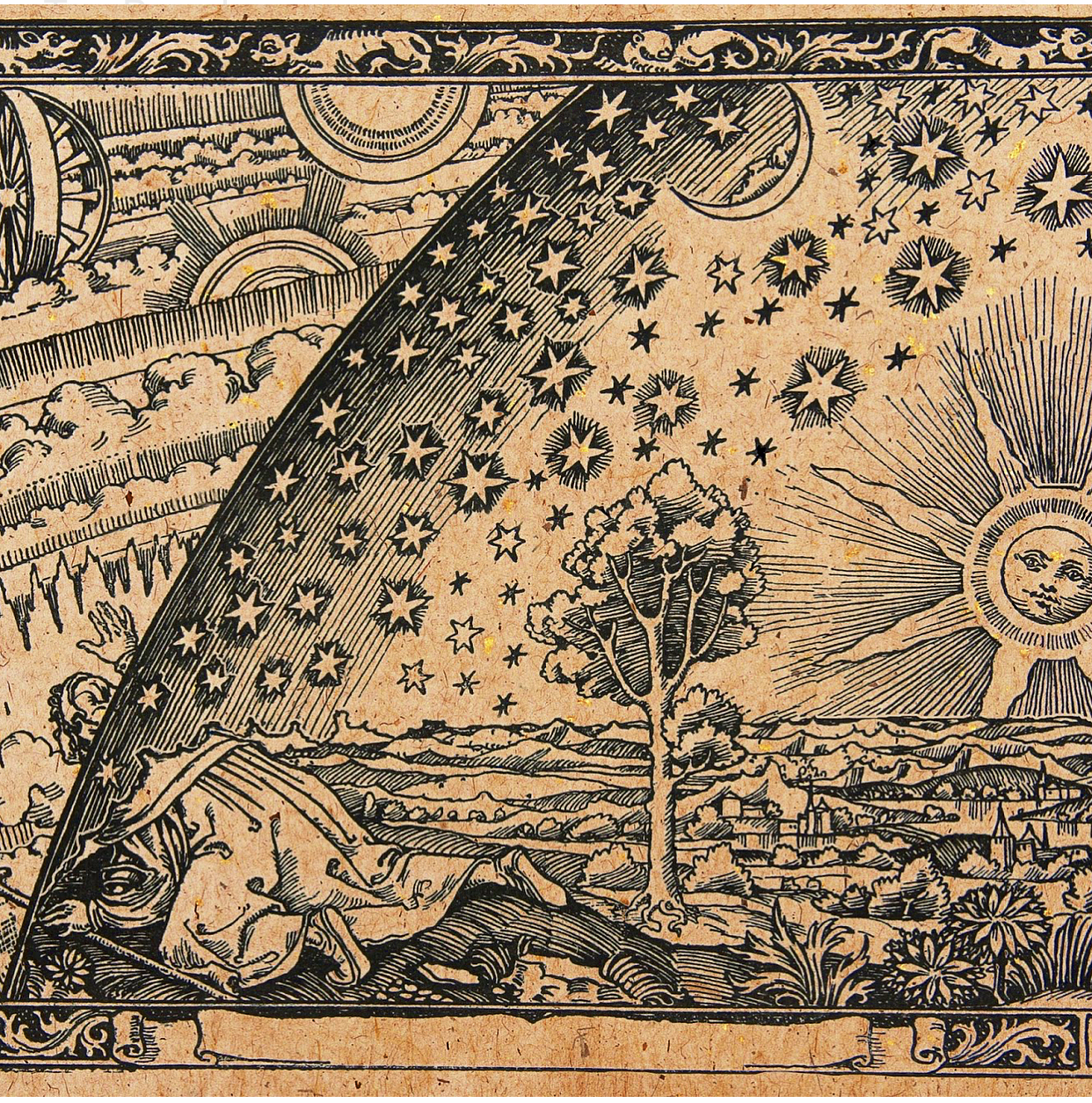
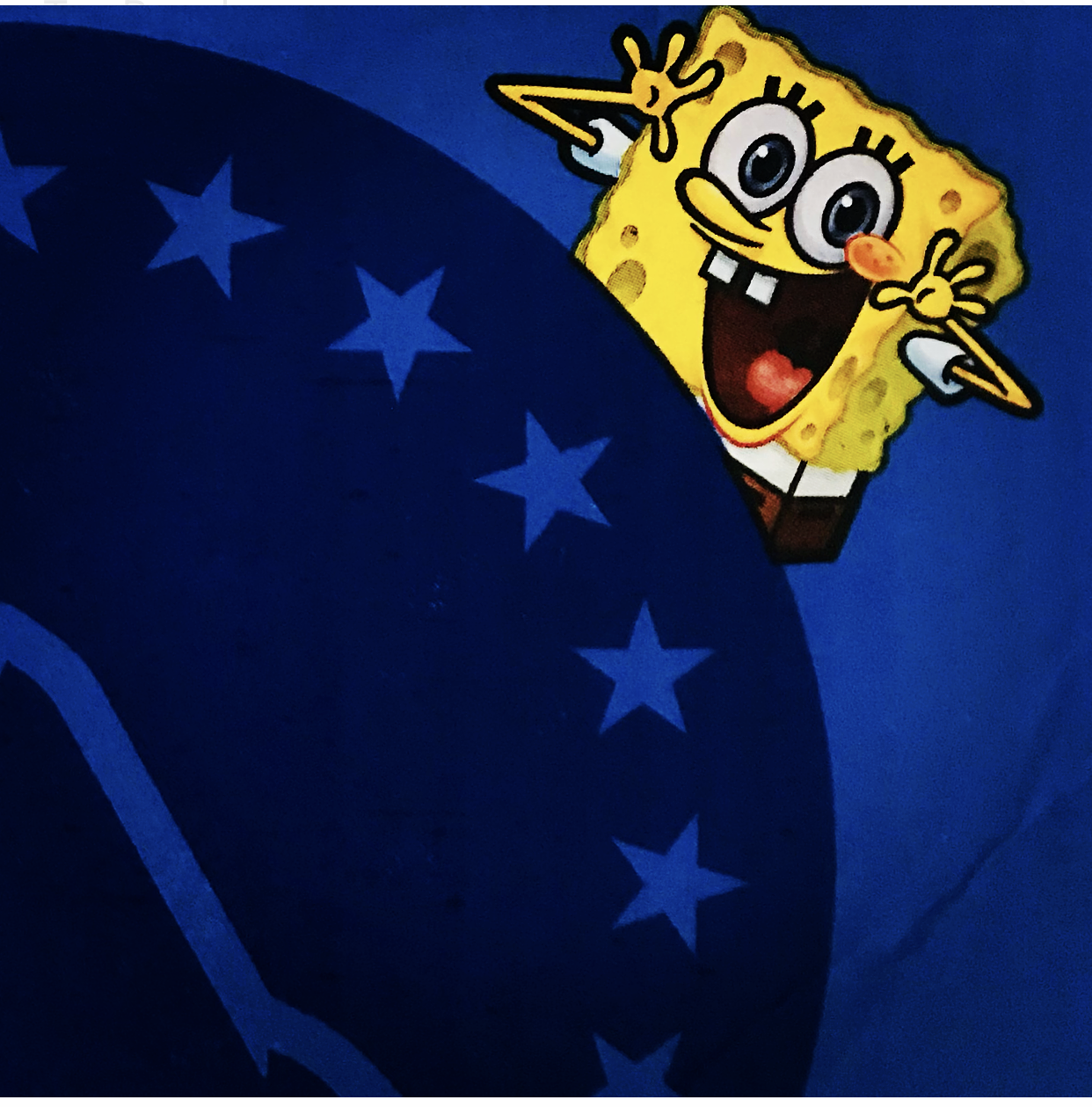
SpongeBob disrupts the first sphere’s fourth wall, smiles at consciousness, injects among solemnity a spirit of mirth set free to roam the cosmos. He, too, partakes of the image’s directionality, the vertical ascent narrative involving spaceships: the thing toward which the parts of the emblem incline. Let us imagine among these ships of possibility that which is prophecied in the mythology of the Dog Star — black anti-slave ships, lines of flight like Marcus Garvey’s Black Star Line. Nathaniel Mackey fuses these symbolisms in his poem “Dogon Eclipse.” The poem ends “as if by then I’d / been thru / Hell / and back.” As if the “I” of the poem were Orpheus, the poet of ancient Greece, founder of the Orphic mysteries. Orphics revered Dionysus. He, too, is said to have descended into the underworld and to have returned. Through his poem, Mackey initiates those who read. So sayeth Michael S. Harper in his preface to Eroding Witness: “These poems are about prophecy and initiation.” Poems like “Dogon Eclipse” hint at mysteries; they transmit a secret knowledge. Other poems in the collection conjure loas from Voodoo and Vodou. Loas are the “mystères,” “the invisibles.” They act as intermediaries between worlds.
Saturday January 16, 2021
Can a text become a time machine, a weaver of strange loops? Where does free jazz fit in the machine’s equation, as Moor Mother says it must? Is the text composed through spontaneous play with others? Have we been living “atemporally,” as Bruce Sterling suggested? The form of these trance-scripts is both-and. One can scroll vertically through a stack of days. Or one can proceed rhizomatically, inputting keywords into a search of the site’s invisible index. Search for Willis Harman, for instance, and read about SRI and LSD. Harman was a square — an electrical engineer who, after getting turned on, turned on others. He became a pivotal figure in the human potential movement. He also coauthored a book with Wired affiliate Howard Rheingold called Higher Creativity: Liberating the Unconscious for Breakthrough Insights. Beware this talk of “liberation,” though. Harman’s research may have been CIA-funded. Something occurred there. Our time-traveling psychedelic detective needs to investigate SRI. If one wants to make it weird, sprinkle into the plot a secret order of time-traveling Hashishins — followers of Hassan i Sabbah. Have the detective find among his case files Michel Jeury’s Chronolysis and Daniel F. Galouye’s Simulacron-3.
Sunday January 10, 2021
Are we genres of people, as Jamaican writer Sylvia Wynter argues? Or do we contain multitudes, selves morphing and genre-shifting? Could capitalist realism reality-shift? It could become a romance: a “scientific romance” as per Wells, with a time machine. And it could do this with or without the horrors of weird fiction. It could be a detective comic. It could be a portal fantasy. It could be all of these. Even at times, under game-like conditions, a dungeon-crawl. Let us remake ourselves as magical realists. The story that contains is a story of love. It can get smutty, as Sarah says of Bridgerton. Persons in their many phases, including altered states of consciousness: some higher, some lower. Let us imagine time machines, war machines, starships. Revolution occurs, a revolution of consciousness. Heads awaken to higher states: romantic comedy, utopian fantasy. Genres combine, as do gods and archetypes in Neil Gaiman’s American Gods. Paradise is both the third book of the Divine Comedy and a novel by Toni Morrison. The latter begins with a call to sobriety.
Friday January 1, 2021
Noisemakers announce the arrival of a new year. Let us breathe sighs of relief at 2020’s passing. The year ended with word of a final casualty: hiphop legend MF DOOM. Let this new year be a year of healing. Let portals open onto novel developments: new courses, new branches of study. What’s this talk about time travel, for instance, in the recent Avengers film, Avengers: Endgame? Dr. Strange makes an appearance — as he will again in due course, in the course I teach this spring. Marvel characters invaded the American national-popular imaginary in conjunction with popularization of psychedelics in the 1960s. Early psychonauts like Ken Kesey and the Merry Pranksters were, as Tom Wolfe notes, “Super Kids,” turned on by a mix of peyote and Captain Marvel. Jeffrey J. Kripal’s Mutants and Mystics might speak to this conjuncture. And for magic, let us read Alan Moore’s Promethea.
Tuesday July 30, 2019
Neighborhood cats greet me as I pull up in front of my home upon my return from Des Moines. We exchange hellos, after which point the cats go back to lounging on their sides. Settling onto a couch, bags only partly unpacked, I begin to think again about these trance-scripts. The best I can say about their origins and effects, I tell myself, is that through them I seem to be speaking to myself across time. And yet, in saying that, I find myself immediately wanting to add, I don’t just mean I write so as to be read by myself in the future. That much is obvious. What I mean, rather, is that some future version of myself is the one seeding these trance-scripts, communicating backwards, bootstrapping itself into being. I grant the paradoxical, seemingly impossible nature of that claim — but paradox or not, it remains to my mind the hypothesis that comes nearest to truth, and that thus best approximates my condition.
Monday July 1, 2019
Well placed to notice memory’s modularity, losses and accretions, rooms refurbished by time. I was real or so I thought. Like a golden birthday balloon made of creased mylar, I press against a ceiling, inside filled to bursting, wondering how I got here. Birds, planes, sunset skies of pink, orange, and blue. Time with family overwhelms me, wears me down. The finest moments are the silent ones, a light breeze, water lapping the sides of a canal.
 Trance-Scripts