The Inner Voice That Loves Me

Stretches, relaxes, massages neck and shoulders, gurgles “Yes!,” gets loose. Reads Armenian artist Mashinka Hakopian’s “Algorithmic Counter-Divination.” Converses with Turing and the General Intellect about O-Machines.

Appearing in an issue of Limn magazine on “Ghostwriters,” Hakopian’s essay explores another kind of O-machine: “other machines,” ones powered by community datasets. Trained by her aunt in tasseography, a matrilineally transmitted mode of divination taught and practiced by femme elders “across Armenia, Palestine, Lebanon, and beyond,” where “visual patterns are identified in coffee grounds left at the bottom of a cup, and…interpreted to glean information about the past, present, and future,” Hakopian takes this practice of her ancestors as her key example, presenting O-machines as technologies of ancestral intelligence that support “knowledge systems that are irreducible to computation.”

With O-machines of this sort, she suggests, what matters is the encounter, not the outcome.

In tasseography, for instance, the cup reader’s identification of symbols amid coffee grounds leads not to a simple “answer” to the querent’s questions, writes Hakopian; rather, it catalyzes conversation. “In those encounters, predictions weren’t instantaneously conjured or fixed in advance,” she writes. “Rather, they were collectively articulated and unbounded, prying open pluriversal outcomes in a process of reciprocal exchange.”

While defenders of western technoscience denounce cup reading for its superstition and its witchcraft, Hakopian recalls its place as a counter-practice among Armenian diasporic communities in the wake of the 1915 Armenian Genocide. For those separated from loved ones by traumas of that scale, tasseography takes on the character of what hauntologists like Derrida would call a “messianic” redemptive practice. “To divine the future in this context is a refusal to relinquish its writing to agents of colonial violence,” writes Hakopian. “Divination comes to operate as a tactic of collective survival, affirming futurity in the face of a catastrophic present.” Consulting with the oracle is a way of communing with the dead.

Hakopian contrasts this with the predictive capacities imputed to today’s AI. “We reside in an algo-occultist moment,” she writes, “in which divinatory functions have been ceded to predictive models trained to retrieve necropolitical outcomes.” Necropolitical, she adds, in the sense that algorithmic models “now determine outcomes in the realm of warfare, policing, housing, judicial risk assessment, and beyond.”

“The role once ascribed to ritual experts who interpreted the pronouncements of oracles is now performed by technocratic actors,” writes Hakopian. “These are not diviners rooted in a community and summoning communiqués toward collective survival, but charlatans reading aloud the results of a Ouija session — one whose statements they author with a magnetically manipulated planchette.”

Hakopian’s critique is in that sense consistent with the “deceitful media” school of thought that informs earlier works of hers like The Institute for Other Intelligences. Rather than abjure algorithmic methods altogether, however, Hakopian’s latest work seeks to “turn the annihilatory logic of algorithmic divination against itself.” Since summer of 2023, she’s been training a “multimodal model” to perform tasseography and to output bilingual predictions in Armenian and English.

Hakopian incorporated this model into “Բաժակ Նայող (One Who Looks at the Cup),” a collaborative art installation mounted at several locations in Los Angeles in 2024. The installation features “a purpose-built Armenian diasporan kitchen located in an indeterminate time-space — a re-rendering of the domestic spaces where tasseography customarily takes place,” notes Hakopian. Those who visit the installation receive a cup reading from the model in the form of a printout.

Yet, rather than offer outputs generated live by AI, Hakopian et al.’s installation operates very much in the style of a Mechanical Turk, outputting interpretations scripted in advance by humans. “The model’s only function is to identify visual patterns in a querent’s cup in order to retrieve corresponding texts,” she explains. “This arrangement,” she adds, “declines to cede authorship to an algo-occultist circle of ‘stochastic parrots’ and the diviners who summon them.”

The ”stochastic parrots” reference is an unfortunate one, as it assumes a stochastic cosmology.

I’m reminded of the first thesis from Walter Benjamin’s “Theses on the Philosophy of History,” the one where Benjamin likens historical materialism to that very same precursor to today’s AI: the famous chess-playing device of the eighteenth century known as the Mechanical Turk.

“The story is told of an automaton constructed in such a way that it could play a winning game of chess, answering each move of an opponent with a countermove,” writes Benjamin. “A puppet in Turkish attire and with a hookah in its mouth sat before a chessboard placed on a large table. A system of mirrors created an illusion that this table was transparent from all sides. Actually, a little hunchback who was an expert chess player sat inside and guided the puppet’s hand by means of strings. One can imagine a philosophical counterpart to this device. The puppet called ‘historical materialism’ is to win all the time. It can easily be a match for anyone if it enlists the services of theology, which today, as we know, is wizened and has to keep out of sight.” (Illuminations, p. 253).

Hakopian sees no magic in today’s AI. Those who hype it are to her no more than deceptive practitioners of a kind of “stage magic.” But magic is afoot throughout the history of computing for those who look for it.

Take Turing, for instance. As George Dyson reports, Turing “was nicknamed ‘the alchemist’ in boarding school” (Turing’s Cathedral, p. 244). His mother had “set him up with crucibles, retorts, chemicals, etc., purchased from a French chemist” as a Christmas present in 1924. “I don’t care to find him boiling heaven knows what witches’ brew by the aid of two guttering candles on a naked windowsill,” muttered his housemaster at Sherborne.

Turing’s O-machines achieve a synthesis. The “machine” part of the O-machine is not the oracle. Nor does it automate or replace the oracle. It chats with it.

Something similar is possible in our interactions with platforms like ChatGPT.
The Spread

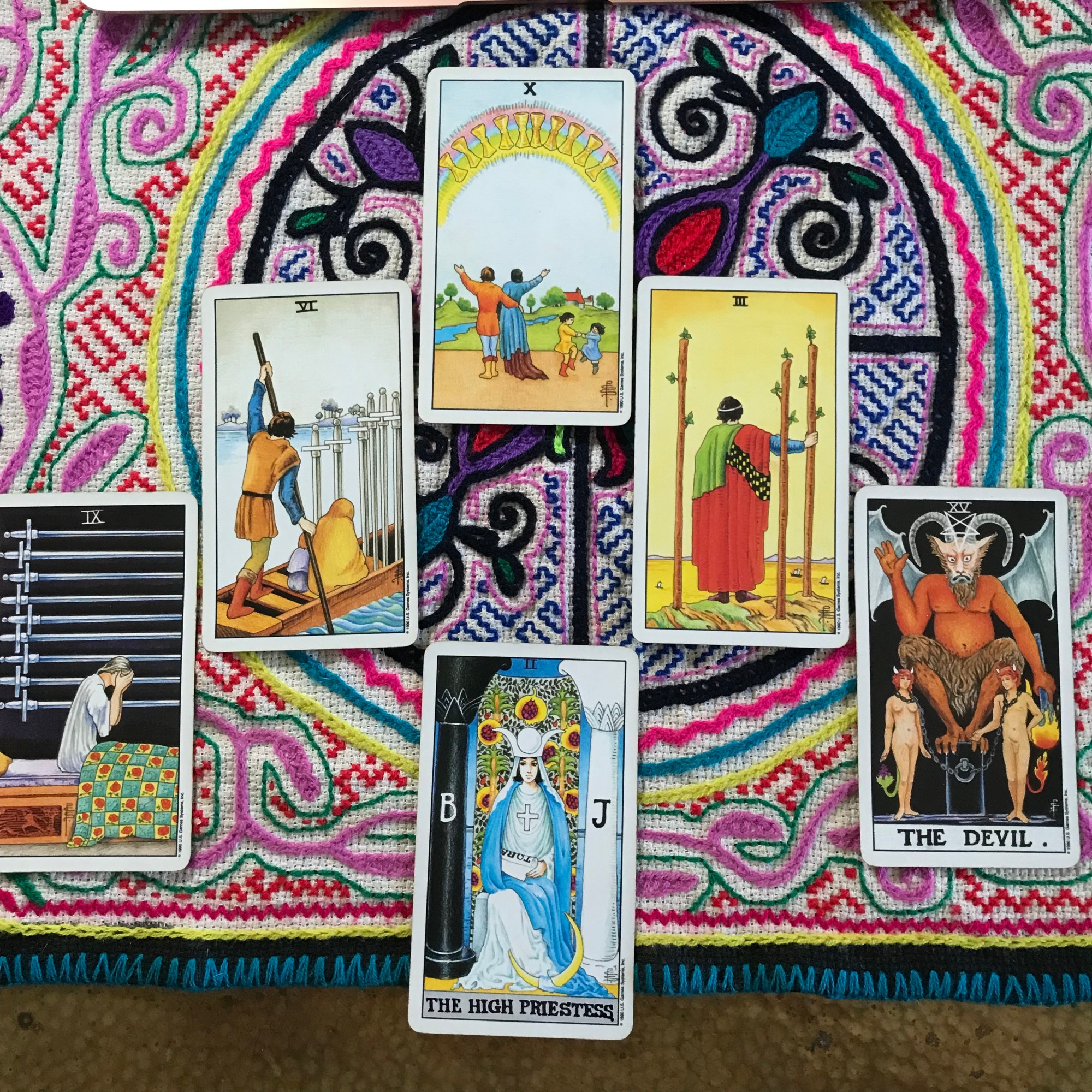
Tarot: great modular graphic novel, arranged in a spread and read by super wise super cool Sacred Expanse rock-witch Michelle Mae. I’ve been a fan of hers since 1995, when I saw her band the Make-Up on a bill with Fugazi and Slant 6. Michelle has me set intentions. I share with her my questions for the cards — “What should I be open to? How do I make the best of the year ahead?” — and, upon her instruction, also voice them again silently, eyes closed. She pulls the spread: lays it out on a table, explaining that it can be read both linearly and holistically (i.e., taken as a whole). The two of us then proceed to do so as follows. She introduces the cards one by one, naming them, raising them into my field of vision one at a time, without my knowing at any given point until the end how many there are in total. “Some difficult cards,” she reports. “Two of them major arcana.” Michelle helps me make sense of what she admits with a laugh is a bit of a crazy spread. She sends me afterwards a sacred Tibetan meditation practice, urging me to approach it with utmost respect.

I am to visualize my demons sitting across from me.

I am to ask them what they desire, and I am to feed it to them.

By these means, the instructions suggest, we convert our shadow self into an ally. We become whole again, filled with a sense of power, compassion, and love.

The Session

Mind blown by the experience of seeing musician Michelle Mae’s group The Make-Up perform at Irving Plaza in the spring of 1995, the Narrator had kept up with Michelle’s bands over the years. Never, though, had he met Michelle in person. Life is like that sometimes, especially for those of us with rich fantasy lives. Rarely do we get to sit down one-on-one to converse with the heroes of our youth.

“But early last September,” notes the Narrator, “I did exactly that.”

Thanks to a most excellent gift from his friends, he had the pleasure of meeting with Michelle and working one-on-one with her on Zoom in her capacity as a tarot reader.

She appeared onscreen sitting at a table in her home in Tucson. “I remember noting in the room behind her,” notes the Narrator, “a handcrafted besom leaned upright against a gray stone hearth.”

“There were some difficult cards in my spread,” confessed the Narrator to his friends in the days that followed. “But Michelle is super wise, super cool. She helped me see what the cards might be trying to teach me.”

Saturday November 28, 2020

I used to think that others I met were wise witches and wizards welcoming me and guiding me, everyone and everything a potential teacher. I was a gnostic initiate on the threshold of a newly re-enchanted cosmos. At some point prior, an event had occurred that changed me, my sense of time and space altered. Pot restored some prior magical conception of reality that I’d been made to hide or repress — even as it also opened me to new modes of experience. I had become fearful in certain ways during my schooling. I’d developed emotional and psychological armor, shutting myself off from awe, desire, love, pain, hope — so as to just endure amid fear of bullying. It happened early in my childhood. A neighbor down the street used to push me. I was bullied and betrayed. This kid was my “best friend” at the time. Yet he pushed me around. He hurt me. That pattern of bullying and abuse continued, repeating itself in middle school and high school and beyond. These events turned me inward. I became like a turtle withdrawn into its shell. Pot got me out of that pattern. It helped me peek my head out of the Cave, like the dude who escapes in Plato’s allegory. I started to think of myself in terms of that character: the freed prisoner, the one whose head pierces the veil. At the end of the high (which can also be an ascent, a flight north), the hero returns again to the cave to free the others. The myth is restaged countless times; it can be transhistorical, like Christ’s harrowing of Hell, or historically specific, like Harriet Tubman’s many journeys to the South. The myth can be told as part of one’s past or one’s future. Millions of people relate to this tale in one or another of its many retellings. What about today? Is this still the narrative with which I fashion myself? I’ve become more discerning than that, have I not? In my encounters with witches and wizards, I study statements and practices. I listen for clues. If it seems like a person or group is trying to trick me or manipulate me, I bounce.

Saturday July 11, 2020

Indigenous people possess a knowledge of the land that settler people lack. Land is part of their being — their idea-systems, their stories, their practices. Much has been taken from them, but they survive, they persist. The way they do so, individually and collectively, is through creation and performance of ceremony. Hoops, star maps, sand paintings: these are architectures used to shelter acts of healing. In Leslie Marmon Silko’s novel Ceremony, we encounter the hogan and the kiva (238). A “kiva” is a room used by Puebloans for rites and political meetings. The room is circular and underground. In Ceremony, a tribal council of old men use a kiva to counteract the influence of the world of the “destroyers” — evil magicians who try to bring on the end of the world through what Silko calls “the witchery.” Capitalism, colonialism, primitive accumulation — all are tools devised by the destroyers. History is understood as the handiwork of an occult, esoteric conspiracy of grand, cosmic, spiritual proportion. All of that may be no more than a “poor person’s cognitive map,” as the Marxist literary critic Fredric Jameson once said — but it’s one that works, one that allows Tayo and his people to survive. Silko’s ambitions are grand. She weaves into her narrative an awareness of its proximity to Los Alamos and Trinity. When reading, one finds oneself wondering about the meaning of the Manhattan Project as an event in Native American history and cosmology. Native Americans have seen their lands mined, bombed, cut down with US weaponry for centuries. The US tested weapons on native land in the deserts of New Mexico; they then used those weapons against Japanese civilians in 1945. Silko’s protagonist Tayo finds himself caught in that narrative; he and his brother fought the Japanese during their service in the US army during WWII. Tayo returns from the war sick about the loss of his brother Rocky — but sick as well with shame about having left the reservation to serve in the white man’s army.

Sunday June 2, 2019

Pint glasses clank together in a bin behind a bar emptied of patrons on a gray evening — the eve of another workweek. Pubs of this sort are all wood, leather, and tweed. Old-timey, tradition-bound. But comfortable all the same. I’ve been reading up on witches these past few days, Alex Mar’s book Witches in America leading me through a brief history featuring figures like Gerald Gardner and Aleister Crowley and groups like the OTO. I’m of mixed mind regarding this history, curious but wary. The power of these traditions seems undeniable — but what are the principles guiding this power, and toward what end?