Jamberry is an audio-visual tone-poem that riffs on the American Dream-State and its history. It sings the raft down the river, the one containing Huck and Jim from Mark Twain’s The Adventures of Huckleberry Finn — only it follows the raft’s progression (reimagined as a canoe) well beyond Twain’s time. Huck and Jim plunge over a waterfall, enter a time tunnel and drift prophetically past trains into outer space. Moons, rockets: they’re there on the page, Jamberry thus possessing a kind of “space flick plot,” like the one referenced by Black Arts poet David Moore (aka “Amus Mor”) in the opening minutes of Muhal Richard Abrams’s “The Bird Song.” Traveling across time I recall Raistlin Majere, the mage who adventures to the years prior to the Cataclysm in Margaret Weis and Tracy Hickman’s Dragonlance novels. Books that delighted me when I read them as a kid. Afrofuturists like Moore see in the space flick plot a means of escape. Chariots and arkestras part the waters and lead the righteous ones to Zion.
Category: Uncategorized
The Bird Song
I receive the gift of a solitary afternoon at Durant-Eastman Beach in Rochester, NY on the south shore of Lake Ontario. The stretch of beach across from where I park is closed, so I walk to the right toward an anchored sailboat. Along the way, I discover a seagull lying dead in the sand. I hesitate for a moment upon sight of it, and in this act of hesitation offer it my condolences. Giving it wide berth, I continue on my way. A dune buggy crawls past and retrieves the bird soon thereafter. Setting myself down into a beach chair, I stare out toward the horizon and long and pine for an unknown unknown. Desire’s many-tendrilled, dendritic — stopped only by awkwardness on account of fear. Speaking of fear: pitbulls on leashes get in scuffles mere feet from my feet. Female owners yank at the leashes until, calmed of whatever caused them to behave as they did, the dogs are allowed to lay together again in peace. Waves crashing I give listen to Muhal Richard Abrams’s Levels and Degrees of Light (1968).
There it is, as if in answer to my ministrations: “The Bird Song.” Lauren Berlant & Kathleen Stewart recommend it in their book The Hundreds. The authors collaborate through “hundred-word units or units of hundred multiples” (ix). The form of their book emerged through obedience to this capacious, generative constraint. Words set toward description of affect-events through scanning of object-worlds for vibrant tableaux. I feel adjacency to this form. “Everyone has their own version,” they write, “of the glimpse of a long-forgotten realm of possibility suddenly intruding into the real like a splice of light captured in a photograph” (9).
The Time Tunnel
I listen to Julius Hemphill’s “Dogon A.D.” as tree-friends dance in the evening air. Push and pull of many forces: sadness, loneliness, anger, disappointment. All amid boredom: relentless repetition, until a friend recommends Prince Far I’s “Free From Sin.”
Digital flânerie leads on two separate occasions to The Time Tunnel, an Irwin Allen production that aired on ABC from September 1966 through April 1967. G-men work in some top secret underground facility in the desert, a sequel of sorts to the Manhattan Project. More than 12,000 personnel in their own self-contained city. A brash scientist accelerates the program, sends himself into the time tunnel. His friend goes in after him. Two men tumble helplessly through time as colleagues and friends work to rescue them and bring them home. Allen went on to fame as the “Master of Disaster” in the 1970s with The Poseidon Adventure (1972) and The Towering Inferno (1974)—films I discussed at length in my dissertation.
Grammars of Animacy
Robin Wall Kimmerer teaches the importance of a “grammar of animacy” in her book Braiding Sweetgrass. The book’s title reminds me of the great Iroquois culture hero Hiawatha, whose name means “He Who Combs.” Hiawatha was a kind of healer, combing snakes from the mind of Onondaga wizard Atotarho (also known as “Tadodaho”). Kimmerer “braids” where Hiawatha “combed.” She’s a member of the Potawatomi, a Great Lakes tribe whose lands were far to the west of the Iroquois. Kimmerer now lives and teaches, however, near the Onondaga Territory, the center of what was once the Iroquois Confederacy.
Birthplace of the Iroquois Confederacy
Syracuse is a place with a rich and storied past. The Iroquois Confederacy was founded here at Onondaga “some time about the middle of the fifteenth century,” as Paul Wallace tells us in White Roots of Peace: The Iroquois Book of Life. I find Wallace’s book on a shelf in the city’s four-story Antiques Exchange: one of innumerable structures and forms by which the city retains its history.
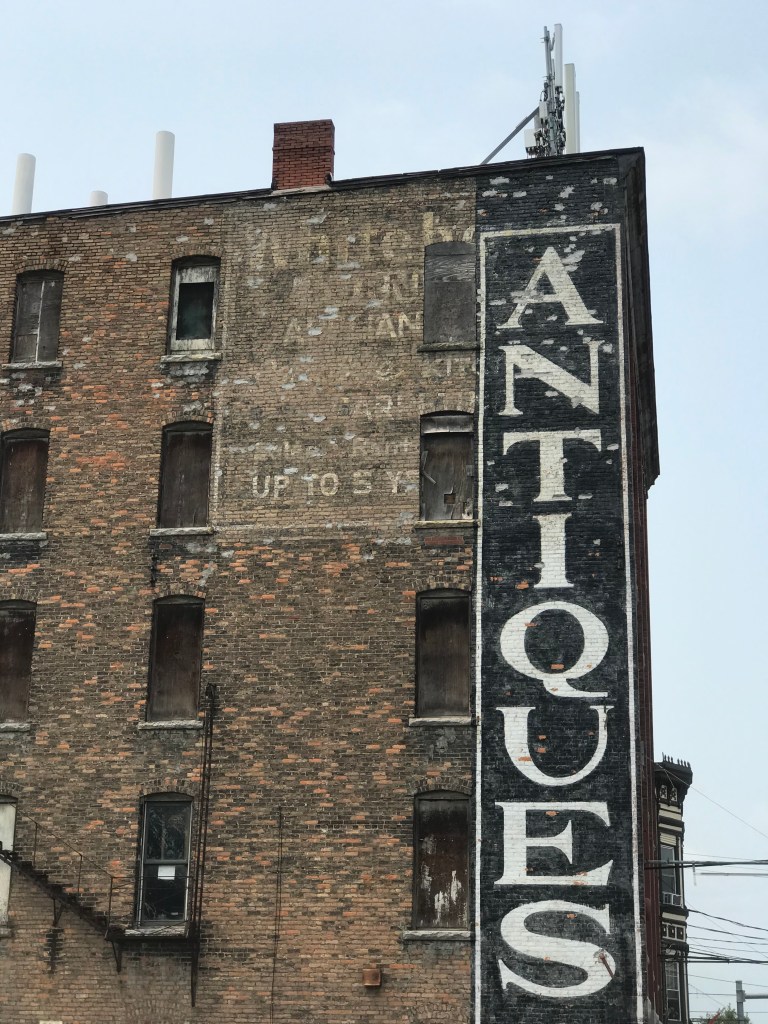
Driving a car is already a form of time travel — but ’tis especially so in Syracuse. Multiple eras coexist amid the beauty and dilapidation of major city thoroughfares like Salina Street. Sitting now on a sleeping bag in a tent, I read of the Five and Six Nations and the Constitution of the Haudenosaunee. Wallace recognizes the resulting Iroquois Confederacy as “a model for, and an incentive to, the transformation of the thirteen colonies into the United States of America” (19). Other scholars contest some of Wallace’s claims, suggesting that the ratification occurred further west (near what is today Victor, NY). These are stories told among Indigenous people, passed on to white anthropologists like Wallace: tales retold in the tongue of the settler. One understands that much is lost in translation. Time travel is an imaginal practice, not a science. The Great Peacemaker Deganawidah appears in Wallace’s account as a miraculous figure comparable to Christ and Buddha. “I come from the west and I go toward the sunrise,” he tells those he encounters. “I carry the Mind of the Master of Life, and my message will bring an end to the wars between east and west” (38-39).
Westcott Nation
The phrase “Lady and the Tramp,” like the title of the Disney film, sung to the tune of “Bennie & the Jets”: such is how I begin my morning. I wake to a lovely quiet hour in the tent, sun rising in front of me. There’s a conversation among crows in those trees there — the ones beside which I slept. It’s good to be back in Syracuse, camped in my sister-in-law’s backyard, listening to crickets and birds, music discernible from the park across the street here in Westcott Nation, a sister nation of sorts to the nearby Onondaga Territory. The Westcott’s persistence gives me comfort. To know better where we are, let us listen to Robin Wall Kimmerer’s Braiding Sweetgrass: Indigenous Wisdom, Scientific Knowledge, and the Teachings of Plants. Kimmerer’s book has me wanting to enter into caring relation with the pecan trees in my yard — indeed, makes me want to honor all beings, including those crows parked in the branches above my tent. Geese, too — like those in the story of Skywoman. Kimmerer shares this tale: the great Potawatomi creation story. “Skywoman Falling” will pair well with texts I teach this fall, thinks the Traveler as he reads. We have been given this gift. Let us share it with others. Let us fit it in at semester’s end. Let it resonate with Silko’s Ceremony and Snyder’s Turtle Island and Butler’s Parable of the Sower. Kimmerer’s cosmology “places” all of the others. Skywoman transmits “original instructions,” tells us where we are, how we got here. It suggests as well what ought to be done. It sets us within cyclings of a vast cosmic gift economy: one that conceives and receives numberless generations of Skywoman’s daughters — for Skywoman is the Great Mother, bearing life despite the story of her fall.
Pyramids, Hideaways, and Hollows
It rains through the night, but we stay dry in our tent. I sleep comfortably and wake to a world of sound. Daddy long-legs spiders gather in the dry space between the breathable net of the tent’s roof and the tarp above. Breakfast is delicious: pancakes, sausage, Canadian bacon, maple syrup, bread made with cardamom and dates, purchased the morning prior by the author’s aunt and uncle from a farmer’s market in Bolton Landing. Tent goes tie-dye with the addition of a blue tarp. I reflect for a time on the pyramidal symbology of my surroundings: zippers, seams, poles all tending toward apex as we await windows of sunlight. Respite from the rain. Camping educates desire. In my case, it teaches me the value of nooks, coves, hideaways. My nephews lead me to a hollow formed beneath the roots of a tree, down near the edge of the lake. “Bookmark it, note it down, save it for later,” thinks the time traveler. “The image may be of use to us elsewhere in our journey.” News arrives soon thereafter: another inch or two of rain expected in the night ahead.


Under the Dome
Camping: a play starring mother, sister, brother-in-law, niece and nephews, aunts and uncles, Sarah and Frankie. Air mattress craps out, so Sarah drives into town to purchase another. I stay behind at the camp, in a camp chair beside Frankie as she naps. Sister orders pizza; brother-in-law and uncle handle boat and jet-ski. Domed tents go up amid leafy profusion: Coleman, Ozark Trail. ‘Tis the universe of Sears-Roebuck, L.L. Bean, and Whole Earth Catalog: temporary tools and architectures. But beside each tent sits a car, where in earlier times would have stood a horse. Nothing here is as I wish. No wisdom, no gnosis. No silence, no solace. No love ’til I sit with trees. Is the time travel narrative’s hero the one who stays or the one who goes?
Indra’s Net
An itchy, hairy, melancholy spider tiptoes along threads of text. Time is to the one who travels a bit like Indra’s Net. At each “eye” in this net of infinite dimension, one is told, lies a jewel set there by the net’s artificer to please the tastes of the great god Indra. Inspect any one jewel and one will discover reflected there in its polished surface all of the others. Alan Watts described it thus: “Imagine a multidimensional spider’s web in the early morning covered with dew drops. And every dew drop contains the reflection of all the other dew drops. And, in each reflected dew drop, the reflections of all the other dew drops in that reflection. And so on ad infinitum. That is the Buddhist conception of the universe in an image.”
In, But Not Of
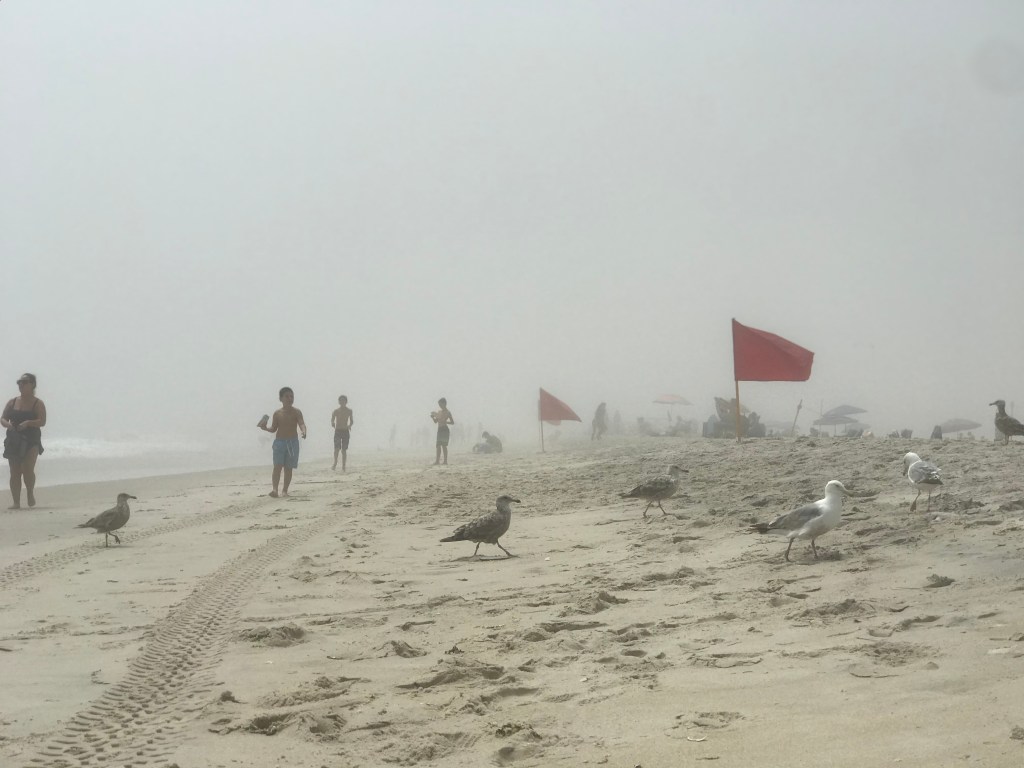
Seagull flies low, peruses the scene along the shore, horizon obscured by fog. Others follow, seeking edibles amid grains of sand. Beachgoers mill about until, fog passing, whistles blown, flags raised, lifeguards announce “Coast clear.” I boogie board, I body surf. In this place but not of it, I jut my tongue out and, as if prepping for a shot of tequila, lick salt from the edge of my mustache.
 Trance-Scripts