Broke ’til the end of the month, I entertain myself by walking, listening to Dennis Wilson’s “Dreamer,” lounging about, watching sunsets. Syd Barrett’s “Octopus” gives me pause. Eyes closed, I meditate in a state of pure sound: elaborate spatializations of the sounds of instruments and voices.
Category: Uncategorized
Wednesday January 23, 2019
If my government were a channel, I’d grab the controller and change it. Out with this immiserating, sadistic, Walking Dead bullshit. Enough already. I work full-time as a college professor, I live modestly, and yet because of student debt, here I am on the 23rd of the month, bank account overdrawn, savings nonexistent. This system is unworkable.
Tuesday January 22, 2019
Noting a shift in my sensitivity toward rhythm and percussion, I opt for music made by ecstatic ensembles that shake, ring, and sizzle. Thomas Meloncon warms things up with “Waiting On Your Mind,” before laying it straight with “Ain’t Gonna Wait Too Long.”
All of this turns out to be foreplay, however, for what I’ve been seeking: Elevation, a Pharoah Sanders LP from 1973. The theme is certainly in keeping with Jack Kerouac’s The Dharma Bums, a book I’m reading with students. Lighthouses, rivers, rainbows, meadows: over these I travel, dancing along, movement of a mind at play.
Monday January 21, 2019
I wrote a letter to a cousin of mine ten years into serving a seventeen-year sentence in prison. I try not to dwell in sadness over my own condition for his sake, given his condition, nearly impossible for me to imagine, let alone endure. I loathe and despise my society’s appetite for imprisonment and detainment, yet writing this letter is one of the few things I’ve done to try to comfort a prisoner. “Better late than never?” asks the ego in hope of absolution as it lies on a couch reading about “Moloch the incomprehensible prison,” “Moloch whose mind is pure machinery.” Reading “A Supermarket in California,” one of the “other poems” in Howl & Other Poems, I hear Ginsberg evoking Walt Whitman as a Virgil, leading him through the neon-lit inferno of the American Century.
Saturday January 19, 2019
Jean-Michel Basquiat’s SAMO graffiti and his no-wave band Gray sneak onto my train of thought, and the train breaks down into boxcars of found phrases. Countercultural, determined not to go home again, determined to make it happen. Darling of the art world. Acting out the society’s wildest dreams. Putting that smoke in the air. Graffiti broadcast from the control room, as in the Times Square Show or the movie Downtown 81. For early critical celebrations of Basquiat’s work, see Rene Ricard’s “The Genius Child” in Artforum, and Robert Farris Thompson’s Flash of the Spirit: African and Afro-American Art and Philosophy. Things done by chance. By the end of the night, I’m listening to Funkadelic and thinking, “Fried ice cream is a reality!” Funkadelic’s intervention is not all that different from Basquiat’s. It’s as if a strikethrough artist painted over Jefferson Airplane’s After Bathing at Baxter‘s to create the richly allegorical / mythopoetic cover art to P-Funk’s One Nation Under a Groove. The psychedelic cultural revolution lies secreted away there, a transmission for those who have ears to hear and eyes to see.


Friday January 18, 2019
How is it that both the United States and China hosted movements of urban youth to rural areas, “back to the land” in the one, “down to the countryside” in the other, to such vastly different effects? Let us care for life in all its forms, including the form it took in Dirt Road to Psychedelia, a film about Austin, TX in the 1960s. The radical comix artist Gilbert Shelton emerged from that scene, as did Roky Erickson and Janis Joplin. The documentary reinstates in consciousness lesser-known classics, like Take Me to the Mountains by Shiva’s Headband. My pedagogy begins by offering students collective power-sharing and shared ownership in the classroom. Once a class collaborates on revision of the syllabus, they’ve become co-creators of reality. Class consciousness foments and rises. They witness their vast and previously unrealized collective capacities.
Thursday January 17, 2019
The second part of the 1990 documentary Berkeley in the Sixties is titled “Confronting America.” After the victory of the Free Speech movement on the Berkeley campus, the world transforms from black-and-white to color. Students decide to commit themselves to naming and controlling the system, else it destroy the world. They start to change: new ideas, new music, new hair, new groups, new consciousness. The counterculture enters the equation. More and more people start to turn on. They start to gather and collaborate in liberated territories. They march, they don helmets, they defend themselves from attacks by police. This gives way to “Part Three: Confronting History,” where armed revolutionary organizations like the Black Panthers step onstage and revolutionary confrontations occur in France, Japan, Mexico, and Czechoslovakia. “So much life, so much death,” as Michael Rossman notes in retrospect, “so much possibility, so much impossibility.” Now that all of these kids are at the table, what happens next? How do we let ourselves go and speak freely? How do we deactivate internal censors? Sons of Champlin sing in reply, “Get High.” Lovely midsection built around bells and vibes. Out of it we emerge giggling, “Where are we?” This new dawn looks fantastic. My students are bright and interesting. We spent the day together deconstructing and rebuilding our classroom in the spirit of power-sharing egalitarianism. The air feels rich with possibility. A voice speaks up and teaches, “Open doors, look around you: we’ve all been blessed with wings!”
Wednesday January 16, 2019
Life unfolds in installments of day and night. For work I review the documentary Berkeley in the Sixties, a film I’ve watched and taught many times over the years. The first section of the film is titled “Confronting the University.” Berkeley President Clark Kerr appears before an audience attempting to rebrand the public university as an appendage of the “knowledge industry” and a focal point of fiscal growth for the state economy. Against him rise students like Jack Weinberg and Jackie Goldberg, young people who arrived to the university looking for truth and meaning. The university came to operate for them and for the other members of the Free Speech movement as a site for live, immediate, direct, hands-on transformation of society. As viewers we watch with some surprise as the movement succeeds in growing and repeatedly mobilizing a large coalition of members. The “children of affluence,” the future managers of the society realize in the thousands that their education has been designed to ruin them. The battle over free speech evolves into something more generalizable, something much more meaningful and appealing: a battle against dehumanization. The war of humanity against unchecked bureaucracy. Students at Berkeley made the radical choice to live, to revolt, to actively push back and participate in co-creation of the future through occupation of buildings. They gather in the agora of the auditorium and laugh and boo at and surround and confront the bald head of the head of the university, President Kerr. They talk about sitting down together and re-planning the whole structure of the university with a new conception of the purpose of education. They realize that the mechanisms that the Free Speech movement attempted to change are mechanisms operating throughout the society. As audience members, we realize the same is true today. Their story thus confronts us with the question, “What would WE say, how would WE behave, if we abolished hierarchy and suspended authority? What if we did that, here and now, in our classrooms?”
Tuesday January 15, 2019
Listening closely, entertaining a variety of interpretations as possibilities running simultaneously beside one another, I wander, first among the hallways of David Bowie’s “Memory of a Free Festival,” already a bit distant and nostalgic, the gathering recalled in past tense: “It was…It was…It was.”
Bowie’s lyrical persona sings from Milton territory — trying to reconstitute hope amid summer’s end, paradise lost. By song’s end, distant festival-goers join voices in a chorus of reconciliation, animated by the sentiment, “The Sun Machine is Coming Down, and We’re Gonna Have a Party.” Afterwards, I re-watch Easy Rider, noting the semantic riches of the film’s opening shot of a trompe l’oeil mural of pre-Conquest Mexico on the side of a pit-stop called La Contenta Bar in Taos, New Mexico. The scene depicts US-Mexican relations in terms of the black-market capitalist exchange-relation of the drug deal. The Captain and Billy are just small-timers, their counterculture a mere cargo cult, the film notes in the next scene, where the two men crouch defensively as the planes of the global techno-capitalist superpower fly overhead. Look at Peter Fonda loading his bike’s American flag embroidered fuel tank with rolls of dollars as Steppenwolf sings “The Pusher.” He and Hopper walk like natives of the space age among desert farmhouse ruins. They seem as alien to these landscapes as their motorbikes — products of a different stage of development. The bikes make the horses of white settler-colonialist ranchers skittish. The Captain pays respect by complimenting the ranchers on their “spread.” “You do your own thing on your own time: you should be proud.” Hippies appear here as mere nouveau riche speculators eyeing potential property on the frontier. The montage sequence that accompanies “The Weight” is an ode to the magic of the deserts of the American Southwest. Passing a joint back and forth with a paisley-bandana’d hitchhiker, Captain and Billy learn of the disrespectful nature of their colonial heritage. After soaking it in, the Captain asks the others if they’ve ever wished they were someone else. The same theme reemerges later in the film. After smoking his first joint around a campfire on the way to Mardi Gras, Jack Nicholson’s character George Hanson comes alive with far-out tales of aliens from a more advanced civilization living among Americans since 1946. Both he and the Bowie of “Memory of a Free Festival” refer to these figures as “Venusians.” By the end of the film, though, I’m left wondering: Are Captain and Billy victims of a Faustian bargain, as J.D. Markel argues, following the path of Dante’s Inferno?
Monday January 14, 2019
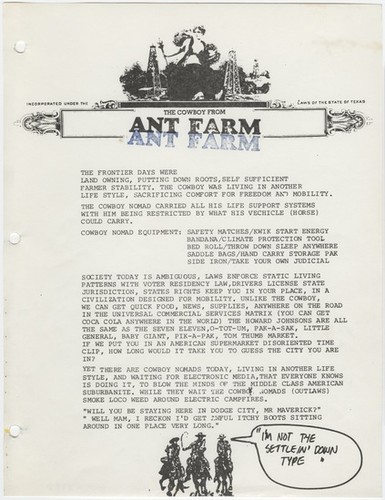
I wish there was time to fit radical media theorist Gene Youngblood’s book Expanded Cinema into my course on Hippie Modernism. Youngblood’s work shares in the cosmic consciousness whipped up by the two big events of the Summer of ’69, Woodstock and the moon launch. For Abbie Hoffman, remember, Woodstock served as a mind-blowing demonstration of “Functional anarchy, primitive tribalism, gathering of the tribes.” Youngblood’s book examined the role participatory media events and media revolution might play in this project. The main prerequisites to demonstrate the human capacity for psychedelic beloved community were all present at Woodstock: willingness to live side by side in harmony, feeding and caring for one another, with no expectation of profit. Another version of the utopian hippie modernist Woodstock Nation of the future can be glimpsed in Ant Farm’s Cowboy Nomad manifesto from 1969. One can imagine dozens of Woodstocks scaling up into Ant Farm’s Truckstop Network, tribes traveling in caravans of camper vans and VW buses.
 Trance-Scripts