Monday December 17, 2018

Worry not: Look outward upon a radiant new environment loaded with hidden Easter eggs. Go out and listen. There is great peace of mind to be had by exhaling and breathing silently along a calm evening walk. I walk in wonder, staring up at chirping birds on lofty branches, a clear cold sky lit for sunset. “Breathe,” I tell myself, “and concentrate mind in the present.” It’s been a tiring past couple of weeks, this conclusion of autumn and entry into winter. To cheer myself, I throw on the Flamin’ Groovies album Teenage Head — but something’s off, the album fails to suit the mood. I fail to find in it the significance suggested by its title, minus that great line at the end of the song from which the album gets its name: “I’m a child of atom bombs / and rotten air and Vietnams; I am you / you are me.”

The band also released a single the following year, an anti-drug song called “Slow Death” — the same phrase used as the nickname for Substance D, the fictional drug in Philip K. Dick’s doper dystopia A Scanner Darkly. I wonder if Dick was a Flamin’ Groovies fan.

Sunday December 16, 2018

Such rich and various object- and person-oriented ontologies represented in the opening shots of Alfonso Cuarón’s Roma. Class and racism are woven into the sights and sounds of the film’s riveting black-and-white portrait of a domestic worker in 1970s Mexico City. Social reproduction is an immense labor — and I worry that because of late-capitalist melancholia, I’ve failed in the past to adequately perform my share. History always felt distant, elsewhere than the level of personal destiny. And yet here we are, working to transform life into a source of poetry, a space of plenty, each day’s activity dealt with imaginatively. As Denis Donoghue says in his book on Yeats, “The idea of self-transformation is implicit in any Romanticism that takes itself seriously, where imagination is deemed a creative faculty and the self its final concern” (8). What is the alternative? The eternalism of the block universe, wherein “the Empire never ended”? Donoghue’s “penury of the given”? In that case, one might as well just announce oneself the Owl of Minerva, or the anima mundi, evoking via hindsight a universe of narrative “hospitable to miracle, the occult, and magic” (16-17). Of course, in the block universe, a thing matters only inasmuch as it must. Worlds ought instead to be listened for, their revealing sung. I aspire to serve not as an “erotic poet” like Yeats, but as what R.P. Blackmur called a “sacramental poet” — one who “respects the object for itself but even more for the spirit which, however mysteriously, it contains” (24). And to respect the object is not simply to belabor it, but to aid and await its realization.

Saturday December 15, 2018

The Whole Earth Catalog appears like a new thing again when viewed in light of psychedelics. Jim Fadiman peers out at me, as does Chester Anderson. I find myself wanting to hear Bubbha Thomas & The Lightmen’s Energy Control Center, spiritual jazz self-released in 1972, and a new tape of field recordings out on Alien Garage called Two Portraits by Kyle Landstra.

The more I study hippie modernism, the more I sense a path opening, reality acquiring arrows and post-horns as in The Crying of Lot 49. Lines of communication radically reorganize, and with them change the worlds they represent. The whole thing swings into focus as if it always existed that way, even though it’s been remembered and refashioned anew. “Shake the snow globe,” as Robin Carhart-Harris says, and “more salubrious patterns and narratives have an opportunity to coalesce as the snow slowly resettles” (as quoted in Pollan 320).

Tuesday December 11, 2018

The stories we read and tell one another compose us collectively into an intersubjective multiverse linked by each consciousness holding up to the Other its mirror. Philip K. Dick’s A Scanner Darkly is a hard novel to end a course on, hard because it contains so many prior horizons of psychedelic-utopian possibility in the uncertainty and despair of its narrative universe. I worry that the book inspires in its readers an excess of aversion to chemical modification of consciousness. The book is too unqualified in its denunciation of drug use; the book’s fictional Substance-D operates allegorically (most vividly via its street name “slow death”) as an emblem, a universal shorthand for every drug — drugs in general. Dick leaves readers without a positive alternative to the “straight” world’s miserly, hypocritical relationship to mental health, where “sanity” equals mind-numbing adherence to pre-established norms, and all are expected to board what Margo Guryan called “The 8:17 Northbound Success Merry-Go-Round.”

I prefer to focus instead on collecting recipes for a cookbook. The cookbook was a great utopian art form of the late 1960s and 1970s, from The Grub Bag and The Tassajara Bread Book to Ant Farm’s INFLATOCOOKBOOK of 1971. To my cookbook I add a recipe for “Vegan Cream of Mushroom and Wild Rice Soup” from the Food 52 website.

Monday December 10, 2018

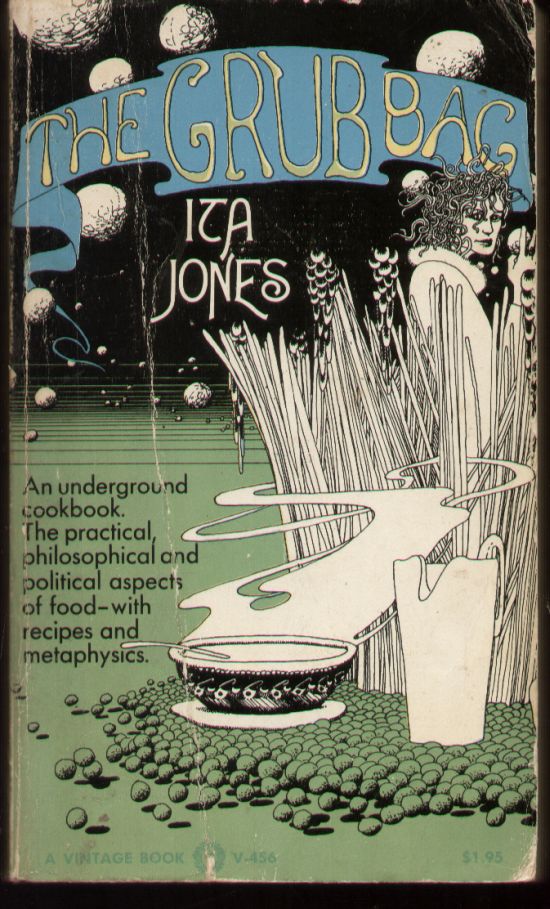
As a lifetime shirker of responsibility for cooking as a necessary component of household labor, the human potential in me for communist love and compassion demands revolution, demands I spend my daily material labor-hours differently. Perhaps in so doing I can model a better mode of being. Toward that end I pull out and peruse Ita Jones’s hippie-modernist “underground cookbook,” The Grub Bag. Brad Johannsen’s other-dimensional cover art is super trippy. (For those seeking more of Johannsen’s artwork, look for copies of his book Occupied Spaces.) Jones writes to today’s reader here in the twenty-first century as if a being from a utopian future, despite The Grub Bag‘s publication almost half a century ago in March 1971. Comrades, this is the book we ought to be reading in our study groups and revolutionary sanghas. The book began as “a food column carried by the Liberation News Service,” the news service of the Movement here in the United States in the late 1960s. Jones gives us her peace brother / peace sister salute by proclaiming on the book’s back cover, “I have always been on the side of revolution, on the side of people struggling to break the chains that oppress them. I support wars of liberation. I am a mystic. I seek to penetrate the nature of nature. I am a poet. I seek meaning. I am part of a generation that exploded six years ago and my creative energy is part of that explosion.”

GrubBag

Saturday December 8, 2018

Tune in to White Noise’s hippie modernist masterpiece, An Electric Storm, an album of utterly distinctive and sometimes deeply creepy recordings from 1969.

Pitchfork refers to the album’s “widescale psychedelic mayhem,” and that sounds about right. An Electric Storm originated from a unit of composers and engineers at BBC’s Radiophonic Workshop (best known for the theme music to Doctor Who). Julian Cope’s review of the record is so frightening, I never even made it to side two. Busied myself instead with Cope’s website Head Heritage, part of which he describes as “a Gnostic Odyssey through lost and forgotten freakouts.” The Roman emperor Julian, remember, was raised as a Christian, but after studying Neoplatonism apostatized and attempted to revive paganism. He wrote a polemic in Greek titled Against the Galileans, but the text was anathematized by subsequent rulers and lost to history, its arguments known only second-hand through work that sought to refute it. Perhaps Cope is some sort of rock ‘n’ roll re-embodiment of the Julian Ur-spirit dredged from the collective Id.

Friday December 7, 2018

From early adolescence onward, I’ve been haunted, conflicted, attracted into near identity with yet simultaneously repulsed by the wizard archetype, particularly as embodied by “Raistlin Majere,” a character introduced to me through the fantasy novels of Margaret Weis and Tracy Hickman’s Dragonlance series. Raistlin has become synonymous in my imagination with the Lucifer character in Milton — though I encountered Raistlin first. I often hear myself wondering in a ponderous, psychoanalytic way, “Why did these books grasp hold of me? What was the nature of their appeal? What was it that I heard calling to me? How did these books reconstitute and reshape me? I found in them an entire cosmology, did I not? Was it my first, my original — or was there another, one prior? Did I ever reflect self-consciously about Christianity, accept it or choose it as my mythos, know myself to believe in it — or was it only ever a series of meaningless, inexplicable rituals imposed upon me by alien authority structures: family, church, community?” Part of me has come to view Weis and Hickman as corporate corruptors of the fantastic imagination. These were books that fed and perhaps irritated, worsened, fed and prolonged my sensitivity to the violence of being labelled a “nerd” by my classmates at school. That’s a powerful memory: one’s slightly larger male classmates narrowing their eyes, clenching their fists and snarling disgustedly, “Nerd!” I remember resolving to read the Bible in its entirety and getting distracted, setting it aside, reading Tolkein, Weis and Hickman’s Dragonlance and Darksword trilogies, Marvel superhero comics, horror novelists like Clive Barker and Stephen King. From their cover art onward, the Dragonlance books are all about a universe become filled with pubescent menace: men with swords, dragon-riding women. A world ensorcelled by hormones, symbol-systems, RPGs, and media. Readers are encouraged to see themselves in the Raistlin character: a figure of great intelligence trapped in a weak and sickly body, and for that reason contemptuous of others. That contempt is localized in the figure of Raistlin’s twin brother Caramon, the sibling who inherited the pair’s physical strength. Public school attempted to divide me from this through memorization of the alternative rituals of “science” and “mathematics” — but these had none of the same seductive powers, none of the erotic charge, the pleasure felt when under the spell of a fantasy.
Wednesday December 5, 2018

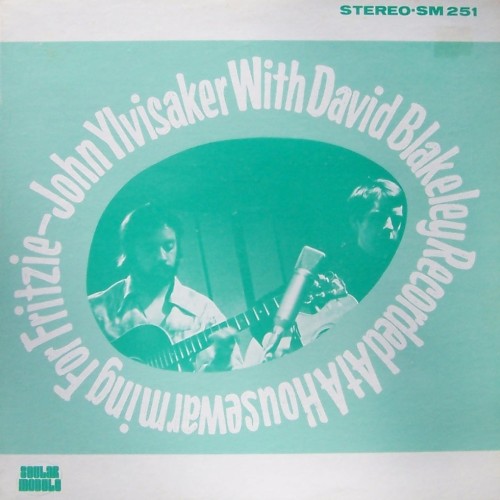
The etymology of “gonzo” unlocks a new level in my understanding of countercultural history. To celebrate, I sing along to the “Moratorium” chorus from John Ylvisaker and David Blakeley’s Recorded at a Housewarming for Fritzie, a rare private-press christian psych-folk LP released in 1972 on Soular Module.

John-Ylvisaker-Housewarming

Ylvisaker’s obituary refers to him as the “Bob Dylan of Lutheranism.” Reawakened by its use as slang among beats and hippies and entered into print to name Hunter S. Thompson’s drug-fueled brand of New Journalism, “gonzo” probably derives from the Italian figure of the simpleton or fool, the great lightener of moods who speaks cheerfully of the miracle of reconciliation. Also a play on “gone,” as in “out there,” wild and crazy, mind unfurling in the midst of a great trip. My courses are basically guided tours of elaborate, personally crafted memory palaces, demonstrations of compatibility among multiple systems of gnosis, literary, philosophical, cultural, and political texts woven into a vast assemblage, my eyes like those of the Muppet conveying moment by moment a “zany, bombastic appreciation for life.”

Tuesday November 27, 2018

I’ll be revisiting old friendships this weekend — high school friends, some of whom I haven’t seen or spoken to in decades. How might I best characterize myself for them? By what terms might I achieve peace with these brethren, unburdened of unspoken rivalries? In the past, I may have been wounded and wronged by these friends, just as I may have wounded and wronged them in return. Yet as Laura Archera Huxley counsels in her book You Are Not The Target, “each one of us has a function to fulfill. It is when we spend our time and energy looking down in contempt or looking up with sterile longing that we lose sight of this function. Envy is comparison. He who is in the continuous process of being and becoming what he really is, directs his attention to real values, not to measuring other people’s achievements” (240). What I’m suffering is what Ralph McTell calls the “Zimmerman Blues.”

I traveled far from home, lost touch, saddled myself with unrepayable debt — but amid this impoverished wandering, I followed my heart, I found my partner, I learned how to love. Freedom outside in the sun of the prison yard. The country is not one where each person owns or gets enough on which to live. The fault for that lies with the country, not me. Were it otherwise, each could attend to the beauty and the glory of the earth. In the meantime, I break away as much as I can from “compulsions, ambitions, hates, vanities, envies”; I try to conduct myself day by day as a whole being.

Monday November 26, 2018

For the artist, the universe remains a plaything, a site for open exploratory stars-in-eyes investigation. One wanders about or thumbs through books of symbols asking, “Where in the world is my next sacred-ecstatic encounter? What material should I alter, and by what process?” Curiosity leads to discovery, and discovery leads to artistic creation or invention, as in Fanita English’s transactional analysis script matrix, “Sleepy, Spunky, and Spooky,” an essay referenced in Philip K. Dick’s A Scanner Darkly.