The Wizard’s Tastes, as Expressed Through Interior Design

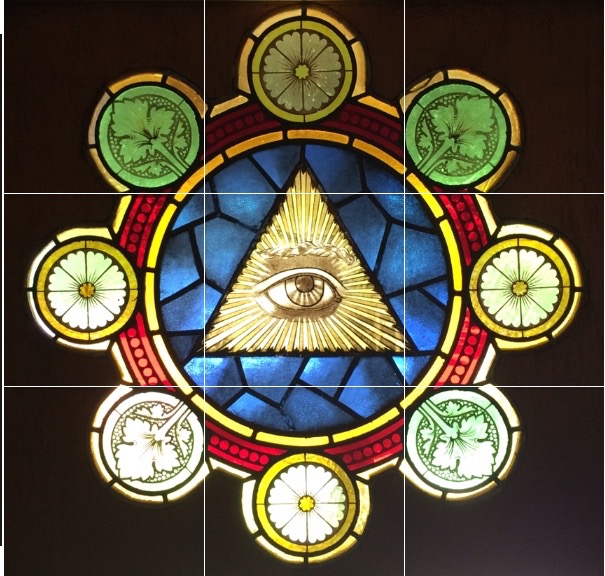
In design terms, the Wizard’s tastes skewed toward the epic, the ornate — total art! cosmic syncretism! He hung large antique mirrors on walls in three of the home’s rooms; he filled most of the home’s windows with stained glass, including a large window at the front of the house featuring an image of the Eye of Providence — the latter retrieved, I’m told, from either a former church or a former Masonic Temple. From the ceilings of those of the home’s rooms adorned with foxed mirrors, he added dazzling, many-armed, many-bulbed chandeliers — beautiful, gaudy, dusty old things! The home’s several built-in bookcases may have been of his making as well — as were one room’s shelves sized for storage of records. The most characteristic of his contributions, though, was the imp crouched atop the home’s door bell, or the pair of werewolves carved into the corners of a mantle atop one room’s fireplace.

The Move-In

When Sarah and I first moved in, we hired a team of local movers to help us unload. One of the movers took one look at the werewolves, and one look at the Eye of Providence, and said, “Y’all ought to have a preacher come and bless this place.”

Weird Occurrences

Suffice to say, we had some weird occurrences there at the home we rented on Shady. None of it seemed malevolent in intent — just a bit weird. I developed a writing practice during my time there involving self-induced trance states, similar to the surrealist practice of “automatic writing.” I experienced auditory hallucinations, where it felt like I was hearing voices. Some of this was admittedly disconcerting at first. I realized almost immediately, however, that I could write some of it down. I could take notes like a kind of sleuth. And so, a Text began to germinate — one I transcribed gratefully, in a state of silent absorption as I listened.

Hence these trance-scripts.

As for the house, Frank sold it when we moved out — and from what I’ve heard, he tempered the decor when preparing to put the place on the market. Thankfully, however, I have some photos of how it looked when I was there.

I have the photos…and I have the Text.

The Gay Wizard

I know what you’re thinking, says the Narrator: Can I trust an author who calls one of his characters “The Gay Wizard”? I use that name not to offend, but because that was how he was known about town.

People knew the Gay Wizard. He was a local personality, a figure in the community. I remember Sarah and I speaking to our neighbor Sue one afternoon. Sue lived up the street from us, in a cream-colored home. Ferns hung in baskets from her porch. By the time we met her, Sue was already decades into her time on Shady. She spoke fondly of the wizard: his parties, his Studebaker, his boat.

Atop skeletal details of that sort, gathered haphazardly in the course of my tenancy, I crafted a character: someone I fancied meeting one day via time machine. Like an egregore of sorts, he entered first into my imaginings via the spirit of books of an earlier era. The books started turning up in the bins at Goodwill, as if he’d sent them: rare, obscure screeds like Arthur Evans’s Witchcraft and the Gay Counterculture and Mitch Walker’s Visionary Love: A Spirit Book of Gay Mythology and Trans-mutational Faerie. From them and others like them I culled a portrait of a loving psychedelic animist: a gardener like Derek Jarman. That’s how I see him now, in fact: poised there in the sunlit grove at the center of the home’s back yard, spade in hand amid the growth of his garden.

In picturing him thus, I resist the story’s pull toward horror. If this were a work of horror, notes the Narrator, he’d have been a shadier dude. Play the horror factor one way, and he’d have been a Crowleyan sex magician. A Thelemite; a Satanist: a practitioner of black magic. Play it another way, as might, say, Jordan Peele or P. Djèlí Clark, and he’d have been a wizard of an even deadlier sort: the kind who go around in white, terrorizing people of color.

If he’s ours to imagine, says the Narrator, let us imagine him otherwise. In our choosing of genre, let us act with hope.

Conversations with Frank

Conversations with Frank are always lovely, sprawling, rangy things. Early on in the course of one (perhaps even our first), he disclosed to us that several of the Shady home’s occupants prior to our renting it had been musicians in local bands. “Oh yeah? What bands?” I’d asked, hoping to learn more. That was my first hint, I suppose: Frank, rehearsing the names of those bands. “Golden Dawn,” he’d said. “Tetragrammaton.” The latter, I knew, referred to the sacred name of god in Hebrew. I knew, too, of the longstanding prohibition in some quarters on saying that name aloud. And with that, I suppose, I began to suspect, at least on an intuitive level, that there was something odd about the home’s history, some sympathy for occult or forbidden things retained between roof and ground.

But the oddness, I soon learned, was one that preceded Frank and his musician-friends. Well before any of them had arrived on the scene, the home’s occupant was someone known around town as the Gay Wizard. If the place has a whatever-you-wanna-call-it — an ectoplasmic charge; an occult presence of some sort — that dude is, at minimum, a key link in that charge’s chain of transmission, if not its source.

The Arrival of the Narrator into the Narrative, aka “The Katabasis”

I myself was a latecomer, fresh on the scene thanks to a Craigslist ad posted once upon a morning in the spring of 2013, says the Narrator. Sarah had taken a job at a university in town, and we needed a place to rent. By then, Shady had lost some of its fame. Much had changed. The garage behind the Easter house had already been torn down years before our arrival. All that remained was its stone foundation. And Mitch himself had moved away to nearby Kernersville. In all likelihood, then, the story of Drive-In Studio might have gone undetected, might have remained part of Shady’s secret history, hidden away, occulted by the passage of time, had it not been for Frank, our landlord: a goateed documentarian with a film degree from UNC School of the Arts, fixture of sorts in the local music scene, and amateur collector of fossils. Frank and some fellow students at UNCSA had been part of an artists’ collective that had squatted an old, deactivated meat-packing plant in the late 1990s, on what was then the edge of downtown. Through legal and financial machinations that, I admit, were never entirely clear to me, Frank and his fellow squatters had achieved the impossible. Despite the odds, they’d gained control of the building; they’d transformed it into some other kind of thing. There it stood, suddenly, teeth and claws gleaming: an art space and show venue called The Werehouse.

Tuesday August 4, 2020

What are white people whose grandfathers fought on behalf of the settler state to do? Silko would say begin by acknowledging one’s ancestry and one’s relationship to the land. The land upon which we stand is like the back of a turtle. Native people, along with their ancestors, including nonhuman relatives and kin, are the ones who made this world. I, meanwhile, am a child of people who called themselves “immigrants.” Before that, they were Europeans; upon settling, they became thinkable to themselves and others as “Italian-Americans,” “Irish-Americans,” or what have you. Assimilated into whiteness but for a hyphenated attachment — a sometimes-proudly, sometimes-guiltily-clung-to trace of ethnicity. These latter were everywhere present among members of my extended family. Dialect; manners of eating, speaking, and being together with others; a tendency to gesticulate; a regional accent. Some of what I myself possessed, I lost when I left home for school. Yet here I am now, with a home, and a family, and a bit of land. From this property mortgaged to me by a bank, the settler state exacts its fee.

Monday June 29, 2020

How might we characterize Frederick Douglass’s views regarding religion? Douglass tries to forestall misunderstanding about his views in the appendix to his autobiography. He doesn’t want his readers to suppose him “an opponent of all religion” (107). “What I have said respecting and against religion,” he writes, “I mean strictly to apply to the slaveholding religion of this land, and with no possible reference to Christianity proper; for, between the Christianity of this land, and the Christianity of Christ, I recognize the widest possible difference — so wide, that to receive the one as good, pure, and holy, is of necessity to reject the other as bad, corrupt, and wicked. […]. I love the pure, peaceable, and impartial Christianity of Christ: I therefore hate the corrupt, slaveholding, women-whipping, cradle-plundering, partial and hypocritical Christianity of this land” (107). Why is religion the terrain of appeal here at book’s end? Religion has been a tool of indoctrination, a violently imposed ideology, a “crown of thorns”-style cognitive map and/or map of the cosmos imposed upon slaves. Douglass shows that the crown can be seized and repurposed. The slave arrives into Logos, reclaims “Scripture,” and sits in judgment upon the master. Douglass’s religious views also manifest in his several attestations about “divine providence,” and his claims regarding the latter’s influence over key events in the course of his narrative.

Sunday June 28, 2020

“Chapter XI,” the final chapter of Douglass’s Narrative but for a brief appendix, is where the author describes how he “planned and finally succeeded in making” his escape from slavery (94). How does Douglass escape, and what role does literacy play in his plan? Does he, in effect, write his way to freedom? Or is writing but a small part? One arrives to the chapter excited to read further. But Douglass tells us immediately that he’ll have to withhold some of the facts of the escape. Too much of the particular, and others might come to harm. Because of slavery’s persistence as a system, he must deprive himself of the pleasure to speak freely the facts of the matter; otherwise, he would run the hazard of closing doors of use to those still enslaved. Means of flight must be kept secret. At most, no more than hinted at. Of the slaveholder, from whom knowledge of this sort must be kept, Douglass says, “Let him be left to feel his way in the dark; let darkness commensurate with his crime hover over him” (95).