In the second book in the Parable series, Parable of the Talents, Earthseed’s status as a religion places it into conflict with neighboring creeds, especially hostile, intolerant ones like US President Andrew Steele Jarret’s Christian America. With Earthseed, Butler creates for us a black feminist reimagining of John Africa’s group MOVE and its 1985 conflict with the Philadelphia Police Department during the reign of Ronald Reagan. Butler projects that earlier conflict forward into a twenty-first century America presaged by the LA riots of 1992. If one teaches this book, one should encourage one’s students to sit with Earthseed. Read its verses. Try it on, test it out as a belief system. Which aspects of it appeal to you? Which, if any, trouble you, and why? My attitude toward Earthseed is a bit like Zahra’s when she tells Lauren, “I don’t care about no outer space. You can keep that part of it. But if you want to put together some kind of community where people look out for each other and don’t have to take being pushed around, I’m with you” (223). After reading Nick Estes, I also find myself pondering Lauren’s relationship to settler-colonialism. Is Earthseed settler-colonialist, both in its establishment of Acorn (a literal settlement intent on growth) and in its advocacy for the spread of a “survivalistic” earthly biology into outer space? Or is its pursuit of multiracial community in fact the only real alternative to settler-colonialism? Settler-colonialism has already, for the past 500 years, been the case here on Turtle Island, and will remain so, unless and until groups commit to decolonization and antiracism. With Earthseed, Butler imagines for us a movement that does this. Earthseed resists the white settler-colonialist project, given that the biology Earthseed wishes to propagate is ethnically and racially diverse. All are welcome. To join, one simply agrees to live by Earthseed’s creed: a belief system that demands only that we serve and protect each other and come to each other’s aid — no more and no less.
Tag: Books
Saturday June 13, 2020
Earthseed, the religion founded by Lauren Oya Olamina, the heroine who narrates Octavia E. Butler’s novel Parable of the Sower, resembles other faiths (including the Baptism of Butler’s upbringing) in its evangelical cast. Lauren spreads the word and seeks converts, her church being a kind of mutual aid society. Together, she and her followers form a traveling, changing community — a “team” or “tribe” of sorts, decisions made organically based on the group’s capacity to survive amid thieves, murderers, cannibals, junkies, wild dogs, and arsonists. Lauren’s view of the world is paranoid, but it’s a paranoia borne out by lived events of trauma. She “experiences” and “shares” the pain of others due to what she calls “hyperempathy syndrome.” She has an ability that makes her vulnerable, and thus cautious of who she can trust. We needn’t think of this as mere delusion. The reactions to bodily harm sometimes manifest physically, another’s pain sometimes drawing blood. However we view this aspect of Lauren’s experience, it leads her to seek followers. She wants others to believe her, offering in exchange a path toward survival.
Wednesday June 3, 2020
One senses other voices — distractions from the work we’re here to do. “Ascent” and “descent” seem to be top priority for esotericists. Others call for reparation, insurrection, revolution, loving-kindness. Some speak of Babylon, purgatory, Tartarus. Beware the spooky ones and the trolls — the paranoids who think everything’s a plot. Get one’s house in order, noting daily the interplay between psyche and cosmos. Remember, too, that Butler’s heroine in Parable of the Sower writes a book of the living rather than a book of the dead.
Wednesday May 20, 2020
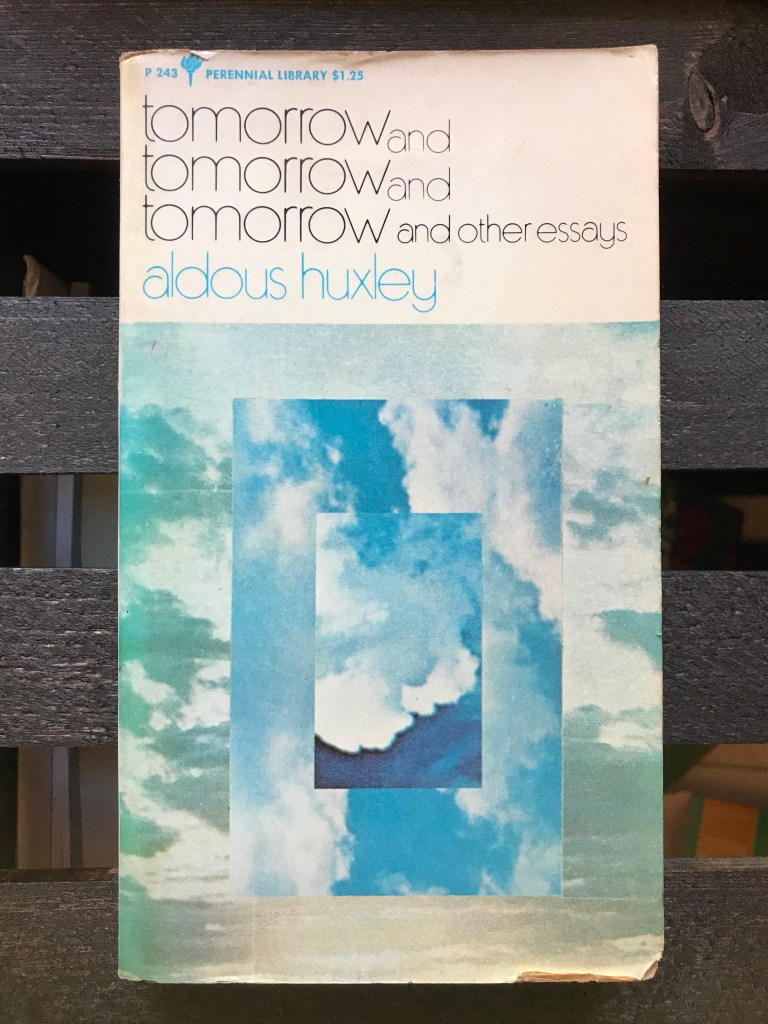
Packing books into boxes takes time — not least because I keep pausing to admire ones that catch my eye, like Aldous Huxley’s Tomorrow and Tomorrow and Tomorrow, which, in its 1972 Perennial Library paperback edition, features a groovy cover design by a young Barbara Kruger. But into boxes they go — all of them. Kirkpatrick Sale’s SDS, R. Buckminster Fuller’s Operating Manual for Spaceship Earth. To be retrieved at the new place a few days hence.
Tuesday May 5, 2020
The baby and I read a trippy “opposites primer” version of Sense & Sensibility beside the window in the room above the garage. Afterwards I join a conversation on Gene Youngblood. Listen in, that is — and read along. Erik Davis leads the way through “Part Three: Toward Cosmic Consciousness” from Youngblood’s classic “post-McLuhan philosophical probe,” Expanded Cinema. Youngblood begins Part Three with a reference to Louis Pauwels and Jacques Bergier’s French mindbender The Morning of the Magicians. Mind of the observer transformed by science, he says, “We move now in sidereal time” (135). Meaning what, exactly? Time measured according to the stars rather than the sun? Youngblood replies with a quote from John Cage: “A measurement measures measuring means.” Time to venture into invisible worlds — the worlds of the electronic nervous system. Consciousness, omni-operative, pervades every atom, every molecule, right down to the quanta. Youngblood strikes me as a bit of an accelerationist. Worlds evolve, he suggests, rendering other worlds obsolete. Authors seed and cede ground to star children, human/plant/machine hybrids moved by a marriage of reason and intuition. In place of obsolescence I prefer cosmologies that support shared ongoing being.
Wednesday April 15, 2020
During break time, I stare at pinwheels, rosemary bushes, a neighbor with a cat on a leash, a Royal Enfield motorcycle with a Cozy sidecar parked in front of another neighbor’s home down the street. I walk about, listening to birds, the wind as it rustles the leaves in the trees, motivating as well some wooden wind chimes. The cry of a waking baby returns me indoors, where we dance to tunes by NEU! and Pere Ubu. Time for redirection. Sarah’s suggestion: download into being a children’s book on Buckminster Fuller. The baby rests on Sarah’s knees as the three of us chill on the couch vibing to Future Shock — Volume 1, a compilation released by Names You Can Trust.
As the sun descends, shining through the window in the room above the garage, I stare down at a book propped open on the dining room table: The Living Book of the Living Theatre. I learn about Judith Malina and Julian Beck and the direction they took from the philosophical anarchism of Paul Goodman at the time of the Theatre’s founding in the mid- to late- 1940s. The couple launched the Theatre at their 789 West End Avenue apartment in New York. In 1951, they staged four one-act plays by Goodman, Gertrude Stein, Bertolt Brecht, and Federico García Lorca. In later years, the Theatre became communal and nomadic.
Monday April 13, 2020
At three and a half months, the baby is all smiles, dressed in a jumper with bright yellow sneakers, chatty with a speech of sounds, sighs, efforts toward words. Sarah plays her “Bulletproof” by La Roux. I scoot next door and dip into Design for Utopia: Selected Writings of Charles Fourier. In his 1971 Foreword, Frank E. Manuel says Fourier’s ideal “calls to mind the ‘synergic’ society originated by Ruth Benedict and expounded by Abraham H. Maslow, who found it consonant with his own doctrine of self-actualization. In synergy, as Maslow defined it, the individual acting in his own behalf at the same time furthers social ends, fulfilling simultaneously and harmoniously his obligations to himself and his responsibilities to society” (4-5). Manuel maintains an attitude of bemused skepticism, maybe even a haughty distance, with regard to all such doctrines and ideals, his imagination far too stingy and conservative for my taste.
Saturday April 11, 2020
Finished with midterms, I wander the neighborhood, admiring a field of periwinkles (never mind others’ designation of them as weeds). See me there, walking in the streets, whistling and singing, banging on a tambourine, telling the story of the society that opts for peace. Can one get there without a fight? Joanna Russ includes an epigraph at the start of The Female Man: a passage from R.D. Laing’s book The Politics of Experience. Laing was a thinker of the New Left: one of the era’s radical “anti-psychiatrists,” best known for his studies of schizophrenia. Check out Robert Klinkert and Iain Sinclair’s short film Ah, Sunflower (1967), shot on location at the Dialectics of Liberation conference, with appearances by Laing, Allen Ginsberg, Stokely Carmichael, and others. Sinclair also published a diary he kept during the filming called The Kodak Mantra Diaries. Sinclair says of himself that he was “captured” by Charles Olson and the Black Mountain Poets, writers who served as some of his “first enthusiasms” when starting out as a writer in the early 1960s. Olson taught him that life is an allegory — a large, potent myth. The “amniotic fluid,” as Sinclair says, through which we swim and struggle. Is this sifting of texts a kind of purgatory? Are we characters in a ghost story?
Friday April 10, 2020
On these walks each day around my neighborhood, I weigh possibilities for revolution and admire trees and gardens. Yet so much else of the capitalist neighborhood seems distant, alien, preconstituted, practico-inert. Little sense of community other than polite hellos. Nods of the head, the assumption being all of us are “about our business,” do not disturb. This is what it’s like, existentially, to live under the regime of social distancing — while in some more abstract sense, everything around one is the land of Trump. Time to practice drumming and horn-blowing. Noisy, clamorous complaint. Yet the parent in me knows to be quiet so as not to wake the baby during her nap. She’ll wake on her own when she’s ready. Or WE will: into happier times, each day tending toward the better. So too with consciousness. The surrealist revolution attempted a synthesis, an overcoming of dualisms, did a stately pleasure-dome decree: dream-states and pleasure-states reconciled with reality. Or so it seemed as I sat after my walk, mind at play. A student’s paper has me thinking about the politics of “liberation.” By dream or by memory I summon up before me a book from Verso, The Dialectics of Liberation, resting in a stack of books across from me atop Lenore Kandel’s Word Alchemy. What better thing to read? Dialectics of Liberation was a congress held at the Roundhouse in London in 1967. Radical “anti-psychiatrists” like David Cooper and R.D. Laing met with Marxist philosopher Herbert Marcuse and Black Power leader Stokely Carmichael, among others. Paul Goodman was there, as was Gregory Bateson. A “curious pastiche,” as Cooper says in his introduction. In a kind of “circus poster” at the start of her book Word Alchemy, meanwhile, Kandel announces, “ALL dreams ARE true / THIS is a dream / THIS is TRUE.” Kandel’s poems are funky, wonderful, and witchy.
Thursday April 9, 2020
White roses overgrow a trellis beside the driveway. I admire them from atop my perch on my front stoop as I shelter in place. Look at all the lovely everything, the leafy and flowery manifold Earth, sunlit and glorious, waving in the wind! A softness, a gentleness, enters into one’s manner. A grey tabby that likes to visit now and then sleeps out on my porch. I let it. Dreamboat baby tell all. At some point, though, I plan to grill some hot dogs. In a journal I note down the following: “In an imaginary interview published in his book Revolution for the Hell of It, Abbie Hoffman uses language borrowed from his mentor Abraham Maslow to signal how his own approach and vision differed from those of his contemporaries in the New Left. Movements for change should be built, he says, not on sacrifice, dedication, responsibility, anger, frustration, and guilt, but on fun. ‘When I say fun,’ he tells the interviewer, ‘I mean an experience so intense that you actualize your full potential. You become LIFE. LIFE IS FUN’ (61-62).”
 Trance-Scripts