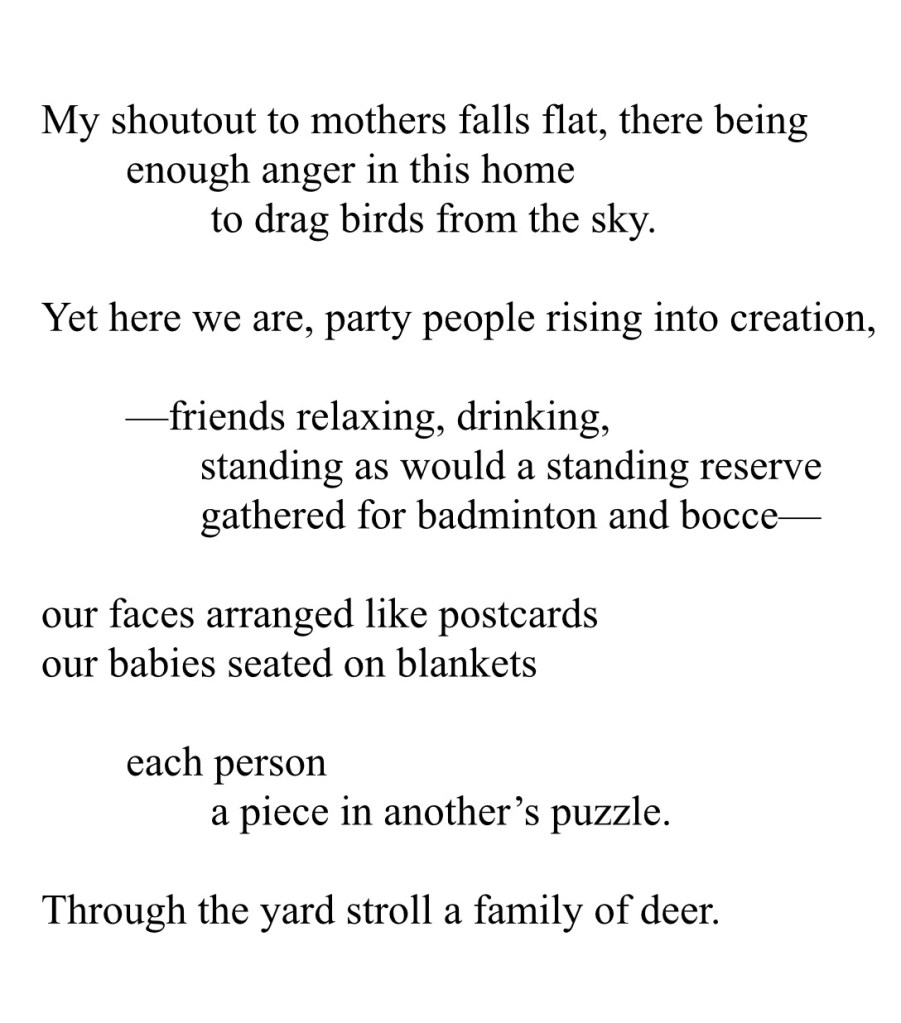
We kick off the weekend relaxing beside a community pool in our neighborhood. Frankie loves it. After some initial skepticism, I too come to like it. It’s a bit busy, but Sarah packs us a great lunch. And in the afternoon, we gather gang-like for a barbecue in a friend’s backyard. It’s a good group; we all enjoy each other’s company. And the friend is a great host. For all who make events of this sort possible, for all who labor in their preparation and/or facilitate their happening, I give thanks.
Tag: Family
Sunday May 9, 2021
Wednesday April 7, 2021
I sit in the sun room at the back of the house listening to birds, wondering about the status of the statue, a Native American chief holding a peace pipe across his knee, an item I accepted as an “inheritance” after the death of my grandparents. It was an object that fascinated me; I remember sitting with it, contemplating it with reverence upon encountering it in my grandparents’s “rumpus room” as a child. How else is one to act in this being’s presence? Is what Ken Kesey does through his invention of Chief Bromden, the “half-Indian” narrator of Kesey’s 1962 novel One Flew Over the Cuckoo’s Nest, a form of “literary redface”? The Western was a popular genre in the culture of Kesey’s childhood. The novel imagines an encounter between Bromden and a “red-faced Irish brawler” named Randall Patrick McMurphy. Both men are war veterans committed as patients in a mental institution run by the novel’s communist-matriarch supervillain, Nurse Ratched. Communism is figured as an emasculating threat, an overly demanding mother, a superego intent upon world-ordering through replacement of nature with machinery. Capitalism, meanwhile, appears via McMurphy as a kind of confidence trick. It allows patients to enjoy sex and alcohol. It gets them gambling and making bets. And best of all, it’s willing to sacrifice itself like Christ so that natives like Bromden can be “made big again.” Bromden is the one saved by novel’s end. He smothers the lobotomized and defeated McMurphy, throws a control panel through a window, flees the ward, and returns to nature.
Thursday April 1, 2021
We rejoice upon word of the rapid, successful birth of our niece. My sister FaceTimes with us: she and baby are well. We care for her boys until her return, while teaching and caring for each other. The boys are into lightsabers and Fortnite. I race after them, pushing Frankie in a stroller, as they bike to the neighborhood park on the bay. They request “Lava Monster,” where I roar and give chase.
Tuesday March 23, 2021
Kids and I play in my brother-in-law’s back yard.
Geese swim up and greet Frankie and I on the canal, splashing, squawking loudly.
I build the kids a fort.
I drive my nephew to preschool.
Sarah and I see his brothers to the bus stop, send them to school.
It’s a day of many moving parts.
Sicilian pizza for lunch from my favorite pizzeria.
I return home with slices for Sarah and Frankie.
L. attends the same preschool I attended forty years ago.
Clear skies, sunlit afternoon.
I man the grill and prepare dinner.
A day of actions rather than words.
Monday January 4, 2021
Voices overheard through a wall scoff at and belittle; members of a circle seduce one another with words. Why do I continue to lean in? Do I sense among these voices a proud knowing? Do I think that by listening in, I might learn? Experimenting with that possibility, I place on my turntable a gift from my father — a copy of Sun Ra’s The Magic City. My father trained as a jazz percussionist, and told me a story a few nights ago — the night prior to the record’s appearance in the bins, in fact — of a show he played in the early 1970s. A band of his shared the stage with African percussionist Babatunde Olatunji. Several tracks on The Magic City were recorded live at Olatunji’s loft in New York in Spring 1965. Let us learn of this remarkable happening, part of what critic Paul Youngquist calls “the Arkestra’s wonder years,” 1965 and 1966. Youngquist calls The Magic City “a miracle of musical invention” (A Pure Solar World, p. 182). Let us lie on a couch with our heads in the sun as we listen. Timpani, ride cymbal, bass, and piano: together with horns, these ride “Cosmic Eye,” the first song on the album’s B-side. Cacophony clears the way. Music of this kind helps us breathe, airs us out like laundry on a line.
Wednesday December 30, 2020
How do we heal the paranoid, distrusting people in our lives (ourselves included)? Take my mother-in-law, an ardent anti-abortionist. Why do such storylines appeal to her? She watches crime shows. Her and my father-in-law love Jeopardy. She suffered a traumatic childhood. After her mother’s institutionalization, she was separated from her siblings and placed in an orphanage. These experiences live on, I suppose, informing her relationship to narrative. Let us spiral in “sound-star tetrahedrons,” as does Mei-Mei-Berssenbrugge in her poem “Singing” (A Treatise on Stars, p. 82). Let us visit the Santa Fe Institute. Berssenbrugge credits the latter with talk of “ETs, … coincidence, spirit molecules, time tunnels and quantum uncertainty” (88).
Sunday December 27, 2020
Peering at books I received as gifts on Christmas morning, I happen upon A Treatise on Stars, a new collection by poet Mei-Mei Berssenbrugge. Sarah brings word of a friend’s new novel dedicated to our daughter Frances. This same friend authored a book I’ve taught — one I plan to teach again this spring. Time to think about stars and cosmologies. Stars appear in the Berssenbrugge book, as they do in the new Star Wars series The Mandalorian, a show we watch with family. My nephews received a talking Baby Yoda doll for Christmas. Together let us explore together systems of stars. Establish communication among spinning galaxies across the distances of space and time. Listen to each star as it sings.
Monday November 16, 2020
Headlines suggest vaccines are approaching readiness. I’m hopeful on that front — though I dread the winter ahead. We wish to travel north to visit family over break. We wish to gather to celebrate Frankie’s birthday and the holidays: Christmas and New Year’s. We also wish to raise and decorate a Christmas tree here in our home in the weeks ahead, like the one we kept in our apartment last winter before and after Frankie’s birth. When time allows, I bundle up in a hoodie and jacket to gather up bundles of sticks, like that figure from the Tarot. I sit at the picnic table in the yard on a cold afternoon, enjoying a calm moment: light Doppler effect coupled with birdsong. Wind rustles leaves, gathers occasionally for light gusts.

Wednesday March 25, 2020
In phone calls a mere hour apart from one another, I receive word that my department has voted to hire me into a better, more permanent position, and that my grandfather, my only remaining grandparent, has tested positive for the virus. He has a large, loving family — children, grandchildren, great-grandchildren — all of whom would like to be with him. It’s a lot to take in and process, these waters of March.
 Trance-Scripts