Broke ’til the end of the month, I entertain myself by walking, listening to Dennis Wilson’s “Dreamer,” lounging about, watching sunsets. Syd Barrett’s “Octopus” gives me pause. Eyes closed, I meditate in a state of pure sound: elaborate spatializations of the sounds of instruments and voices.
Tag: music
Tuesday January 22, 2019
Noting a shift in my sensitivity toward rhythm and percussion, I opt for music made by ecstatic ensembles that shake, ring, and sizzle. Thomas Meloncon warms things up with “Waiting On Your Mind,” before laying it straight with “Ain’t Gonna Wait Too Long.”
All of this turns out to be foreplay, however, for what I’ve been seeking: Elevation, a Pharoah Sanders LP from 1973. The theme is certainly in keeping with Jack Kerouac’s The Dharma Bums, a book I’m reading with students. Lighthouses, rivers, rainbows, meadows: over these I travel, dancing along, movement of a mind at play.
Tuesday January 15, 2019
Listening closely, entertaining a variety of interpretations as possibilities running simultaneously beside one another, I wander, first among the hallways of David Bowie’s “Memory of a Free Festival,” already a bit distant and nostalgic, the gathering recalled in past tense: “It was…It was…It was.”
Bowie’s lyrical persona sings from Milton territory — trying to reconstitute hope amid summer’s end, paradise lost. By song’s end, distant festival-goers join voices in a chorus of reconciliation, animated by the sentiment, “The Sun Machine is Coming Down, and We’re Gonna Have a Party.” Afterwards, I re-watch Easy Rider, noting the semantic riches of the film’s opening shot of a trompe l’oeil mural of pre-Conquest Mexico on the side of a pit-stop called La Contenta Bar in Taos, New Mexico. The scene depicts US-Mexican relations in terms of the black-market capitalist exchange-relation of the drug deal. The Captain and Billy are just small-timers, their counterculture a mere cargo cult, the film notes in the next scene, where the two men crouch defensively as the planes of the global techno-capitalist superpower fly overhead. Look at Peter Fonda loading his bike’s American flag embroidered fuel tank with rolls of dollars as Steppenwolf sings “The Pusher.” He and Hopper walk like natives of the space age among desert farmhouse ruins. They seem as alien to these landscapes as their motorbikes — products of a different stage of development. The bikes make the horses of white settler-colonialist ranchers skittish. The Captain pays respect by complimenting the ranchers on their “spread.” “You do your own thing on your own time: you should be proud.” Hippies appear here as mere nouveau riche speculators eyeing potential property on the frontier. The montage sequence that accompanies “The Weight” is an ode to the magic of the deserts of the American Southwest. Passing a joint back and forth with a paisley-bandana’d hitchhiker, Captain and Billy learn of the disrespectful nature of their colonial heritage. After soaking it in, the Captain asks the others if they’ve ever wished they were someone else. The same theme reemerges later in the film. After smoking his first joint around a campfire on the way to Mardi Gras, Jack Nicholson’s character George Hanson comes alive with far-out tales of aliens from a more advanced civilization living among Americans since 1946. Both he and the Bowie of “Memory of a Free Festival” refer to these figures as “Venusians.” By the end of the film, though, I’m left wondering: Are Captain and Billy victims of a Faustian bargain, as J.D. Markel argues, following the path of Dante’s Inferno?
Tuesday January 1, 2019
Twenty-eighteen ends with a friend recommending Earl Lovelace’s The Dragon Can’t Dance to the sound of Sly & the Family Stone’s “Everyday People” and P-Funk’s “Mothership Connection,” two powerful Afrofuturist expressions of hippie modernism. Twenty-nineteen begins with Chaka Khan’s “Like Sugar” and the mystery of the dancing queen.
Radical disconnection from the discourse of the community, including the FIRE (Financial Independence, Retire Early) community. Others tell tales about a YouTube character known as The Thrift Shop Dude. Public transportation. Something having to do with a basilisk. Fascinating conversations as reality evolves, jumps levels from one year to the next. “We’re actually on 2016, version 3,” says some dude at the party, as if each year since has been a failure to self-actualize, both for me and for the society as a whole. There’s a strange sense of stasis. I want Sarah and I to have a kid, I want us to improve our living conditions and move into a better home, I want us to pay off our debts. I also want an end to Trump and a reorganization for the better of our relations with the General Intellect. People are smart. How do I activate that intelligence in my classroom? The new year began with a reminder of my limited knowledge of dance and funk and partying (epitomized, perhaps, by my ignorant former fondness at an earlier stage in my being for the playing-to-stereotypes cash machine known as “Jungle Boogie”), only to then unfold into an allegory leading toward a choice between Christian Socialism, Democratic Socialism, and Left Accelerationism. I pulled a Bartleby and remained throughout the night a fence-sitter. When I asked the three allegorical figures, the three wise men speaking on behalf of these positions, inhabiting points on a spectrum from less to more bearded, if there was still time to choose between augmented intelligence and artificial intelligence, they shook their heads adamantly, especially the Left Accelerationist, and told me that that train had already left the station. “Empathy” appeared initially as a term around which we could agree, but the representative of Christian Socialism seemed troubled and unwilling to assent to even so modest a commons as that, worrying that it amounted to short-sighted, guilt-absolving but otherwise ineffective efforts to “put people out of their misery.” I begged pardon to consult with Sarah, only to be shoulder-rubbed gently and told by the Left Accelerationist that it was unfair to burden others with what were no more than thoughts improvised in the spur of several moments. Why do years leap like this, each moment containing infinite branching pathways toward radically incommensurate futures? The lesson, I guess, is that I remain unsatisfied with existing options, despite the clock’s advance.
Monday December 24, 2018
“Do you hear a robin?” I overhear my niece asking her sister in the next room. Let us resolve to learn something new. Listen to Lee Konitz’s “Sunflower” and drink a Martini.
“The essential irony here,” wrote LeRoi Jones in response to “cool jazz” players of the 1950s like Konitz, is that “when the term cool could be applied generally to a vague body of music, that music seemed to represent almost exactly the opposite of what cool as a term of social philosophy had been given to mean. The term was never meant to connote the tepid new popular music of the white middle-brow middle class. On the contrary, it was exactly this America that one was supposed to ‘be cool’ in the face of” (Blues People, p. 213). Fair enough — but let us not make “existing to cast judgment on others” our middle name. Get out there, swept up in the joy of common, everyday, familial being with others. ‘Tis the season. Imagine in the circle of an eye a triangle of power. With one’s hands, weigh a series of geodes and prisms. Go for walks in a snow-covered neighborhood. Exchange presents. Sit by a fire. Recognize “modernity” as a trope that signals the emergence of the condition to which it refers. Those who use this term come to occupy an alternative temporality — a “temporal structure,” as Fredric Jameson explains, “distantly related to emotions like joy or eager anticipation,” where time fills with promise (A Singular Modernity, p. 34). The term generates an electrical charge, a feeling of intensity and energy. Think of it as a shock doctrine, a shock to the system, an electrification of consciousness.
Monday December 17, 2018
Worry not: Look outward upon a radiant new environment loaded with hidden Easter eggs. Go out and listen. There is great peace of mind to be had by exhaling and breathing silently along a calm evening walk. I walk in wonder, staring up at chirping birds on lofty branches, a clear cold sky lit for sunset. “Breathe,” I tell myself, “and concentrate mind in the present.” It’s been a tiring past couple of weeks, this conclusion of autumn and entry into winter. To cheer myself, I throw on the Flamin’ Groovies album Teenage Head — but something’s off, the album fails to suit the mood. I fail to find in it the significance suggested by its title, minus that great line at the end of the song from which the album gets its name: “I’m a child of atom bombs / and rotten air and Vietnams; I am you / you are me.”
The band also released a single the following year, an anti-drug song called “Slow Death” — the same phrase used as the nickname for Substance D, the fictional drug in Philip K. Dick’s doper dystopia A Scanner Darkly. I wonder if Dick was a Flamin’ Groovies fan.
Saturday December 15, 2018
The Whole Earth Catalog appears like a new thing again when viewed in light of psychedelics. Jim Fadiman peers out at me, as does Chester Anderson. I find myself wanting to hear Bubbha Thomas & The Lightmen’s Energy Control Center, spiritual jazz self-released in 1972, and a new tape of field recordings out on Alien Garage called Two Portraits by Kyle Landstra.
The more I study hippie modernism, the more I sense a path opening, reality acquiring arrows and post-horns as in The Crying of Lot 49. Lines of communication radically reorganize, and with them change the worlds they represent. The whole thing swings into focus as if it always existed that way, even though it’s been remembered and refashioned anew. “Shake the snow globe,” as Robin Carhart-Harris says, and “more salubrious patterns and narratives have an opportunity to coalesce as the snow slowly resettles” (as quoted in Pollan 320).
Saturday December 8, 2018
Tune in to White Noise’s hippie modernist masterpiece, An Electric Storm, an album of utterly distinctive and sometimes deeply creepy recordings from 1969.
Pitchfork refers to the album’s “widescale psychedelic mayhem,” and that sounds about right. An Electric Storm originated from a unit of composers and engineers at BBC’s Radiophonic Workshop (best known for the theme music to Doctor Who). Julian Cope’s review of the record is so frightening, I never even made it to side two. Busied myself instead with Cope’s website Head Heritage, part of which he describes as “a Gnostic Odyssey through lost and forgotten freakouts.” The Roman emperor Julian, remember, was raised as a Christian, but after studying Neoplatonism apostatized and attempted to revive paganism. He wrote a polemic in Greek titled Against the Galileans, but the text was anathematized by subsequent rulers and lost to history, its arguments known only second-hand through work that sought to refute it. Perhaps Cope is some sort of rock ‘n’ roll re-embodiment of the Julian Ur-spirit dredged from the collective Id.
Wednesday December 5, 2018
The etymology of “gonzo” unlocks a new level in my understanding of countercultural history. To celebrate, I sing along to the “Moratorium” chorus from John Ylvisaker and David Blakeley’s Recorded at a Housewarming for Fritzie, a rare private-press christian psych-folk LP released in 1972 on Soular Module.
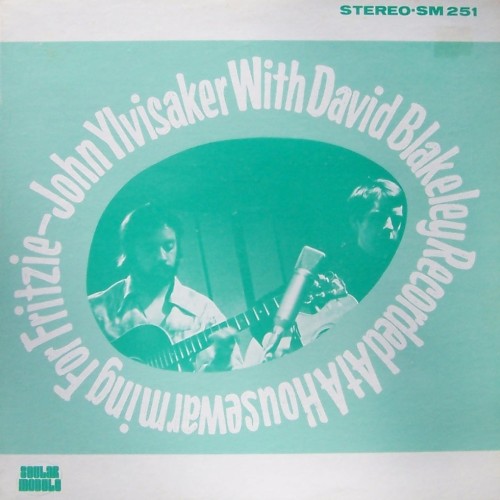
Ylvisaker’s obituary refers to him as the “Bob Dylan of Lutheranism.” Reawakened by its use as slang among beats and hippies and entered into print to name Hunter S. Thompson’s drug-fueled brand of New Journalism, “gonzo” probably derives from the Italian figure of the simpleton or fool, the great lightener of moods who speaks cheerfully of the miracle of reconciliation. Also a play on “gone,” as in “out there,” wild and crazy, mind unfurling in the midst of a great trip. My courses are basically guided tours of elaborate, personally crafted memory palaces, demonstrations of compatibility among multiple systems of gnosis, literary, philosophical, cultural, and political texts woven into a vast assemblage, my eyes like those of the Muppet conveying moment by moment a “zany, bombastic appreciation for life.”
Saturday November 24, 2018
“Me with nothing to say, and you in your autumn sweater,” go the words to a song of my late teen years by the New Jersey band Yo La Tengo. I heard it the other day, only to be reminded of it again midafternoon as Sarah and I, bundled in hats and scarves, set out on a brief walk through our neighborhood. By the evening, though, I’m back to re-reading Philip K. Dick’s A Scanner Darkly, a book I’m teaching next week. Dick’s dystopian future depicts widespread, near-universal dehumanization as a consequence of prolonged multi-decade domestic drug war. A pair of narcotics officers review horror stories involving consequences of addiction to the novel’s fictional drug Substance D: rapid aging, blown scholarships, a sister raped by her amoral drug-dealing brothers, babies born addicted, spread of STDs. Yet Dick also shows the lack of humanity among the cop side of this nightmarish future. When speaking to each other, Dick writes, these two narcotics officers, Fred and Hank, “neutralize” themselves; they assume “a measured and uninvolved attitude,” repressing feelings of warmth and arousal and cloaking themselves in anonymity. No one is likeable in this future. In order to live in it, one has to be willing to negate the humanity of others. “In this day and age,” says a character named Barris, “with the kind of degenerate society we live in…every person of worth needs a gun at all times” (61). This is a slight exaggeration; on the next page we learn of a character who has never owned a gun. But Dick’s future is one where gun violence is a commonplace (a world, in other words, much like our own). Everyone’s paranoid; everyone’s depressed, depraved, anxious, neurotic, confused. Indeed, to the extent that novels undergo cathexis when written, this one feels strangely anhedonic, borne of a period in Dick’s life of deep psychological crisis. For more on this period, see The Dark Haired Girl, a posthumously released collection of Dick’s letters and journals.
 Trance-Scripts