The Spread

Tarot: great modular graphic novel, arranged in a spread and read by super wise super cool Sacred Expanse rock-witch Michelle Mae. I’ve been a fan of hers since 1995, when I saw her band the Make-Up on a bill with Fugazi and Slant 6. Michelle has me set intentions. I share with her my questions for the cards — “What should I be open to? How do I make the best of the year ahead?” — and, upon her instruction, also voice them again silently, eyes closed. She pulls the spread: lays it out on a table, explaining that it can be read both linearly and holistically (i.e., taken as a whole). The two of us then proceed to do so as follows. She introduces the cards one by one, naming them, raising them into my field of vision one at a time, without my knowing at any given point until the end how many there are in total. “Some difficult cards,” she reports. “Two of them major arcana.” Michelle helps me make sense of what she admits with a laugh is a bit of a crazy spread. She sends me afterwards a sacred Tibetan meditation practice, urging me to approach it with utmost respect.

I am to visualize my demons sitting across from me.

I am to ask them what they desire, and I am to feed it to them.

By these means, the instructions suggest, we convert our shadow self into an ally. We become whole again, filled with a sense of power, compassion, and love.
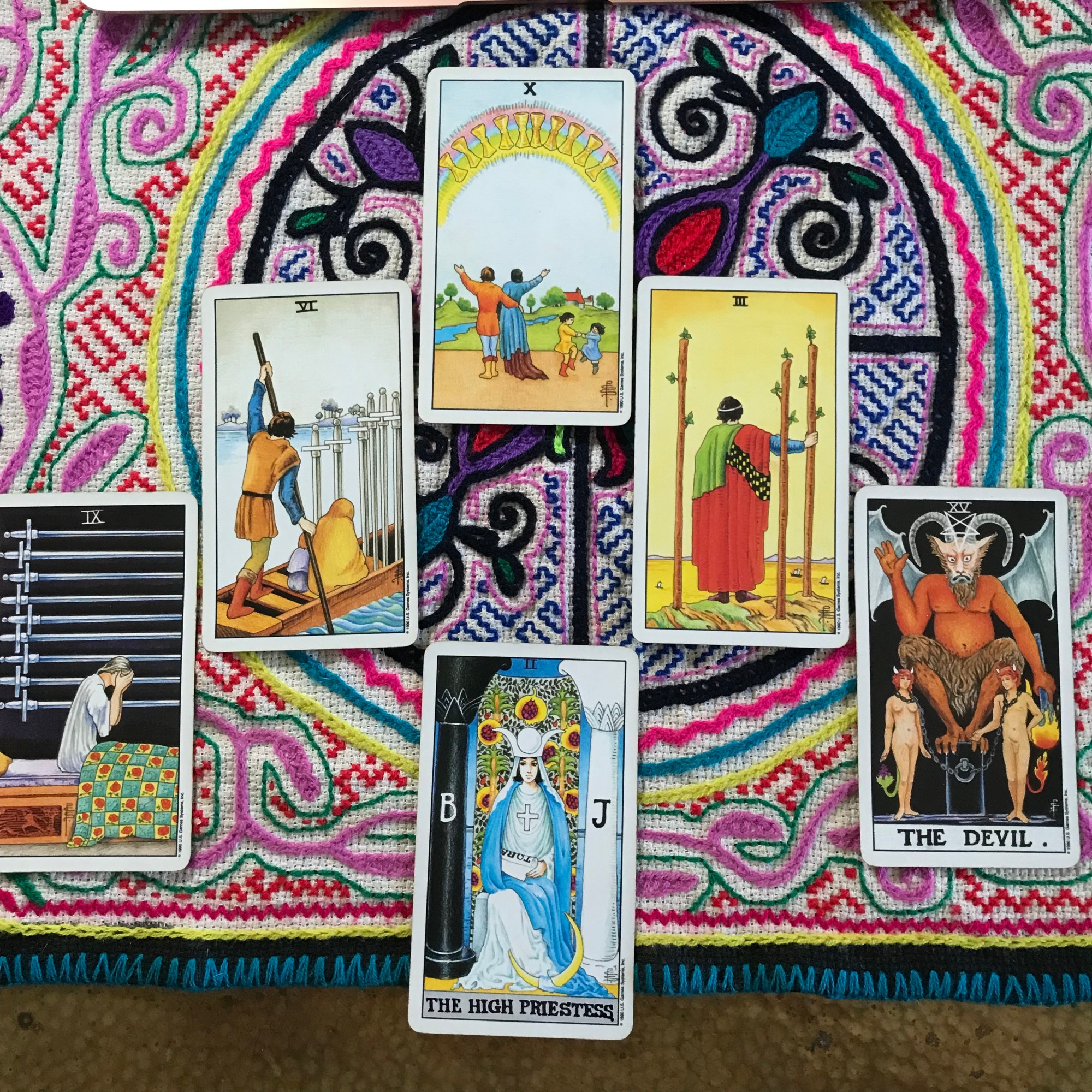
The Session

Mind blown by the experience of seeing musician Michelle Mae’s group The Make-Up perform at Irving Plaza in the spring of 1995, the Narrator had kept up with Michelle’s bands over the years. Never, though, had he met Michelle in person. Life is like that sometimes, especially for those of us with rich fantasy lives. Rarely do we get to sit down one-on-one to converse with the heroes of our youth.

“But early last September,” notes the Narrator, “I did exactly that.”

Thanks to a most excellent gift from his friends, he had the pleasure of meeting with Michelle and working one-on-one with her on Zoom in her capacity as a tarot reader.

She appeared onscreen sitting at a table in her home in Tucson. “I remember noting in the room behind her,” notes the Narrator, “a handcrafted besom leaned upright against a gray stone hearth.”

“There were some difficult cards in my spread,” confessed the Narrator to his friends in the days that followed. “But Michelle is super wise, super cool. She helped me see what the cards might be trying to teach me.”

Precipitations

More must be said, too, of Devin’s book, Precipitations: Contemporary American Poetry as Occult Practice. ‘Tis a book of criticism prepared by Devin based on a dissertation he wrote under the supervision of Robert von Hallberg and Saree Makdisi at the University of Chicago. I am grateful Devin wrote it — for with its overview of prior acts of trance-scription by the likes of poets Robert Duncan, James Merrill, and H.D. comes the potential to retell the backstory of what I’ve done. It sits with me here as I write.

The Johnstons

I admire a small stone and a pair of clam shells: mementos from last weekend’s party on the beach. In thinking about bathing the stone in salt water, an occult practice suggested in Aidan Wachter’s book Weaving Fate, I’m reminded of Devin Johnston’s Precipitations: Contemporary American Poetry as Occult Practice (Wesleyan University Press, 2002), a book I read last fall. Although most of Devin’s books are collections of poetry, the above book is a work of criticism — as were the books on Irish poetry published by Devin’s father Dillon Johnston, who Devin thanks in the above book’s acknowledgements.

I introduce each figure here, as each plays a part in my tale.

Dillon taught in my department, his time overlapping that of his more famous colleague, the poet, memoirist, and civil rights activist Maya Angelou. Dillon is the one who founded the press here at my university. His name now graces our reading series.

And oddly enough, Dillon lived for a time here on Shady Blvd, this street about which I’ve been writing — his home Mitch Easter’s home, two doors down from my own. He settled there in the wake of a divorce, and stayed there for several years.

Indeed, in all respects, he seems like an interesting character — someone I would have liked to have known. By the time of my own tenancy on Shady, however, Dillon had moved on to Wash U., where he trained several of my friends and colleagues. Our times thus never aligned in our respective homes — though I suspect Dillon’s stint overlapped that of the Gay Wizard.

For hyperstition’s sake, let us assume the two to have been friends and neighbors. The story of their friendship is one I venture to tell in what follows.

Portals

Because of its stained glass, its gaudy chandeliers, its profusion of mirrors, there was always a liveliness, a vibrancy to the Shady home’s interiors. The home’s mirrors were the equivalent of portals. Black Lodge, the occult-themed bar in town, utilized similar décor—though of course, as the name suggests, with the color removed: the Shady home stripped of its shine, replaced with an abundance of black.

The Gay Wizard

I know what you’re thinking, says the Narrator: Can I trust an author who calls one of his characters “The Gay Wizard”? I use that name not to offend, but because that was how he was known about town.

People knew the Gay Wizard. He was a local personality, a figure in the community. I remember Sarah and I speaking to our neighbor Sue one afternoon. Sue lived up the street from us, in a cream-colored home. Ferns hung in baskets from her porch. By the time we met her, Sue was already decades into her time on Shady. She spoke fondly of the wizard: his parties, his Studebaker, his boat.

Atop skeletal details of that sort, gathered haphazardly in the course of my tenancy, I crafted a character: someone I fancied meeting one day via time machine. Like an egregore of sorts, he entered first into my imaginings via the spirit of books of an earlier era. The books started turning up in the bins at Goodwill, as if he’d sent them: rare, obscure screeds like Arthur Evans’s Witchcraft and the Gay Counterculture and Mitch Walker’s Visionary Love: A Spirit Book of Gay Mythology and Trans-mutational Faerie. From them and others like them I culled a portrait of a loving psychedelic animist: a gardener like Derek Jarman. That’s how I see him now, in fact: poised there in the sunlit grove at the center of the home’s back yard, spade in hand amid the growth of his garden.

In picturing him thus, I resist the story’s pull toward horror. If this were a work of horror, notes the Narrator, he’d have been a shadier dude. Play the horror factor one way, and he’d have been a Crowleyan sex magician. A Thelemite; a Satanist: a practitioner of black magic. Play it another way, as might, say, Jordan Peele or P. Djèlí Clark, and he’d have been a wizard of an even deadlier sort: the kind who go around in white, terrorizing people of color.

If he’s ours to imagine, says the Narrator, let us imagine him otherwise. In our choosing of genre, let us act with hope.

Conversations with Frank

Conversations with Frank are always lovely, sprawling, rangy things. Early on in the course of one (perhaps even our first), he disclosed to us that several of the Shady home’s occupants prior to our renting it had been musicians in local bands. “Oh yeah? What bands?” I’d asked, hoping to learn more. That was my first hint, I suppose: Frank, rehearsing the names of those bands. “Golden Dawn,” he’d said. “Tetragrammaton.” The latter, I knew, referred to the sacred name of god in Hebrew. I knew, too, of the longstanding prohibition in some quarters on saying that name aloud. And with that, I suppose, I began to suspect, at least on an intuitive level, that there was something odd about the home’s history, some sympathy for occult or forbidden things retained between roof and ground.

But the oddness, I soon learned, was one that preceded Frank and his musician-friends. Well before any of them had arrived on the scene, the home’s occupant was someone known around town as the Gay Wizard. If the place has a whatever-you-wanna-call-it — an ectoplasmic charge; an occult presence of some sort — that dude is, at minimum, a key link in that charge’s chain of transmission, if not its source.

John Dee, as Imagined by Derek Jarman

Among the more fearsome of the precursors to what follows is John Dee, the great Renaissance spymaster, court magician and inventor of the British Empire. Filmmaker Derek Jarman is just one of several artists to have made much of Dee in recent decades. In fact, Dee appears repeatedly throughout Jarman’s oeuvre. We first meet Dee, for instance, in Jarman’s 1978 film Jubilee, where he operates as a kind of early-modern Doc Brown. At Her Majesty’s behest, the Dee of that film works up a spell that sends Queen Elizabeth I 400 years into the future–i.e., to London in the age of punk. And what begins in Jubilee continues in the films that follow, with Dee cropping up again the very next year by way of Shakespeare’s famous magician character Prospero. The latter wields a wand modeled upon Dee’s Monas Hieroglyphica in Jarman’s adaptation of The Tempest (1979). Nor is this the last of Dee’s appearances in Jarman’s catalog. He also turns up as muse, for example, in a film named after Dee and Kelley’s famous scrying experiments, The Angelic Conversation (1987). Nor was Jarman alone in thinking highly of Dee. The latter captured the imaginations of several of Jarman’s contemporaries. To mention just two examples: Dee appears as a character in Michael Moorcock’s Gloriana, or The Unfulfill’d Queen; and comics artist Alan Moore wrote a libretto about him. For Jarman’s own reflections on his interest in Dee and in related topics like alchemy, see his memoir Dancing Ledge.

Tuesday December 1, 2020

Ishmael Reed chips away at Freud, portrays Herr Doktor as an “Atonist” in his brilliant 1972 novel Mumbo Jumbo. PaPa LaBas lectures about Freud in the book’s “Epilogue” — tells of his attempt to communicate with Freud, thwarted by the latter’s “entourage”: Freud’s “ego defenses,” his sycophants and followers. “Freud,” Reed writes, “whose real talent lies in the coinage of new terms for processes as old as the Ark,” reacted with revulsion upon encountering America’s racial diversity. He pitted his “Austrian” conception of civilization against “occultism,” or what in conversation with Carl Jung he called “The Black Tide of Mud” (208-209). The “Id” is Freud’s “boogeyman” — a denunciation of all that is Other: racially other, culturally other, religiously other. What does it matter now? Freud has receded in the culture’s memory, replaced by neuroscience. Or so it seems. Time, perhaps to listen to Stanislav Grof’s Psychology of the Future: Lessons from Modern Consciousness Research, a seminar Grof recorded at Naropa in 2004. Change the channel, flip the script. Or as Gene Youngblood would say, “Secede from the broadcast.”

Tuesday November 24, 2020

Tasks arise, so I attend to them. One sees to the things one has to do. Grooming, cleaning, parenting. “So be it! See to it!” as Octavia E. Butler would say. The phrase was Butler’s mantra, one she wrote to herself in her journal years ago, before she was a published author. The words on that page of her journal are a spell. She decides what she wants and she proclaims it. Forget the excuses, she tells herself. “See to it!” Spells of this sort combine imperatives and future tense declarations of what will be. What were Butler’s thoughts on magic and the occult? What would she have called this if not magic? Psy-ops? An experiment in self-programming? Either way, it’s a power related to journaling. One becomes one’s own storyteller, writing dialogically day by day. Lauren’s journal functions this way. (Lauren is the main character in Butler’s Parable novels.) Lauren’s spells are the sections of the Parable novels written in verse. And here I am journaling about Butler‘s journals. Texts arrive bearing word about the process of initiation, like Butler’s 1988 novel Adulthood Rites, the second book in her Xenogenesis trilogy. (The three works in this trilogy — Dawn, Adulthood Rites, and Imago — have also been gathered under the title Lilith’s Brood.) Initiation requires a teacher, though, does it not? Perhaps I can just learn from my friends.