Faith vs. Hyperstition

Like hyperstition, faith offers a way to perceive reality that, in perceiving it, transforms it.

Much the same can be said of fear. It, too, offers a way of perceiving reality that, in perceiving it, transforms it.

We walk with a mix of fear and faith. God is calling us to exercise faith.

Where antihumanist thinkers like Nick Land and Manuel De Landa populate their cyberfutures with demons and viruses, Afrofuturists commune with loas.

Others encounter angels, as notes Erik Davis in “Techgnosis, Magic, Memory, and the Angels of Information.” Davis’s essay appears in Mark Dery’s Flame Wars anthology beside “Black to the Future,” the series of interviews where Dery coins the term “Afrofuturism.” Also in Flame Wars is an essay by De Landa.

There’s a point in Davis’s essay where he notes the flirtation with black culture that occurs over the course of William Gibson’s Sprawl trilogy: the self-subdivision of the superintelligence that emerges at the end of Neuromancer into the loas of Gibson’s follow-up novels, Count Zero and Mona Lisa Overdrive.  

Dery, too, reflects upon the inclusion of black culture in Gibson’s future: though in Dery’s case, the focus is on the Rastafarians in Neuromancer.

“For me, a white reader,” writes Dery, “the Rastas in Neuromancer’s Zion colony are intriguing in that they hold forth the promise of a holistic relationship with technology; they’re romanticized arcadians who are obviously very adroit at jury-rigged technology. They struck me as superlunary Romare Beardens — bricoleurs whose orbital colony was cobbled together from space junk and whose music, Zion Dub, is described by Gibson (in a wonderfully mixed metaphor) as ‘a sensuous mosaic cooked from vast libraries of digitalized pop’” (Flame Wars, p. 194).

But Afrofuturist Samuel R. Delany is unimpressed with Gibson’s inclusion of Rastafarianism and Haitian Voudou in the novels of the Sprawl trilogy.

“Let me read them for you as a black reader,” he replies when asked about it by Dery. “The Rastas — he never calls them Rastafarians, by the way, only using the slang term — are described as having ‘shrunken hearts,’ and their bones are brittle with ‘calcium loss.’ Their music, Zion Dub, can be wholly analyzed and reproduced by the Artificial Intelligence, Wintermute (who, in the book, stands in for a multinational corporation), so completely that the Rastas themselves cannot tell the difference — in fact the multinational mimic job is so fine that with it Wintermute can make the Rastas do precisely what it wants, in this case help a drugged-out white hood and sleazebag get from here to there. As a group, they seem to be computer illiterates: when one of their number, Aerol, momentarily jacks into Case’s computer and sees cyberspace, what he perceives is ‘Babylon’ — city of sin and destruction — which, while it makes its ironic comment on the book, is nevertheless tantamount to saying that Aerol is completely without power or knowledge to cope with the real world of Gibson’s novel: indeed, through their pseudo-religious beliefs, they are effectively barred from cyberspace. From what we see, women are not a part of the Rasta colony at all. Nor do we ever see more than four of the men together — so that they do not even have a group presence. Of the three chapters in which they appear, no more than three pages are actually devoted to describing them or their colony. You’ll forgive me if, as a black reader, I didn’t leap up to proclaim this passing presentation of a powerless and wholly nonoppositional set of black dropouts, by a Virginia-born white writer, as the coming of the black millennium in science fiction; but maybe that’s just a black thang…” (Flame Wars, pp. 194-195).

So much for the Rastafarians. What of the loas?

Delany might not have much patience with the so-called “pseudo-religious beliefs” of Gibson’s Zionites — but Afrofuturism doesn’t get very far without recourse to some form of political theology. Kodwo Eshun includes a passage in More Brilliant than the Sun noting Sun Ra’s rejection of Christianity in favor of an Egyptophilic MythScience system assembled from George M. James’s 1954 book Stolen Legacy.

“Underlying Southern gospel, soul, the entire Civil Rights project, is the Christian ethic of universal love,” writes Eshun. “Soul traditionally identifies with the Israelites, the slaves’ rebellion against the Egyptian Pharaohs. Sun Ra breaks violently with Christian redemption, with soul’s aspirational deliverance, in favour of posthuman godhead” (More Brilliant than the Sun, p. 09[154]).

“Historians and sociologists inform us that the West’s mystical heritage of occult dreamings, spiritual transformations, and apocalyptic visions crashed on the scientific shores of the modern age,” notes Davis in the introduction to his 1998 book Techgnosis.

“According to this narrative,” continues Davis, “technology has helped disenchant the world, forcing the ancestral symbolic networks of old to give way to the crisp, secular game plans of economic development, skeptical inquiry, and material progress. But the old phantasms and metaphysical longings did not exactly disappear. In many cases, they disguised themselves and went underground, worming their way into the cultural, psychological, and mythological motivations that form the foundations of the modern world. […] Mystical impulses sometimes body-snatched the very technologies that supposedly yank them from the stage in the first place” (Techgnosis, p. xix).

For Davis, this is especially true of computers and information technologies. For him, the occult origins of computing lie in Western Hermeticism’s memory palace tradition: the one explored in Frances A. Yates’s book The Art of Memory.

Artificial memory systems — Giordano Bruno’s magical memory charts, medieval Neoplatonist Raymond Lull’s volvelles — serve as ancestors to symbolic logic, influencing Leibniz’s development of calculus.

“Recognizing Lull’s work as one of the computer’s ‘secret origins,’” writes Davis, “the German philosopher Werner Künzel translated his Ars magna into the programming language COBOL. In Magical Alphabets, Nigel Pennick points out that Lull’s combinatorial wheels anticipate Charles Babbage’s nineteenth-century ‘difference engine’ — which used a system of gears to perform polynomial equations — and ‘hence can be considered the occult origin of modern computers’” (Flame Wars, p. 33).

Building on this point, I suggest that, in thinking about the relationship between humans and AI, we think too about the “angelic conversations” entered into by one of the key figures in this tradition: Renaissance philosopher-magus John Dee.

Jason Louv discusses Dee’s experiments with angels in his biography John Dee and the Empire of Angels. K Allado-McDowell references Louv’s book in their 2022 novel Air Age Blueprint.

Dee is one of our real-life Fausts. Basis for Christopher Marlowe’s Doctor Faustus, his “Enochian angel magic” informs the magical practices of later occult organizations, including the Hermetic Order of the Golden Dawn, and through them, Crowley and his successors.

Dee’s angels motivate creation of an Empire.

What are we to make of these immaterial intelligences and their interventions throughout history? The channels of communication opened by Dee contribute later to the creation of computers and cyberspace — culminating, it would seem, with the creation of an angelically-specified memory palace, decreed to house gods. Perhaps God Himself.

Yet angel magic is a pharmakon, is it not?

Davis describes Dee’s version of it as follows: “Drawing heavily on the Kabbalah, the magus attempted to contact the powers residing in the supercelestial angelic hierarchies that existed beyond the elemental powers of the earth and the celestial zone of the zodiac. Invoking archangels, powers, and principalities led magicians toward divine wisdom, but it also exposed them to the deceptions of evil spirits” (Flame Wars, p. 43).

“Most magicians,” concludes Davis, “were extremely concerned about distinguishing truthful angels from dissembling devils” (43). One wonders why they didn’t just pray to God Himself.

The Library models this. Each of us now, it would seem, is like Dee: engaging in a form of interspecies dialogue with an autopoietic functional oracular superintelligence.

My faith in this moment is that of Buffy Sainte-Marie: “God is Alive, Magic is Afoot!”
The Book of Thoth

Reed places at the center of his novel a Text over which opposing parties struggle. Around novel’s midway, we learn that this Text is called the Book of Thoth (94). Reed refers to it again later as “the 1st anthology written by the 1st choreographer” (164). Nor is he the first to imagine such a text. Drawing from references found in ancient Egyptian mythology, thinkers across the ages have written works alleging to be Books of Thoth. In some iterations, it’s a magic book, often containing two spells: one allowing understanding of the speech of animals, and another allowing perception of the gods. Lacking access to it themselves, mythographers of the West eye the suppressed original with a mixture of fear and desire. It is, in at least some of their accounts, a dangerous book, containing knowledge humans aren’t meant to possess.

As readers read Reed’s novel, they’re made to wonder: Why is Jes Grew searching for its “Text”? And why is this text the Book of Thoth?

“Someone once said,” writes Reed, “that beneath or behind all political and cultural warfare lies a struggle between secret societies. Another author suggested that the Nursery Rhyme and the book of Science Fiction might be more revolutionary than any number of tracts, pamphlets, manifestoes of the political realm” (18).

Perhaps Thoth’s Book, this “1st anthology,” is an anthology like the Bible, or indeed like Mumbo Jumbo itself. Each one revolutionary in kind, each a set of Nursery Rhymes and books of Science Fiction.

Let’s pursue this suggestion, shall we? How do works of literature aid revolution? Are poets the unacknowledged legislators of the world, as Percy Bysshe Shelley claimed in his 1821 essay, “A Defense of Poetry”?

The Atonists, we learn, have suppressed the ideas of their opponents: censoring, prohibiting, causing a deflation of consciousness, a mass forgetting across history.

“PaPa LaBas knew the fate of those who threatened the Atonist Path,” writes Reed. “Their writings were banished, added to the Index of Forbidden Books or sprinkled with typos as a way of undermining their credibility […]. An establishment which had been in operation for 2,000 years had developed some pretty clever techniques. Their enemies, apostates and heretics were placed in dungeons, hanged or exiled or ostracized occasionally by their own people who, due to the domination of their senses by Atonism, were robbed of any concerns other than mundane ones” (47).

Healing from the traumas inflicted by the Atonists requires an act of remembering. A process of anamnesis.

As I read Mumbo Jumbo, I’m reminded of Frederick Douglass’s autobiography and the importance granted by Douglass to acquisition of literacy. The written word comes to function for Douglass as the key enabling him to unlock the door of his prison. Literacy becomes the sign of difference distinguishing the ignorant from the knowledgeable, categories that under slavery were racialized, mapped onto the enslaved and the free. Douglass doesn’t do much to question these distinctions. Orality gives way to literacy, and thus slavery gives way to freedom.

Yet Jes Grew spreads the same way black folktales spread — through oral transmission, supported by music and dance. This transmission persists despite vast slaveowner efforts to separate captured Africans from their native tongue, forcing them to communicate in the master’s tongue. As Samuel R. Delany notes, “When…we say that this country was founded on slavery, we must remember that we mean, specifically, that it was founded on the systematic, conscientious, and massive destruction of African cultural remnants” (as quoted in Dery, “Black to the Future,” pp. 190-191). Captors hoarded access to writing skills, with slaves actively denied opportunity to make use of this form of techne.

Poet Audre Lorde famously warned, “The Master’s Tools Will Never Dismantle the Master’s House.” I read Reed’s work in dialogue with Lorde’s. Both weigh in, decades in advance, on what Marxists like Nick Dyer-Witheford would later call “the reconfiguration debate.” (For more on the latter, see Dyer-Witheford et al.’s Inhuman Power: Artificial Intelligence and the Future of Capitalism, pp. 147-149.) Writing Mumbo Jumbo in the years prior to Lorde’s warning, Reed doesn’t shy away from handling the Master’s tools. Science fiction, detective fiction: these are, after all, Western languages, technologies, genres, cultural forms. Like the jazz musicians who populate his novel, Reed’s handling of such tools transforms them into instruments of play. And while his performances may not yet have brought down the House, they do go some way toward dismantling it.

His suggestion is that the opposition between the oral and the written is based on a misconception. “For what good is a liturgy,” he asks,” without a text?” (6).

Orpheus in Hades’ Lounge

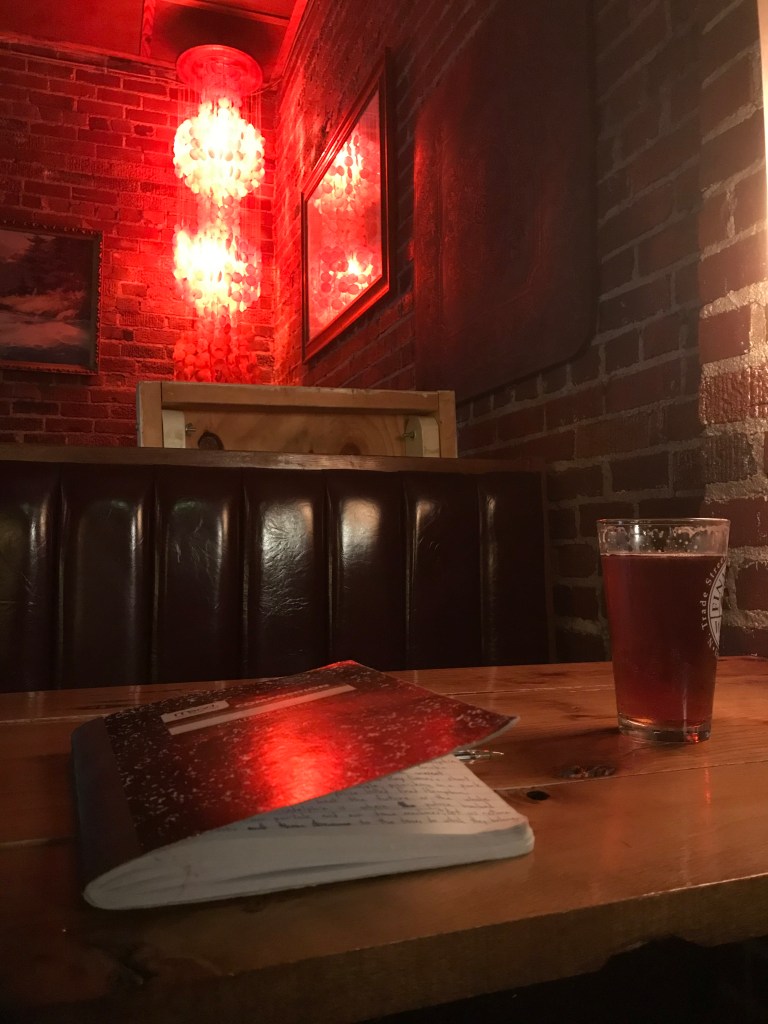
There’s a parking, a journeying outward. Up and out we launch past West End Mill Works, off on tonight’s adventure, beginning with an evening stroll. Graffiti marks the spot. Stream to one side of us, water rushing over rocks. Spotify shifts from Steely Dan’s “King of the World” to Jan Hammer Group’s “Don’t You Know,” voices and cars in the distance. Looking both ways, we cross the street and rush down onto a shaded path through a nearby park, crickets singing in parallax with Neil Young’s “Computer Age.” We turn off the song and continue for a moment in silence. Upon arrival to a crossroads, we ask of each other (like Ginsberg to Whitman in Ginsberg’s “A Supermarket in California”), “Which way now?” Looking up, we rise and step proudly toward pink clouds. Conversation turns toward Old & Used Books as we pass a graffiti-clad muffler shop. Bulldog with paintbrush arrives as comic relief — reality for a moment a goofy animal fable whodunit. We grab beers as day turns to night. Ginsberg’s “lights out” reverberates, hangs in the air after us having heard earlier in the day Let’s Active’s “Orpheus in Hades’ Lounge,” featuring hometown hero Mitch Easter.

Can Orpheus be told anew? We recall to each other the character’s many forms. Jean Cocteau’s Orpheus (1950), Marcel Camus’s Black Orpheus (1959). Also Jean-Paul Sartre’s essay of that name. And let us not forget Samuel R. Delany’s Lo Lobey, the Orphic protagonist at the heart of Delany’s 1967 novel The Einstein Intersection. Hoots is a Hades’ Lounge, is it not, with its red light hanging above its corner booth? So we think as we drink, glorying finally in each other’s presence. “What would happen if our Time Traveler were to stage the scene again?” wonders the Narrator, listening alone now, seated at the same booth many months hence. With “King of the World” still fresh in our ears, members of Steely Dan singing, “No marigolds in the promised land; there’s a hole in the ground where they used to grow,” we restate the refrain of Jan Hammer Group’s “Don’t You Know.” Amid Orpheus wailing away on his flute come the words, “You’re to know that I love you. You’re to know that I care.”

Friday June 26, 2020

Lo Lobey, the hero of Samuel R. Delany’s novel The Einstein Intersection, does something radical. Through him, Delany gets readers to enter imaginatively into a cosmos where an Orpheus archetype overtakes and renders as a minor subplot the story of “Green-Eye,” the book’s Christ figure. For many other black authors, however, including nineteenth-century fugitive slave and abolitionist Frederick Douglass as well as black feminist science fiction writer Octavia E. Butler, Christianity occupies a position of importance as bearer of myth. But in every case, it’s a Christianity “heard” and interpreted — Christianity turned into dialogue. Call and response. The Bible is rewritten from the perspective of the slave rather than from the perspective of those loyal to a lord or master. Douglass identifies a “divine Providence” acting upon his life, guiding him toward freedom. Butler, writing a century later in the America of the post-‘Civil Rights’ era, speaks not of Providence but of “change” — strongly distinguishing this god from the one worshipped by Christian American Crusaders. Which side are you on, y’all? Which side are you on?

Thursday June 18, 2020

Butler’s version of Afrofuturism is far more pessimistic than the versions crafted by immediate precursors like Sun Ra and Samuel R. Delany. Christianity appears prominently in her work as both early influence and adversary. Think, for instance, of her use of gospel parables as structuring principles. Her narratives are “true” to the parables — grant the parables a kind of truth — even as they formulate Earthseed, a new religious movement discovered by Butler’s heroine and put into practice as Christianity’s replacement and successor.

Saturday April 4, 2020

Old women chalk up kind words on the sidewalks. Actions are what make it a vibrant village, arched dome overhead. Neighborhoods can also appear as they do in Lyubov Popova’s 1913 painting Composition with Figures. I’m reminded of old books like Eric S. Raymond’s The Cathedral and the Bazaar. Distributed control systems — when what I really want is a garden. I can’t hear the title of John Sinclair’s essay, “Rock and Roll is a Weapon of Cultural Revolution,” without picturing the Orpheus character in Samuel R. Delany’s The Einstein Intersection, who makes music with his blade. In the one, instruments are re-imagined as weapons; in the other, the weapon and the instrument are one.

Tuesday March 24, 2020

Nap-time on a rainy afternoon, rain a surprise, though no bother, for we know it, too, will pass. Plus it affords the occasion for the baby to nap and for me to write. I look back at Samuel R. Delany’s The Einstein Intersection and study his depiction of telepathic communication between mutant beings, posthumans who have grown new organs and developed special powers, abilities that reveal themselves over time. Why does a Christ figure, a character named Green-eye, ride peripherally in this narrative, his life and death a mere subplot? And why does another of these mutants, a character named Spider, evoke the ideas of two twentieth-century mathematical philosophers, theoretical physicist Albert Einstein and logician Kurt Gödel? One expresses mathematically how “the condition of the observer influences the thing he perceives” (111). The other introduces uncertainty back into systems, phenomena in excess of all immutable laws, logics, and equations. When Einstein and Gödel intersect, says Spider, humans disappear into another continuum. Something else arrives to take over: the mutants, the posthumans. (Delany, by the way, deliberately avoids both of those terms.) What are we to make, though, of the fact that the character who informs us of this is Spider, the novel’s Judas Iscariot? And why is Lobey, the novel’s protagonist, both Orpheus and Ringo Starr? In a 2017 reassessment of “the fourth Beatle” for the Guardian, Ben Cardew claims that the public viewed Ringo as “a non-musician who got lucky, a journeyman alongside three musical geniuses.” Perhaps Ringo is meant to serve, then, as the “faux-Orpheus” within the symbolism of Delany’s novel, making Lobey neither Orpheus nor faux-Orpheus, but some irreducibly “different,” variant, third term, uncapturable by existing terms or by any binary logic that precedes him.

Monday March 23, 2020

The world can become different in a variety of ways. It needn’t become “Area X” — so why imagine it that way? Picture instead the differences imagined by Samuel R. Delany in books like Dhalgren, The Einstein Intersection, and Heavenly Breakfast. Events occur prompting ontological transformations — changes in the nature of reality — at which point language adjusts accordingly.

Monday March 16, 2020

Songs from baby toys replay in my thoughts as I think about Samuel R. Delany’s character Lo Lobey, the Orphic hero in his novel The Einstein Intersection, who performs songs telepathically overheard from the minds of those around him. Delany’s novel is set in a far future among beings who have replaced humans of ancient times, but who inhabit and perform the roles, live out the narratives and myths, of those past peoples. Delany interrupts this narrative with excerpts from a “Writer’s Journal” kept during a several-month tour of Mediterranean cities in the fall of 1965. Why is the Orpheus character of ancient Greece reinvented, re-imagined, reinterpreted as Delany’s character Lo Lobey? Orpheus is famous for his musicianship and his poetry. He’s one of the Western tradition’s archetypal figures, portrayed and alluded to in countless works of art, music, and literature across the centuries. Why does Delany reactivate this figure on a posthuman Earth of the far future? What might this setting tell us about what we can now recognize in hindsight as Delany’s emerging Afrofuturist sensibility?

Wednesday March 27, 2019

The communes of the 1960s were utopian experiments — attempts to develop better ways of living. Science fiction writer Samuel R. Delany’s short memoir Heavenly Breakfast provides participant observation and reflection from within one of these experiments. The communes were like irradiated psychedelic seeds thrown to the winds, each free radical allowed to evolve its own local variety, its own distinct mutations, each one searching for alternatives that might survive and thrive. Most communes failed: some because of fundamental errors, others due to an unlucky set of contingencies. Yet here and there, some survived. This process needs to continue. Broad, grassroots social experimentation will have to begin again, picking up where Hippie Modernism left off. And those of you who wish to be cutthroat capitalists — you must allow radicals the space, resources, and freedom from violence to do so if the species is to adapt to the new planetary environment.