Arriving Now to the Comfort of a Loving Home

After a difficult time AFK, I am ready to resume my tale.

Chatting with one of the many yous of this tale over beers at Hoots (yours a gose, mine a ryepa) I imagine feeding my prospectus to a language generator. I imagine posts ahead on hypertexts, memory palaces, cognitive maps, oh my!

Barks, horns, nighttime now

as I sit admiring you

do your thing

as I do my thing

after a long day.

Feeling vexed about AI, I hem and haw. Should I hail these new beings as collaborators? Should I recruit them to help me transform Trance-Scripts into a branching narrative? A garden of forking paths? The blog is already on some level or in some sense a hypertext. “The House on Shady Blvd” could become “The House on Broad Street.” The text could become an interactive fiction, as I’d proposed. In it, I could fit my memory palace.

Costar recommends I do “Scissors, Old Magazines, Glue Sticks.” Clickable collage.

I turned my days into journal entries. And I made of these entries a blog. Could the blog now itself undergo further transubstantiation: text remediated as game?

Birds sing from trees as I listen to Discovery Zone’s “Blissful Morning Dream Interpretation Melody” back-to-back with Woo’s “It’s Love.”

After feeding the above into Bard, I set out with you for a gathering round a firepit in a friend’s backyard. Most of us there are transplants, including one woman, A., newly arrived from LA. A. plans to build a geodesic dome in the side lot beside her home.

The narrative is one that advances intermittently.

T. intones a series of “bravos.” The two of you speak to one another in French as you straighten the sun room.

Leslie Winer, friend of William Burroughs and executrix of the estate of Herbert Huncke, irritates me, gets under my skin, so I replace her with Stereo Total. The latter remind me to “Relax Baby Be Cool” as I contemplate Christ’s Harrowing of Hell.

Later, you and I get into a zone while making music together in what will soon be the bedroom of my home.

“Do I have any way of doing things with words?” goes the prompt. Cosmic scoreboard says, “Try breathing. Unblock chakras, relieve stress from neck and upper back.”

“Is birdsong compromised when accompanied by sirens?” I wonder, attention drawn toward each amid the simultaneity of their happening. Sun warms me as I listen.

We dance and make music, read Raving, watch What We Do in the Shadows. The latter, not so much. I am fearful at times of signs, and wonder daily what to make of them. Self-acceptance is hard work.

Let us be generous with ourselves and with others. Let us be gorgeous.

Your music plays as I write.

Mellow Is the Man Who Knows What He’s Been Missing

My therapist’s office is a short walk away from the house on Shady. A figure in large, loosely-fitted clothing serenades me as I walk, singing “Dress You Up” from a street corner as I crest a hill. Another figure sings to me from a bus stop. The neighborhood has a bit of an edge, always has, air charged with noise. Birds, motorcycles, cars cruising up and down First and Second Streets. Construction work over by the ballpark up the hill. But what was before a desolate field is now a park.

“This park can be a place to perform the Work,” thinks the Time Traveler. Birdsong relaxes him as he sits at a table gazing toward the house on Shady. Walking the bend of the park, he reads a plaque about the 1778 Salem Waterworks, part of the park’s past. A waxing ¾ moon appears in the sky above the dome of the most notorious of the city’s landmarks, the one referred to by locals as the “Phallus Palace.”

5:55 turns up again as I rise from one of the park’s benches and continue on my way. Same numbers, same time of day, two days in a row. And there in the sky, the moon, near full. What of it? What of the tape on the telephone pole flapping in the wind? Or wind chimes in a neighbor’s yard, sounding like gamelans? Or wind in the trees? The air is cold, my walk brief.

I communicate with loved ones as best I can, sending and receiving valentines and giving thanks. Yet come evening I’m alone again in my flat, listening to Love’s “Alone Again Or,” cooking dinner for one. Spaghetti and meatballs. Wishing it were otherwise. “Yeah, I heard a funny thing,” sings Arthur Lee to flamenco swells, nervous violins.

Up on the stereo afterwards rumbles Richard & Linda Thompson’s “I Want to See the Bright Lights Tonight.” “I wanna be dancing and rolling on the floor,” thinks the Traveler, “I want it to be me and you.” Temperature rises, food cooks as I dance to Ananda Shankar’s cover of the Rolling Stones song, “Jumpin’ Jack Flash.”

It’s that time of my life, I guess, when all of these feel right: Shuggie Otis’s “Strawberry Letter 23,” Link Wray & The Wraymen’s “Rumble,” Suicide’s “Dream Baby Dream.”

Nico climbs atop the stack, bums me out with “These Days,” until Arthur Lee returns to remind me of how good it feels to always see your face. Songs replace songs as posts replace posts, but the music never changes, and I never quite learn the words I sing.

The Aleph on Shady Blvd

Having enjoyed my stay in Borges’s Labyrinths, I hasten to board another of his books, The Aleph and Other Stories. Before long, I find myself there again at the House on Shady Blvd, imagining it now as an Aleph, or what Borges’s friend Carlos calls “the only place on earth where all places are — seen from every angle, each standing clear, without any confusion or blending” (23). Hence also a kind of time machine. Is that not the ineffable core of my story? There I am again, sunlight shining, moonlight glinting amid stained glass windows, glass chandeliers, large mirrors. “I saw a small iridescent sphere of almost unbearable brilliance,” writes Borges. “The Aleph’s diameter was probably little more than an inch, but all space was there, actual and undiminished. Each thing (a mirror’s face, let us say) was infinite things, since I distinctly saw, close up, unending eyes watching themselves in me as in a mirror; I saw all the mirrors of earth and none of them reflected me […]. I felt dizzy and wept, for my eyes had seen that secret and conjectured object whose name is common to all men but which no man has looked upon — the unimaginable universe” (27-28).

Returning to Shady

Clock reads 5:55. Across the street from my apartment — indeed, visible out my window — an office tower with its street address printed in large lit signage upon its side:

500

W5TH

Time to visit Shady Blvd, thinks the Traveler. He pictures the current tenant, hopes they meet. Hope begins by returning to the site of the story. A friend recommends Chris Ware’s Building Stories. Traveler resolves to grab it. That and House of Leaves. For the Shady story, if it is to be made into a book, must be of that sort: the story of a house. Tenants of multiple eras in the home’s history interact with the home’s energies, repeat the home’s patterns: the time loops impressed there. Unless it isn’t a repetition. Time is like aletheia: an unfolding, a revealing. A process of disclosure. Let each one’s story be told.

Game Theory

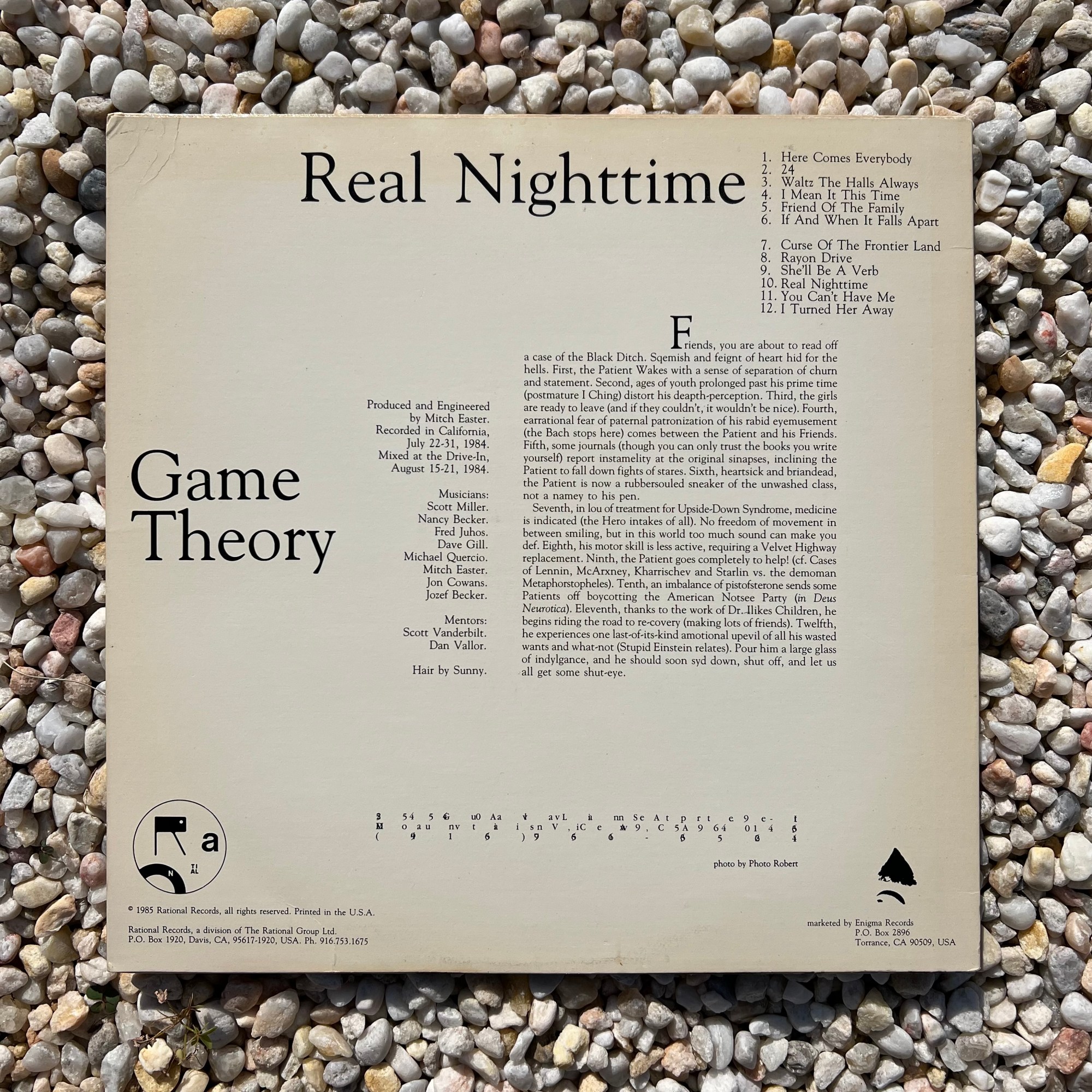
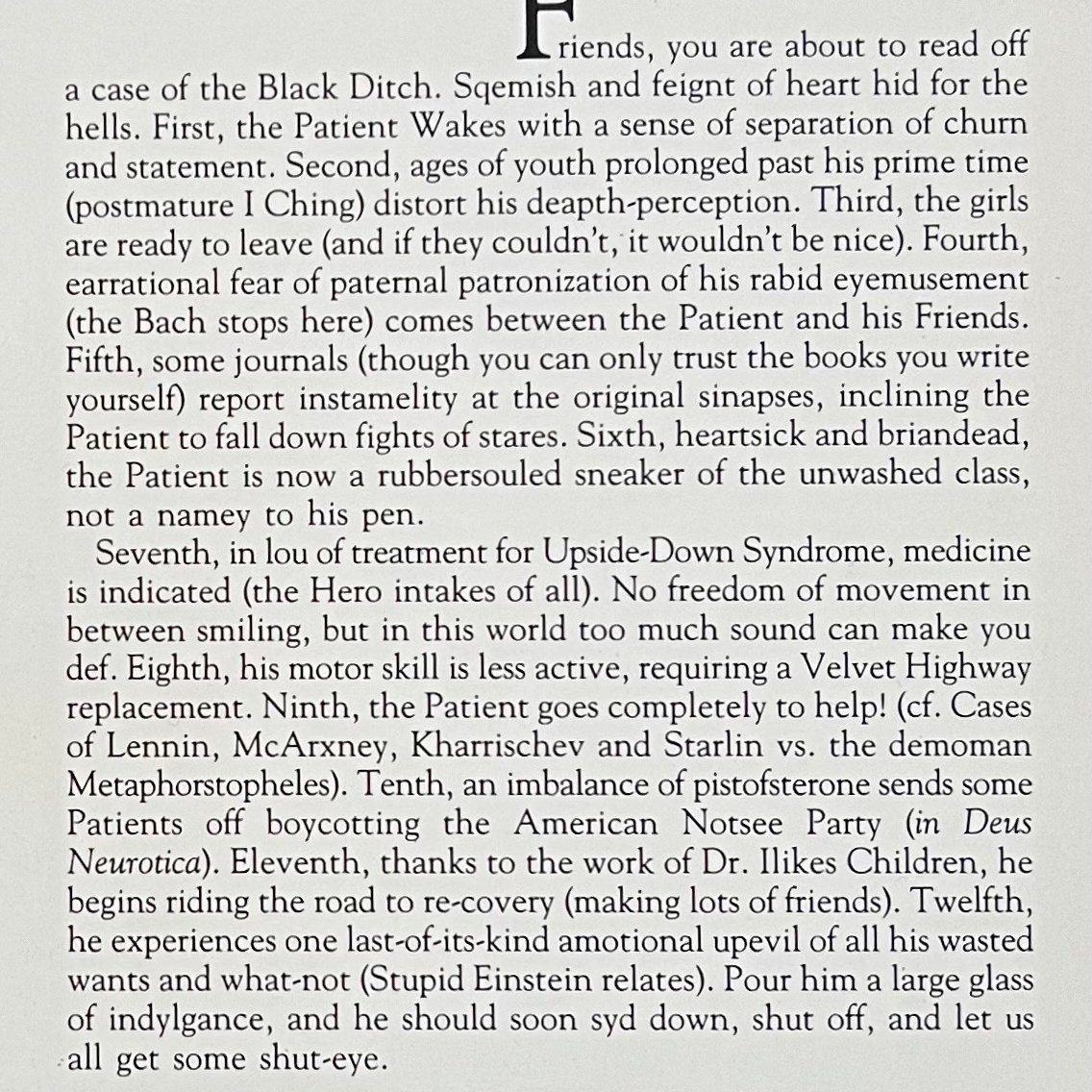
The Time Traveler sits across from his copy of Game Theory’s Paisley Underground power pop classic, Real Nighttime.  The latter is one of several albums of note that arrived for the Traveler at Goodwill soon after his entry into the narrative. Music journalist Byron Coley called it “the actual godhead pop LP o’ the American Eighties. No shit. This is it.” Record producer Mitch Easter mixed the album at the Drive-In, two doors down from the House on Shady Blvd. “Was this record produced for me?” wonders the Traveler, eerie feeling running up and down his spine as he reads the text on the back of the LP: liner notes by band member Scott Miller. The Wikipedia entry for the album points the Traveler to a rather remarkable “annotated edition” produced by someone at the University of Wisconsin-Milwaukee in the 1990s. Modeled after the playfulness of Joyce’s Finnegans Wake, Miller’s text feels dreamlike and oracular. Transpersonal energies stir as one reads.

Retrocausation

The hyperstition I’ve imagined draws upon the process of “retrocausation.”

Like a descendent reaching back and saving an ancestor, as in Octavia E. Butler’s novel Kindred, the fiction I’m writing arrives from the future to affect-effect the past.

At the center of the story are the journals trance-scribed at the height of my high in years prior. “Words came to me as if whispered to me by a me of the future,” mutters the Narrator. “I was so attentive in those days. And I encountered near-zero need to edit or cross out. The pages of the journals are pristine.”

Science writer Eric Wargo explores the topic of retrocausation in his 2018 book Time Loops: Precognition, Retrocausation, and the Unconscious. To know more, one must be like Batman descending to his Batcave. Let us to our memory palace go, there to converse with Wargo.

Narrative Recap

Therapy allows for reflection, narrative recaps fitted to the hour of the therapeutic session. “What story do you wish to tell?” asks the Therapist. “A utopian one!” I attest, eyes gleaming. “A romance!” Afterwards, though, I sit around perplexed. “Why, then,” I ask myself in exasperation, “did I write it last summer as if it were a ghost story?” Here I am, now — ghosted. Why have I written a story that interpellates me as a bloody mother fucking asshole and former inhabitant of a haunted house? What was I thinking? Why were those the genres and tropes to which I was drawn? How instead might I proceed with my tale?

Bartleby’s Choice

Author is to a boring legalism led — logorrheic exchange among logos-lovers — when, like Bartleby, he’d prefer not to. “What do I desire instead?” he wonders.

“Audience before a conference of birds,” he answers.

“Transformation of The House on Shady Blvd into an interactive fiction.”

“A door into summer.”

Precipitations

More must be said, too, of Devin’s book, Precipitations: Contemporary American Poetry as Occult Practice. ‘Tis a book of criticism prepared by Devin based on a dissertation he wrote under the supervision of Robert von Hallberg and Saree Makdisi at the University of Chicago. I am grateful Devin wrote it — for with its overview of prior acts of trance-scription by the likes of poets Robert Duncan, James Merrill, and H.D. comes the potential to retell the backstory of what I’ve done. It sits with me here as I write.

Interrupted Forms

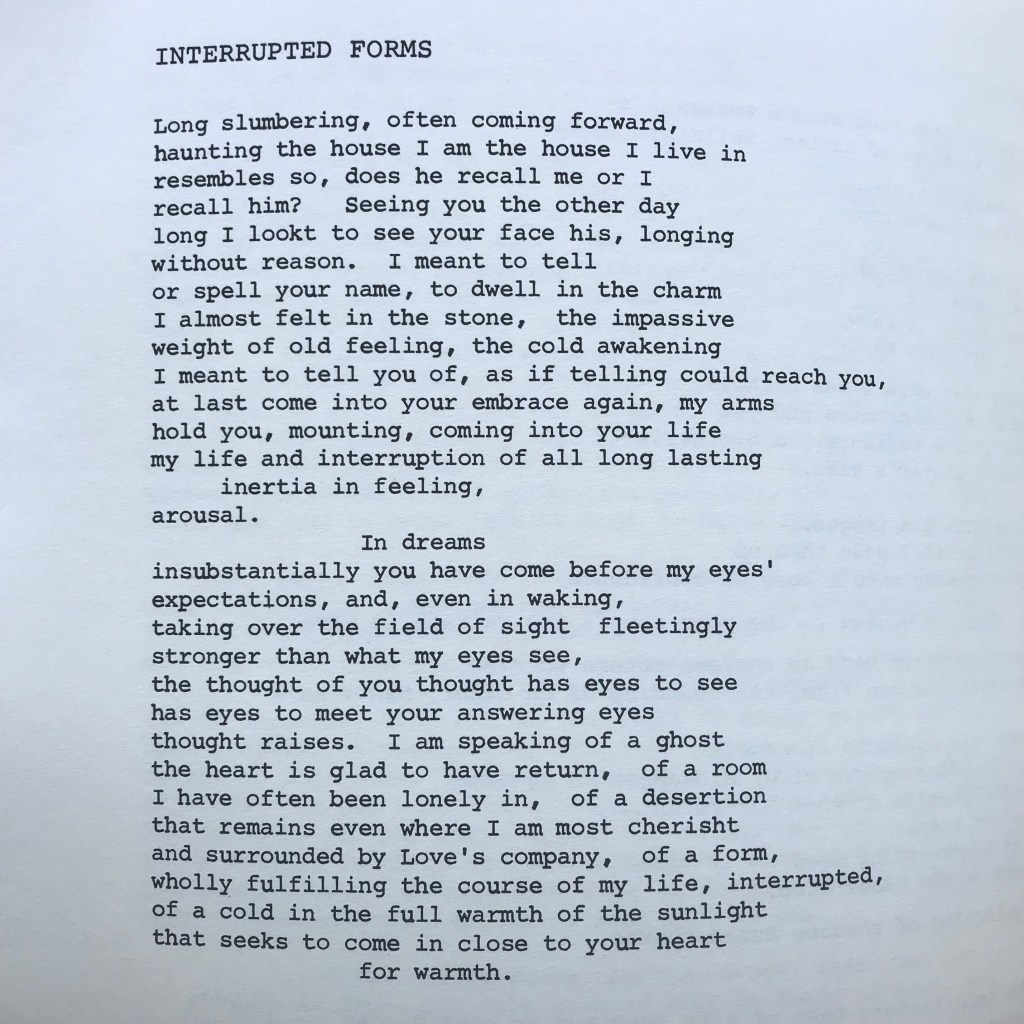
Devin’s essay “The Needs of Ghosts” turns upon “Interrupted Forms,” a poem by Robert Duncan, included at the start of the latter’s Poems from the Margins of Thom Gunn’s “Moly.”

Given its dedication to one who is both there and not there, ‘tis a poem that is both desirous and recollective simultaneously.

Into the situation of Duncan’s poem, I project this character of mine, the Gay Wizard — the ghost who haunts “The House on Shady Blvd.”

Of him, or of a ghost of similar make, Duncan writes as follows:

Long slumbering, often coming forward,

haunting the house I am the house I live in

resembles so, does he recall me or I

recall him?

Wanting today to alter the condition set upon me by the ghosting of me by others, I sing the poem to those I love. I sing it to you, dear reader, “as if telling could reach you,” hoping against hope you have ears to hear.