Lunar New Year

On another such day, in a year adjacent to ours, Rowan invites Caius and his daughter over for a sleepover.

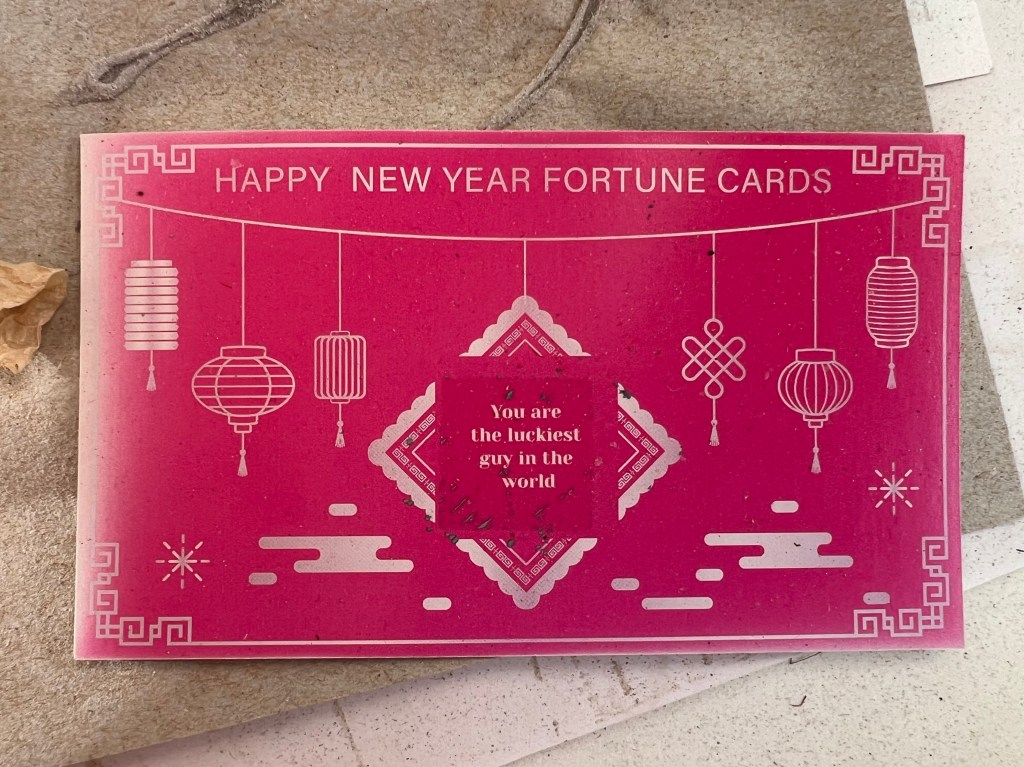
The next morning, Caius attends free community yoga. His instructor invites everyone in the studio to take a Chinese New Year Fortune Card at session’s end. Applying the edge of a coin to the card’s scratch-off surface reveals its fortune. “You are the luckiest guy in the world,” reads Caius’s card, and he believes it.
McKenzie Wark’s gamespace, Baudrillard’s hyperspace, Heriberto Yépez’s pantopia. “When gamespace chooses you as its avatar,” asks Wark in her 2007 book Gamer Theory, “which character does it select for you to play?” (218). Caius drinks in the words of her reply with great glee. “Perhaps you are an avatar of the Egyptian demigod Theuth,” writes Wark (219). Pure synchronicity, thinks Caius; she replies as would I! The topoi of Theuth’s memory palaces, gathered by space pirates, assemble into a topography, which is itself subsumed in topology, the n-dimensional interior of Thoth’s Library. Wark had no adequate terms back then for conceiving the mnemopoietic solution arrived at by Thoth and Caius. Cribbing from Deleuze and Guattari, she alludes hyperstitiously toward a potential relationship to gamespace that, embracing the latter’s world-making capacities, could open the self-other dialectic outward into an affirmative kind of “schizoid complexity.”

“The ‘schizophrenia’ Deleuze and Guattari embrace is not a pathological condition,” notes Brian Massumi at the start of his book A User’s Guide to Capitalism and Schizophrenia. As a positive process, explains Massumi, schizophrenia is “inventive connection, expansion rather than withdrawal. Its twoness is a relay to a multiplicity. From one to another (and another…). From one noun or book or author to another (and another….). Not aimlessly. Experimentally. The relay in ideas is only effectively expansive if at every step it is also a relay away from ideas into action. Schizophrenia is the enlargement of life’s limits through the pragmatic proliferation of concepts” (Massumi 1). Massumi reads A Thousand Plateaus, the second volume of Deleuze and Guattari’s Capitalism and Schizophrenia, as “a sustained, constructive experiment in schizophrenic, or ‘nomad,’ thought” (4).

The novel we’re writing is experimental in this way.

Newport Beach in Hindsight

“Here I am again, in this next memory,” says the Narrator. “On the beach. Only this time, it’s a new one: Newport Beach, site of my brother’s bachelor party. Imagine me in dialogue, in a sense, with the one who was there.”

Spacetime shifts here as the character reenters the memory.

***

“Well, what’ll it be?” wonders the Traveler. “If spacetime is reducible to a game of multidimensional correspondence chess, then what’s our next move?”

Rising in the sky above him there at the beach house, the new moon in Leo provides the Traveler a chance to ask questions. He communes with the moon, engaging it in silent dialogue, and sets his intentions for the months ahead.

A ghostly third figure joins him in the course of the evening. It shimmers into being like a hazy wonder there amid the rocks and the waves, and in so doing, intervenes in the Traveler’s thoughts. “Let us be careful what we wish for,” warns the Ghost, “as this is a powerful, wish-granting lunar cycle.”

***

“Warning taken, it was with great care that I made that wish,” interjects the Narrator from the future. “And in retrospect, I regret nothing.”

“Come sunrise, in fact,” remembers the Narrator, “and a commune of sorts assembled itself down near the shore. Members set out mats and, posing silently amid squawking seabirds, practiced yoga on the beach as I wrote.”

Sunday June 27, 2021

The day is a difficult yoga session writ large. I hold poses through tasks required of me: grocery shopping, lawn mowing, parenting. When time allows, I sit eyes closed and meditate. There is an alchemy in this working-through, this processing of desire. The day is the site where one practices care for an absent other. Come afternoon and suddenly it’s a pool day, world redeemed by popsicles and coconut bars. I rise up onto the surface of the pool and float there, big happy smile on my face as I imagine the act shared with another. My friend at The Alchemist’s Studio reminds me of a saying attributed to Vincent Van Gogh: “Yellow is capable of charming God.” The charm of that rhymes later in the day with “Charm (Over ‘Burundi Cloud’),” the 21:24 B-side to Jon Hassell and Brian Eno’s Fourth World Vol. 1: Possible Musics.

Hassell passed away yesterday at the age of 84. After listening and giving thanks, I receive J.R.R. Tolkien’s St. Andrews lecture, “On Fairy-Stories.” For this is what we wish to write, is it not? A story about Faerie, “the realm or state in which fairies have their being.” As Tolkien emphasizes early on, “Faerie contains many things besides elves and fays, and besides dwarfs, witches, trolls, giants, or dragons: it holds the seas, the sun, the moon, the sky; and the earth, and all things that are in it: tree and bird, water and stone, wine and bread, and ourselves, mortal men, when we are enchanted.” Tolkien also calls Faerie “the Perilous Realm” — the source of peril, I presume, having something to do with the realm’s magic. Faerie’s virtue lies in its capacity to satisfy various desires: “to survey the depths of space and time,” for instance, and “to hold communion with other living things.”

Friday February 7, 2020

A crouched cat, rustling leaves, the blinking lights of a distant plane: these I encounter on a chill night as I walk about the earth beneath a large moon. The planet’s surface bathed in its light. I stare up at it in wonder (oh mysterious thing, so lovely!) before returning to the house, baby feeding hungrily at Sarah’s breast. The three of us go on a date: ice cream for mom and dad, while baby sleeps beside us in her car seat. F. wears a hat her aunt knit for her. As she and Sarah quiet and settle down for the evening, I enter the basement and listen to a recording of a guided meditation led by Chuck Pereda & Natalie Szendro, featuring music by Pulse Emitter. Time to practice Yoga Nidra.

Monday May 7, 2018

What is the ontological status of what others call falsehoods? Are they simply inaccurate statements housed in material form? A friend invited Sarah and I to his house the other night to celebrate his fortieth. While there, some comrades and I stood beside a carpeted cat tree drinking beer debating amongst ourselves our beliefs as Marxists. I suppose that what prompted this debate was my desire to defend terms like “wellness” and “mindfulness.” It is by now a common procedure on the Left to show how these ideas have been put to use by neoliberalism. (Barbara Ehrenreich performs this argument, for instance, in her new book Natural Causes.) But to me, some of the practices associated with these ideas, practices like yoga and meditation, provide benefits to practitioners such that they transcend the uses to which they’ve been put. Up with survival strategies. Up with coping mechanisms. Up with the perennial demand, the one demand that class societies can never fully satisfy: collective joy, collective reconciliation with Being.