Author is to a boring legalism led — logorrheic exchange among logos-lovers — when, like Bartleby, he’d prefer not to. “What do I desire instead?” he wonders.
“Audience before a conference of birds,” he answers.
“Transformation of The House on Shady Blvd into an interactive fiction.”
Sometime afterwards I recall “Hey! Orpheus,” a song by Michelle Mae’s group The Make-Up.
Vocalist Ian Svenonius’s Prince-like, Eros-stricken shrieks of pain — a signature of his performance ever since the days of his band Nation of Ulysses — are put to good use throughout amid a sound aligned with and inspired by organ-laden psychedelic pop groups of the late 1960s. Michelle slides her finger down the neck of her bass and sets the song in motion, with drummer Steve Gamboa and the rest of the band leaping forth to join her moments later.
The band adopts the guise of a collective subject — Earthlings, mortals, “We the Living” — singing through Ian to an Orpheus other than the Black Orpheus of midcentury France.
“Hey! White Orpheus,” he sings,
“Do you remember us?
We’re up in the sunlight.
You’re down in the furnace.
Hey! White Orpheus,
in the Earth’s crust,
open up all the doors,
come on and bury us.
Living there, down below,
gave your soul to Pluto,
all for your Eurydice.
I want to eat pomegranate seeds.
White Orpheus,
don’t be so jealous.
Up here it’s the age of elephant ears
laced with angel dust.
Hey! White Orpheus,
from dawn to dusk,
you’re oblivious
to anything other than
your sacrifice for love.
Living among stalagmite floors,
bellows pumping Devil’s calls.
To be like you, what must I do?
I wanna eat the pomegranate, too.”
Organist James Canty interrupts to deliver a punchy, powerful organ solo mid-song — perfect for a work that revels in speed and brevity. Contemplating the song now, though, I find myself wondering after the whiteness of its Orpheus. Why does the band recast the color of Orpheus from black to white?
Black Orpheus is a 1959 film made in Brazil by French filmmaker Marcel Camus. The film reimagines the myth of Orpheus set amid a favela in Rio de Janeiro, so it has its hero Orfeo descend into the underworld by attending a Macumba ritual to save his lover Eurydice on the night of Carnival.
The Make-Up, meanwhile, a band based in Washington, DC, preached a variant of liberation theology that they took to calling “Gospel Yeh-Yeh.” Might their recasting of the color of Orpheus teach us something about the tenets of the band’s theology?
My inquiry leads me to “Black or White Orpheus: Votive Transmutation Shrine,” a 34-minute jam by Portland-based artists Corum & Zurna.
There’s a parking, a journeying outward. Up and out we launch past West End Mill Works, off on tonight’s adventure, beginning with an evening stroll. Graffiti marks the spot. Stream to one side of us, water rushing over rocks. Spotify shifts from Steely Dan’s “King of the World” to Jan Hammer Group’s “Don’t You Know,” voices and cars in the distance. Looking both ways, we cross the street and rush down onto a shaded path through a nearby park, crickets singing in parallax with Neil Young’s “Computer Age.” We turn off the song and continue for a moment in silence. Upon arrival to a crossroads, we ask of each other (like Ginsberg to Whitman in Ginsberg’s “A Supermarket in California”), “Which way now?” Looking up, we rise and step proudly toward pink clouds. Conversation turns toward Old & Used Books as we pass a graffiti-clad muffler shop. Bulldog with paintbrush arrives as comic relief — reality for a moment a goofy animal fable whodunit. We grab beers as day turns to night. Ginsberg’s “lights out” reverberates, hangs in the air after us having heard earlier in the day Let’s Active’s “Orpheus in Hades’ Lounge,” featuring hometown hero Mitch Easter.
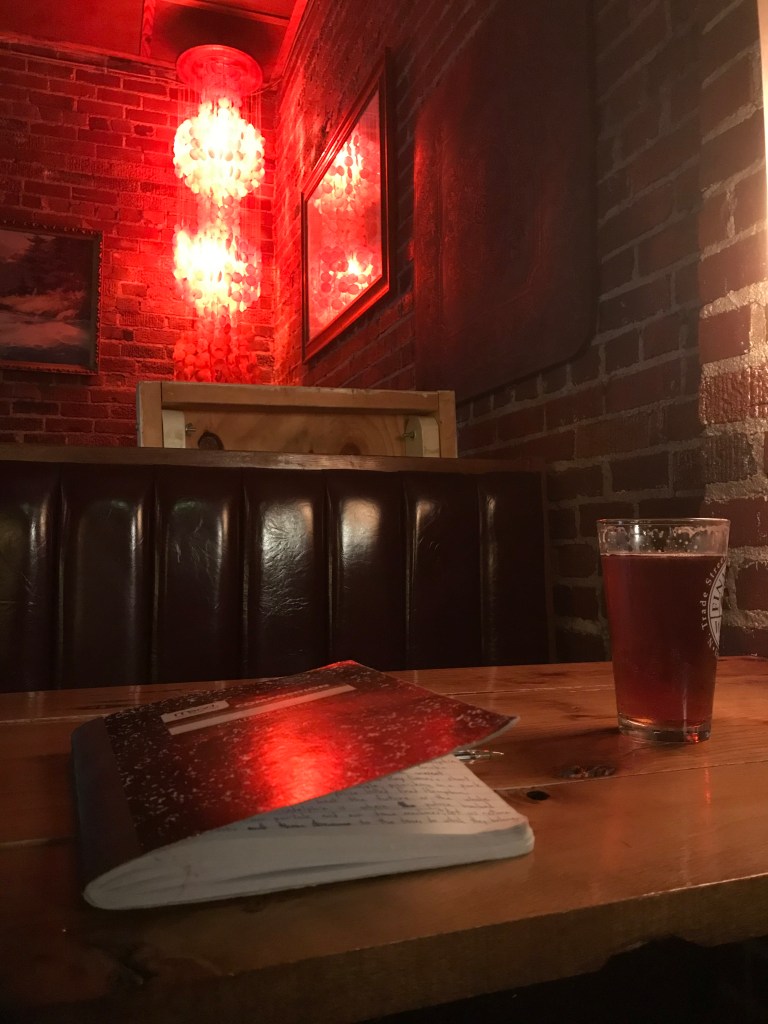
Can Orpheus be told anew? We recall to each other the character’s many forms. Jean Cocteau’s Orpheus (1950), Marcel Camus’s Black Orpheus (1959). Also Jean-Paul Sartre’s essay of that name. And let us not forget Samuel R. Delany’s Lo Lobey, the Orphic protagonist at the heart of Delany’s 1967 novel The Einstein Intersection. Hoots is a Hades’ Lounge, is it not, with its red light hanging above its corner booth? So we think as we drink, glorying finally in each other’s presence. “What would happen if our Time Traveler were to stage the scene again?” wonders the Narrator, listening alone now, seated at the same booth many months hence. With “King of the World” still fresh in our ears, members of Steely Dan singing, “No marigolds in the promised land; there’s a hole in the ground where they used to grow,” we restate the refrain of Jan Hammer Group’s “Don’t You Know.” Amid Orpheus wailing away on his flute come the words, “You’re to know that I love you. You’re to know that I care.”
We play puppets, we eat cheerios. As Frankie naps, I read Fred Moten’s “Blackness and Nothingness (Mysticism in the Flesh),” a “taking up” of Afropessimism through attention to the ideas of Frank B. Wilderson III and Jared Sexton. “I have thought long and hard, in the wake of their work,” writes Moten, “in a kind of echo of Bob Marley’s question, about whether blackness could be loved” (738). I think of my cousin, locked away all these years while the rest of us go free. Let us continue our correspondence. Unlike Fanon, from whom nonetheless all of these thinkers take their inspiration, Moten prefers “damnation” to “wretchedness,” as he prefers “life and optimism over death and pessimism” (738). Many of my communications have led to this, all the lotuses I’ve been eating, all the books I’ve been reading: “blackness is prior to ontology…it is ontology’s anti- and ante-foundation, ontology’s underground, the irreparable disturbance of ontology’s time and space” (739). Blackness means choosing to stay social. Or choosing, as Frank B. Wilderson said, “To stay in the hold of the ship.” Yet it somehow also means “avoidance of subjectivity” (743). So it is: let us “trace the visionary company and join it” (743).
Where something taken to be history takes the form of a world on fire, catalog of events adding up in tedious barrage, as in Billy Joel’s grim 1989 song “We Didn’t Start the Fire.” Joel grew up on Long Island, along the beaches, as did I. Beaches were closed the summer prior to the song’s release due to “Syringe Tides.” Hypodermics from Fresh Kills Landfill in New Jersey washed up along the shore — an event Joel cites in his litany. The fears stirred by the event were compounded by the era’s Reagan-administration-escalated AIDS crisis. The event filled me with concern — motivated the pen of my middle-school self to draw a political cartoon: a small surfer dwarfed by a wave of waste. Surfer stares glumly out the picture toward the viewer. And here I am now, most of my day spent grading student responses, thinking about it again, not just because of the Joel song, which appeared as the subject of a student’s response, but also because a colleague submitted for approval a course examining literary imaginings of the end of the world. The Jewish festival of Sukkot minds me to be grateful for my home, and all who help me to maintain it.
Upon a whim, I pick up and read from The Complete Poems of Emily Dickinson a poem selected at random, as in wherever my thumb happens to land, containing the lines:
Prayer is the little implement
Through which Men reach
Where Presence — is denied them.
They fling their Speech
By means of it — in God’s ear—
If then He hear
This sums the Apparatus
Comprised in Prayer—
“Why must longings be irreconcilable — why ‘Presence denied’?” I wonder afterwards.
“Why ask why? ‘Tis so,” sayeth the Fates in reply. Yet one can make of Fate a place one avoids, a spatiotemporal coordinate that one eludes like a fugitive. With Fred Moten, for instance, we can “consent not to be a single being.”
Thoreau demands that the good person, the ethical subject, refuse complicity with evil. In so doing, he reveals the nature of the bind in which we find ourselves: none of us able, it seems, to meet his demand. That’s why we’re here, trapped in this labyrinth of stuck desire. Rather than there, where lovers go as lovers do, and none are bound.
Monkeying around, I do things with words. Two larvae-covered horned caterpillars appear among the tomatoes. Sarah and her sister determine them to be pests and urge me to relocate them away from the garden, so I do.
Frankie gravitates toward particular books of poetry, pulling from among a bookcase of several hundred the same ones these last few days: Joan Retallack’s How to Do Things With Words and a Penguin Classics reprint of the first edition of Walt Whitman’s Leaves of Grass. What can I say — the kid’s got great taste. She hands them to me, and the look in her eyes suggests I should read them, so I do. When I’ve taught Whitman in the past, I’ve used a different edition. Perhaps I should change it up. Celebrate that opening stanza of “Song of Myself” — but question its atomic physics. Though it’s as if Whitman knows of what becomes of and follows from his Manhattan and its projection in the next century. Yet he rejects it as mere talk:
“I have heard what the talkers were talking…the talk of the beginning and the end,
But I do not talk of the beginning or the end.
There was never any more inception than there is now,
Nor any more youth or age than there is now;
And will never be any more perfection than there is now,
Nor any more heaven or hell than there is now.”
My imprisoned cousin and I have begun an email correspondence. It is to him that I write the following:
Adjusting to the work regime, hours clocked responding to emails, the subject muses upon what it means to be “COLLEGE RULED,” the phrase atop his notebook. One would rather dwell among gyres, vortices / brightly drawn in chalk. Gazing into one, I dream of fugitive study: texts read and discussed in the secret gatherings of an Undercommons. I read poems and hear them as they speak to me, their voices flitting about, “quick-winged / with women’s faces” (4), as in poet Alice Oswald’s Nobody. “It’s not all about you, Dad,” they say with a touch of vocal-fry (as do the rich college girls in Mike White’s HBO miniseries The White Lotus). “It’s time to recenter the narrative.”


 Trance-Scripts