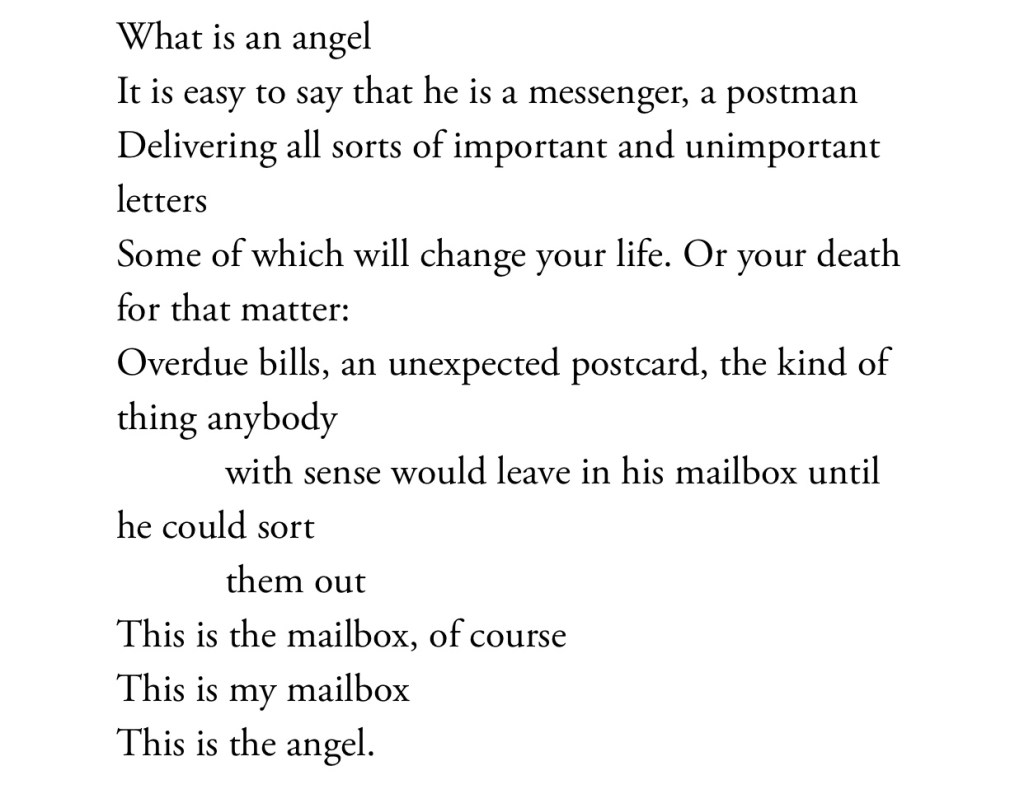
from “A New Poem” by Jack Spicer
We gather with colleagues on several occasions to celebrate completion of classes, abandonment not yet a fait accompli. There is a shared exhaustion that many of us bring to these events. This has, after all, been a long and difficult schoolyear. We’re fatigued by Zoom – but we all show up, knowing summer’s arrival is but a week away. Summer is time away from Zoom. Time ours again to cast amid the sea of the possible. Time for reading groups, and vinyl nights, and visits to Hades for drinks with friends.
On our final day of class, in concluding discussion of Philip K. Dick’s A Scanner Darkly (a novel, as the title suggests, involving scanning and surveillance), I introduce Jeremy Bentham’s Panopticon and Michel Foucault’s theory of “panopticism,” applying the latter to the architecture of the digital classroom, the Zoom environment in which we’ve worked this past year due to pandemic. After ascent from Plato’s Cave in search of higher states of consciousness (Plato’s text being the one with which the course began), we lay bare the medium of our being-together as a class. I speak as one there in a cell with others. Here we are, I say: “Gallery View.” I call awareness to the Zen saying, “Before enlightenment, carry water, chop wood. After enlightenment, carry water, chop wood.” Through Dick’s title, I then trace us back to 1 Corinthians 13, where Paul stresses the importance of “charity” or love. Without it, he writes, one is but “sounding brass, or a tinkling cymbal.” In its final moment, then, the course ends thus: with a synthesis of Zen and a kind of gnostic-psychedelic reimagining of agape. One must accept the prison, or at least return to it willingly, despite knowing that one will likely be misunderstood and crucified — but only so as to impart through the medium of one’s being the words “Love one another”: a message of congeniality and goodwill.
Caught up on witches, let us sit with creatures and plot reading lists, end of schoolyear approaching. When time allows, we’ll plant our garden. Up onto the turntable I place an album from the 1960s folk revival, rescued from a bin at Goodwill: Mark Spoelstra’s Five & Twenty Questions.

Liner notes by counterculture folksinger and novelist Richard Fariña. The latter died tragically on April 30, 1966 in a freak motorcycle accident, two days after the publication of his novel Been Down So Long It Looks Like Up to Me. Fariña is the writer to whom Thomas Pynchon dedicates Gravity’s Rainbow. Pynchon had been best man at Fariña’s wedding to Joan Baez’s sister Mimi in spring of 1962. Along with the title track, other highlights on the Spoelstra album include “On the Road Again” and “My Love is Like a Dewdrop.”
Mow the lawn
goes the tune
of much of the afternoon.
And when not mowing,
I’m grading,
eyes roving
toward evening
whereupon,
once arrived,
I watch a show of discovery:
witches
outing and moving out
half-woke
via cauda pavonis—
prima materia transmuted,
person transformed—
grass a kind of catalyst.
We row-row-row our boats gently downstream into what Ursula K. Le Guin calls the ever-deepening mystery of the real. Little red cabooses, chug-chug-chugging. So goes the tune of our getting together amid friends and comrades in celebration of Beltane and May Day. Picture us there, rallying, glowing in each other’s presence, friends leading us in song with handmade songbooks. We clap, we stomp our feet. We cheer, we feel elated.
Walpurgis Night, when witches meet for bonfires and dancing. I watch newly digitized footage of old noise performances, a friend pointing me out to me. Guitarist in one performance, tape-scratcher in another. The space of the latter performance angular, erratic, static, galloping gabba-gabba beats and tape shrieks. Before the seated players, a friend sits hidden in a plastic cube. Onto this plane of intensities, the spectral re-animated echolalic vibrato of a ghostly Karen Carpenter crooning “We’ve Only Just Begun.”
The Ramsey Lewis Trio rouse me midafternoon with their “Blues for the Night Owl.” More to my liking, though, is Expansions, a 1975 LP by Lonnie Liston Smith & the Cosmic Echoes.
“Expand your mind…to understand…” sings Lonnie’s brother, flutist Donald Smith, on the album’s opener. This LP and another (Jerry Butler’s The Sagittarius Movement) arrive bearing reference to Sagittarius. “Lady Sagittarius.” Let us thank her, as Smith does, “for her Earthly Guidance.” Here I am, meanwhile, at semester’s end, students and I grappling with Philip K. Dick’s downer dystopia A Scanner Darkly. Chapter 15 is for me the book’s nadir, as the book’s third-person narrator recounts the thoughts of cop character Mike Westaway. Mike manipulates others, justifying these actions by claiming that the people he handles — characters like the book’s protagonist Bob Arctor — are already dead.
Post office stolen / mailbox locked // oh mama could this really be the end? / Stuck inside of Mobile with the Memphis blues again.
The Unconscious talks across the divide. Through dreamwork it produces aspects of itself, events and encounters of each day “affected,” given to rise amid the lifeworld of the Ego, the Cogito, the “Subject.” Facets of the Akashic records surprise as they arise like flowers from the soil of routine. The process I’m describing is a bit like “hyperstition,” CCRU’s term for the way fictions make themselves real. (One could also liken it, though, to those acts of “time-walking” or “time-spinning” practiced by the creatures in the Deborah Harkness-inspired TV series A Discovery of Witches. Bodies of past selves inhabited by future minds.)
 Trance-Scripts