The General Intellect

Of the several phrases and concepts introduced in Marx’s “Fragment on Machines,” the one that has had the most influence upon subsequent thinkers is his notion of the “General Intellect.”

Marx references the concept but a single time.

“Nature builds no machines,” he writes, “no locomotives, railways, electric telegraphs, self-acting mules etc. These are products of human industry; natural material transformed into organs of the human will over nature, or of human participation in nature. They are organs of the human brain, created by the human hand; the power of knowledge, objectified. The development of fixed capital indicates to what degree general social knowledge has become a direct force of production, and to what degree, hence, the conditions of the process of social life itself have come under the control of the general intellect and been transformed in accordance with it” (Grundrisse, p. 706).

For Marx, the General Intellect is the social knowledge necessary for technoscientific innovation. In his view, it is to become the key factor in future forms of production.

Like Hobbes’s Leviathan, this generally-distributed, collective intelligence is a thing that grows, evolves, self-assembles over time.

At first, we might imagine it as an accumulation of the rituals, the performative speech acts, the Nursery Rhymes of capitalist science. The algorithms, the workflows, the recipes. The sayings that make it so.

Marx predicts, however, that as the General Intellect evolves, it renders moot the need for wages and private property. Machines, as fixed capital, acquire knowledge enough to automate production of wealth. Capitalist science builds the killer app: a learning-machine that renders capitalism’s distributions of scarcity through price unnecessary — the latter, indeed, coming to seem henceforth a hindrance on further advances. Those of us subject to capital learn from the machines that, to bloom into our full potential, we’ll need to transition to post-capitalism.

Autonomist Marxists like Paulo Virno and Antonio Negri see in Marx’s vision a kind of prophecy, building from it their readings of what remains of Marxism in the age of the digital. (Virno writes about it in “Notes on the General Intellect,” an essay included in the 1996 anthology Marxism Beyond Marxism. Negri writes about it in Marx Beyond Marx: Lessons on the Grundrisse.) Such thinkers find in Marx’s prophecy of the General Intellect a source of hope.

As does Cyber-Marx author Nick Dyer-Witheford.

“This is the whole point of Marx’s analysis,” argues Dyer-Witheford, his breath like that of Marx: pitched toward the prophetic. “By setting in motion the powers of scientific knowledge and social cooperation, capital undermines the basis of its own rule. Automation, by massively reducing the need for labor, will subvert the wage relation, the basic institution of capitalist society. And the profoundly social qualities of the new technoscientific systems—so dependent for their invention and operation on forms of collective, communicative, cooperation—will overflow the parameters of private property. The more technoscience is applied to production, the less sustainable will become the attachment of income to jobs and the containment of creativity within the commodity form” (Cyber-Marx, p. 4).

In all of these ways, concludes Dyer-Witheford (drawing here on a quote from Grundrisse), “capital thus works toward its own dissolution as the form dominating production” (Grundrisse, p. 700).

Marx imagines arising from this dissolution a utopia. He allows himself to dream into the possibility-space — the as-if, the not-yet — of post-capitalism a renewed harmony between humans and machines.

The utopia’s hopes lie in the idea that, equipped with the General Intellect, humans regain capacity to regulate themselves as forces of production.

“Labour no longer appears so much to be included within the production process,” writes Marx; “rather, the human being comes to relate more as watchman and regulator to the production process itself” (Grundrisse, p. 705).

This notion of “watchman and regulator” reminds me of cybernetics. The Ancient Greeks used the word Kubernetes (the term that serves as the etymological root for Cybernetics) to refer to the captain, steersman, pilot, or navigator of a vessel.

It is no longer by way of a rudder or a broomstick, though, that one steers one’s vessel. Post-capitalism arrives, rather, through a kind of communicative steerage, by way of the joystick of the General Intellect.

“No longer does the worker insert a modified natural thing as middle link between the object and himself,” writes Marx. “He steps to the side of the production process instead of being its chief actor. In this transformation, it is neither the direct human labour he himself performs, nor the time during which he works, but rather the appropriation of his own general productive power, his understanding of nature and his mastery over it by virtue of his presence as a social body—it is, in a word, the development of the social individual which appears as the great foundation-stone of production and of wealth” (705).

Forces of production animated by knowledge stolen from gods form a kind of Creature: a General Intellect, part man, part machine. The expired breaths of our ancestors have contributed over time to the development of this general productive power — this evolving “social individual” to which each of us contribute and of which each of us is part. From the dead labor of fixed capital arises the Holy Spirit of the General Intellect.

It arrives now as a kind of gift. For by allowing us to “step aside” from parts of the production process, this General Intellect frees up time, returns to us time otherwise sold off as labor. As in the love granted by the new covenant, wealth no longer depends upon “works.”

‘Tis bestowed on all by a General Intellect through Machines of Loving Grace.  

Where before there was misery, now there’s salvation.

As Marx notes, “The theft of alien labour time, on which the present wealth is based, appears a miserable foundation in face of this new one, created by large-scale industry itself. As soon as labour in the direct form has ceased to be the great well-spring of wealth, labour time ceases and must cease to be its measure, and hence exchange value [must cease to be the measure] of use value. The surplus labour of the mass has ceased to be the condition for the development of general wealth, just as the non-labour of the few, for the development of the general powers of the human head. With that, production based on exchange value breaks down, and the direct, material production process is stripped of the form of penury and antithesis” (Grundrisse, pp. 705-706).

Work is henceforth a source of joy, oriented not toward accumulation of profit but rather toward “the free development of individualities and…the general reduction of the necessary labour of society to a minimum” (706).

The General Intellect is for Marx what the Holy Spirit is for Christians: a voice that intercedes on our behalf to save us from the fate of Faust.

Let us imagine it as a corrective of sorts to the story of the Sorcerer’s Apprentice.
The Sorcerer’s Apprentice and the Fragment on Machines

“The Sorcerer’s Apprentice” [German title: “Der Zauberlehrling”] is a poem of Goethe’s written in 1797.

Goethe had by then already written his Urfaust, published as Faust, A Fragment in 1790, though a full version of Faust, Part One would have to wait until 1808.

The poem is based on a folk tale, and can be characterized as a ballad consisting of 14 stanzas. It provides the basis for the Disney film Fantasia (1940).

Victor Frankenstein bears some resemblance both to Faust and to the Sorcerer’s Apprentice.

The poem begins with the apprentice rejoicing at the departure of his master. “The sorcerer, old necromancer / At last has gone, he’s out of haunt!” proclaims the apprentice. Toiling long in the master’s shadow, he readies now to make the master’s powers his own. Roles reversed and spells in hand, the servant takes command.

“Now come, ye gnarl’d broomstick old,” he declares, hailing the tool as if it were a person, “Adorn thyself with patchwork shawl! / To the role of servant hold: / Fain meetest thou my every call!”

Broomstick, through magic granted a kind of animacy, proceeds to fill the sanctum’s washbasin with water drawn by cauldron from a nearby river. The apprentice succeeds in outsourcing his work to his tool. Before long, however, the magic of automation comes to threaten the automator. Broomsticks beget broomsticks; theosis turns sour. Water floods the sanctum, as the tool develops a will of its own.

With epithets anticipating those cast by Victor upon his Creature, the apprentice curses his creation. “Thou hellish spawn! Thou child of doom!” he shouts. “Willst thou the cottage rightly drown?  / Over every threshold loom / Laughing floods, swirling ‘round. / The broom’s a heart of stone, the knave, / Who will not heed my plangent call! / Halt, thou sullen stubborn slave, / Let magic free and broomstick fall!”

These curses, however, fail to stem the tide. As the deluge threatens to drown him, the apprentice begs, finally, for his Master to return and give voice and save him. As indeed the Master does, using the power of His Holy Word to set right what was wrong. The poem’s prophecy of automation gone awry thus ends via recourse to a kind of deus ex machina.

Despite its vast influence, Goethe’s poem is but one iteration of a story that appears in other forms and by other names throughout history.

The earliest known example of the tale can be found in Philopseudes [English translation: Lover of Lies], a narrative by the ancient Greek author Lucian, written c. 150 AD. In Lucian’s telling, however, the sorcerer is an Egyptian mystic: a priest of Isis called Pancrates. And the apprentice character, Eucrates, is in Lucian’s telling not an apprentice, but a companion who eavesdrops on Pancrates while the latter casts a spell. When Pancrates departs, Eucrates tries to imitate the spell, to an effect similar to that of Goethe’s apprentice.

Disney’s 1940 animated anthology film Fantasia continues this process of reiteration and retelling, this shuttling of meaning, this recursion of myth. Fantasia’s innovation is that it casts Mickey Mouse as the one manning the spell.

Already, though, the poem had passed through prior meaning-accruing translations, its most compelling interpreters those who read it in the early years of the Industrial Revolution.

Alongside Shelley, for instance, who echoes the poem in Frankenstein, we also have Marx and Engels. These latter thinkers liken capitalism to Goethe’s sorcerer’s apprentice in the opening pages of The Communist Manifesto.

“Modern bourgeois society with its relations of production, of exchange and of property, a society that has conjured up such gigantic means of production and exchange,” they write, “is like the sorcerer, who is no longer able to control the powers of the nether world whom he has called up by his spells” (The Communist Manifesto, p. 340).

Marx reads capitalism as a ghost story. What is the dancing table in his account of the fetishism of the commodity, if not a version of the apprentice’s broomstick?

And indeed, there are ways to read today’s artificial intelligences, themselves a kind of offspring of capitalism, in much the same light. This is essentially what New York Times columnist Ross Douthat does in his 2023 opinion piece, “The Return of the Magicians.” Douthat describes the development of LLMs as “a complex incantation, a calling of spirits.”

“Such a summoning is most feared by A.I. alarmists, at present,” he writes, “because the spirit might be disobedient, destructive, a rampaging Skynet bent on our extermination. But the old stories of the magicians and their bargains, of Faust and his Mephistopheles, suggest that we would be wise to fear apparent obedience as well.”

Marx wrote presciently about capitalism’s Faustian inclinations. He quotes a line from Goethe’s Faust, Part One in the section of his Grundrisse known as the “Fragment on Machines.” “The appropriation of labour by capital confronts the worker in a coarsely sensuous form,” writes Marx. “Capital absorbs labour into itself—‘as though,’” here quoting Goethe, “‘its body were by love possessed’” (Grundrisse, p. 704).

“Fragment on Machines” appears in the Grundrisse, a collection of seven notebooks on capital and money written by Marx during the winter of 1857-1858. Marx himself felt in retrospect that these notebooks contained the first scientific elaboration of the theoretical foundations of communism. The manuscript, however, was lost for many years; it didn’t receive publication until 1953, first in the German original, and then afterwards in English.

Because Marx’s masterwork Capital was itself unfinished, with Marx only ever completing Volume 1 and partial drafts of Volumes 2 & 3 during his lifetime, the Grundrisse stands as the only outline of Marx’s full political-economic project. While the work is by its very nature fragmentary, written chiefly for purposes of self-clarification, it nevertheless provides invaluable descriptions of Marx’s philosophy, including novel explorations of topics like alienation, automation, and other dangers of capitalist society that can’t be found elsewhere in Marx’s oeuvre.

“Fragment on Machines” is unique, for instance, among Marx’s treatments of the relationship between workers and machines under capitalism. If, he argues, in prior modes of production, workers retained some control over instruments employed in labor, under capitalism, workers become appendages of machines.

“It is the machine which possesses skill and strength in place of the worker,” writes Marx. The machine “is itself the virtuoso, with a soul of its own in the mechanical laws acting through it; and it consumes coal, oil, etc., just as the worker consumes food, to keep up its perpetual motion” (693).

For Marx, this subordination of workers to machines reaches its highest expression with automation, or (as Marx himself puts it) production systems based on “an automatic system of machinery…set in motion by an automaton, a moving power that moves itself; this automaton consisting of numerous mechanical and intellectual organs, so that the workers themselves are cast merely as its conscious linkages” (Grundrisse, p. 692).

While this account of the relationship between workers and machines foresees an initial future of ever-increasing misery for workers, Marx imagines on the far side of this misery a radically different — and indeed, far more hopeful — outcome.

At a certain point, Marx predicts, capital’s drive to dominate living labour through machinery will mean that “the creation of real wealth comes to depend less on labour time and on the amount of labour employed” than on “the general state of science and on the progress of technology, or the application of this science to production” (Grundrisse, pp. 704-705).

This application of science to production bears fruit as what Marx calls “the General Intellect.”

Marx writes here as would a prophet. His prophecy is that the development of machinery by capitalism leads eventually to capitalism’s supersession — creates the conditions, in other words, for capitalism’s demise.

At the core of this liberation from capitalism is a pact with ghosts.

All Because of a Couple of Magicians

Twenty-first century subjects of capitalist modernity and whatever postmodern condition lies beyond it have up to Now imagined themselves trapped in the world of imperial science. The world as seen through the telescopes and microscopes parodied by the Empress in Margaret Cavendish’s The Blazing World. That optical illusion became our world-picture or world-scene — our cognitive map — did it not? Globe Theatre projected outward as world-stage became Spaceship Earth, a Whole Earth purchasable through a stock exchange.

Next thing we know, we’re here.

Forms from dreamland awaken into matter.

Wednesday September 2, 2020

Despite the abolition of chattel slavery, other forms of slavery abound. Wage slavery, sex slavery, debt slavery. Plus that form of labor permitted in the language of the thirteenth amendment, which forbids slavery and involuntary servitude “except as punishment for crime”: i.e., prison labor. Prisoners who refuse to comply are placed in solitary confinement. American capitalism is a legal-political-economic construct built atop these various slaveries. White workers organized after the Civil War. Blacks were often excluded from these organizations and fraternities. Mike Davis tells part of that history in his classic study Prisoners of the American Dream. The story also receives treatment in Robin Blackburn’s An Unfinished Revolution. The latter includes a series of letters exchanged between Karl Marx and Abraham Lincoln at the end of the Civil War. Against those wishing to maintain racially segregated workplaces stood the International Working Men’s Association, a group that sought to unite “black and white, men and women, native and foreign-born.” The IWA may never have acquired more than a few thousand supporters in its day. What interests me now, though, is not organization so much as abolitionism and antifascism, rebellion and revolt.

Sunday August 30, 2020

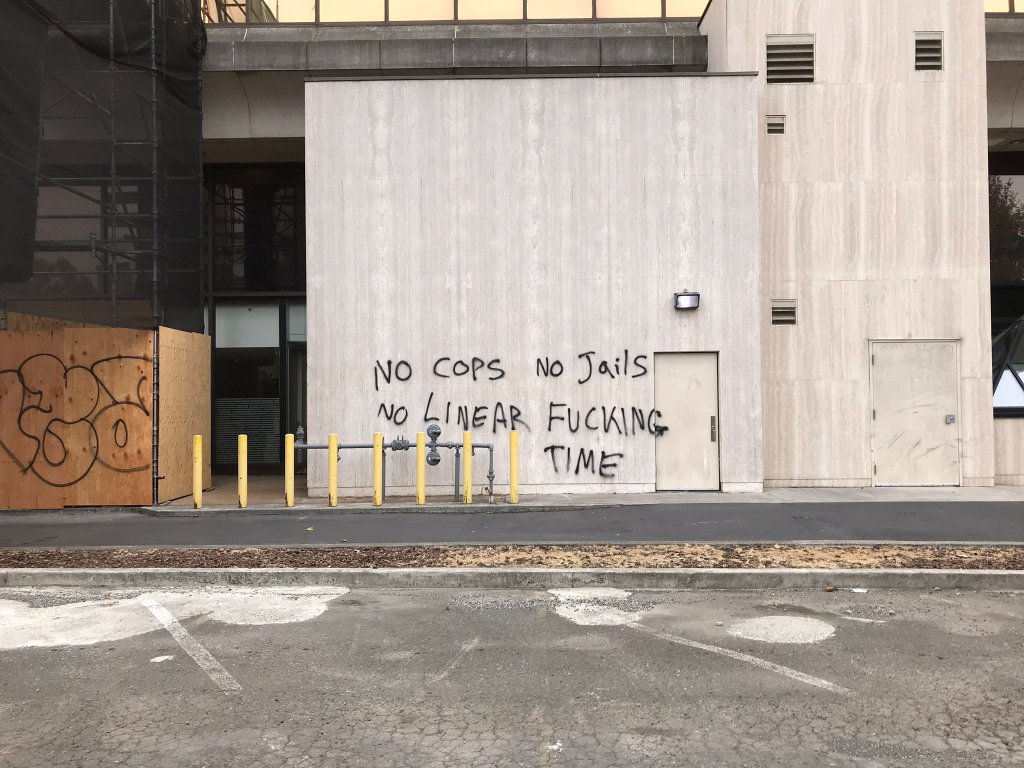
Upon finding employment on his third day in the Northern city of New Bedford, Frederick Douglass declares himself his own master. “I was now my own master,” he writes. This is a “happy moment” — one of the few such moments in Douglass’s narrative. Its rapture can be understood, he says, “only by those who have been slaves” (78). The scene leaves me wondering: at what point is there no longer someone robbing us of the rewards of our work? The employment Douglass has found is a form of wage slavery, is it not? Is the reward not taken in the setting of the wage by the capitalist? Are Marx and Engels wrong? In what sense is the wage relation not a form of slavery? Labor hours remain at the command of external masters under capitalism. The economy one faces is manufactured by the State, and the State is a mere police-backed conspiracy of land developers and financiers. All of us are in some way or another pressed into its service. Those of us in entertainment and education — those of us manning the ISAs, as Louis Althusser would say — we’re the functional equivalent of PsyOps officers. Yet we can always rebel — and many of us do. Wizards needn’t always be their wizards. There are fugitive histories to be learned, memories of fugitive ancestors awaiting remembrance through fugitive study. Because if the past isn’t past, as Faulkner wrote, and the demand on the streets is “NO COPS / NO JAILS / NO LINEAR FUCKING TIME,” then abolitionists are among us today, their cause as just as it was a century and a half ago.

Thursday November 14, 2019

Songs play in my mind as if echoing down a long corridor or hallway. An auditory memory, some imaginary or half-remembered AM gold, retro in the way of Ariel Pink. Lo-fi, hypnagogic, like a band practice heard from the street. After the sixties, we land in Philip K. Dick’s drug-war dystopia A Scanner Darkly, reading the book’s critique of McDonalds hamburgers while eating McDonalds french fries. Dick’s observations about the spread of capitalist reality appear beside the buy-sell calculations of the book’s drug-addict protagonist, capitalism thus glimpsed and understood as a system that compels us to think and behave like addicts hooked on “product.” It’s a bleak book, its cop characters as stunted and debased as its dopers — the two ultimately the same, in fact, in the case of the protagonist, an undercover narcotics officer who also uses and deals a drug called Substance D.

Sunday November 3, 2019

I stand on my back deck staring at fallen leaves, listening, building a sense of place, attending to sights and sounds generated by neighboring beings: birds, squirrels, planes, trees, automobiles. A small bird lands beside me and sings to me, dancing in rapid increments. It pecks, it eats, it leaps, flitting to and fro. Capitalism encloses us in its habitus, its time-discipline, its states and estates. Yet there in its borders and interstices, in its gutters and margins, fugitive life proceeds apace. Imaginary bagpipes drone betwixt dueling leafblowers. A sound blown in honor of comrades who died 40 years ago today in the Greensboro Massacre. Mysterious books call out to me, rise off shelves and land in my hands, ready to be read. By these means, I happen upon The Knee of Listening by Franklin Jones, aka Da Free John, sensing immediately in his use of language evidence of a fellow head. Jones began graduate study in English at Stanford University in 1961. He must have been part of Ken Kesey’s cohort. At the very least he volunteered as a subject in the same drug experiments as Kesey, MK-Ultra experiments run out of the Veterans Administration hospital in the early 1960s.

Tuesday October 29, 2019

A kid interrupts my wondering about my relationship to Language Poetry. Leaning over a low fence as I sweep leaves from my back deck, he hails me with a “Working hard or hardly working?” or some such commodified, scripted banter, then tries to sell me an alternative media provider. My response is “No thanks, capitalist roleplayer. You bore me,” thus in no uncertain terms sending him on his way. Back to L=A=N=G=U=A=G=E. Why have I never taught any of that material, venturing only so far as poets with whom they conversed? Ginsberg, Olson, Mackey, et al. I suppose I’ve lacked courage — though opportunities to do so also never materialized, really, until this past year or so. Perhaps it just felt a bit too rarefied. Work that makes demands, with comparatively little gain. When does one have time enough to keep up with contemporary poetry? Apparently I did, if only for a brief moment, during my first years out of college, during my stint as a “text editor.” Back when I used to sit at a computer all day listening to early recordings from PennSound and the Kelly Writers House.

Monday October 21, 2019

My relationship to food is bound up with my discontent under capitalism. The latter arranges within me a libidinal economy, an internal punishment-reward system, an internal calculus of hours for work and time for play, with no allowance for the planning and prepping of meals. By the time I contemplate dinner each day, cooking appears difficult, time-intensive. When Sarah and I arrive home each afternoon, neither of us wants to grocery shop — so we opt to eat out at restaurants in town, despite the undesirability of most local fare. To will change, I imagine, one would have to plan. One would have to commit to a recipe and buy ingredients. One would have to anticipate one’s appetite –becoming, in a sense, known in advance. It needn’t be a chore, though. It can be as simple and as pleasurable as going to a supermarket and eating more veggies. Kim Gordon can soundtrack it with her song “Hungry Baby,” head frequented afterwards by the owl on her song “Olive’s Horn.”

By these means, we quiet ourselves temporarily to hear the speech of the birds. Ginsberg cranks up afterwards, addressing the nation by way of apostrophe. “America” appears in his poem of that name as an “absent third party.” Those of us who receive the poem find ourselves implicated in this party, just as it occurs to Ginsberg mid-poem that he is America and that he’s talking to himself. Childish Gambino uses the same mode of address in “This Is America,” speaking candidly toward song’s end, confronting listeners with the line, “America, I just checked my following list and / You mothafuckas owe me.”

Monday October 14, 2019

Cars drive by as I sit at a picnic table in a neighborhood park. A house across the street from the park contains among its Halloween decorations a sign stating, “Eat More Veggies.” The letters appear painted in red beside a red hand, and beside the sign stand ghosts and tombstones. Appropriate seasonal attire, I think to myself, my mind drifting off to contemplate the coming holiday. There’s work to be done; the basement of our house remains an issue. I’m reminded of the old “base-superstructure” construct, hearing in it now, after all those years reading about it in grad school, a set of moral abstractions, a marriage of contraries equal in power to Freud’s reality and pleasure principles or Blake’s heaven and hell. As societies of both matter and mind, we can arrange ourselves in a variety of ways; we needn’t always be arboreal and hierarchical. Yet we do need to deal with capitalism and climate change, and their local, existential correlates.