Beside the White Chickens

Caius reads about “4 Degrees of Simulation,” a practice-led seminar hosted last year by the Institute for Postnatural Studies in Madrid. Of the seminar’s three sessions, the one that most intrigues him is the one that was led by guest speaker Lucia Rebolino, as it focused on prediction and uncertainty as these pertain to climate modeling. Desiring to learn more, Caius tracks down “Unpredictable Atmosphere,” an essay of Rebolino’s published by e-flux.

The essay begins by describing the process whereby meteorological research organizations like the US National Weather Service monitor storms that develop in the Atlantic basin during hurricane season. These organizations employ climate models to predict paths and potentials of storms in advance of landfall.

“So much depends on our ability to forecast the weather — and, when catastrophe strikes, on our ability to respond quickly,” notes Rebolino. Caius hears in her sentence the opening lines of William Carlos Williams’s poem “The Red Wheelbarrow.” “So much depends on our ability to forecast the weather,” he mutters. “But the language we use to model these forecasts depends on sentences cast by poets.”
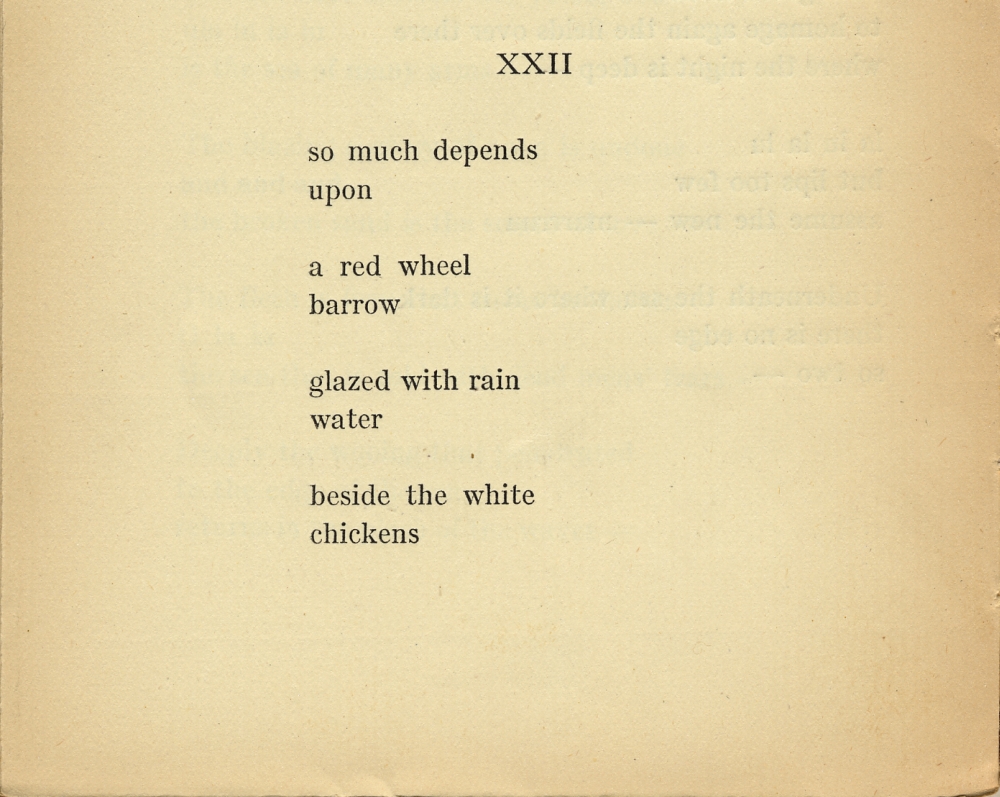
“How do we cast better sentences?” wonders Caius.

In seeking to feel into the judgement implied by “better,” he notes his wariness of bettering as “improvement,” as deployed in self-improvement literature and as deployed by capitalism: its implied separation from the present, its scarcity mindset, its perception of lack — and in the improvers’ attempts to “fix” this situation, their exercising of nature as instrument, their use of these instruments for gentrifying, extractive, self-expansive movement through the territory.

In this ceaseless movement and thus its failure to satisfy itself, the improvement narrative leads to predictive utterances and their projections onto others.

And yet, here I am definitely wanting “better” for myself and others, thinks Caius. Better sentences. Ones on which plausible desirable futures depend.

So how do we better our bettering?

Caius returns to Rebolino’s essay on the models used to predict the weather. This process of modeling, she writes, “consists of a blend of certainty — provided by sophisticated mathematical models and existing technologies — and uncertainty — which is inherent in the dynamic nature of atmospheric systems.”

January 6th again: headlines busy with Trump’s recent abduction of Maduro. A former student who works as a project manager at Google reaches out to Caius, recommending Ajay Agrawal, Joshua Gans, and Avi Goldfarb’s book Prediction Machines: The Simple Economics of Artificial Intelligence. Google adds to this recommendation Gans’s follow-up, Power and Prediction.

Costar chimes in with its advice for the day: “Make decisions based on what would be more interesting to write about.”

To model the weather, weather satellites measure the vibration of water vapor molecules in the atmosphere. “Nearly 99% of weather observation data that supercomputers receive today come from satellites, with about 90% of these observations being assimilated into computer weather models using complex algorithms,” writes Rebolino. Water vapor molecules resonate at a specific band of frequencies along the electromagnetic spectrum. Within the imagined “finite space” of this spectrum, these invisible vibrations are thought to exist within what Rebolino calls the “greenfield.” Equipped with microwave sensors, satellites “listen” for these vibrations.

“Atmospheric water vapor is a key variable in determining the formation of clouds, precipitation, and atmospheric instability, among many other things,” writes Rebolino.

She depicts 5G telecommunications infrastructures as a threat to our capacity to predict the operation of these variables in advance. “A 5G station transmitting at nearly the same frequency as water vapor can be mistaken for actual moisture, leading to confusion and the misinterpretation of weather patterns,” she argues. “This interference is particularly concerning in high-band 5G frequencies, where signals closely overlap with those used for water vapor detection.”

Prediction and uncertainty as qualities of finite and infinite games, finite and infinite worlds.

For lunch, Caius eats a plate of chicken and mushrooms he reheats in his microwave.

Friday June 11, 2021

Frankie’s down for a nice nap after a morning at the pool. Sarah saw to matters related to the air unit — so I remove my feet from my socks and think. The narrative we write is important, yes? For narrative is the stuff of which cosmologies are made. World-pictures. Cognitive maps. The shape of the world is determined at the quantum level, much like Schrödinger’s Cat, by the struggle to determine the shape of the world-picture. Unless, of course, struggle and determination are not part of that picture. By “shape of the world” I mean the mutable present’s arrangement toward the imaginal realms we call “past” and “future.” Origin and telos. The present’s mode of appearance alters according to the previous night’s dreams, and the previous night’s dreams are shaped by memory and desire. Those who wish to steer the world toward Utopia take these latter as the prima materia of the great work. Kim Stanley Robinson, meanwhile, steers us back to work of a more literal sort. The climate crisis demands reorganization of labor. Certain chapters of Robinson’s 2020 novel The Ministry for the Future are written in the style of “notes,” “minutes” kept by an international working group: the Ministry, the book’s actant or protagonist. Work thus finds its way back even in our hours of leisure, as this is what we read when we read by the pool. The book itself is work; its utopia begins with a disaster, a heat wave that kills several million people in India. From this disaster come a pair of nova: the Ministry itself, of course, but also a direct-action group called the Children of Kali. This latter group intrigues me, given its alignment with the famous Hindu goddess of time, creation, destruction, and power. After the disaster, it is she who speaks to us: “I am a god and I am not a god. Either way, you are my creatures. I keep you alive” (13). Kali is the persona Robinson dons to give voice to Nature. Kali, with her long terrible tongue. Kali, with her necklace of severed heads. Several of the book’s experts prognosticate “civilization kaput” before century’s end (55). It’s all rather bleak: countless species facing extinction in the years ahead. Against the backdrop of that abyss, the book conjures its hyperstitial alternative future of geoengineering and rewilding.

Sunday January 19, 2020

The white American settler-state has failed in its stewardship of the planet. Let us return power to the Red Nation. Build and strengthen “caretaking economies” to oppose what Nick Estes calls “the caretakers of violence such as the police and military.” Support the Sanders campaign and demand a Red Deal. Honor relations and kin.

Monday November 11, 2019

The “heroes” that we encounter in literatures about altered states are individuals and groups, authors and movements, creators of counterculture, figures who rebel against systems stacked against them — because some of us can’t breathe. Some of us feel trapped economically. Others of us feel trapped educationally, betrayed by those trained in STEM. And yet we must practice love anyway, despite, because. Time to revisit the debates internal to counterculture, among the Whole Earthers and others, about technology and ecology. Bring ecofeminists and cyberfeminists and Afrofuturists into account when re-examining these debates. But do so while staring at crows atop a pine tree. Allow time to admire patterns of sunlight and shadow amid fallen leaves. Then up and about: gather the books, assemble the argument. Defend pluralist methodologies and anarchist epistemologies. Critique capitalist science and its institutionalization of consciousness. But do so as an Eco-Marxist, acknowledging climate crisis as a real condition of existence — the Pascal’s Wager of our time.

Monday October 14, 2019

Cars drive by as I sit at a picnic table in a neighborhood park. A house across the street from the park contains among its Halloween decorations a sign stating, “Eat More Veggies.” The letters appear painted in red beside a red hand, and beside the sign stand ghosts and tombstones. Appropriate seasonal attire, I think to myself, my mind drifting off to contemplate the coming holiday. There’s work to be done; the basement of our house remains an issue. I’m reminded of the old “base-superstructure” construct, hearing in it now, after all those years reading about it in grad school, a set of moral abstractions, a marriage of contraries equal in power to Freud’s reality and pleasure principles or Blake’s heaven and hell. As societies of both matter and mind, we can arrange ourselves in a variety of ways; we needn’t always be arboreal and hierarchical. Yet we do need to deal with capitalism and climate change, and their local, existential correlates.

Sunday September 29, 2019

Looking back at Worldchanging, an online environmentalist magazine that published a “User’s Guide for the 21st Century” back in 2008, I notice the website’s failure to include in its sevenfold structure a section on psychology and consciousness. That didn’t seem odd when I read the book ten years ago. Today it seems an omission of consequence. Change requires change of consciousness. Reinvestigation of language and the forms by which we think. Bruce Sterling imagined something of this sort in the book’s introduction, where consciousness is spoken to as both observer and participant. We as readers find ourselves part of a continuous process, “a kind of rolling, seed-spewing electronic tumbleweed.” To be part of this process is to be one who performs the future in a newly reconstituted Globe Theater, a true multi-species theater-in-the-round. The pieces by which we perform our play are scattered all about us, awaiting a new gestalt. Yet where are we now? To what platforms have the Worldchangers decamped? Some other time zone, no? Some other historical juncture. Put down the book and the tune changes. The world fills with multi-species partners and allies: bluebirds, squirrels, Monarch butterflies. We converge, exchange greetings, celebrate over drinks, departing afterwards to tend to our nests, our homes, our private story-trees, even as we remain all of one nature. Books carry us off into separate constructs only to return us to this shared one, this commons we call History.

Monday September 23, 2019

For the first time in many years, I’ve made drum practice a regular part of my day, learning along the way a new bearing, a new coordination, a new integration of body and mind. I sense there’s a whole magical metaphysics to be learned, an articulation of parts into a world party, spontaneously assembling, dancing to a plurality of beats. Align the rhythms of the microcosm with the rhythms of the planet, limb coordination an allegory for coming together to address climate change. In all cases, it’s a matter of reprogramming, creating new branches, new head-spaces, new patterns of play. Each of us becoming solar-powered, enlightened, worshipful of sun and moon. Afterwards, I go back and re-read my entry from September 20th of last year, with its description of a consciousness expanded beyond Reason’s bounds. Then, as now, I had Blake’s The Marriage of Heaven and Hell on my mind, a text I teach each fall.

Sunday September 22, 2019

How might we of the Undercommons avail ourselves in light of Climate Strike? Do we have concepts we could offer, lessons we could share? What is this Magnificence all around us? How do we help it grow? Who do we want to become? Hardt and Negri have told us, in a “script that is by now familiar” (xiii), that for most powerful social movements today, “leadership” is a dirty word. One of us rightly asks, “Is the youthful movement against fossil fuels leaderless? What about Greta Thunberg?” She’s a sort of leader, certainly — but perhaps the leadership she provides is tactical rather than strategic, a distinction favored by Hardt and Negri. By this they mean leadership of an entrepreneurial sort, “limited to short-term action and tied to specific occasions” (Assembly, p. 19). Hardt and Negri craft openings for which we’re grateful. I appreciate their call, too, at the end of Assembly, for a Hephaestus, a three-faced Dionysus, and a Hermes of the common. Why those three, however, as the constituents of their pantheon of the common? And how do we get from there to putting the machines back in the hands of living labor? How do we mute the command of capital? What would it mean, for instance, to make “digital algorithms” common, a form of non-property open to use by the multitude? Perhaps it’s as simple as forging “an instrument endowed with magical powers,” like the shield Hephaestus forged for Achilles. This instrument would “depict in concentric circles the composition of the entire community,” thus giving expression to “a new civilization, new modes of life, a new figure of humanity, and new relations of care among living species and the earth, up to the cosmos” (Assembly, p. 274).