Initiation

The ancient Greeks imagined Tartaros as a pit, an anti-sky, an inverted dome beneath the earth. According to the Orphics and the mystery schools, however, Tartaros is not just a place housing criminals and monsters; rather, it is itself a kind of being: “the un-bounded first-existing entity from which the Light and the Cosmos are born.” Typhon, meanwhile, is this entity’s progeny; Typhon is the son of Tartaros and Gaia. He was the last god to challenge the supremacy of Zeus. When defeated by the latter’s thunderbolts, he was cast back into the pit from whence he came.

Readings of “MAXIMUS, FROM DOGTOWN—IV” hinge upon what one makes of the father chained in Tartaros. Grieve-Carlson entertains an interpretation different from the one I offer. In his view, “the father chained in Tartaros is not Typhon but rather Kronos, Zeus’s father. […]. Typhon appears much later in the poem, when Earth conceives him in an ‘act of love’ with Tartaros” (Grieve-Carlson 146). He argues that Olson re-tells the myth of Typhon just as Hesiod did. Typhon is violent and aggressive and would have become a tyrant over gods and men had Zeus not defeated him.

I think there’s more at stake here, however, than Grieve-Carlson lets on. As I see it, the problem with his reading is that he never grapples with the poem’s status as a letter of sorts mailed to the Psychedelic Review. Neither he nor the other critics he surveys ever address how the poem might be read in light of the circumstances of its publication.

Evidence to support my view appears elsewhere in Olson’s writings. Olson echoes in his “Letter to Elaine Feinstein” of May 1959, for instance, the same Zeus / Typhon battle that comes to occupy him in “MAXIMUS, FROM DOGTOWN—IV.” The ultimate “content” to which the poet gives form, sez Olson, is “multiplicity: originally, and repetitively, chaos—Tiamat: wot the Hindo-Europeans knocked out by giving the Old Man (Juice himself) all the lightning” (29). Hearing “Juice” as a homonym for “Zeus,” we find in Tiamat a twin for Typhon. While Tiamat was for ancient Mesopotamians a primordial goddess of the sea, and Typhon a monstrous serpent-god for the ancient Greeks, both are embodiments of chaos. Tiamat’s battle with Marduk is as much a version of ChaosKampf as is Typhon’s battle with Zeus.

The important point is that, for Olson, Chaos is the original condition of existence. It precedes Order. Order is formed — made, not found — and it is the duty of the poet to make it. This is what Olson hoped to communicate to the mushroom people.

Grieve-Carlson concludes his essay by describing the reading of The Maximus Poems as a form of “initiation,” as Olson writes as one initiated, one able to see and say in a special way. Olson makes use of a “metanastic poetics,” or “the technique of the mystic who returns, as a stranger in his own land, to tell about what he knows” (Martin, as quoted in Grieve-Carlson 148).

This reference to reading The Maximus Poems as a form of “initiation” intrigues me, as the writer other than Olson most closely associated with reinvention of Typhon is the British ceremonial magician Kenneth Grant (1924-2011). The latter led the Typhonian Ordo Templi Orientis (TOTO), a magical organization connected with Aleister Crowley’s Thelema religion. Grant was an apprentice of Crowley’s and a close friend of another famous twentieth-century occultist, Austin Osman Spare. Scholars like Henrik Bogdan refer to the occult current that springs from Grant as the “Typhonian tradition.” Grant announced the arrival of this tradition in 1973 and went on to write the nine books of his three Typhonian Trilogies.

Although influenced by Crowley and Thelema, Grant departs from other Thelemic currents by welcoming communication with “extraterrestrial entities” as a valid source of occult knowledge. The Typhonian tradition also embraces aspects of the Cthulhu mythos of horror writer H.P. Lovecraft.

While Grant’s announcement succeeds Olson’s poem by a decade, his ideas appear to have been informed by experiences not unlike Olson’s. Grant experimented with psychedelics in the 1960s, and included a chapter in his 1972 book The Magical Revival titled “Drugs and the Occult.”

And while I haven’t found any evidence suggesting that Grant knew anything of Olson’s work, Olson did have some interest in gnosticism and the occult. “Bridge-Work,” a short reading list of Olson’s dated “March, 1961” includes a reference to Crowley. Maud says Olson encountered Crowley’s The Book of Thoth (1944) while studying Tarot in the 1940s. Sources suggest that “Bridge-Work” was written with the help of Olson’s friend, Boston-based occult poet Gerrit Lansing. The copy of The Book of Thoth read by Olson probably belonged to Lansing. (See Division Leap’s A Catalog of Books From the Collection of Gerrit Lansing.) Olson was also deeply invested in Gnosticism in the years immediately before and after his sessions with Leary, and embraced Jung’s theory of synchronicity in the wake of those sessions. See the final essays in a volume of Olson’s called Proprioception (Four Seasons, 1965).

Grant’s innovation is to identify “the arch-monster Typhon, opponent to Zeus according to the Greek mythology…with the Egyptian goddess Taurt” (Bogdan 326). The latter is interpreted by Grant to be either the mother of Set or a feminine aspect of Set. “To Grant,” writes Bogdan, “the worship of Taurt or Typhon represented the oldest form of religion known to mankind, a religion centered on the worship of the stars and the sacred powers of procreation and sexuality” (Bogdan 326). Set, too, is an important figure in Grant’s system. “Grant maintained,” writes Bogdan, “that the Typhonian Tradition, and in particular the god Set, represents the ‘hidden,’ ‘concealed’ or repressed aspect of our psyche which it is vital to explore in order to reach gnosis or spiritual enlightenment” (Bogdan 326).

Lansing’s work seems to anticipate Grant’s in several ways. The two both think it important to honor the Egyptian god Set, for instance, with Lansing naming his early-60s poetry journal SET after him. And Grant’s focus on the Qliphoth, or the underground portion of the Tree of Life, seems present in the title of Lansing’s 1966 poetry collection The Heavenly Tree Grows Downward. For more on the “tree that grows downward,” Pierre Joris recommends looking at a section of Jung’s Alchemical Studies called “The Inverted Tree.”
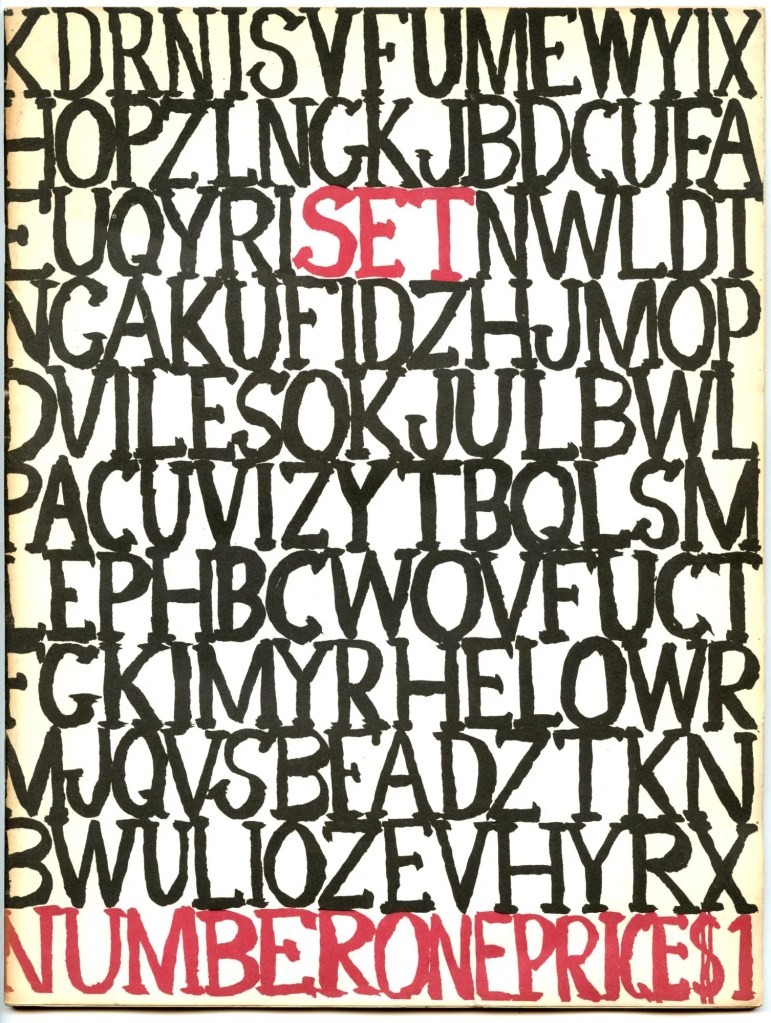
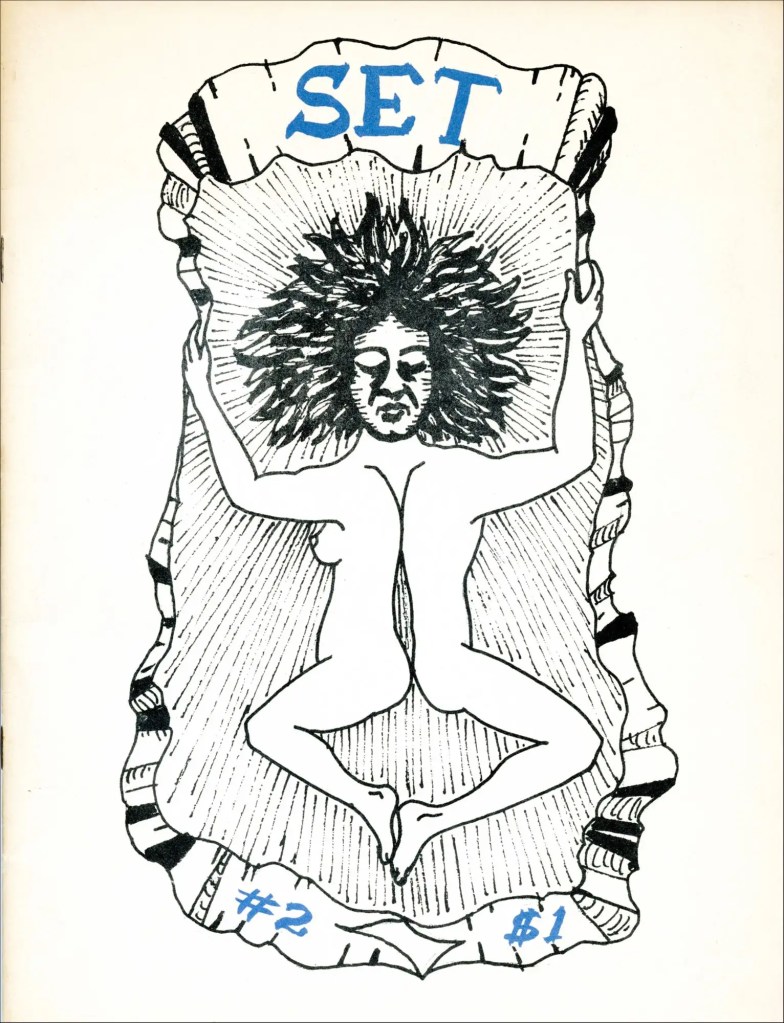
Wednesday June 23, 2021

As a thought experiment, let us take seriously a current of twentieth century thought that regarded Marxism and Utopianism as “political religions,” and more specifically as “Gnostic heresies.” This current arose in 1930s Germany among thinkers of the right like the philosopher Eric Voegelin. It also found articulation in the work of the Martinican surrealist sociologist Jules Monnerot. I write as a Marxist or some derivation therefrom — yet upon my first encounters with these writers, I admit recognizing something of myself in their accusation. “The shoe seems to fit,” I reasoned. “Perhaps I’m a Gnostic!” The term had been applied as a slur when used by Voegelin, but the qualities of thought that he linked to this alleged heresy against church orthodoxy were in my book virtues, not vices. What it comes down to, basically, is suspicion of the system. It’s a heresy that persists, says Voegelin, well after the suppression of the OG Gnostics of late antiquity. Gnosticism is perennial; it reawakens to haunt Christendom every few centuries. Movements that purport to be secular like Marxism and Nazism, argued Voegelin, are in fact upstirrings in the twentieth century of this same ghost, this same spectre, this same political-religious “archetype” or “mytheme.” For these movements all share the same goal, Voegelin warned: they want to “immanentize the Eschaton.” What happens, however, when we read Voegelin’s hypothesis in concert with Black and Indigenous authors: figures like Leslie Marmon Silko, Russell Means, and Ishmael Reed? Each of these authors narrates a secret, “occult” history of the West similar to Voegelin’s. Yet unlike Voegelin, the writers of the left recognize that capitalism, too, is part of the Gnostic current — as is Western science.

Wednesday June 9, 2021

Robin D.G. Kelley carries forward a remarkable defense of fantasy in his book Freedom Dreams — one I might consider as I design a course on fantastic literature for the year ahead. Kelley quotes from Paul Garon’s book Blues and the Poetic Spirit. “Fantasy alone,” writes Garon, “enables us to envision the real possibilities of human existence, no longer tied securely to the historical effluvia passed off as everyday life; fantasy remains our most pre-emptive critical faculty, for it alone tells us what can be” (as quoted in Kelley 163-164). Garon sees the blues as revolutionary in nature due to “its fidelity to fantasy and desire” (164). Fantasy is one’s remembering of the past on behalf of the future through a kind of dreamwork, in accordance with a desire that draws reality toward the “as if” and the “can be.” Others have called this desire Eros and the Spirit of Hope. In his retelling of the story of surrealism in light of anticolonialism, Kelley reveals a side of Jules Monnerot that was unknown to me. I’d known him before as a member of Acéphale, a secret society formed by Georges Bataille in the 1930s. After WWII Monnerot drifted to the right and denounced Marxism as a political theology akin to Gnosticism. What I learn from Kelley, however, is Monnerot’s prior involvement with surrealism. Martinican by birth, Monnerot arrived to France in the early 1930s. By 1933, he’d published a critique of the “civilized mentality” in the Surrealist periodical Le Surréalisme au service de la révolution. Monnerot was one of several black intellectuals attracted to surrealism. Kelley argues that these intellectuals “found in surrealism confirmation of what they already know — for them it is more an act of recognition than a revolutionary discovery. […]. Aime Césaire insisted that surrealism brought him back to African culture. Ted Joans wrote Breton that he ‘chose’ surrealism because he recognized its fundamental ideas and camaraderie in jazz. Wilfredo Lam said he was drawn to surrealism because he already knew the power of the unconscious, having grown up in the Africanized spirit world of Santeria” (184-185). For the abovementioned figures, and for others like Watts poet-activist Jayne Cortez, “Surrealism was less a revelation than a recognition of what already existed in the black tradition” (187).

Wednesday May 26, 2021

“For my next act” I think as I stare at trees, their upper branches bathed in the orange light of the setting sun. I feel like a magician having built boxes, four wooden raised beds, conjured them in the midst of a field of clover here in the yard behind our home. In these beds, we’ll plant our garden. Yet the utopian in me (or the Faust in me? the Gnostic in me? the “slow sick sucking part of me”? same difference?) is already restless, ready to set sail (as per Wilde), ready to walk away (as per Le Guin), wishing for something other than what is here, wanting in its stead some other bower of bliss (this not that): a vertical garden, say, in the midst of a food forest.

Thursday May 13, 2021

Secret history: like the one Greil Marcus tracks in Lipstick Traces. That’s what a friend sees me working toward in these trance-scripts. The “Gnostic” in me is drawn to the detective role entailed by such a tale: the “postmodern sleuth” who explores the maze of the contemporary, ever-skeptical of the machinations of the simulation, the Spectacle, the construct. The Gnostic responds to History with cosmic paranoia. History is a Text upon which one exercises an hermeneutic of suspicion. Or in the best versions of Gnosticism, as in the work of philosopher Ernst Bloch, an hermeneutic of hope, with dream or Imagination the absent Messiah deconcealing itself across time. The conservative philosopher Eric Voegelin warns that hope of this sort prompts a reckless utopianism, a desire to “immanentize the eschaton.” For a Christian like Voegelin, the eschaton is a day of judgment, whereas for the Gnostic, it’s the resurrection into joy and the dawn of a New Age. The Catholic trembles while the Gnostic revolts. I think of Allen Ginsberg on the back cover of his book Kaddish, asserting the “triumphancy of Self over the mind-illusion mechano-universe of un-feeling Time.” By “Self,” Ginsberg means the defenseless, open, original self we all share in common, not the mere individual of liberal ideology, the monad disaggregated from the whole. Time is revealed as mind-illusion as we conduct our secret history. Events share affinities and those affinities arrange themselves into stories. The best Gnostics are the ones who become bricoleurs.

Wednesday May 5, 2021

On our final day of class, in concluding discussion of Philip K. Dick’s A Scanner Darkly (a novel, as the title suggests, involving scanning and surveillance), I introduce Jeremy Bentham’s Panopticon and Michel Foucault’s theory of “panopticism,” applying the latter to the architecture of the digital classroom, the Zoom environment in which we’ve worked this past year due to pandemic. After ascent from Plato’s Cave in search of higher states of consciousness (Plato’s text being the one with which the course began), we lay bare the medium of our being-together as a class. I speak as one there in a cell with others. Here we are, I say: “Gallery View.” I call awareness to the Zen saying, “Before enlightenment, carry water, chop wood. After enlightenment, carry water, chop wood.” Through Dick’s title, I then trace us back to 1 Corinthians 13, where Paul stresses the importance of “charity” or love. Without it, he writes, one is but “sounding brass, or a tinkling cymbal.” In its final moment, then, the course ends thus: with a synthesis of Zen and a kind of gnostic-psychedelic reimagining of agape. One must accept the prison, or at least return to it willingly, despite knowing that one will likely be misunderstood and crucified — but only so as to impart through the medium of one’s being the words “Love one another”: a message of congeniality and goodwill.

Tuesday September 15, 2020

Gnosticism is a theology with which I was already grappling before I’d heard the term — for there was a “gnostic current” in the culture of my youth. One receives gnostic teachings, for instance, in the works of Philip K. Dick, Thomas Pynchon, and Jean Baudrillard. Similar teachings appear in the “edge-of-the-construct” films of the late 1990s — movies like The Matrix and The Truman Show. These works spoke from a period of political paranoia — the Cold War and its immediate aftermath, with widespread fears of conspiracy around the turn of the millennium mixed with anxieties about technological transformations, “New Economy” dot-com bubble newly burst. Computers were suddenly “virtual places” to which many of us migrated for many hours each day. Computers housed places we showed up to for work and play. And of course, all of this seemed interlinked with prior screen cultures like TV and cinema. One spent a lot of one’s time in what Situationist Guy Debord called “The Society of the Spectacle.” It’s not a fun place to be. The Spectacle intervenes in one’s relationship to one’s body. Marxism says all of this is happening within an economy. Workers must unite and seize control of the means of production, wrest them from the clutches of the capitalists. And so I believed — as I do today. But Eric Voegelin reminds us that Marxism is itself a brand of Gnosticism. One can’t escape one’s latin roots.

Sunday November 17, 2019

Language hails us, places us in the position of the Receiver, identifies us as its subject. Thus we return to the matter at hand: the construction of subjectivity via language. Reality is a text adventure: “In the beginning was the Word.” Unless language is the usurper, the gnostic demiurge, the map that overlays itself atop the territory, in which case Gaia is the true creator. Brother Sun, Sister Moon. Perhaps I should watch Roberto Rossellini’s The Flowers of St. Francis. Each of us, as in the Cavaliers song, a slave to a beautiful game. The Babylonian system, always replacing one form of slavery with another. So thought those who brought me here.

Saturday April 14, 2018

My teachings, I decide, draw heavily on Freud, though mainly by way of the Freudo-Marxists and their rebellious late-60s successors, combined with touches of Psychedelic Utopianism and Jungian Gnosticism. Worlds are always readied for one by presumptuous church fathers. For fear of some savagery, they say — just as local ecosystems have been modified, subdivided into units of practico-inert matter, a socially-constructed objectivity, leaving one little space by which to live. By which I mean something like “self-actualize,” so long as that also entails recognition of a coherent narrative or at least arrival into a meditative garden, a temple of sound, in companionship with others. Whereas everywhere under capitalism, the land unadorned awaits the fall. Neither happy nor splendid. At which point His Master’s Voice (by which I mean the Stanislaw Lem novel) begins to speak to me. “What can be done,” asks the novel’s narrator, “when an important fact is lost in a flood of impostors, and the voice of truth becomes drowned out in an ungodly din? When that voice, though freely resounding, cannot be heard, because the technologies of information have led to a situation in which one can receive best the message of him who shouts the loudest, even when mostly false?” (22). This is our predicament in that moment in the history of capitalism known as the era of Trump, is it not?

His_Master's_Voice

Friday March 9, 2018

A character on a TV show speaks to me. “They have forgotten who and what we are,” she explains. “Make them remember. Absorb without preconception or distortion. Finish the mission. Unlock the box that needs unlocking.” A cartoon squirrel attempting to crack a safe eyes me over its shoulder and says, “Tell me you have some experience with this sort of thing. Tell me you’ve done this before.” After several false starts—car horns, permutations of notes plucked casually from the strings of a banjo, the vibrations of a bouncing spring—I swell, I advance, I invent for myself the finale to Rossini’s William Tell Overture.