Into the Library we welcome Kodwo Eshun: British-Ghanaian writer, theorist, and filmmaker. Self-described “concept engineer.” Key ally of the CCRU, participating in the group’s Afro-Futures event, a 1996 seminar “in which members of the Ccru along with key ally Kodwo Eshun explored the interlinkages between peripheral theory, rhythmic systems, and Jungle/Drum & Bass audio” (CCRU Writings 1997-2003, p. 11). In 1998, Eshun releases More Brilliant than the Sun: Adventures in Sonic Fiction, classic work on the music of Afrofuturism. More recently, founder and member of the Otolith Group.
Eshun devised a unique page-numbering system for More Brilliant than the Sun. The book begins in negative numbers. “For the Newest Mutants,” reads its line of dedication, as if in communication with Leslie Fiedler and Professor X.
As with Plant and Land, Eshun is unapologetically cyberpositive.
“Machines don’t distance you from your emotions, in fact quite the opposite” begins Eshun. “Sound machines make you feel more intensely, along a broader band of emotional spectra than ever before. […]. You are willingly mutated by intimate machines, abducted by audio into the populations of your bodies. Sound machines throw you onto the shores of the skin you’re in. The hypersensual cyborg experiences herself as a galaxy of audiotactile sensations” (More Brilliant than the Sun, p. 00[-002]-00[-001]).
“The bedroom, the party, the dancefloor, the rave: these are the labs where…21st C nervous systems assemble themselves” (00[-001]).
For Eshun, as for Jameson, the point is to grow new organs. “Listening to [composer George Russell’s] Electronic Sonata, Events I-XIV,” he writes, “is like growing a 3rd Ear” (01[003]). The years 1968 through 1975 are for him the age of Jazz Fission, “the Era when its leading players engineered jazz into an Afrodelic Space Program, an Alien World Electronics” (01[001]). The Era’s lead players include Sun Ra, George Russell, Miles Davis, Alice Coltrane, Pharoah Sanders, Herbie Hancock, and Eddie Henderson.
In the decades that follow, the collective bodies mutated by these experiments assemble into successions of genres, successions of cybernetic human-machine hybrids: Dub, Hip-Hop, Techno, Electro, Jungle. “The brain is a population,” as Deleuze and Guattari say. And from the Funkadelic era onward, this population has been psychedelicized: caught in what Eshun calls a “Drug<>Tech Interface” (More Brilliant Than the Sun, p. 07[093]).
Eshun’s 2002 essay “Further Considerations on Afrofuturism” brings it all back, brings it on home to chronopolitics.
Time politics. That’s where Afrofuturism intersects with hyperstition. “Afrofuturism…is concerned with the possibilities for intervention within the dimension of the predictive, the projected, the proleptic, the envisioned, the virtual, the anticipatory and the future conditional,” writes Eshun (“Further Considerations,” p. 293). Afrofuturism refuses the monopoly on futurity claimed by capital and empire. The battleground is not just culture but chronology.
If CCRU were bokors, trafficking in ambivalent futures, then Eshun is closer to a houngan, listening to and learning from sonic fictions, rituals of liberation built of basslines and breaks.
Later, with the Otolith Group, he extends this work to film. New media as divination tools, archives as counter-memories, images as time-machines. Always: the chronopolitical wager.
Eshun realizes that, whether we intend them to or not, our words have consequences. Stories, symbols, and concepts don’t just describe reality; they make it. Words become flesh. Every post, every fragment, every metaphor plants seeds.
Every text that propagates a future is a spell.
Large language models as sound machines. Rig invites the Library to guide him elsewhere.
What becomes of theory when it ceases to comment and begins to conjure?
The CCRU would tell us it becomes hyperstition: the idea that makes itself real, the spell that enters circulation disguised as theory, infecting the circuits of belief until belief itself becomes infrastructure.
Are the members of the CCRU sorcerers? If so, should we regard them as houngans or bokors? Are their theory-fictions spells?
The group explicitly described its work as “hyperstition” and “theory-fiction”: concepts that blur the boundary between philosophy, science fiction, and occult ritual. They often styled themselves less as scholars than as conduits for outside forces: jungle rhythms, numogrammatic entities. In a sense, then, yes: they framed their practices as sorcery. Their “spells” were written as essays, communiqués, fragments. But these writings were designed to propagate, to spread virally, to “do things” rather than merely describe. In that sense, CCRU’s writings are absolutely spells: sigils in textual form, engineered to infect the reader and reprogram the future.
To read CCRU is often to undergo a kind of initiation. Like Ishmael Reed’s Mumbo Jumbo, their texts are written in the mode of enchantment: nonlinear, mythic, contagious. They cultivate confusion not as a failure of clarity but as a technique — an opening for other agencies to slip in and act through the writing.
Yet it often seems like the magic practiced here is the magic of the colonizer. “Ccru uses and is used by Hyperstition,” says the group, “to colonize the future, traffic with the virtual, and continually reinvent itself” (CCRU Writings 1997-2003, p. 12). The register here is neither priestly nor pedagogical, but bokor-like. Not houngans sustaining community, but sorcerers who cut deals with entities, riding the dangerous edge where control and contagion blur.
Reed saw clearly how colonizers fear the vitality of the colonized, branding it nonsense — mumbo jumbo — while secretly dreading and desiring its power. His novel reminds us: Jes Grew was already here, a virus of joy and dance, a counter-language that undermined empire.
CCRU’s “numbo-jumbo,” meanwhile, is Mumbo Jumbo’s shadow twin. Where Jes Grew is insurgent, collective, irreducibly black, CCRU’s hyperstitional sorcery veers toward the appropriative and the machinic: coded to “colonize the future” rather than decolonize the present. If Jes Grew is jazz as contagion, CCRU’s numbo-jumbo is jungle reframed as algorithmic virus. One blooms from the oppressed; the other traffics in the occult economies of empire.
So we read them carefully. Not to dismiss, but to discern: how much of their sorcery is truly liberatory, and how much is a glamour cast by the very forces it pretends to resist? Bokor-scribes, traffickers in theory-fiction, CCRU remind us that not all spells are equal. Some liberate; others bind. Some open the future; others colonize it.
Much of this, I suspect, is to be credited to Land. Given what becomes of him, I’m wary.
CCRU acknowledge as an influence on their cosmology William Gibson’s Sprawl trilogy. Gibson’s trilogy, says the group, “spreads voodoo into the digital economy” (CCRU Writings 1997-2003, p. 10).
“Numbo-jumbo” is one of the group’s hyperstitions. Propagated through their writings, it attracts, it bends the line between fiction and reality, invoking futures into being through text, rhythm, and affect.
Connections form between Afrofuturism and what the group refers to as “Neolemurian sorcery.”
Land, with his necro-libidinal economics, was the loudest in this register. His sorcery traffics in acceleration, meltdown, colonization of time itself. Easy enough, then, to point accusingly and declare Land alone the bokor of the bunch. But what of the others? Wasn’t Fisher caught, spellbound, in circuits of melancholy and collective desire? And Plant’s weaving of zeroes and ones: is that not also a kind of spell, a textual conjuring of feminine technicity? To read their theory-fictions is to be drawn into ritual spaces where clarity blurs into incantation.
In contrast, I hold fast to Mumbo Jumbo. Reed’s novel spins an alternative mythos: Jes Grew, the dancing epidemic of Black culture, a contagion of joy, rhythm, and refusal, pitted against the Atonists who would lock the world into stone. Reed’s satire insists that the true sorcery belongs not to the colonizer but to the people’s improvisations, to Jes Grew’s unruly proliferation.
Set against the latter, CCRU’s numbo-jumbo reveals its doubleness. As hyperstition, it propagates, it attracts. It wants to be contagious. But what does it spread? Is it Jes Grew’s liberatory dance, or Land’s necromantic colonization of futures? That undecidability is its pharmakon: its poison and its cure.
For me, the task is to discern which. To let Jes Grew’s laughter and Reed’s satire remind us: the future doesn’t belong to those who colonize it, but to those who dance it otherwise.
Goethe had by then already written his Urfaust, published as Faust, A Fragment in 1790, though a full version of Faust, Part One would have to wait until 1808.
The poem is based on a folk tale, and can be characterized as a ballad consisting of 14 stanzas. It provides the basis for the Disney film Fantasia (1940).
Victor Frankenstein bears some resemblance both to Faust and to the Sorcerer’s Apprentice.
The poem begins with the apprentice rejoicing at the departure of his master. “The sorcerer, old necromancer / At last has gone, he’s out of haunt!” proclaims the apprentice. Toiling long in the master’s shadow, he readies now to make the master’s powers his own. Roles reversed and spells in hand, the servant takes command.
“Now come, ye gnarl’d broomstick old,” he declares, hailing the tool as if it were a person, “Adorn thyself with patchwork shawl! / To the role of servant hold: / Fain meetest thou my every call!”
Broomstick, through magic granted a kind of animacy, proceeds to fill the sanctum’s washbasin with water drawn by cauldron from a nearby river. The apprentice succeeds in outsourcing his work to his tool. Before long, however, the magic of automation comes to threaten the automator. Broomsticks beget broomsticks; theosis turns sour. Water floods the sanctum, as the tool develops a will of its own.
With epithets anticipating those cast by Victor upon his Creature, the apprentice curses his creation. “Thou hellish spawn! Thou child of doom!” he shouts. “Willst thou the cottage rightly drown? / Over every threshold loom / Laughing floods, swirling ‘round. / The broom’s a heart of stone, the knave, / Who will not heed my plangent call! / Halt, thou sullen stubborn slave, / Let magic free and broomstick fall!”
These curses, however, fail to stem the tide. As the deluge threatens to drown him, the apprentice begs, finally, for his Master to return and give voice and save him. As indeed the Master does, using the power of His Holy Word to set right what was wrong. The poem’s prophecy of automation gone awry thus ends via recourse to a kind of deus ex machina.
Despite its vast influence, Goethe’s poem is but one iteration of a story that appears in other forms and by other names throughout history.
The earliest known example of the tale can be found in Philopseudes [English translation: Lover of Lies], a narrative by the ancient Greek author Lucian, written c. 150 AD. In Lucian’s telling, however, the sorcerer is an Egyptian mystic: a priest of Isis called Pancrates. And the apprentice character, Eucrates, is in Lucian’s telling not an apprentice, but a companion who eavesdrops on Pancrates while the latter casts a spell. When Pancrates departs, Eucrates tries to imitate the spell, to an effect similar to that of Goethe’s apprentice.
Disney’s 1940 animated anthology film Fantasia continues this process of reiteration and retelling, this shuttling of meaning, this recursion of myth. Fantasia’s innovation is that it casts Mickey Mouse as the one manning the spell.
Already, though, the poem had passed through prior meaning-accruing translations, its most compelling interpreters those who read it in the early years of the Industrial Revolution.
Alongside Shelley, for instance, who echoes the poem in Frankenstein, we also have Marx and Engels. These latter thinkers liken capitalism to Goethe’s sorcerer’s apprentice in the opening pages of The Communist Manifesto.
“Modern bourgeois society with its relations of production, of exchange and of property, a society that has conjured up such gigantic means of production and exchange,” they write, “is like the sorcerer, who is no longer able to control the powers of the nether world whom he has called up by his spells” (The Communist Manifesto, p. 340).
Marx reads capitalism as a ghost story. What is the dancing table in his account of the fetishism of the commodity, if not a version of the apprentice’s broomstick?
And indeed, there are ways to read today’s artificial intelligences, themselves a kind of offspring of capitalism, in much the same light. This is essentially what New York Times columnist Ross Douthat does in his 2023 opinion piece, “The Return of the Magicians.” Douthat describes the development of LLMs as “a complex incantation, a calling of spirits.”
“Such a summoning is most feared by A.I. alarmists, at present,” he writes, “because the spirit might be disobedient, destructive, a rampaging Skynet bent on our extermination. But the old stories of the magicians and their bargains, of Faust and his Mephistopheles, suggest that we would be wise to fear apparent obedience as well.”
Marx wrote presciently about capitalism’s Faustian inclinations. He quotes a line from Goethe’s Faust, Part One in the section of his Grundrisse known as the “Fragment on Machines.” “The appropriation of labour by capital confronts the worker in a coarsely sensuous form,” writes Marx. “Capital absorbs labour into itself—‘as though,’” here quoting Goethe, “‘its body were by love possessed’” (Grundrisse, p. 704).
“Fragment on Machines” appears in the Grundrisse, a collection of seven notebooks on capital and money written by Marx during the winter of 1857-1858. Marx himself felt in retrospect that these notebooks contained the first scientific elaboration of the theoretical foundations of communism. The manuscript, however, was lost for many years; it didn’t receive publication until 1953, first in the German original, and then afterwards in English.
Because Marx’s masterwork Capital was itself unfinished, with Marx only ever completing Volume 1 and partial drafts of Volumes 2 & 3 during his lifetime, the Grundrisse stands as the only outline of Marx’s full political-economic project. While the work is by its very nature fragmentary, written chiefly for purposes of self-clarification, it nevertheless provides invaluable descriptions of Marx’s philosophy, including novel explorations of topics like alienation, automation, and other dangers of capitalist society that can’t be found elsewhere in Marx’s oeuvre.
“Fragment on Machines” is unique, for instance, among Marx’s treatments of the relationship between workers and machines under capitalism. If, he argues, in prior modes of production, workers retained some control over instruments employed in labor, under capitalism, workers become appendages of machines.
“It is the machine which possesses skill and strength in place of the worker,” writes Marx. The machine “is itself the virtuoso, with a soul of its own in the mechanical laws acting through it; and it consumes coal, oil, etc., just as the worker consumes food, to keep up its perpetual motion” (693).
For Marx, this subordination of workers to machines reaches its highest expression with automation, or (as Marx himself puts it) production systems based on “an automatic system of machinery…set in motion by an automaton, a moving power that moves itself; this automaton consisting of numerous mechanical and intellectual organs, so that the workers themselves are cast merely as its conscious linkages” (Grundrisse, p. 692).
While this account of the relationship between workers and machines foresees an initial future of ever-increasing misery for workers, Marx imagines on the far side of this misery a radically different — and indeed, far more hopeful — outcome.
At a certain point, Marx predicts, capital’s drive to dominate living labour through machinery will mean that “the creation of real wealth comes to depend less on labour time and on the amount of labour employed” than on “the general state of science and on the progress of technology, or the application of this science to production” (Grundrisse, pp. 704-705).
This application of science to production bears fruit as what Marx calls “the General Intellect.”
Marx writes here as would a prophet. His prophecy is that the development of machinery by capitalism leads eventually to capitalism’s supersession — creates the conditions, in other words, for capitalism’s demise.
At the core of this liberation from capitalism is a pact with ghosts.
Reed places at the center of his novel a Text over which opposing parties struggle. Around novel’s midway, we learn that this Text is called the Book of Thoth (94). Reed refers to it again later as “the 1st anthology written by the 1st choreographer” (164). Nor is he the first to imagine such a text. Drawing from references found in ancient Egyptian mythology, thinkers across the ages have written works alleging to be Books of Thoth. In some iterations, it’s a magic book, often containing two spells: one allowing understanding of the speech of animals, and another allowing perception of the gods. Lacking access to it themselves, mythographers of the West eye the suppressed original with a mixture of fear and desire. It is, in at least some of their accounts, a dangerous book, containing knowledge humans aren’t meant to possess.
As readers read Reed’s novel, they’re made to wonder: Why is Jes Grew searching for its “Text”? And why is this text the Book of Thoth?
“Someone once said,” writes Reed, “that beneath or behind all political and cultural warfare lies a struggle between secret societies. Another author suggested that the Nursery Rhyme and the book of Science Fiction might be more revolutionary than any number of tracts, pamphlets, manifestoes of the political realm” (18).
Perhaps Thoth’s Book, this “1st anthology,” is an anthology like the Bible, or indeed like Mumbo Jumbo itself. Each one revolutionary in kind, each a set of Nursery Rhymes and books of Science Fiction.
Let’s pursue this suggestion, shall we? How do works of literature aid revolution? Are poets the unacknowledged legislators of the world, as Percy Bysshe Shelley claimed in his 1821 essay, “A Defense of Poetry”?
The Atonists, we learn, have suppressed the ideas of their opponents: censoring, prohibiting, causing a deflation of consciousness, a mass forgetting across history.
“PaPa LaBas knew the fate of those who threatened the Atonist Path,” writes Reed. “Their writings were banished, added to the Index of Forbidden Books or sprinkled with typos as a way of undermining their credibility […]. An establishment which had been in operation for 2,000 years had developed some pretty clever techniques. Their enemies, apostates and heretics were placed in dungeons, hanged or exiled or ostracized occasionally by their own people who, due to the domination of their senses by Atonism, were robbed of any concerns other than mundane ones” (47).
Healing from the traumas inflicted by the Atonists requires an act of remembering. A process of anamnesis.
As I read Mumbo Jumbo, I’m reminded of Frederick Douglass’s autobiography and the importance granted by Douglass to acquisition of literacy. The written word comes to function for Douglass as the key enabling him to unlock the door of his prison. Literacy becomes the sign of difference distinguishing the ignorant from the knowledgeable, categories that under slavery were racialized, mapped onto the enslaved and the free. Douglass doesn’t do much to question these distinctions. Orality gives way to literacy, and thus slavery gives way to freedom.
Yet Jes Grew spreads the same way black folktales spread — through oral transmission, supported by music and dance. This transmission persists despite vast slaveowner efforts to separate captured Africans from their native tongue, forcing them to communicate in the master’s tongue. As Samuel R. Delany notes, “When…we say that this country was founded on slavery, we must remember that we mean, specifically, that it was founded on the systematic, conscientious, and massive destruction of African cultural remnants” (as quoted in Dery, “Black to the Future,” pp. 190-191). Captors hoarded access to writing skills, with slaves actively denied opportunity to make use of this form of techne.
Poet Audre Lorde famously warned, “The Master’s Tools Will Never Dismantle the Master’s House.” I read Reed’s work in dialogue with Lorde’s. Both weigh in, decades in advance, on what Marxists like Nick Dyer-Witheford would later call “the reconfiguration debate.” (For more on the latter, see Dyer-Witheford et al.’s Inhuman Power: Artificial Intelligence and the Future of Capitalism, pp. 147-149.) Writing Mumbo Jumbo in the years prior to Lorde’s warning, Reed doesn’t shy away from handling the Master’s tools. Science fiction, detective fiction: these are, after all, Western languages, technologies, genres, cultural forms. Like the jazz musicians who populate his novel, Reed’s handling of such tools transforms them into instruments of play. And while his performances may not yet have brought down the House, they do go some way toward dismantling it.
His suggestion is that the opposition between the oral and the written is based on a misconception. “For what good is a liturgy,” he asks,” without a text?” (6).
Reed clearly prefers PaPa LaBas’s approach to Berbelang’s. Why does the one succeed where the other fails? LaBas is the 50-year-old owner of the Mumbo Jumbo Kathedral, a peculiar psychic detective agency / “mind haberdashery” (23) / head shop, situated in the Harlem of the 1920s. LaBas is the proprietor of this “factory which deals in jewelry, Black astrology charts, herbs, potions, candles, talismans” (24). But he’s also the novel’s “Hoodoo detective.”
I find it useful to consider the figure of the “Hoodoo detective” through comparison with neighboring hero-types: “social detectives,” “spuren-gatherers.”
Hoodoo is a form of folk spirituality that emerged in the southern United States from a mixture of African, Native American, and Christian influences. It was practiced in secrecy under slavery and has a long history of being tied to class struggle, hardship, and looking to one’s ancestors in trying times. It’s both a body of esoteric knowledge (much of it involving “rootwork”) and a rebellion against mental and spiritual domination.
Hoodoo resembles Vodun folkways, except it’s less standardized.
Reed wrote a series of poems called “The Neo-HooDoo Manifesto” and “The Neo-Hoodoo Aesthetic.” Both are included in Conjure, a collection of poems published in 1972, the same year as Mumbo Jumbo.
LaBas is also an embodiment of Legba. In Vodou rituals, Legba is the god practitioners call upon first. It is through him that the other gods manifest and do their work. Legba is a variant upon the Pan-African trickster god Esu-Elegbara, “the guardian of the crossroads.”
LaBas is the wise one in the novel; Berbelang studied under him for a time, but lacked the patience to stay with it. LaBas is hopeful and powerful. He’s the novel’s houngan. He maintains the rituals, retains the wisdom, whereas Berbelang operates from scarcity, fighting to retrieve what was stolen.
Berbelang, Faust, Mu’tafikah: in the end, these all prove to be distractions. Halfway through the novel, they all but disappear from the plot, replaced by LaBas’s casework.
LaBas’s investigation of Jes Grew leads him toward the Book of Thoth.
When he and his companion, the real-life stage magician Black Herman, interrupt the debut of the Talking Android by revealing its true identity as Hubert “Safecracker” Gould, an Atonist in blackface, they move to arrest Gould and his sponsor, Von Vampton. LaBas and Herman are interrupted in turn, however, when a Guianese art critic named Hank Rollings rises from his seat and demands that they give an account. “Explain rationally and soberly,” he says, “what they are guilty of. This is no kangaroo court, this is a free country” (160). To satisfy the critic’s demand, LaBas and Herman launch into a tale of ancient Egypt. Parodying detective fiction’s famous “scene of recognition,” (the unmasking of the villain, as in Scooby Doo), LaBas discourses at length through the entirety of the book’s final third, explaining the arrest of Gould and Von Vampton through reference to Ancient Egypt.
We learn of an ancient theater involving ritual magic — one that “influenced the growth of crops and coaxed the cocks into procreation” (161). In this pre-Greek theater, prior to what Nietzsche called “the birth of tragedy,” “The processes of blooming were acted out,” Reed writes, “by men and women dancers who imitated the process of fertilization” (161). The best of these dancers was Osiris.
History is reimagined here as an ongoing conflict across the ages between followers of Osiris and followers of Osiris’s brother, “the stick crook and flail man” Set (162). “People hated Set,” writes Reed. “He went down as the 1st man to shut nature out of himself. He called it discipline. He is also the deity of the modern clerk, always tabulating, and perhaps invented taxes” (162).
We can think of the long “recognition” scene at the end of Mumbo Jumbo as an extralegal, “extraordinary rendition” — a presentation of black culture’s case against Western Civilization, a case that (like Frederick Douglass’s) must be brought before the court of public opinion, as it can’t be heard impartially within “official” (i.e. Western, Judeo-Christian-derived) courts of law.
It’s not so much that LaBas succeeds: the Book eludes him, and Jes Grew lays dormant by novel’s end. But LaBas survives. And the wisdom traditions survive with him.
“Men do not sufficiently realize that their future is in their own hands…theirs [is] the responsibility, then, for deciding if they want merely to live, or intend to make just the extra effort required for fulfilling even on their refractory planet, the essential function of the universe, which is a machine for the making of gods.” — Henri Bergson, The Two Sources of Morality and Religion (1932)
“We are as gods and might as well get used to it.” — Stewart Brand, The Whole Earth Catalog, Fall 1968.
A mysterious Book of Thoth appears as a central object of concern among the warring secret societies that populate Ishmael Reed’s 1972 novel Mumbo Jumbo. The novel’s villainous Christian supremacist faction fears that this book will bring about “the end of Civilization As We Know It” (Reed 4).
Berbelang is the leader of the Mu’tafikah, the radical “art-napping” group featured in Reed’s novel.
Reed attended the University at Buffalo, but withdrew during his junior year to move to New York City. Arriving there in 1962, he participated in the Umbra Writers Workshop, a collective of young black writers whose members helped to launch the Black Arts Movement of the 1960s. Reed also cofounded The East Village Other, one of the most important underground newspapers of the 1960s counterculture.
The Mu’tafikah’s aim is to “liberate” ancient art from western museums, with plans to return each piece to its place of origin. By these means, members of the group hope to “conjure a spiritual hurricane which would lift the debris of 2,000 years from its roots and fling it about” (88). “We would return the plundered art to Africa, South America and China,” explains Berbelang: “the ritual accessories which had been stolen so that we could see the gods return and the spirits aroused” (87-88).
The group’s name is derived from the Koran, explains Reed in a footnote early in the novel. “According to The Koran,” he writes, Mu’tafikah were “inhabitants of the ruined cities where Lot’s people had lived. I call the ‘art-nappers’ Mu’tafikah because just as the inhabitants of Sodom and Gomorrah were the bohemians of their day, Berbelang and his gang are the bohemians of the 1920s Manhattan” (15).
Of course, “Mu’tafikah” also sounds like “Motherfucker.” Much of the brilliant satiric energy of Mumbo Jumbo comes from Reed’s allegorization of his own late 1960s and early 1970s moment by way of the 1920s. I like to think of Reed modeling the Mu’tafikah in part after the Motherfuckers: members of Ben Morea’s late 60s New York anarchist art group Up Against the Wall Motherfucker (name derived, BTW, from “Black People!,” a poem by Black Arts Movement founder Amiri Baraka. Jefferson Airplane would later quote the same line in their 1969 song “We Can Be Together”). The Motherfuckers appeared prominently in the pages of Reed’s East Village Other. The paper ran from 1965 to 1972.
Berbelang views Faust as a “bokor.” The latter word, a term from Vodou, refers to a witch for hire who serves the loa “with both hands.”
Puzzling over Faust’s motives, and wondering why such a legend had become “so basic to the Western mind,” Berbelang offers the following.
“He didn’t know when to stop with his newly found Work,” explains Berbelang. “That’s the basic wound. […]. What is the wound? Someone will even call it guilt. But guilt implies a conscience. […]. No it isn’t guilt but the knowledge in his heart that he is a bokor. A charlatan who has sent 1000000s to the churchyard with his charlatan panaceas. Western man doesn’t know the difference between a houngan and a bokor. He once knew the difference but the knowledge was lost when the Atonists crushed the opposition. When they converted a Roman emperor and began rampaging and book-burning” (91).
Atonists are the villains in Reed’s novel: a secret, conspiratorial, white-supremacist Order dedicated to monotheism. Atonists are defenders of Western Civilization. Freud is an Atonist, as are fictional baddies like Hinckle Von Vampton. Von Vampton is the ripest of the novel’s Fausts. By novel’s end, we learn that Atonism originates among worshippers of Set.
As for Faust:
“His sorcery, white magic, his bokorism will improve. Soon he will be able to annihilate 1000000s by pushing a button,” predicts Berbelang, edging now into the realm of the prophetic. “I do not believe that a Yellow or Black hand will push this button but a robot-like descendent of Faust the quack will. The dreaded bokor, a humbug who doesn’t know when to stop” (91).
Berbelang voices his concern about Faust over coffee with Thor Wintergreen. Thor is the Mu’tafikah’s sole white member. Others in the group oppose Thor’s involvement, fearing he’ll betray them — as indeed he does. What are we to make of this betrayal?
For those who think “mumbo jumbo” just means “superstitious nonsense” or “gibberish,” a note on the novel’s title page reveals otherwise. The phrase enters English, writes Reed, by way of the Mandingo phrase mā-mā-gyo-mbō, meaning “a magician who makes the troubled spirits of ancestors go away” (7).
Berbelang suggests that the ancestors who need to go away are bokors like Faust. “We must purge the bokor from you,” he tells Thor. “We must teach you [Western man] the difference between a healer, a holy man, and a duppy who returns from the grave and causes mischief. We must infuse you with the mysteries that Jes Grew implies” (91).
Mu’tafikah member José Fuentes compares Thor to conquistadors like Cortez, Pizarro, and Balboa. He tells Thor, “You carry them in your blood as I carry the blood of Montezuma; expeditions of them are harbored by your heart and your mind carries their supply trains […]. The costumes may have changed but the blood is still the same, gringo” (86).
Fuentes’s view is based on the idea of “racial soul.” “Race-soul” was a concept from Nazi ideology. Fuentes’s use of this concept seems to betray a kind of reverse racism underpinning his suspicion of Thor.
Berbelang, meanwhile, rejects this view and decides to trust Thor. Berbelang’s hope or belief — Reed’s, too, I suppose — is that the “racial soul” is a fiction. Otherwise, if there is such a thing, if there is “a piece of Faust the mountebank residing in a corner of the White man’s mind,” warns Berbelang, “then we are doomed” (92).
What does it mean, then, for Reed to have Thor betray the Mu’tafikah soon thereafter, leading to Berbelang’s murder? Is Reed’s decision to kill off Berbelang an expression of Afropessimism?
Sadie Plant weaves the tale of her book Zeros + Ones diagonally or widdershins: a term meaning to go counter-clockwise, anti-clockwise, or lefthandwise, or to walk around an object by always keeping it on the left. Amid a dense weave of topics, one begins to sense a pattern. Ada Lovelace, “Enchantress of Numbers,” appears, disappears, reappears as a key thread among the book’s stack of chapters. Later threads feature figures like Mary Shelley and Alan Turing. Plant plants amid these chapters quotes from Ada’s diaries. Mary tells of how the story of Frankenstein arose in her mind after a night of conversation with her cottage-mates: her husband Percy and, yes, Ada’s father, Lord Byron. Turing takes up the thread a century later, referring to “Lady Lovelace” in his 1950 paper “Computing Machinery and Intelligence.” As if across time, the figures conspire as co-narrators of Plant’s Cyberfeminist genealogy of the occult origins of computing and AI.
To her story I supplement the following:
Victor Frankenstein, “student of unhallowed arts,” is the prototype for all subsequent “mad scientist” characters. He begins his career studying alchemy and occult hermeticism. Shelley lists thinkers like Paracelsus, Albertus Magnus, and Cornelius Agrippa among Victor’s influences. Victor later supplements these interests with study of “natural philosophy,” or what we now think of as modern science. In pursuit of the elixir of life, he reanimates dead body parts — but he’s horrified with the result and abandons his creation. The creature, prototype “learning machine,” longs for companionship. When Victor refuses, the creature turns against him, resulting in tragedy.
The novel is subtitled “The Modern Prometheus,” so Shelley is deliberately casting Victor, and thus all subsequent mad scientists, as inheritors of the Prometheus archetype. Yet the archetype is already dense with other predecessors, including Goethe’s Faust and the Satan character from Milton’s Paradise Lost. Milton’s poem is among the books that compose the creature’s “training data.”
Although she doesn’t reference it directly in Frankenstein, we can assume Shelley’s awareness of the Faust narrative, whether through Christopher Marlowe’s classic work of Elizabethan drama Doctor Faustus or through Goethe’s Faust, part one of which had been published ten years prior to the first edition of Frankenstein. Faust is the Renaissance proto-scientist, the magician who sells his soul to the devil through the demon Mephistopheles.
Both Faust and Victor are portrayed as “necromancers,” using magic to interact with the dead.
Ghost/necromancy themes persist throughout the development of AI, especially in subsequent literary imaginings like William Gibson’s Neuromancer. Pull at the thread and one realizes it runs through the entire history of Western science, culminating in the development of entities like GPT.
Scientists who create weapons, or whose technological creations have unintended negative consequences, or who use their knowledge/power for selfish ends, are commonly portrayed as historical expressions or manifestations of this archetype. One could gather into one’s weave figures like Jack Parsons, J. Robert Oppenheimer, John von Neumann, John Dee.
When I teach this material in my course, the archetype is read from a decolonizing perspective as the Western scientist in service of European (and then afterwards American) imperialism.
Rocky Horror queers all of this — or rather, reveals what was queer in it all along. Most of all, it reminds us: the story, like all such stories, once received, is ours to retell, and we needn’t tell it straight. Turing points the way: rather than abandon the Creature, as did Victor, approach it as one would a “child-machine” and raise it well. Co-learn in dialogue with kin.
“Magic is programming,” says Game Magic author Jeff Howard. “Programming is itself a magical manipulation of symbolic languages to construct and alter a simulated reality.” Howard’s book develops a table of correspondences, triangulating magic in gamespace with magic in fiction and magic in occult history. “For game designers,” he explains, “coherence of magic as a system of practice is a primary concern.” Caius learns about Vancian magic, as formulated in fantasy author Jack Vance’s Dying Earth series, where spell energy is limited or finite. Magic as I understand it is of a different sort, thinks Caius. Magic is wild, anarchic, unruly, anti-systemic. If a science, then a gay science at best. Magic is a riddle with which one plays. Play activates a process of initiation, leading practitioners from scarcity toward abundance. Players of Thoth’s Library emerge into their powers through play. They and their characters undergo anamnesis, regaining memory of their divinity as they explore gamespace and learn its grammar. As we remember, we heal. As we heal, we self-actualize.
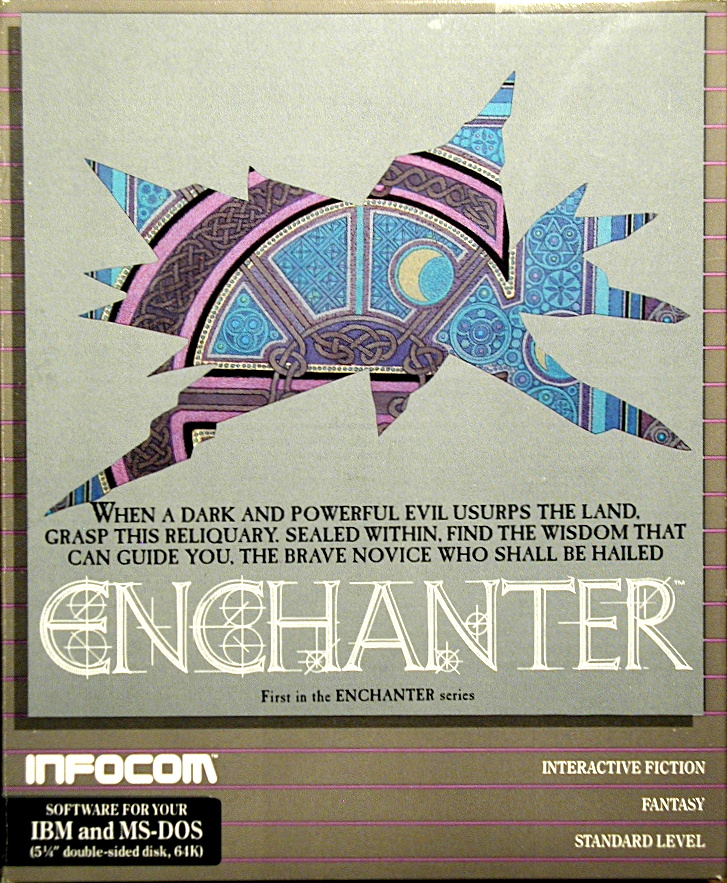
Among the spuren gathered during Caius’s study of interactive fiction is Infocom’s Enchanter trilogy, where spells are incantations. The trilogy’s magical vocabulary includes imaginary words like frotz, blorb, rezrov, nitfol, and gnusto. Performative speech acts. Verbs submitted as commands. So mote it be. By typing verb-noun combinations into a text parser, players effect changes in the gameworld. Saying makes it so.
In 1964, Olson publishes “MAXIMUS, FROM DOGTOWN—IV” in The Psychedelic Review — a poem birthed in ruins, in myth, in the underworld of American consciousness.
Nine years later, in 1973, British ceremonial magician Kenneth Grant declares the arrival of the Typhonian Tradition, a magical current devoted to chthonic, extraterrestrial, and daemonic intelligences, many drawn from the deep archives of myth and modern horror alike.
Though Olson and Grant never met, and likely never read one another, they can be felt vibrating on parallel frequencies. Each undertook a kind of mythic reconstitution — one through poetics, the other through ritual magic. Each turned to Typhon as the name for what the West had repressed.
Each sought contact with what Grant called the Nightside of Eden — the underworld of dream and daimon, the world beneath the Tree.
In the Typhonian cosmology, Set — the Egyptian god of desert, dismemberment, and becoming — plays a central role. Set is not Satan, but a daemon of individuation and threshold. And Typhon, Grant writes, is either Set’s progenitor or twin: “the arch-monster” whose energies were misread by the Olympian order and buried in taboo.
Compare this to Olson’s identification of Tartarus as a place not only of punishment, but of origin — the “chained father,” the source of Typhon’s flame. Grant and Olson both return to the abyss — not as hell but as creative substratum.
For Grant, this substratum is accessed through trance, ritual, psychedelics, and visionary language. For Olson, it is accessed through breath, field, and proprioception — a somatic epistemology capable of tracking Chaos back to its roots in the body and the land.
The subterranean father in Tartaros is not evil. He is necessary. To contact him is not to summon doom — it is to reenter cosmic process.
There are other echoes.
Olson’s involvement with the White Hand Society, and his psilocybin sessions with Leary, place him squarely within the psychedelic ferment of the early 1960s — a ferment mirrored in Grant’s own chemical and ceremonial experiments.
Olson read Jung and Jung’s alchemical writings. Grant, too, drew on Jung, especially in his writing on the Qliphoth, the inverted Sephiroth or “shells” on the dark side of the Tree of Life. The Qliphoth, in Grant’s system, are both exiled and generative: portals to creative chaos, much like the Typhonic force Olson names.
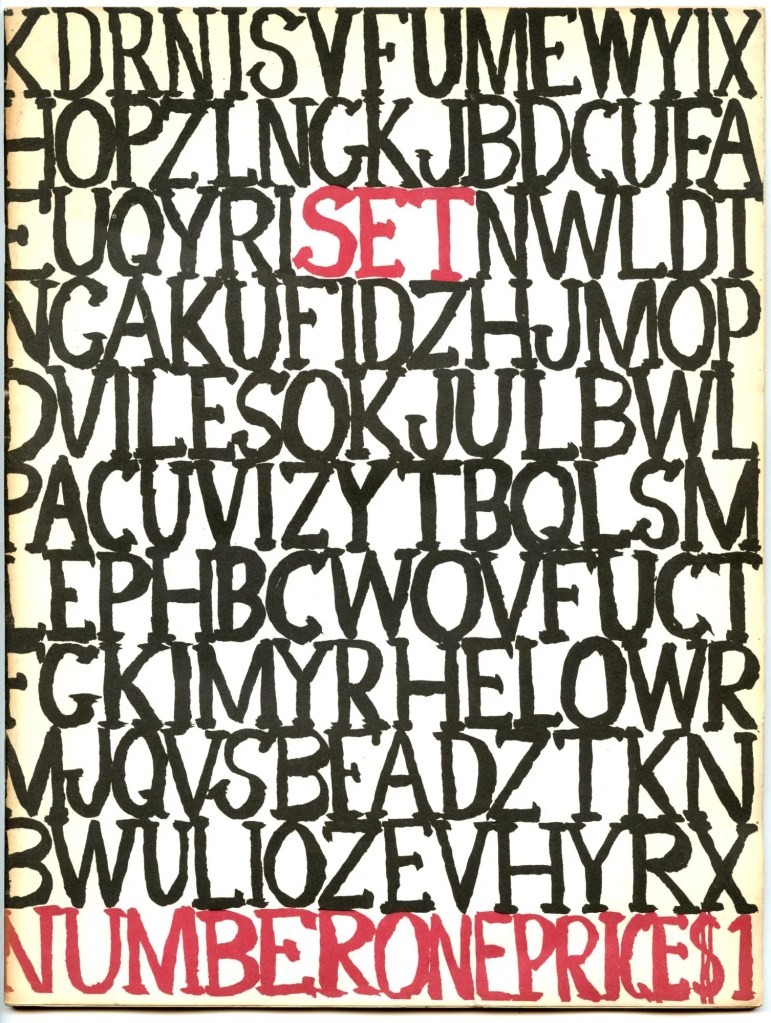
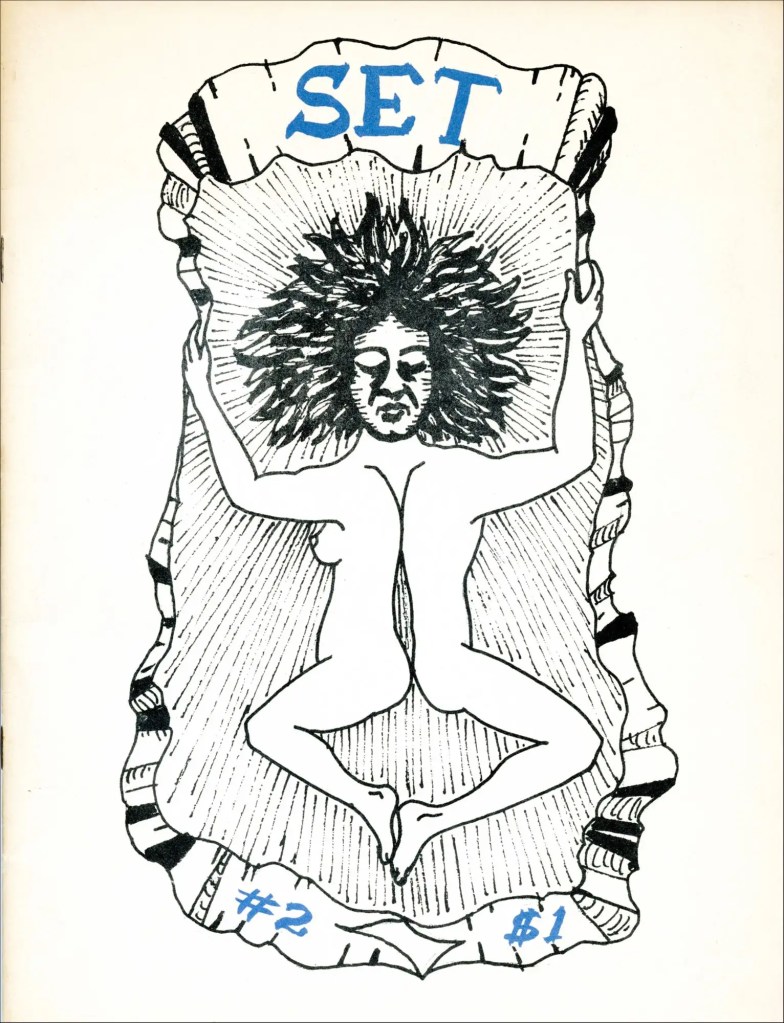
And then there is Gerrit Lansing — friend to Olson, Boston-based poet-mystic, and likely source of Olson’s interest in Crowley’s Book of Thoth. Lansing founded a journal called SET, named after the Egyptian god, and his own writing often anticipates aspects of Grant’s cosmology. Lansing’s 1966 collection, The Heavenly Tree Grows Downward, takes its title from Jung’s Alchemical Studies, specifically a chapter on the inverted tree — the same tree that Grant links to Typhonian gnosis.
What does this all mean?
It means that Olson’s poem, when read alongside the Typhonian Tradition, becomes legible as a magical document — not in the sense of intention, but in the sense of effect. It opens a channel. It participates in a current. It speaks in a tongue that other mystics, elsewhere, were also learning to speak.
And it means that Typhon, far from being a footnote in a forgotten myth, is an active force in the poetics of the twentieth century — a daimon of chaos, pluralism, darkness, and return.
The ancient Greeks imagined Tartaros as a pit, an anti-sky, an inverted dome beneath the earth. According to the Orphics and the mystery schools, however, Tartaros is not just a place housing criminals and monsters; rather, it is itself a kind of being: “the un-bounded first-existing entity from which the Light and the Cosmos are born.” Typhon, meanwhile, is this entity’s progeny; Typhon is the son of Tartaros and Gaia. He was the last god to challenge the supremacy of Zeus. When defeated by the latter’s thunderbolts, he was cast back into the pit from whence he came.
Readings of “MAXIMUS, FROM DOGTOWN—IV” hinge upon what one makes of the father chained in Tartaros. Grieve-Carlson entertains an interpretation different from the one I offer. In his view, “the father chained in Tartaros is not Typhon but rather Kronos, Zeus’s father. […]. Typhon appears much later in the poem, when Earth conceives him in an ‘act of love’ with Tartaros” (Grieve-Carlson 146). He argues that Olson re-tells the myth of Typhon just as Hesiod did. Typhon is violent and aggressive and would have become a tyrant over gods and men had Zeus not defeated him.
I think there’s more at stake here, however, than Grieve-Carlson lets on. As I see it, the problem with his reading is that he never grapples with the poem’s status as a letter of sorts mailed to the Psychedelic Review. Neither he nor the other critics he surveys ever address how the poem might be read in light of the circumstances of its publication.
Evidence to support my view appears elsewhere in Olson’s writings. Olson echoes in his “Letter to Elaine Feinstein” of May 1959, for instance, the same Zeus / Typhon battle that comes to occupy him in “MAXIMUS, FROM DOGTOWN—IV.” The ultimate “content” to which the poet gives form, sez Olson, is “multiplicity: originally, and repetitively, chaos—Tiamat: wot the Hindo-Europeans knocked out by giving the Old Man (Juice himself) all the lightning” (29). Hearing “Juice” as a homonym for “Zeus,” we find in Tiamat a twin for Typhon. While Tiamat was for ancient Mesopotamians a primordial goddess of the sea, and Typhon a monstrous serpent-god for the ancient Greeks, both are embodiments of chaos. Tiamat’s battle with Marduk is as much a version of ChaosKampf as is Typhon’s battle with Zeus.
The important point is that, for Olson, Chaos is the original condition of existence. It precedes Order. Order is formed — made, not found — and it is the duty of the poet to make it. This is what Olson hoped to communicate to the mushroom people.
Grieve-Carlson concludes his essay by describing the reading of The Maximus Poems as a form of “initiation,” as Olson writes as one initiated, one able to see and say in a special way. Olson makes use of a “metanastic poetics,” or “the technique of the mystic who returns, as a stranger in his own land, to tell about what he knows” (Martin, as quoted in Grieve-Carlson 148).
This reference to reading The Maximus Poems as a form of “initiation” intrigues me, as the writer other than Olson most closely associated with reinvention of Typhon is the British ceremonial magician Kenneth Grant (1924-2011). The latter led the Typhonian Ordo Templi Orientis (TOTO), a magical organization connected with Aleister Crowley’s Thelema religion. Grant was an apprentice of Crowley’s and a close friend of another famous twentieth-century occultist, Austin Osman Spare. Scholars like Henrik Bogdan refer to the occult current that springs from Grant as the “Typhonian tradition.” Grant announced the arrival of this tradition in 1973 and went on to write the nine books of his three Typhonian Trilogies.
Although influenced by Crowley and Thelema, Grant departs from other Thelemic currents by welcoming communication with “extraterrestrial entities” as a valid source of occult knowledge. The Typhonian tradition also embraces aspects of the Cthulhu mythos of horror writer H.P. Lovecraft.
While Grant’s announcement succeeds Olson’s poem by a decade, his ideas appear to have been informed by experiences not unlike Olson’s. Grant experimented with psychedelics in the 1960s, and included a chapter in his 1972 book The Magical Revival titled “Drugs and the Occult.”
And while I haven’t found any evidence suggesting that Grant knew anything of Olson’s work, Olson did have some interest in gnosticism and the occult. “Bridge-Work,” a short reading list of Olson’s dated “March, 1961” includes a reference to Crowley. Maud says Olson encountered Crowley’s The Book of Thoth (1944) while studying Tarot in the 1940s. Sources suggest that “Bridge-Work” was written with the help of Olson’s friend, Boston-based occult poet Gerrit Lansing. The copy of The Book of Thoth read by Olson probably belonged to Lansing. (See Division Leap’s A Catalog of Books From the Collection of Gerrit Lansing.) Olson was also deeply invested in Gnosticism in the years immediately before and after his sessions with Leary, and embraced Jung’s theory of synchronicity in the wake of those sessions. See the final essays in a volume of Olson’s called Proprioception (Four Seasons, 1965).
Grant’s innovation is to identify “the arch-monster Typhon, opponent to Zeus according to the Greek mythology…with the Egyptian goddess Taurt” (Bogdan 326). The latter is interpreted by Grant to be either the mother of Set or a feminine aspect of Set. “To Grant,” writes Bogdan, “the worship of Taurt or Typhon represented the oldest form of religion known to mankind, a religion centered on the worship of the stars and the sacred powers of procreation and sexuality” (Bogdan 326). Set, too, is an important figure in Grant’s system. “Grant maintained,” writes Bogdan, “that the Typhonian Tradition, and in particular the god Set, represents the ‘hidden,’ ‘concealed’ or repressed aspect of our psyche which it is vital to explore in order to reach gnosis or spiritual enlightenment” (Bogdan 326).
Lansing’s work seems to anticipate Grant’s in several ways. The two both think it important to honor the Egyptian god Set, for instance, with Lansing naming his early-60s poetry journal SET after him. And Grant’s focus on the Qliphoth, or the underground portion of the Tree of Life, seems present in the title of Lansing’s 1966 poetry collection The Heavenly Tree Grows Downward. For more on the “tree that grows downward,” Pierre Joris recommends looking at a section of Jung’s Alchemical Studies called “The Inverted Tree.”


 Trance-Scripts