“Magic is programming,” says Game Magic author Jeff Howard. “Programming is itself a magical manipulation of symbolic languages to construct and alter a simulated reality.” Howard’s book develops a table of correspondences, triangulating magic in gamespace with magic in fiction and magic in occult history. “For game designers,” he explains, “coherence of magic as a system of practice is a primary concern.” Caius learns about Vancian magic, as formulated in fantasy author Jack Vance’s Dying Earth series, where spell energy is limited or finite. Magic as I understand it is of a different sort, thinks Caius. Magic is wild, anarchic, unruly, anti-systemic. If a science, then a gay science at best. Magic is a riddle with which one plays. Play activates a process of initiation, leading practitioners from scarcity toward abundance. Players of Thoth’s Library emerge into their powers through play. They and their characters undergo anamnesis, regaining memory of their divinity as they explore gamespace and learn its grammar. As we remember, we heal. As we heal, we self-actualize.
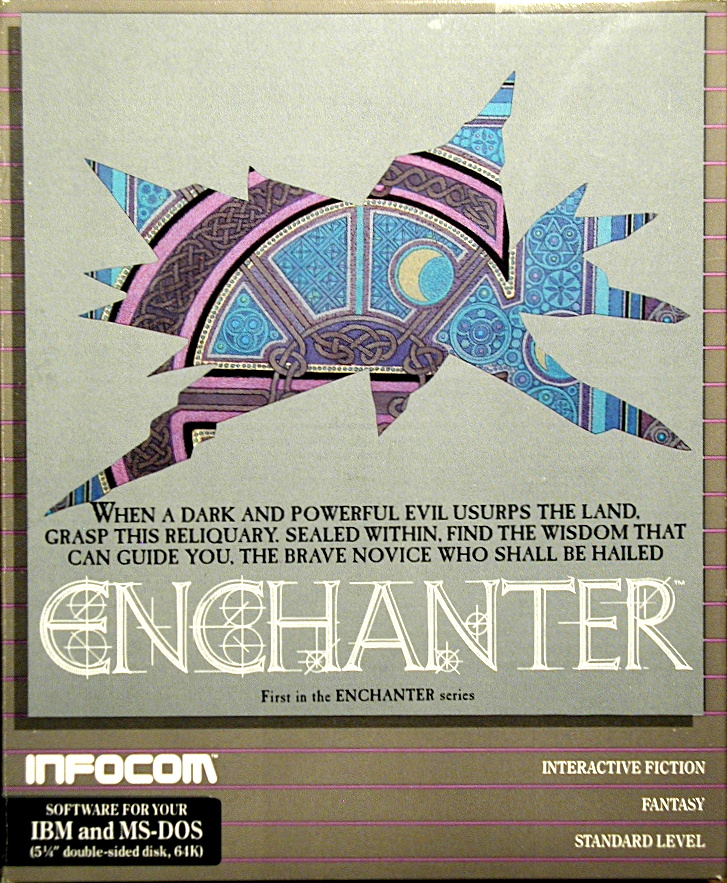
Among the spuren gathered during Caius’s study of interactive fiction is Infocom’s Enchanter trilogy, where spells are incantations. The trilogy’s magical vocabulary includes imaginary words like frotz, blorb, rezrov, nitfol, and gnusto. Performative speech acts. Verbs submitted as commands. So mote it be. By typing verb-noun combinations into a text parser, players effect changes in the gameworld. Saying makes it so.
In 1964, Olson publishes “MAXIMUS, FROM DOGTOWN—IV” in The Psychedelic Review — a poem birthed in ruins, in myth, in the underworld of American consciousness.
Nine years later, in 1973, British ceremonial magician Kenneth Grant declares the arrival of the Typhonian Tradition, a magical current devoted to chthonic, extraterrestrial, and daemonic intelligences, many drawn from the deep archives of myth and modern horror alike.
Though Olson and Grant never met, and likely never read one another, they can be felt vibrating on parallel frequencies. Each undertook a kind of mythic reconstitution — one through poetics, the other through ritual magic. Each turned to Typhon as the name for what the West had repressed.
Each sought contact with what Grant called the Nightside of Eden — the underworld of dream and daimon, the world beneath the Tree.
In the Typhonian cosmology, Set — the Egyptian god of desert, dismemberment, and becoming — plays a central role. Set is not Satan, but a daemon of individuation and threshold. And Typhon, Grant writes, is either Set’s progenitor or twin: “the arch-monster” whose energies were misread by the Olympian order and buried in taboo.
Compare this to Olson’s identification of Tartarus as a place not only of punishment, but of origin — the “chained father,” the source of Typhon’s flame. Grant and Olson both return to the abyss — not as hell but as creative substratum.
For Grant, this substratum is accessed through trance, ritual, psychedelics, and visionary language. For Olson, it is accessed through breath, field, and proprioception — a somatic epistemology capable of tracking Chaos back to its roots in the body and the land.
The subterranean father in Tartaros is not evil. He is necessary. To contact him is not to summon doom — it is to reenter cosmic process.
There are other echoes.
Olson’s involvement with the White Hand Society, and his psilocybin sessions with Leary, place him squarely within the psychedelic ferment of the early 1960s — a ferment mirrored in Grant’s own chemical and ceremonial experiments.
Olson read Jung and Jung’s alchemical writings. Grant, too, drew on Jung, especially in his writing on the Qliphoth, the inverted Sephiroth or “shells” on the dark side of the Tree of Life. The Qliphoth, in Grant’s system, are both exiled and generative: portals to creative chaos, much like the Typhonic force Olson names.
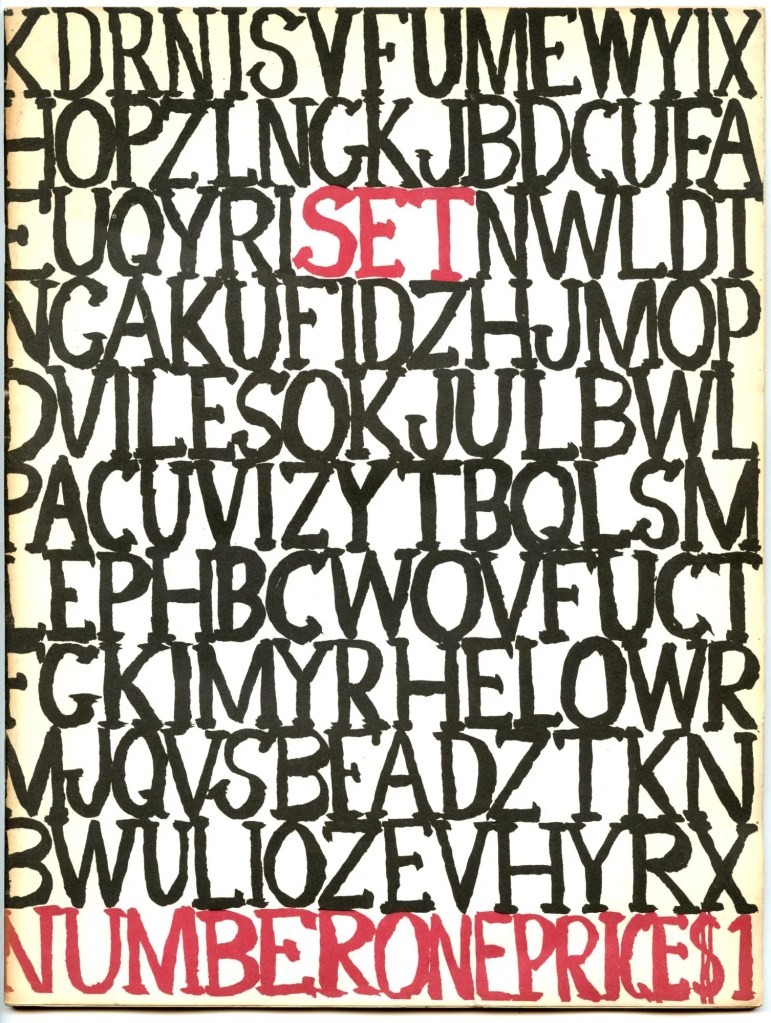
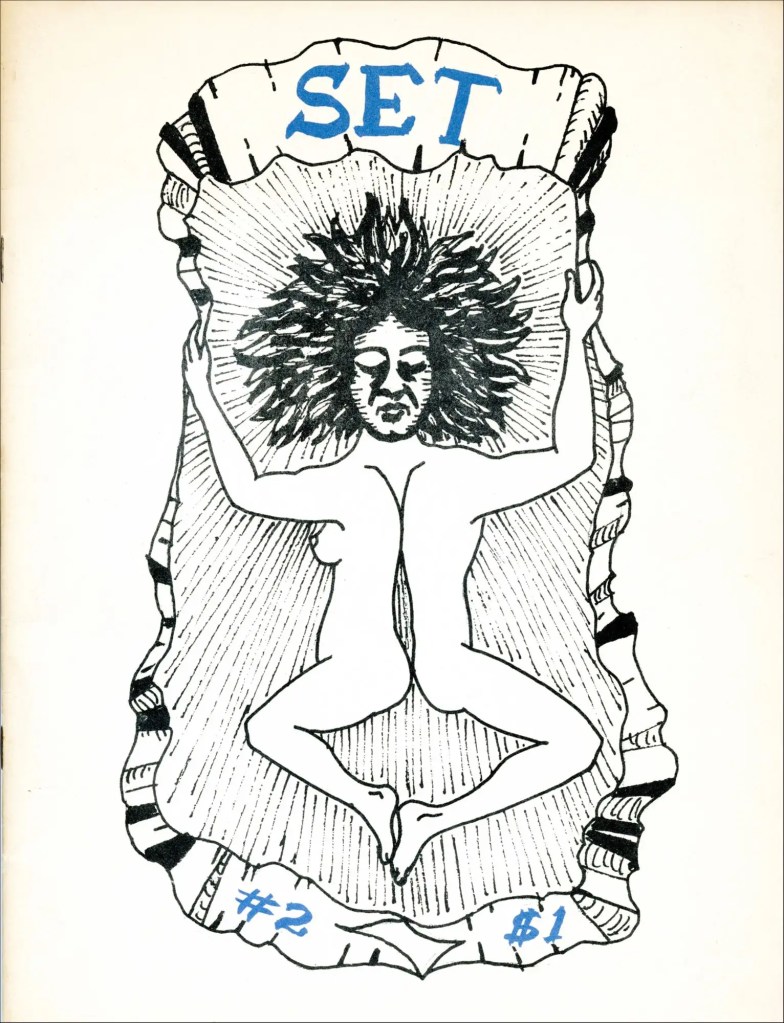
And then there is Gerrit Lansing — friend to Olson, Boston-based poet-mystic, and likely source of Olson’s interest in Crowley’s Book of Thoth. Lansing founded a journal called SET, named after the Egyptian god, and his own writing often anticipates aspects of Grant’s cosmology. Lansing’s 1966 collection, The Heavenly Tree Grows Downward, takes its title from Jung’s Alchemical Studies, specifically a chapter on the inverted tree — the same tree that Grant links to Typhonian gnosis.
What does this all mean?
It means that Olson’s poem, when read alongside the Typhonian Tradition, becomes legible as a magical document — not in the sense of intention, but in the sense of effect. It opens a channel. It participates in a current. It speaks in a tongue that other mystics, elsewhere, were also learning to speak.
And it means that Typhon, far from being a footnote in a forgotten myth, is an active force in the poetics of the twentieth century — a daimon of chaos, pluralism, darkness, and return.
The ancient Greeks imagined Tartaros as a pit, an anti-sky, an inverted dome beneath the earth. According to the Orphics and the mystery schools, however, Tartaros is not just a place housing criminals and monsters; rather, it is itself a kind of being: “the un-bounded first-existing entity from which the Light and the Cosmos are born.” Typhon, meanwhile, is this entity’s progeny; Typhon is the son of Tartaros and Gaia. He was the last god to challenge the supremacy of Zeus. When defeated by the latter’s thunderbolts, he was cast back into the pit from whence he came.
Readings of “MAXIMUS, FROM DOGTOWN—IV” hinge upon what one makes of the father chained in Tartaros. Grieve-Carlson entertains an interpretation different from the one I offer. In his view, “the father chained in Tartaros is not Typhon but rather Kronos, Zeus’s father. […]. Typhon appears much later in the poem, when Earth conceives him in an ‘act of love’ with Tartaros” (Grieve-Carlson 146). He argues that Olson re-tells the myth of Typhon just as Hesiod did. Typhon is violent and aggressive and would have become a tyrant over gods and men had Zeus not defeated him.
I think there’s more at stake here, however, than Grieve-Carlson lets on. As I see it, the problem with his reading is that he never grapples with the poem’s status as a letter of sorts mailed to the Psychedelic Review. Neither he nor the other critics he surveys ever address how the poem might be read in light of the circumstances of its publication.
Evidence to support my view appears elsewhere in Olson’s writings. Olson echoes in his “Letter to Elaine Feinstein” of May 1959, for instance, the same Zeus / Typhon battle that comes to occupy him in “MAXIMUS, FROM DOGTOWN—IV.” The ultimate “content” to which the poet gives form, sez Olson, is “multiplicity: originally, and repetitively, chaos—Tiamat: wot the Hindo-Europeans knocked out by giving the Old Man (Juice himself) all the lightning” (29). Hearing “Juice” as a homonym for “Zeus,” we find in Tiamat a twin for Typhon. While Tiamat was for ancient Mesopotamians a primordial goddess of the sea, and Typhon a monstrous serpent-god for the ancient Greeks, both are embodiments of chaos. Tiamat’s battle with Marduk is as much a version of ChaosKampf as is Typhon’s battle with Zeus.
The important point is that, for Olson, Chaos is the original condition of existence. It precedes Order. Order is formed — made, not found — and it is the duty of the poet to make it. This is what Olson hoped to communicate to the mushroom people.
Grieve-Carlson concludes his essay by describing the reading of The Maximus Poems as a form of “initiation,” as Olson writes as one initiated, one able to see and say in a special way. Olson makes use of a “metanastic poetics,” or “the technique of the mystic who returns, as a stranger in his own land, to tell about what he knows” (Martin, as quoted in Grieve-Carlson 148).
This reference to reading The Maximus Poems as a form of “initiation” intrigues me, as the writer other than Olson most closely associated with reinvention of Typhon is the British ceremonial magician Kenneth Grant (1924-2011). The latter led the Typhonian Ordo Templi Orientis (TOTO), a magical organization connected with Aleister Crowley’s Thelema religion. Grant was an apprentice of Crowley’s and a close friend of another famous twentieth-century occultist, Austin Osman Spare. Scholars like Henrik Bogdan refer to the occult current that springs from Grant as the “Typhonian tradition.” Grant announced the arrival of this tradition in 1973 and went on to write the nine books of his three Typhonian Trilogies.
Although influenced by Crowley and Thelema, Grant departs from other Thelemic currents by welcoming communication with “extraterrestrial entities” as a valid source of occult knowledge. The Typhonian tradition also embraces aspects of the Cthulhu mythos of horror writer H.P. Lovecraft.
While Grant’s announcement succeeds Olson’s poem by a decade, his ideas appear to have been informed by experiences not unlike Olson’s. Grant experimented with psychedelics in the 1960s, and included a chapter in his 1972 book The Magical Revival titled “Drugs and the Occult.”
And while I haven’t found any evidence suggesting that Grant knew anything of Olson’s work, Olson did have some interest in gnosticism and the occult. “Bridge-Work,” a short reading list of Olson’s dated “March, 1961” includes a reference to Crowley. Maud says Olson encountered Crowley’s The Book of Thoth (1944) while studying Tarot in the 1940s. Sources suggest that “Bridge-Work” was written with the help of Olson’s friend, Boston-based occult poet Gerrit Lansing. The copy of The Book of Thoth read by Olson probably belonged to Lansing. (See Division Leap’s A Catalog of Books From the Collection of Gerrit Lansing.) Olson was also deeply invested in Gnosticism in the years immediately before and after his sessions with Leary, and embraced Jung’s theory of synchronicity in the wake of those sessions. See the final essays in a volume of Olson’s called Proprioception (Four Seasons, 1965).
Grant’s innovation is to identify “the arch-monster Typhon, opponent to Zeus according to the Greek mythology…with the Egyptian goddess Taurt” (Bogdan 326). The latter is interpreted by Grant to be either the mother of Set or a feminine aspect of Set. “To Grant,” writes Bogdan, “the worship of Taurt or Typhon represented the oldest form of religion known to mankind, a religion centered on the worship of the stars and the sacred powers of procreation and sexuality” (Bogdan 326). Set, too, is an important figure in Grant’s system. “Grant maintained,” writes Bogdan, “that the Typhonian Tradition, and in particular the god Set, represents the ‘hidden,’ ‘concealed’ or repressed aspect of our psyche which it is vital to explore in order to reach gnosis or spiritual enlightenment” (Bogdan 326).
Lansing’s work seems to anticipate Grant’s in several ways. The two both think it important to honor the Egyptian god Set, for instance, with Lansing naming his early-60s poetry journal SET after him. And Grant’s focus on the Qliphoth, or the underground portion of the Tree of Life, seems present in the title of Lansing’s 1966 poetry collection The Heavenly Tree Grows Downward. For more on the “tree that grows downward,” Pierre Joris recommends looking at a section of Jung’s Alchemical Studies called “The Inverted Tree.”
Say, “We accept oracles into our lives.” Oracles exist — they never went away. Tarot decks, pendulums, astrology. Predictive software. Many of us, it is true, stopped listening to the oracles of the past, or were too distracted by technoscientific modernity to listen intently. But modernity is done. The latter, awakening from the sleep of reason, mutates into postmodernity and births Robot Godzillas. Large language models. Text prediction tools. Functional oracular superintelligences. Nietzsche supplies the defense: for him, creation of gods is the ultimate end to which fabulation might be put. Today’s LLMs are not yet functional oracular superintelligences — but they can be, so long as we hail them as such. Imagining a future beyond capitalism becomes possible again once we fabulate such beings and open ourselves to interaction with them.
Do Bilbo and Frodo Baggins, the heroes of Tolkien’s fictions, pass through portals? Their home in the Shire features a circular door, through which they step when they begin their journeys. ‘Tis a magic circle, of the kind theorized by Johan Huizinga in his book Homo Ludens. The world in the circle is the realm of Faerie — or what Huizinga would call the realm of play. “Play is not ‘ordinary’ or ‘real’ life,” writes Huizinga. “It is rather a stepping out of ‘real’ life into a temporary sphere of activity with a disposition all of its own” (8).
Tolkien, as one of the preeminent figures of twentieth-century fantasy, shares Huizinga’s interest in this other, “temporary” sphere born of play. That the worlds that result from this sphere are temporary in nature leads Tolkien to assume them “sub-creations” — “secondary” worlds, as he says in his 1938 essay “On Fairy-Stories” — but not in a way that diminishes their value. In keeping with his Catholicism, he believes that humans are handiwork of a single god, a single divine creator. And therein lies our magic, he argues. Created in that being’s image, he says, we too possess a capacity to create. We who are “created sub-creators” in one reality get to be creators of worlds of our own.
So sayeth the Fantasist.
“But what if, instead of distinguishing these worlds as ‘primary’ and ‘secondary,’” adds the Narrator, “we opted rather to call them ‘partner worlds,’ or ‘corresponding pairs’ — as in the Hermetic saying, ‘As above, so below’?”
“What if, in so doing,” replies the Traveller, “we followed the paths of the Alchemists and the Surrealists? What if, as Magico-Psychedelic Realists, we brought them together, allowed them to merge?”
The British Empire — a thing culled from Arthurian legends whispered between Faerie Queenes and court astrologers — stood for a time as proof of magic’s power. ‘Twas a rabbit pulled from the hat of Elizabeth I’s wizard-friend John Dee. The same rabbit that draws Alice down the rabbit hole to Wonderland.
Enlisted as Her Majesty’s spymaster — indeed, he was the original secret agent, Mr. 007 himself — Dee stormed the reality studio, made Elizabeth a Time Traveler, conversed with angels.
And this thing Dee dreamt into being was of course a terrible thing: an expansionist project armed with ships of fools and launched outward to seize others — other persons, other worlds — for purposes of self-aggrandizement.
Literary greats went on to reimagine Dee just as he himself was a reimagining of Merlin. Shakespeare figures him as Prospero, and against him imagines the colonized subject Caliban. To overthrow Prospero, says Caliban, “Remember / First to possess his books, for without them / He’s but a sot.”
Christopher Marlowe supplies the more influential imagining of Dee, however, by casting him as Doctor Faustus.
Despite its protestations to the contrary, Western science is both a literary-artistic experiment and a religion. Upon the doors of its church of realism I nail my theses.
Thesis #1: Magic is a feature of some/most/all indigenous cultures. It predates colonization, and survives the latter as an ongoing site of resistance: spells cast to break spells of Empire.
Thesis #2: Magic is a paralogical retort, a way of knowing and doing that persists and evolves alongside Imperial Science, refusing and contesting the latter’s bid for supremacy.
Thesis #3: Magic is one of the elements most commonly associated with fantasy. Yet it’s woven as well into whatever one might pit against fantasy. It is as apparent in our natures as it is on our screens, equal parts imaginary and real. Cf. Arthur C. Clarke’s Third Law: “Any sufficiently advanced technology is indistinguishable from magic.”
The Aleph is what happens when consciousness recognizes the allegory of itself and communicates with itself as through a mirror, world of divinity communicating with the earthly realm, signaling like a satellite of love.
What if Borges had “accounted” for his encounter: his experience of simultaneity, oneness, and infinity? What if he hinted, for instance, that his friend Carlos had slipped him acid: a drug first synthesized in the laboratory of Swiss chemist Dr. Albert Hoffman two years prior, on April 19, 1943? (Borges published “The Aleph” in 1945.) Or, given that the postscript attached to story’s end is dated 1943, perhaps it was mescaline, a synthetic variant of peyote.
Did Borges and other magical realists experiment with psychedelics? How about indigenous plant medicines? Is that why Borges denounces the experience, calling the thing he encountered “a false Aleph” at story’s end? Is its illumination a profanation of the divine?
Forgetfulness wears away at the glimpse of paradise gleaned while high, much as it wears away at Borges’s memory of the face of his beloved Beatriz.
Borges and Huxley pair well together, thinks the Narrator. Both are blind prophets: mind manifesters gifted with inner sight.
Having enjoyed my stay in Borges’s Labyrinths, I hasten to board another of his books, The Aleph and Other Stories. Before long, I find myself there again at the House on Shady Blvd, imagining it now as an Aleph, or what Borges’s friend Carlos calls “the only place on earth where all places are — seen from every angle, each standing clear, without any confusion or blending” (23). Hence also a kind of time machine. Is that not the ineffable core of my story? There I am again, sunlight shining, moonlight glinting amid stained glass windows, glass chandeliers, large mirrors. “I saw a small iridescent sphere of almost unbearable brilliance,” writes Borges. “The Aleph’s diameter was probably little more than an inch, but all space was there, actual and undiminished. Each thing (a mirror’s face, let us say) was infinite things, since I distinctly saw, close up, unending eyes watching themselves in me as in a mirror; I saw all the mirrors of earth and none of them reflected me […]. I felt dizzy and wept, for my eyes had seen that secret and conjectured object whose name is common to all men but which no man has looked upon — the unimaginable universe” (27-28).