What are we talking about when we talk about “political theology”? It’s a rejection of the secularization thesis. Religion never goes away; theological notions haunt the structures and discourses of capitalist modernity. I think of the lyrics to Buffy Sainte-Marie’s song “God Is Alive, Magic Is Afoot.” The song’s title is a line from a poem in Leonard Cohen’s 1966 novel Beautiful Losers. “I propped two pages of his book up on a music stand,” she recalled when asked about the song in an interview, “and I just sang it out, ad-libbing the melody and guitar music together as I went along.” Who is it that tells us “mind itself is magic coursing through the flesh / And flesh itself is magic dancing on a clock / And time itself, the magic length of God”? Is it Sainte-Marie, or is it Catherine Tekakwitha, the 17th century Mohawk saint worshipped by the narrator of Cohen’s novel?
Tag: music
Monday June 21, 2021
“Put a lemon on it” is the first of several words received as I sit eyes closed beside a pool. Words overheard, duly noted, to be reimagined in the evening hours as dream material and as a step in a recipe for pasta with broccoli. There has been a desire of late, some chakra lighting up all that is. I play it records, feed it the exalted public speech of Odetta at Carnegie Hall.
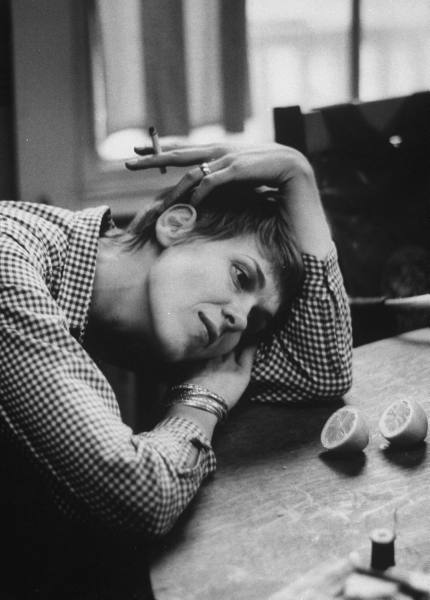
A kind of love is organizing all things, Amens everywhere “all over this land.” That’s what Leary thought, isn’t it? “The history of our research on the psychedelic experience,” he writes, “is the story of how we learned how to pray” (High Priest, p. 171). Let us include among the characters in this story IFIF medical director Madison Presnell. A photograph of Presnell appears in the April 16, 1963 issue of Life magazine. A photographer with the magazine accompanies Cambridge, MA housewife Barbara Dunlap on her first acid trip. Presnell administers the drug. The caption for the final photograph in the series reads, “Dunlap smokes a cigarette while seeing visions in the seeds of a lemon.”
Tuesday June 8, 2021
The pool’s not been what I’d hoped. This is one of the ways that Mercury Retrograde has manifested locally of late, prompting in me a sense of frustration and postponement, despite my knowing that we’ve performed our planting ritual, seeds and seedlings are in the ground, things are growing. Similar processes are afoot intellectually as I continue my wanderings. In my readings, I’ve been moving crabwise among many books at once. Robin D.G. Kelley keeps it surreal with his book Freedom Dreams: The Black Radical Imagination. Thelonious Monk appears near the book’s finale. Kelley went on to write a book on Monk. Thelonious Monk: The Life and Times of an American Original. Thumbing through the latter book’s index, I land upon “Monk, Thelonious: drugs taken by,” hoping to encounter word of Monk’s relationship to psychedelics, as he’s known to have done mushrooms with Allen Ginsberg and Timothy Leary. Monk came to the psychedelic sacrament a seasoned pro. Reports suggest he was unimpressed. Monk had been arrested years prior for marijuana possession. Police rolled up on him after a Sunday night gig in June 1948. He liked to smoke reefer when he played, and other players in his groups relied on drugs and alcohol to keep up. The meeting with Leary occurred in January 1961. Three years later, Monk appeared on the cover of the February 28, 1964 edition of Time magazine. The cover story’s author Barry Farrell wrote, “Every day is a brand-new pharmaceutical event for Monk: alcohol, Dexedrine, sleeping potions, whatever is at hand, charge through his bloodstream in baffling combinations.”

Friday June 4, 2021
Bach’s Toccata and Fugue in D minor opens the evening’s set, though I can’t say much of the 1972 performance of it by Dutch prog group Ekseption. It all feels a bit too tight, too clean, too controlled. I stick around nonetheless for the rest of the A-side on the band’s album Trinity. Flute, organ, and synthesizer solos on “The Peruvian Flute” reach across the frame a bit. “Dreams” is a track that could be sampled, as is “Smile.” And “Lonely Chase” features a lovely organ solo. Heard between episodes of Exterminate All the Brutes, however, it can’t but be a bit repulsive. Tacky, uninspired peacockery. I find myself wanting instead to read Tyson Yunkaporta’s Sand Talk: How Indigenous Thinking Can Save the World.
Tuesday June 1, 2021
We buy varieties of veggies and herbs plus a blackberry bush and a fig tree from a local nursery. Seedlings, mostly, though also some packets of seed. With a bit of digging, we plant these. With a bit more, I unearth several classic Blue Note jazz LPs on CD in the bins at Goodwill: Sonny Rollins’s A Night at the Village Vanguard, Freddie Hubbard’s Hub-Tones, and John Coltrane and the Thelonious Monk Quartet’s Live at the Five Spot: Discovery! Welcome additions, all.
Friday May 28, 2021
A flute is blown, a tone sustained, strung like a bridge of sound across an otherwise silent expanse. By flute I mean the shakuhachi, the most important of traditional Japanese wind instruments. “Certain special effects such as flutter-tonguing and distinctly audible breathing, which in Western music are associated with 20th-century avant-garde flute repertory,” writes David Loeb in the Kōhachirō Miyata album’s liner notes, “were a standard part of traditional shakuhachi technique by the 18th century.” The sounds are ones I reimagine come evening as I listen to birdsong. As May concludes, it’s time to plant. ‘Tis summer–nearly so. If not for rain, I’d have been at the pool reading Reclaiming Art, a book by Weird Studies podcaster J.F. Martel. Or perhaps I’d have finished Jun’ichirō Tanizaki’s In Praise of Shadows. I find the latter troubling in its traditionalism. Japanese communists of the 1930s regarded Tanizaki as a reactionary in the years prior to the Second World War. His writings failed to adopt a recognizable ideological “stance.” He was a foot fetishist; a masochist; his writings explore the erotic and the grotesque. To the ideologues of his day, this made him “decadent,” his worldview colored by nostalgia for premodernity and by an embrace of fantasy and the unconscious. The elements I admire in Tanizaki, however, are his visceral aversion to capitalist modernity, his respect for embodied being, and his desire to live well.
Tuesday May 11, 2021
Sarah and Frankie listen to “Something Good,” one of many songs by Lindsay Munroe that Frankie’s been having us play of late. I dream of a ukulele as sun shines through an upstairs window. Record Night’s a thing again — though rebranded now as “Music Night,” and designed with a bit of forethought so as to approximate the style and spirit of a Rastafarian reasoning session. Thumbing through stacks of vinyl, I settle upon several I hope to share with friends. Rita Marley’s “One Draw” will make an appearance, as will “Şu Derenin Sulari,” a track from an LP that turned up in the bins by Turkish psych outfit Hüsnü Özkartal Orkestrasi.
Tuesday May 4, 2021
Caught up on witches, let us sit with creatures and plot reading lists, end of schoolyear approaching. When time allows, we’ll plant our garden. Up onto the turntable I place an album from the 1960s folk revival, rescued from a bin at Goodwill: Mark Spoelstra’s Five & Twenty Questions.

Liner notes by counterculture folksinger and novelist Richard Fariña. The latter died tragically on April 30, 1966 in a freak motorcycle accident, two days after the publication of his novel Been Down So Long It Looks Like Up to Me. Fariña is the writer to whom Thomas Pynchon dedicates Gravity’s Rainbow. Pynchon had been best man at Fariña’s wedding to Joan Baez’s sister Mimi in spring of 1962. Along with the title track, other highlights on the Spoelstra album include “On the Road Again” and “My Love is Like a Dewdrop.”
Friday April 30, 2021
Walpurgis Night, when witches meet for bonfires and dancing. I watch newly digitized footage of old noise performances, a friend pointing me out to me. Guitarist in one performance, tape-scratcher in another. The space of the latter performance angular, erratic, static, galloping gabba-gabba beats and tape shrieks. Before the seated players, a friend sits hidden in a plastic cube. Onto this plane of intensities, the spectral re-animated echolalic vibrato of a ghostly Karen Carpenter crooning “We’ve Only Just Begun.”
Thursday April 29, 2021
The Ramsey Lewis Trio rouse me midafternoon with their “Blues for the Night Owl.” More to my liking, though, is Expansions, a 1975 LP by Lonnie Liston Smith & the Cosmic Echoes.
“Expand your mind…to understand…” sings Lonnie’s brother, flutist Donald Smith, on the album’s opener. This LP and another (Jerry Butler’s The Sagittarius Movement) arrive bearing reference to Sagittarius. “Lady Sagittarius.” Let us thank her, as Smith does, “for her Earthly Guidance.” Here I am, meanwhile, at semester’s end, students and I grappling with Philip K. Dick’s downer dystopia A Scanner Darkly. Chapter 15 is for me the book’s nadir, as the book’s third-person narrator recounts the thoughts of cop character Mike Westaway. Mike manipulates others, justifying these actions by claiming that the people he handles — characters like the book’s protagonist Bob Arctor — are already dead.
 Trance-Scripts