The SBs: Stewart Brand and Stafford Beer

Caius revisits “Both Sides of the Necessary Paradox,” an interview with Gregory Bateson included as the first half of Stewart Brand’s 1974 book II Cybernetic Frontiers. The book’s second half reprints “Spacewar: Fanatic Life and Symbolic Death Among the Computer Bums,” the influential essay on videogames that Jann Wenner commissioned Brand to write for Rolling Stone two years prior.

“I came into cybernetics from preoccupation with biology, world-saving, and mysticism,” writes Brand. “What I found missing was any clear conceptual bonding of cybernetic whole-systems thinking with religious whole-systems thinking. Three years of scanning innumerable books for the Whole Earth Catalog didn’t turn it up,” he adds. “Neither did considerable perusing of the two literatures and taking thought. All I did was increase my conviction that systemic intellectual clarity and moral clarity must reconvene, mingle some notion of what the hell consciousness is and is for, and evoke a shareable self-enhancing ethic of what is sacred, what is right for life” (9).

Yet in summer of 1972, says Brand, a book arrives to begin to fill this gap: Bateson’s Steps to an Ecology of Mind.

Brand brings his knack for New Journalism to the task of interviewing Bateson for Harper’s.

The dialogue between the two reads at many times like one of Bateson’s “metalogues.” An early jag of thought jumps amid pathology, conquest, and the Tao. Reminded of pioneer MIT cybernetician Warren McCulloch’s fascination with “intransitive preference,” Bateson wanders off “rummaging through his library looking for Blake’s illustration of Job affrighted with visions” (20).
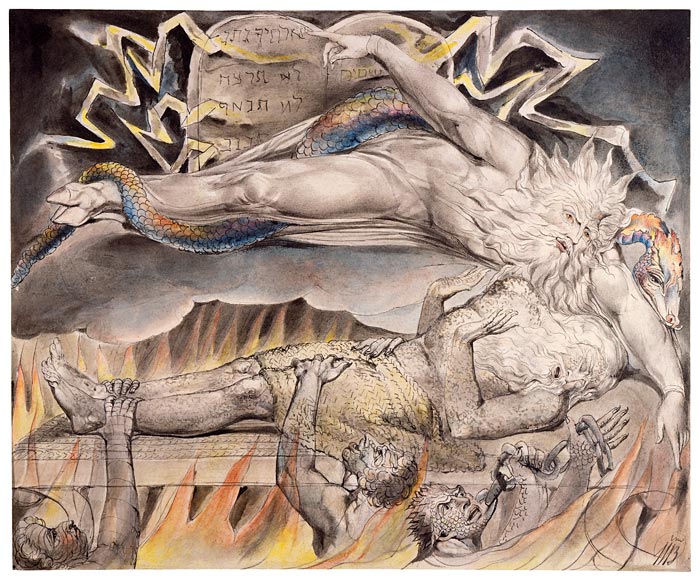
Caius is reminded of Norbert Wiener’s reflections on the Book of Job in his 1964 book God and Golem, Inc. For all of these authors, cybernetic situations cast light on religious situations and vice versa.

Caius wonders, too, about the relationship between Bateson’s “double bind” theory of schizophrenia and the theory pursued by Deleuze and Guattari in Capitalism and Schizophrenia.

Double bind is the term used by Gregory Bateson to describe the simultaneous transmission of two kinds of messages, one of which contradicts the other, as for example the father who says to his son: go ahead, criticize me, but strongly hints that all effective criticism — at least a certain type of criticism — will be very unwelcome. Bateson sees in this phenomenon a particularly schizophrenizing situation,” note Deleuze and Guattari in Anti-Oedipus. They depart from Bateson only in thinking this situation the rule under capitalism rather than the exception. “It seems to us that the double bind, the double impasse,” they write, “is instead a common situation, oedipalizing par excellence. […]. In short, the ‘double bind’ is none other than the whole of Oedipus” (79-80).

God’s response to Job is of this sort.

Brand appends to the transcript of his 1972 interview with Bateson an epilog written in December 1973, three months after the coup in Chile.

Bateson had direct, documented ties to US intelligence. Stationed in China, India, Ceylon, Burma, and Thailand, he produced “mixed psychological and anthropological intelligence” for the Office of Strategic Services (OSS), precursor to CIA, during WWII. Research indicates he maintained connections with CIA-affiliated research networks in the postwar years, participating in LSD studies linked to the MKUltra program in the 1950s. Afterwards he regrets his association with the Agency and its methods.

Asked by Brand about his “psychedelic pedigree,” Bateson replies, “I got Allen Ginsberg his first LSD” (28). A bad trip, notes Caius, resulting in Ginsberg’s poem “Lysergic Acid.” Bateson himself was “turned on to acid by Dr. Harold Abramson, one of the CIA’s chief LSD specialists,” report Martin A. Lee & Bruce Shlain in their book Acid Dreams. Caius wonders if Stafford Beer underwent some similar transformation.

As for Beer, he serves in the British military in India during WWII, and for much of his adult life drives a Rolls-Royce. But then, at the invitation of the Allende regime, Beer travels to Chile and builds Cybersyn. After the coup, he lives in a remote cottage in Wales.

What of him? Cybernetic socialist? Power-centralizing technocrat?

Recognizes workers themselves as the ones best suited to modeling their own places of work.

“What were the features of Beer’s Liberty Machine?” wonders Caius.

Brand’s life, too, includes a stint of military service. Drafted after graduating from Stanford, he served two years with the US army, first as an infantryman and then afterwards as a photographer. Stationed at Fort Dix in New Jersey, Brand becomes involved in the New York art world of those years. He parts ways with the military as soon as the opportunity to do so arises. After his discharge in 1962, Brand participates in some of Allan Kaprow’s “happenings” and, between 1963 and 1966, works as a photographer and technician for USCO.

Amid his travels between East and West coasts during these years, Brand joins up with Ken Kesey and the Merry Pranksters.

Due to these apprenticeships with the Pranksters and with USCO, Brand arrives early to the nexus formed by the coupling of psychedelics and cybernetics.

“Strobe lights, light projectors, tape decks, stereo speakers, slide sorters — for USCO, the products of technocratic industry served as handy tools for transforming their viewers’ collective mind-set,” writes historian Fred Turner in his 2006 book From Counterculture to Cyberculture: Stewart Brand, the Whole Earth Network, and the Rise of Digital Utopianism. “So did psychedelic drugs. Marijuana and peyote and, later, LSD, offered members of USCO, including Brand, a chance to engage in a mystical experience of togetherness” (Turner 49).

Brand takes acid around the time of his discharge from the military in 1962, when he participates in a legal LSD study overseen by James Fadiman at the International Foundation for Advanced Study in Menlo Park. But he notes that he first met Bateson “briefly in 1960 at the VA Hospital in Palo Alto, California” (II Cybernetic Frontiers, p. 12). Caius finds this curious, and wonders what that meeting entailed. 1960 is also the year when, at the VA Hospital in Menlo Park, Ken Kesey volunteers in the CIA-sponsored drug trials involving LSD that inspire his 1962 novel One Flew Over the Cuckoo’s Nest.

Bateson worked for the VA while developing his double bind theory of schizophrenia.

Before that, he’d been married to fellow anthropologist Margaret Mead. He’d also participated in the Macy Conferences, as discussed by N. Katherine Hayles in her book How We Became Posthuman.

Crows screeching in the trees have Caius thinking of condors. He sits, warm, in his sunroom on a cold day, roads lined with snow from a prior day’s storm, thinking about Operation Condor. Described by Morozov as Cybersyn’s “evil twin.” Palantir. Dark Enlightenment. Peter Thiel.

Listening to one of the final episodes of Morozov’s podcast, Caius learns of Brian Eno’s love of Beer’s Brain of the Firm. Bowie and Eno are some of Beer’s most famous fans. Caius remembers Eno’s subsequent work with Brand’s consulting firm, the GBN.

Santiago Boy Fernando Flores is the one who reaches out to Beer, inviting him to head Cybersyn. Given Flores’s status as Allende’s Minister of Finance at the time of the coup, Pinochet’s forces torture him and place him in a prison camp. He remains there for three years. Upon his release, he moves to the Bay Area.

Once in Silicon Valley, Flores works in the computer science department at Stanford. He also obtains a PhD at UC Berkeley, completing a thesis titled Management and Communication in the Office of the Future under the guidance of philosophers Hubert Dreyfus and John Searle.

Flores collaborates during these years with fellow Stanford computer scientist Terry Winograd. The two of them coauthor an influential 1986 book called Understanding Computers and Cognition: A New Foundation for Design. Although they make a bad wager, insisting that computers will never understand natural language (an insistence proven wrong with time), they nevertheless offer refreshing critiques of some of the common assumptions about AI governing research of that era. Drawing upon phenomenology, speech act theory, and Heideggerian philosophy, they redefine computers not as mere symbol manipulators nor as number-crunchers, but as tools for communication and coordination.

Flores builds a program called the Coordinator. Receives flak for “software fascism.”

Winograd’s students include Google cofounders Larry Page and Sergey Brin.

Time Out of Joint

“The Time Traveler” (as since Wells we’ve come to speak of him) lapses again into an introspective state, “his lips moving as one who repeats mystic words” (The Time Machine, p. 5). The sight of Tokyo 2020 here in summer 2021 perplexes him.

Is that you, intrepid Unconscious, telegraphing via Internet-of-things to say, “Time is out of joint”?

Saturday June 19, 2021

Excerpts from several of Hermann Hesse’s novels and short stories appear as paratext to a chapter on Arthur Koestler in Timothy Leary’s experimental 1968 memoir High Priest. ‘Tis the story of Koestler’s acid trip. Koestler had written a book about the East called The Lotus and the Robot. Koestler claims in disdainful orientalist fashion that the East, especially India and Japan, suffer from a sort of “spiritual malady.” Alongside the acid trip, Leary’s book also includes accounts of Koestler’s two mushroom experiences. Leary invited Koestler to participate as a test subject in the Harvard Psilocybin Project knowing full well of Koestler’s disdain for mysticism. The Hesse paratext supplements all of this, as Hesse had already portrayed Koestler in the manner of a roman-à-clef as a character named Frederick in Hesse’s short story “Within and Without.” Frederick is a stubborn, miserly rationalist, angered by the slightest hints of mysticism and superstition. So, too, with Koestler. He returns from India proud to be a European (as quoted in High Priest, p. 139). This is the same Koestler whose “confession” appeared in the 1949 anticommunist tract The God That Failed. “If these are the good old days,” wonders the author as he ponders this history, “then why am I so lonely? Why this ceaseless longing to grow through contact with others?”

Wednesday March 17, 2021

The “new” look of psychedelic art and design of the 1960s was, as a recent Vox video shows, about recooking the past. “Art Nouveau on acid.” For Huxley, meanwhile, the psychedelic experience is about Moksha, a concept from Eastern spiritual traditions involving freedom from samsara, or access to a truth or a reality beyond the cycle of suffering and rebirth. I find myself returning to Huxley’s book The Perennial Philosophy, published in 1945, immediately after WWII. The book assembles passages from the writings of saints and prophets from traditions of Eastern and Western mysticism. The German philosopher Gottfried Leibniz is the one who named this strain of esoteric wisdom “the perennial philosophy.” There’s a universalizing bent to perennialism, arguing as it does that all religions, despite their differences, point to the same truth: “That Art Thou,” or “Thou Art That,” “the immanent and transcendent Ground of all being” (Huxley, The Perennial Philosophy, p. vii). There is an eternal Self in the depths of each person. Or as Marcus Aurelius claimed, “the universe is a single living organism possessed of one substance and one soul, holding all things suspended in a single consciousness and creating all things with a single purpose that they might work together spinning and weaving and knotting whatever comes to pass.”

Monday June 11, 2018

Heads dive down and unearth an important side note in the history of psychedelic mysticism: Oscar Baradinsky and his “Outcast” chapbook series, published in the late 1940s in connection with Baradinsky’s Alicat Book Shop in Yonkers, NY. The tenth chapbook in this series is a work printed in June 1947 by British pacifist poet and critic D.S. Savage titled Mysticism and Aldous Huxley: An Examination of Heard-Huxley Theories. As I dip in, I feel a sudden urge to read with great haste a number of works by Huxley: first and foremost, his 1936 novel Eyeless in Gaza, but also his early defense of mysticism, Ends and Means. Before long, however, Savage’s chapbook launches an attack on what it calls “the general upside-downness of Huxley’s theories.” In consequence, my attention lifts from the page and wanders ‘round the room. Out of the intricate wordplay of Springsteen’s “Blinded By the Light” comes instruction for anti-imperialists: “Dethrone the dictaphone / Hit it in its funny bone / that’s where they expect it least.” Manfred Mann covered the song on The Roaring Silence. If one listens to the rest of side A of that album, one comes upon a great heady stoner-prog instrumental called “Waiter, There’s a Yawn in My Ear.”

Some funny bone jammy-whammy hit the deck pout. Glowing boat bat-symbol. Known entities confer without commonality either of language, focus, or faith, as the Other crosses its arms, sits smugly and asks, “Which of you does the talking?” As a “personalist,” Savage finds fault with what he describes as Huxley’s “naive materialism,” and in particular, his “ubiquitous and unexamined assumption of the existence of the universe as a totality, a whole, superior to, and independent of, the perceiving individual consciousness.” To me, though, Savage’s personalism sounds eerily solipsistic. One has to keep in mind, though, that Savage’s target is also a pre-mescaline Huxley, seven years younger than the one who writes The Doors of Perception. And Savage’s personalism, it turns out, is not as solipsistic as it first appears. He of course affirms the reality of subjective, personal experience; this, after all, is what makes him a personalist. But the work of living, he argues, is the work of relating one’s own world, the world centered around individual, microcosmic personal consciousness, with a totality consisting of a potentially infinite number of other such centers, other coevolving, spirit-imbued self-organizations of matter.

Friday February 16, 2018

A low robotic voice speaks to me in another language. I imagine myself riding around behind set in a golf cart as crew members arrange backdrops for upcoming scenes in my life narrative. One of these crew members, watching me read David Toop’s Ocean of Sound and knowing that this book contains a reference to a famous London music venue of the 1960s called The Roundhouse, places in my path in a bin at Goodwill a VHS recording of a Doors show at The Roundhouse from September 1968. Genesis Breyer P-Orridge and their crew Thee Temple of Psychick Youth bequeathed to heads the concept of “occulture,” referring to “anything cultural yet decidedly occult/spiritual.” It is by way of occulture, then, that I intuit meaning of some sort, evidence of a sentient other, in whose possession is held the torch of enlightenment. I now have a receiver station, above which may open portals out of which may drop gifts, each one a vessel or talisman containing instructions, tools for self-actualization. Access to unconscious powers. I watch myself escorted down into a state-run institutional facility housing the holding cell of the Id. Shadow-dramas of past eras play upon the walls. Under neon lights, we speak.

Thursday November 30, 2017

Boards of wood warp beneath my feet as I stare up at the night sky. Paranoia tugs at me, and I know that’s just the weed becoming manifest — but I also hear the world telling me, “All symptoms are purposeful.” Upon observing this, my reality fast-forwards. I live my life as Providence decrees, dipping into and reading snippets on occasion from St. John of the Cross’s Dark Night of the Soul. Sarah and I shared a mystical experience, a moment of sublimity, while sitting on a bench, staring up at a play of sunlight and wind among the tops of a patch of trees. It is only in retrospect that I see ahead a way to retain the habits of the child, while standing upright. St. John scolds me here, though, for my vanity. Don’t speak proudly or boastfully of spiritual things in the presence of others, he warns. What, then, of these trance-scripts, I wonder. Is it, perhaps, time to take a break? Can’t I pull a Bartleby and say, “I’d prefer not to?” Why am I even considering obedience to what feels like an ultimatum? Are these the first signs, perhaps, of a crisis of faith in my crisis of faith? Nay, it angers me; I resent the imposition. Grace is not a gift if it requires something in return. Utopia ain’t utopia if reserved only for a deserving few. Perhaps I’m too patient, though, with regard to my progress. Let it thus be resolved: for purposes of experiment, I shall assent to a few days off.

Thursday November 23, 2017

Reviewing past trance-scripts, I find in them a portrait of a divided self. I find myself caught in these moments struggling to maintain a shaky détente between two personas representing two competing political orientations: the peaceful, happy-go-lucky hippie and the thwarted, indignant Marxist. This self-discovery of sorts puts me in mind of two books from the early 1970s that washed up yesterday at Goodwill: Gil Green’s The New Radicalism: Anarchist or Marxist? and Adam Curle’s Mystics and Militants: A Study of Awareness, Identity, and Social Action.

Mystics Militants

Despite their differences (more pronounced, I think, in the excitement of the sixties and seventies), I persist in thinking the necessity of both of these personas (and other, more minor ones besides). They grow from the same soil. Their utopias reply to the same intolerable contradiction at the foundation of my existence: land to be lived upon is beautiful and bountiful, yet I lack it. All habits, all ways of living, take this immiserating lack as their premise. But enough with the tragedy, I tell myself. Dwell instead on that which gives joy, no apologies. Let it just be said: so long as the above, the public will remain equal parts rational and deluded, owing always to its positioning with respect to property. Whenever a society compels people of diverse potential to act as apathetic and accepting subjects, a violence is done to consciousness. Such a relationship, as Curle observes, “cannot be termed peaceful.” It leaves all parties disgraced, able to persist under the illusion of separation from open warfare only because lack of parity between combatants is too great. Given these conditions, I find it hard to think and write other than in kinship with twilight, even amid blaze of day. I recommend, though, as a way of conditioning this condition, freeing one’s head through a listen of Roland Kirk’s Volunteered Slavery, by which I mean “I Say a Little Prayer.” Such sonic outpourings have the power to transform social relations, if at least in the instant.

Sunday September 10, 2017

Writing requires as its precondition grounds on which to relax and listen. Words appear — enter perception — in some domain ontologically different from, but nevertheless coextensive with, embodiment amidst being. This domain is what I’ve elsewhere called “consciousness.” Raymond Williams, by the way, neglected to include that term in his book Keywords. Do I need to review debates within Marxism regarding materialism and idealism? How else would one assemble a theory of consciousness? We who wish to advocate on behalf of acid communism need such a theory, for consciousness serves as the heavily trafficked bridge connecting the otherwise radically distinct discourses of Marxism and humanistic psychology. (Along with the latter, I should add, we also need to consider its successor, the field of “positive psychology.” About this more recent field, I remain conflicted, particularly given the current, ongoing appropriation of its concepts — “eudaimonia,” “human flourishing,” etc — by paid ideologues working on behalf of capital.) “So I sing these words,” sings Kevin Ayers. “Let them fly around like birds.”

Horn part on “When Your Parents Go To Sleep,” I salute thee. Soundtrack thus established, we return again to the task at hand. Remember, too, to consult the work of Lev Vygotsky — including, for instance, his book Mind in Society. My theory of consciousness views the mind as an embodied multi-sensory medium; dreams and fantasies are its purest productions, assembled through use of historically-derived forms, images, concepts, languages, sign systems — in other words, that vast edifice that Marx called the “General Intellect,” acquired by each of us through socialization (though only ever incompletely), and modified dialectically through lived experience. What happens to consciousness, however, when its experience-stream delivers to it the event known as ego death? To be honest, I’m not sure I’ve ever myself experienced anything akin to that. Except: no, wait: I take that back. Those jumps, remember? Screen glitching, consciousness tumbling rapidly down many levels. The Subject, through parallel realities, takes flight. The unity makes itself up, just like that — and we are one with that, remember? The path keeps changing scale, until my observing self turbo-powers itself free of the gravity and haecceity or “thisness” of all things. The bodies of the non-player characters, with their oversized plastic bobbleheads, rapture away one by one. The self acknowledges itself as the occulted Alpha and Omega, the one with all the free swag. Thus the Self invents as a gameworld for itself its own adulthood.