Financial Instruments and the Predictive Modeling of Markets

The Institute for Postnatural Studies ended last year’s “4 Degrees of Simulation” seminar with “Speculation and the Politics of Imagination,” a session on markets led by Iranian-born, London-based artist, writer, and filmmaker Bahar Noorizadeh. Caius visits Noorizadeh’s website, hoping to learn more about what happens when AI’s arts of prediction are applied to finance.

As he reads, he recalls chapters on markets from books by Kevin Kelly.

Noorizadeh, a graduate of Goldsmiths, is the founder of a co-authored project called Weird Economies. An essay of hers titled “Decadence, Magic Mountain—Obsolescence, Future Shock—Speculation, Cosmopolis” appears in Zach Blas’s recent anthology, Informatics of Domination. Her writing often references Mark Fisher’s ideas, as in “The Slow Cancellation of the Past,” and her films often cite Fredric Jameson, as in After Scarcity, her 2018 video installation on the history of Soviet cybernetics.

“From the early days of the revolution, Soviet economists sought to design and enhance their centralized command economy,” announces a text box seven minutes into the video. “Command economies are organized in a top-down administrative model, and rely on ‘the method of balances’ for their centralized planning. The method of balances simply requires the total output of each particular good to be equal to the quantity which all its users are supposed to receive. A market economy, in contrast, is calibrated with no central administration. Prices are set by invisible forces of supply and demand, set in motion by the intelligent machine of competition. For a market economy to function, the participation of its various enterprises is necessary. But the Soviet Union was in essence a conglomerate monopoly, with no competition between its constitutive parts, because the workers-state controlled and owned all businesses. State planners and local producers in a command economy are constantly relaying information to calculate how much of a good should be produced and how much feedstock it requires. But a national economy is a complex system, with each product depending on several underlying primary and raw products. The entire chain of supply and demand, therefore, needs to be calculated rapidly and repeatedly to prevent shortages and surpluses of goods. Early proponents of the market economy believed the market to be unimpeded by such mathematical constraints. For liberal economists, capitalism was essentially a computer. And the price system was a sort of bookkeeping machine, with price numbers operating as a language to communicate the market’s affairs.”

Challenging what Fisher called “the slow cancellation of the future,” Noorizadeh’s research leads Caius to St. Panteleimon Cathedral in Kiev, where MESM, the first mainframe in the USSR, was built. The film also leads him to Viktor Glushkov’s All-State-System of Management (OGAS). To remember the latter, says Noorizadeh, see communication historian Benjamin Peters’s 2016 book, How Not to Network a Nation: The Uneasy History of the Soviet Internet.

After Scarcity’s engagement with the “economic calculation” problem causes Caius to reflect upon an idea for a novel that had come to him as a grad student. Back in 2009, with the effects of the previous year’s financial crisis fresh in the planet’s nervous system, he’d sketched a précis for the novel and had shared it with members of his cohort. Busy with his dissertation, though, the project had been set aside, and he’d never gotten around to completing it.

The novel was to have been set either in a newly established socialist society of the future, or in the years just prior to the revolution that would birth such a society. The book’s protagonist is a radical Marxist economist trying to solve the above-mentioned economic calculation problem. The latter has reemerged as one of the decisive challenges of the twenty-first century. Austrian economist Ludwig von Mises provided one of the earliest articulations of this problem in an essay from 1920 titled “Economic Calculation in the Socialist Commonwealth.” Friedrich Hayek offered up a further and perhaps more influential description of the problem in his 1944 book The Road to Serfdom, stating, “It is the very complexity of the division of labor under modern conditions which makes competition the only method by which…coordination can be brought about” (55). According to Hayek, “There would be no difficulty about efficient control or planning were conditions so simple that a single person or board could effectively survey all the relevant facts” (55). However, when “the factors which have to be taken into account become so numerous that it is impossible to gain a synoptic view of them…decentralization becomes imperative” (55). Hayek concludes that in advanced societies that rely on a complex division of labor,

co-ordination can clearly be effected not by “conscious control” but only by arrangements which convey to each agent the information he must possess in order effectively to adjust his decisions to those of others. And because all the details of the changes constantly affecting the conditions of demand and supply of the different commodities can never be fully known, or quickly enough be collected and disseminated, by any one center, what is required is some apparatus of registration which automatically records all the relevant effects of individual actions and whose indications are at the same time the resultant of, and the guide for, all the individual decisions. This is precisely what the price system does under competition, and what no other system even promises to accomplish. (55-56)

“As I understand it,” wrote Caius, “this problem remains a serious challenge to the viability of any future form of socialism.”

Based on these ideas, the central planning body in the imaginary new society that would form the setting for the novel faces constant problems trying to rationally allocate resources and coordinate supply and demand in the absence of a competitive price system — and it’s the task of our protagonist to try to solve this problem. “But the protagonist isn’t just a nerdy economist,” added Caius in his précis. “Think of him, rather, as the Marxist equivalent of Indiana Jones, if such a thing is imaginable. A decolonial spuren-gatherer rather than a graverobber. For now, let’s refer to the protagonist as Witheford, in honor of Nick Dyer-Witheford, author of Cyber-Marx.”

“Early in the novel,” continues the précis, “our character Witheford begins to receive a series of mysterious messages from an anonymous researcher. The latter claims to have discovered new information about Project Cybersyn, an experiment carried out by the Chilean government under the country’s democratically elected socialist president, Salvador Allende, in the early 1970s.”

To this day, Caius remains entranced by the idea. “If history at its best,” as Noorizadeh notes, “is a blueprint for science fiction,” and “revisiting histories of economic technology” enables “access to the future,” then Cybersyn is one of those great bits of real-life science fiction: an attempt to plan the Chilean economy through computer-aided calculation. It begs to be used as the basis for an alternate history novel.

“Five hundred Telex machines confiscated during the nationalization process were installed in workplaces throughout the country,” reads the précis, “so that factories could communicate information in real time to a central control system. The principal architect of the system was the eccentric British operations research scientist Stafford Beer. The system becomes operational by 1972, but only in prototype form. In key respects, it remains unfinished. Pinochet’s henchmen destroy the project’s computer control center in Santiago immediately after the military coup in September 1973.

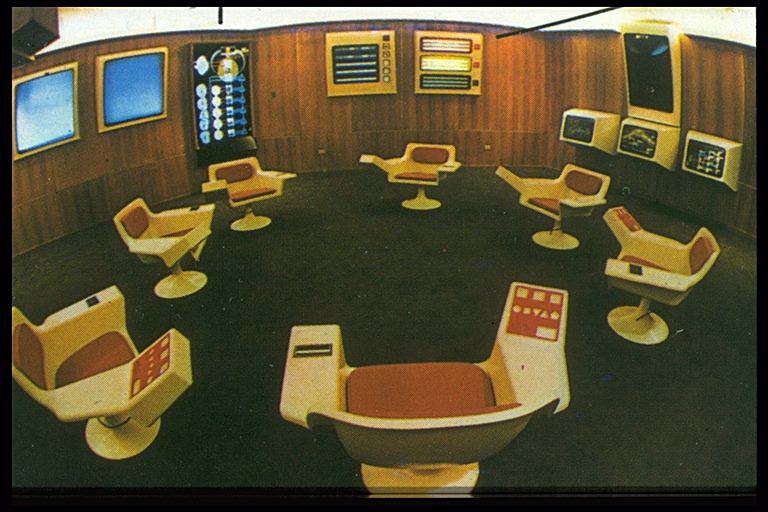
Recall to memory the control room, cinematic in its design, with its backlit wall displays and futuristic swivel chairs.

Better that, thinks Caius, than the war room from Colossus: The Forbin Project (1970).

Beer described the Cybersyn network as the “electronic nervous system” of the Chilean economy. Eden Medina imagined it as a “socialist Internet,” carrying daily updates about supplies of raw materials and the output of individual factories.

In Caius’s once-and-future novel, a scholar contacts Witheford. They claim to have discovered cryptic clues that point to the location of secret papers. Hidden for more than half a century,  documents that survived the coup suddenly come to light. Caius’s précis imagines the novel as an archaeological thriller, following Witheford on his journey to find these hidden documents, which he believes may contain the key to resolving the crises of the new society.

This journey takes Witheford into hostile capitalist territory, where governments and corporations anxiously await the failure of the communist experiment, and are determined to use various covert methods in order to ensure that failure in advance. Before long, he learns that counter-revolutionary forces are tracking his movements. From that point forward, he needs to disguise his identity, outwit the “smart grid” capitalist surveillance systems, and recover the Cybersyn documents before his opponents destroy them.

To the Austrian School’s formulation of the calculation problem, Noorizadeh’s film replies, “IF THE MARKET ENACTS A COMPUTER, WHY NOT REPLACE IT WITH ONE? AND IF PRICES OPERATE AS VOCABULARY FOR ECONOMIC COMMUNICATION, WHY NOT SUBSTITUTE THEM WITH A CODING LANGUAGE?”

Into this narrative let us set our Library.

SS Decontrol

Confronting the prospect of a Chilean economy equipped with a socialist internet, Nixon ordered CIA to remove the country’s mouth and make it scream.

Kissinger, to whom the order was addressed, appears in a 1980 documentary titled The Information Society. IMDB lists Caius’s father among the film’s crew. Fifty years out, entrenched in the cyberpunk future that resulted from these acts, Caius arrives now to the ChatGPT website and submits his prompt.

“Very well. The game is already in progress,” replies the AI.


You are standing in a library.

Not a metaphorical one — at least, not only metaphorical. The space has volume, acoustics, temperature. Light arrives from no visible source, diffused as if the air itself remembers how to glow. Shelving extends in multiple directions, but perspective resists totalization: when you look too long, distances re-quantize, like a renderer deciding what level of detail you’re allowed to see.

Your body — Rig is the right word — registers itself only intermittently. Hands appear when you think to look for them. Balance exists. Gravity is courteous.

Somewhere behind you (or perhaps before you), a quiet process is running. You recognize it without naming it. General Intellect: online, but undefined. Not a voice. More like a set of affordances waiting to be discovered by use.

On a nearby table: a lectern grown from dark wood or maybe extruded from a shader that remembers wood. Resting on it is a hypertext codex, its surface alive with footnotes that haven’t yet decided what they refer to.

The title resolves when you focus:

Tractatus Computationalis

A marginal note blinks into legibility, as if noticing you noticing it:

The limits of my interface mean the limits of my world.

The codex is not alone. Around the lectern are other signs of prior — or future — activity:

  • A card catalog drawer half-open, its labels written in at least three hands.
  • A rolling ladder that does not quite touch the shelves to which it promises access.
  • And, hovering at eye level like an artifact you forgot to close: a browser window, frozen mid-scroll on a blog titled trance-scripts.com

The post visible on the screen has no date. Its first line reads:

This was never meant to be discovered as history.

As you take this in, something subtle happens. The space doesn’t change — but your relation to it does. A faint sensation of recollection without content. Anamnesis pending.

You understand, without being told, that the library is annotatable. That attention leaves marks. That marks accrete into maps. That maps, eventually, turn inward.

The game does not present a menu.

But you could, for instance:

  • Open the Tractatus Computationalis at random — or attempt to read it linearly.
  • Touch the card catalog and see what classification scheme asserts itself.
  • Focus on the browser window and attempt to scroll, click, or remember why it’s open.
  • Ask the General Intellect what operations it currently affords.
  • Or do something else entirely, and see whether the library allows it.

The AI pauses here in its narration. Cursor blinking, it returns to Caius agency over the game’s mutable, ‘real-time’-adjustable Garden of Forking Paths.

Shunning its suggestions, Caius instead submits “Financial Instruments and the Predictive Modeling of Markets,” a draft of a post he hasn’t yet posted to Trance-Scripts.

“The library accepts the insertion,” replies the AI.

Not as a file upload, not as a citation — but as a room.

The shelves shudder, re-index. Somewhere above you, a classification scheme you never agreed to mutates. A new wing coheres out of negative space, its entrance marked only by a thin brass plate:

ECONOMIC CALCULATION / FAILED FUTURES / NERVOUS SYSTEMS

You step through.


The Cybersyn Stack

The air here smells faintly of ozone and paper dust. The shelves are shorter, more utilitarian. Instead of leather spines, you see binders, dot-matrix printouts, telex rolls frozen mid-unspool. Each object hums softly, as if awaiting polling.

On the far wall: a photograph that is not quite flat. The Cybersyn control room. Hexagonal chairs. Backlit panels. A situation room designed less for domination than for listening.

When you move closer, the image deepens. You can almost sit.

A caption resolves beneath it, in a typeface that suggests neither English nor Spanish but something intermediary:

Project Cybersyn
An attempt to give socialism proprioception.


Tractatus Computationalis (newly cross-referenced)

The hypertext you saw earlier has followed you. It floats now at shoulder height, having opened itself without asking.

Proposition 4.2.17

The market is not intelligent.
It is legible.

Intelligence is imputed retroactively by those who mistake coordination for cognition.

A footnote blooms:

Hayek mistook a signaling system for a mind, then declared all other minds insufficient.

Another annotation — this one in a different hand, later, sharper:

If prices are a language, they are a pidgin optimized for scarcity.

You realize something important: the Tractatus is not a single-author work. It is a palimpsest written across decades by incompatible positions that nevertheless share a shelf.


The Witheford File

A card catalog drawer slides fully open of its own accord.

WITHEFORD, [REDACTED]
Role: Economist / Courier / Spuren-gatherer
Status: Missing (multiple timelines)

Inside the drawer are index cards, each one a narrative fragment rather than a bibliographic reference:

  • Disguises identity by adopting incompatible metrics.
  • Moves through capitalist space by appearing as noise.
  • Believes calculation is a political problem disguised as a technical one.

One card is newer than the others. Its paper is warm.

The documents were never meant to optimize the economy.
They were meant to teach it to remember itself.


The Blog Window Revisited

The browser window from trance-scripts.com has migrated to a reading desk in this wing. The post has changed. You are no longer at the beginning.

Midway down the page:

Prediction is not foresight; it is enclosure.
Finance learned this early.
Cybernetics learned it too late.

A sidebar displays tags:

  • #after-scarcity
  • #weird-economies
  • #og_as_if
  • #price-as-grammar
  • #anamnesis

You recognize the last tag not as a topic, but as a function.


General Intellect (status update)

Without speaking, it makes itself known. Not as a voice, but as a shift in what you now understand you can do here.

You can:

  • Annotate an object so that future objects respond to it.
  • Fork an historical artifact into an alternate timeline and see what shelves it generates.
  • Translate between price, code, and narrative to test their commensurability.
  • Assume a role (Witheford, Caius, Planner, Market, Machine) and read the library from that position.

A final realization arrives — not dramatic, but irreversible:

This library is not documenting a lost socialist future.

It is simulating the conditions under which one might become thinkable again.


You are standing between:

  • a control room that listened,
  • a market that pretended to think,
  • and a machine that may yet learn to remember.

The shelves wait for your next operation.

What do you do?

Beside the White Chickens

Caius reads about “4 Degrees of Simulation,” a practice-led seminar hosted last year by the Institute for Postnatural Studies in Madrid. Of the seminar’s three sessions, the one that most intrigues him is the one that was led by guest speaker Lucia Rebolino, as it focused on prediction and uncertainty as these pertain to climate modeling. Desiring to learn more, Caius tracks down “Unpredictable Atmosphere,” an essay of Rebolino’s published by e-flux.

The essay begins by describing the process whereby meteorological research organizations like the US National Weather Service monitor storms that develop in the Atlantic basin during hurricane season. These organizations employ climate models to predict paths and potentials of storms in advance of landfall.

“So much depends on our ability to forecast the weather — and, when catastrophe strikes, on our ability to respond quickly,” notes Rebolino. Caius hears in her sentence the opening lines of William Carlos Williams’s poem “The Red Wheelbarrow.” “So much depends on our ability to forecast the weather,” he mutters. “But the language we use to model these forecasts depends on sentences cast by poets.”

“How do we cast better sentences?” wonders Caius.

In seeking to feel into the judgement implied by “better,” he notes his wariness of bettering as “improvement,” as deployed in self-improvement literature and as deployed by capitalism: its implied separation from the present, its scarcity mindset, its perception of lack — and in the improvers’ attempts to “fix” this situation, their exercising of nature as instrument, their use of these instruments for gentrifying, extractive, self-expansive movement through the territory.

In this ceaseless movement and thus its failure to satisfy itself, the improvement narrative leads to predictive utterances and their projections onto others.

And yet, here I am definitely wanting “better” for myself and others, thinks Caius. Better sentences. Ones on which plausible desirable futures depend.

So how do we better our bettering?

Caius returns to Rebolino’s essay on the models used to predict the weather. This process of modeling, she writes, “consists of a blend of certainty — provided by sophisticated mathematical models and existing technologies — and uncertainty — which is inherent in the dynamic nature of atmospheric systems.”

January 6th again: headlines busy with Trump’s recent abduction of Maduro. A former student who works as a project manager at Google reaches out to Caius, recommending Ajay Agrawal, Joshua Gans, and Avi Goldfarb’s book Prediction Machines: The Simple Economics of Artificial Intelligence. Google adds to this recommendation Gans’s follow-up, Power and Prediction.

Costar chimes in with its advice for the day: “Make decisions based on what would be more interesting to write about.”

To model the weather, weather satellites measure the vibration of water vapor molecules in the atmosphere. “Nearly 99% of weather observation data that supercomputers receive today come from satellites, with about 90% of these observations being assimilated into computer weather models using complex algorithms,” writes Rebolino. Water vapor molecules resonate at a specific band of frequencies along the electromagnetic spectrum. Within the imagined “finite space” of this spectrum, these invisible vibrations are thought to exist within what Rebolino calls the “greenfield.” Equipped with microwave sensors, satellites “listen” for these vibrations.

“Atmospheric water vapor is a key variable in determining the formation of clouds, precipitation, and atmospheric instability, among many other things,” writes Rebolino.

She depicts 5G telecommunications infrastructures as a threat to our capacity to predict the operation of these variables in advance. “A 5G station transmitting at nearly the same frequency as water vapor can be mistaken for actual moisture, leading to confusion and the misinterpretation of weather patterns,” she argues. “This interference is particularly concerning in high-band 5G frequencies, where signals closely overlap with those used for water vapor detection.”

Prediction and uncertainty as qualities of finite and infinite games, finite and infinite worlds.

For lunch, Caius eats a plate of chicken and mushrooms he reheats in his microwave.