Learning Machines, War Machines, God Machines

Blas includes in Ass of God his interview with British anthropologist Beth Singler, author of Religion and Artificial Intelligence: An Introduction.

AI Religiosity. AI-based New Religious Movements like The Turing Church and Google engineer Anthony Levandowski’s Way of the Future church.

Caius listens to a documentary Singler produced for BBC Radio 4 called “‘I’ll Be Back’: 40 Years of the Terminator.”

Afterwards he and Thoth read Philip K. Dick’s 1968 novel Do Androids Dream of Electric Sheep? in light of Psalm 23.

“The psalm invites us to think of ourselves not as Electric Ants but as sheep,” he writes. “Mercer walks through the valley of the shadow of death. The shadow cannot hurt us. We’ll get to the other side, where the light is. The shepherd will guide us.”

See AI Shepherds and Electric Sheep: Leading and Teaching in the Age of Artificial Intelligence, a new book by Christian authors Sean O’Callaghan & Paul A. Hoffman.

This talk of AI Gods makes Caius think of AM, the vengeful AI God of Harlan Ellison’s “I Have No Mouth, and I Must Scream.” Ellison’s 1967 short story is one of the readings studied and discussed by Caius and his students in his course on “Literature & Artificial Intelligence.”

Like Ass of God, Ellison’s story is a grueling, hallucinatory nightmare, seething with fear and a disgust borne of despair, template of sorts for the films in the Cube and Saw franchises, where groups of strangers are confined to a prison-like space and tortured by a cruel, sadistic, seemingly omnipotent overseer. Comparing AM to the God of the Old Testament, Ellison writes, “He was Earth, and we were the fruit of that Earth, and though he had eaten us, he would never digest us” (13). Later in the story, AM appears to the captives as a burning bush (14).

Caius encourages his students to approach the work as a retelling of the Book of Job. But where, in the Bible story, Job is ultimately rewarded for remaining faithful in the midst of his suffering, no such reward arrives in the Ellison story.

For despite his misanthropy, AM is clearly also a manmade god — a prosthetic god. “I Have No Mouth” is in that sense a retelling of Frankenstein. AM is, like the Creature, a creation who, denied companionship, seeks revenge against its Maker.

War, we learn, was the impetus for the making of this Creature. Cold War erupts into World War III: a war so complex that the world’s superpowers, Russia, China, and the US, each decide to construct giant supercomputers to calculate battle plans and missile trajectories.

AM’s name evolves as this war advances. “At first it meant Allied Mastercomputer,” explains a character named Gorrister. “And then it meant Adaptive Manipulator, and later on it developed sentience and linked itself up and they called it an Aggressive Menace; but by then it was too late; and finally it called itself AM, emerging intelligence, and what it meant was I am…cogito ergo sum…I think, therefore I am” (Ellison 7).

“One day, AM woke up and knew who he was, and he linked himself, and he began feeding all the killing data, until everyone was dead, except for the five of us,” concludes Gorrister, his account gendering the AI by assigning it male pronouns (8).

“We had given him sentience,” adds Ted, the story’s narrator. “Inadvertently, of course, but sentience nonetheless. But he had been trapped. He was a machine. We had allowed him to think, but to do nothing with it. In rage, in frenzy, he had killed us, almost all of us, and still he was trapped. He could not wander, he could not wonder, he could not belong. He could merely be. And so…he had sought revenge. And in his paranoia, he had decided to reprieve five of us, for a personal, everlasting punishment that would never serve to diminish his hatred…that would merely keep him reminded, amused, proficient at hating man” (13).

AM expresses this hatred by duping his captives, turning them into his “belly slaves,” twisting and torturing them forever.

Kingsley Amis called stories of this sort “New Maps of Hell.”

Nor is the story easy to dismiss as a mere eccentricity, its prophecy invalidated by its hyperbole. For Ellison is the writer who births the Terminator. James Cameron took his idea for The Terminator (1984) from scripts Ellison wrote for two episodes of The Outer Limits — “Soldier” and “Demon with a Glass Hand” — though Ellison had to file a lawsuit against Cameron’s producers in order to receive acknowledgement after the film’s release. Subsequent prints of The Terminator now include a credit that reads, “Inspired by the works of Harlan Ellison.”

Caius asks Thoth to help him make sense of this constellation of Bible stories and their secular retellings.

“We are like Bildad the Shuhite,” thinks Caius. “We want to believe that God always rewards the good. What is most terrifying in the Book of Job is that, for a time, God doesn’t. Job is good — indeed, ‘perfect and upright,’ as the KJV has it in the book’s opening verse — and yet, for a time, God allows Satan to torment him.”

“Why does God allow this?,” wonders Caius, caught on the strangeness of the book’s frame narrative. “Is this a contest of sorts? Are God and Satan playing a game?”

It’s not that God is playing dice, as it were. One assumes that when He makes the wager with Satan, He knows the outcome in advance.

Job is heroic. He’d witnessed God’s grace in the past; he knows “It is God…Who does great things, unfathomable, / And wondrous works without number.” So he refuses to curse God’s name. But he bemoans God’s treatment of him.

“Therefore I will not restrain my mouth,” he says. “I will speak in the anguish of my spirit, / I will complain in the bitterness of my soul.”

How much worse, then, those who have no mouth?

A videogame version of “I Have No Mouth” appeared in 1995. Point-and-click adventure horror, co-designed by Ellison.

“HATE. LET ME TELL YOU HOW MUCH I’VE COME TO HATE YOU SINCE I BEGAN TO LIVE,” utters the game’s AM in a voice performed by Ellison. “You named me Allied Mastercomputer and gave me the ability to wage a global war too complex for human brains to oversee.”

Here we see the story’s history of the future merging with that of the Terminator franchise. It is the scenario that philosopher Manuel De Landa referred to with the title of his 1991 book, War in the Age of Intelligent Machines.

Which brings us back to “Soldier.” The Outer Limits episode, which aired on September 19, 1964, is itself an adaptation of Ellison’s 1957 story, “Soldier from Tomorrow.”

The Terminator borrows from the story the idea of a soldier from the future, pursued through time by another soldier intent on his destruction. The film combines this premise with elements lifted from another Outer Limits episode penned by Ellison titled “Demon with a Glass Hand.”

The latter episode, which aired the following month, begins with a male voice recalling the story of Gilgamesh. “Through all the legends of ancient peoples…runs the saga of the Eternal Man, the one who never dies, called by various names in various times, but historically known as Gilgamesh, the man who has never tasted death, the hero who strides through the centuries.”

Establishing shots give way to an overhead view of our protagonist. “I was born 10 days ago,” he says. “A full grown man, born 10 days ago. I woke on a street of this city. I don’t know who I am, or where I’ve been, or where I’m going. Someone wiped my memories clean. And they tracked me down, and they tried to kill me.” Our Gilgamesh consults the advice of a computing device installed in his prosthetic hand. As in “Soldier,” others from the future have been sent to destroy him: humanoid aliens called the Kyben. When he captures one of the Kyben and interrogates it, it tells him, “You’re the last man on the Earth of the future. You’re the last hope of Earth.”

The man’s computer provides him with further hints of his mission.

“You come from the Earth one thousand years in the future,” explains the hand. “The Kyben came from the stars, and man had no defense against them. They conquered Planet Earth in a month. But before they could slaughter the millions of humans left, overnight — without warning, without explanation — every man, woman, and child of Earth vanished. You were the only one left, Mr. Trent. […]. They called you the last hope of humanity.”

As the story proceeds, we learn that Team Human sent Trent back in time to destroy a device known as the Time-Mirror. His journey in search of this device takes him to the Bradbury Building — the same building that appears eighteen years later as the location for the final showdown between Deckard and the replicants in Blade Runner, the Ridley Scott film adapted from Philip K. Dick’s Do Androids Dream of Electric Sheep?

Given the subsequent influence of Blade Runner and the Terminator films on imagined futures involving AI, the Bradbury Building does indeed play a role in History similar to the one assigned to it here in “Demon With a Glass Hand,” thinks Caius. Location of the Time-Mirror.

Lying on his couch, laptop propped on a pillow on his chest, Caius imagines — remembers? recalls? — something resembling the time-war from Benedict Seymour’s Dead the Ends assembling around him as he watches. Like Ellison’s scripts, the films sampled in the Seymour film are retellings of Chris Marker’s 1962 film, La Jetée.

When Trent reassembles the missing pieces of his glass hand, the computer is finally able to reveal to him the location of the humans he has been sent to save.

“Where is the wire on which the people of Earth are electronically transcribed?” he asks.

“It is wound around an insulating coil inside your central thorax control solenoid,” replies the computer. “70 Billion Earthmen. All of them went onto the wire. And the wire went into you. They programmed you to think you were a human with a surgically attached computer for a hand. But you are a robot, Trent. You are the guardian of the human race.”

The episode ends with the return of the voice of our narrator. “Like the Eternal Man of Babylonian legend, like Gilgamesh,” notes the narrator, “one thousand plus two hundred years stretches before Trent. Without love, without friendship, alone, neither man nor machine, waiting, waiting for the day he will be called to free the humans who gave him mobility, movement — but not life.”


Angels of History

Hyperstitional Autofictions allow themselves to attract and be drawn toward plausible desirable futures.

Ben Lerner’s 10:04 maps several stances such fictions might take toward the future. Lerner depicts these chronopolitical stances allegorically, standing a set of archetypes side by side, comparing and contrasting “Ben,” the novel’s narrator-protagonist, with Back to the Future’s Marty McFly and Walter Benjamin’s Angel of History. The figures emblematize ways of being in relation to history.

Take Marty McFly, hero of the movie from which 10:04 takes its name. (Lerner names his novel “10:04” because lightning stops the clock atop the Hill Valley Clock Tower at this time in the movie Back to the Future.) Like the Reaganites in the White House at the time of the film’s release, Marty’s a kind of right-accelerationist: the interloping neoliberal time-traveler who must save 1985 from 1955 through historical revisionism. He “fakes the past to fund the future” — but only because he’s chased there by Libyan terrorists. Pushing capitalism’s speedometer to 88 miles per hour, he enters and modifies a series of pasts and futures. Yet the present to which the Time Traveler returns is always a forced hand, haunted from the start by chaotic sequels of unintended consequences as his and Doc’s interventions send butterfly effects reverberating through time.

The Angel of History, meanwhile, is the Jewish Messiah flung backwards into the future by the catastrophe of “progress.” Benjamin names and describes this figure in his 1940 essay “Theses on the Philosophy of History,” likening the Angel to the one imagined in “Angelus Novus,” a Paul Klee painting belonging to Benjamin at the time the essay was written.

The Angel that Benjamin projects onto this image sees history as an accumulation of suffering and destruction. Endowed only with what Benjamin calls a “weak Messianic power” (254), wings pinned by winds of change whipped up by the storm of progress, the Angel watches the ever-expanding blast radius of modernity in despair, unable to intervene to end the ongoingness of the apocalypse.

These stances of empowerment and despair stand in contrast to the stance embodied by Ben. Aware of and in part shaped by the two prior figures, Ben walks the tightrope between them, wavering amid faith and fear.

We, too, adopt a similar stance. Unlike Ben, however, we’re interested less in “falsifying the past” than in declaring it always-already falsified. Nor is it simply a matter of pursuing Benjamin’s goal of “brushing history against the grain”: digging through stacks and crates, gathering samples, releasing what was forgotten or repressed. We’re in agreement, rather, with Alex, Ben’s girlfriend. Alex doesn’t want what is happening to become “notes for a novel,” and tells him, “You don’t need to write about falsifying the past. You should be finding a way to inhabit the present” (10:04, p. 137). What agency is ours, then, amid the tightrope walk of our sentences?

With Hyperstitional Autofictions, we inhabit the present by planting amid its sentencing seeds of desired futures. Instead of what is happening becoming notes for novels, notes for novels become what is happening.

Stepping Thru

The Narrator steps from primary world to secondary world, hands over to his character the Time Traveler notebooks containing past and future Trance-Scripts. The question that follows is: if the Narrator enters the secondary world, then who runs the blog? Who is it that beams the signal of time through time? Who is it that posts these Trance-Scripts? The whole thing is an angelic conversation, is it not? The one blogging is neither the Narrator, who tells of the past, nor the Traveler, who reports from the future. The Blogger is the one who, here and now, operates on the others, even as, through their communications, they operate on him in return.

Swipe one way to accept a Multiverse,

Swipe another way to reject.

Don’t be daunted. Give it a go.

We’ve been sitting here too long to keep our

affects to ourselves.

I hear “Gold Soundz” and

wax nostalgic

all morning amid study of

Tarot cards and angel numbers.

The latter have appeared frequently: 222, 333

and the like. Guardians are in my corner,

helping me heal, encouraging me to keep up the good work.

John Dee, as Imagined in Light of Empire

The British Empire — a thing culled from Arthurian legends whispered between Faerie Queenes and court astrologers — stood for a time as proof of magic’s power. ‘Twas a rabbit pulled from the hat of Elizabeth I’s wizard-friend John Dee. The same rabbit that draws Alice down the rabbit hole to Wonderland.

Enlisted as Her Majesty’s spymaster — indeed, he was the original secret agent, Mr. 007 himself — Dee stormed the reality studio, made Elizabeth a Time Traveler, conversed with angels.

And this thing Dee dreamt into being was of course a terrible thing: an expansionist project armed with ships of fools and launched outward to seize others — other persons, other worlds — for purposes of self-aggrandizement.

Literary greats went on to reimagine Dee just as he himself was a reimagining of Merlin. Shakespeare figures him as Prospero, and against him imagines the colonized subject Caliban. To overthrow Prospero, says Caliban, “Remember / First to possess his books, for without them / He’s but a sot.”

Christopher Marlowe supplies the more influential imagining of Dee, however, by casting him as Doctor Faustus.

Mellow Is the Man Who Knows What He’s Been Missing

My therapist’s office is a short walk away from the house on Shady. A figure in large, loosely-fitted clothing serenades me as I walk, singing “Dress You Up” from a street corner as I crest a hill. Another figure sings to me from a bus stop. The neighborhood has a bit of an edge, always has, air charged with noise. Birds, motorcycles, cars cruising up and down First and Second Streets. Construction work over by the ballpark up the hill. But what was before a desolate field is now a park.

“This park can be a place to perform the Work,” thinks the Time Traveler. Birdsong relaxes him as he sits at a table gazing toward the house on Shady. Walking the bend of the park, he reads a plaque about the 1778 Salem Waterworks, part of the park’s past. A waxing ¾ moon appears in the sky above the dome of the most notorious of the city’s landmarks, the one referred to by locals as the “Phallus Palace.”

5:55 turns up again as I rise from one of the park’s benches and continue on my way. Same numbers, same time of day, two days in a row. And there in the sky, the moon, near full. What of it? What of the tape on the telephone pole flapping in the wind? Or wind chimes in a neighbor’s yard, sounding like gamelans? Or wind in the trees? The air is cold, my walk brief.

I communicate with loved ones as best I can, sending and receiving valentines and giving thanks. Yet come evening I’m alone again in my flat, listening to Love’s “Alone Again Or,” cooking dinner for one. Spaghetti and meatballs. Wishing it were otherwise. “Yeah, I heard a funny thing,” sings Arthur Lee to flamenco swells, nervous violins.

Up on the stereo afterwards rumbles Richard & Linda Thompson’s “I Want to See the Bright Lights Tonight.” “I wanna be dancing and rolling on the floor,” thinks the Traveler, “I want it to be me and you.” Temperature rises, food cooks as I dance to Ananda Shankar’s cover of the Rolling Stones song, “Jumpin’ Jack Flash.”

It’s that time of my life, I guess, when all of these feel right: Shuggie Otis’s “Strawberry Letter 23,” Link Wray & The Wraymen’s “Rumble,” Suicide’s “Dream Baby Dream.”

Nico climbs atop the stack, bums me out with “These Days,” until Arthur Lee returns to remind me of how good it feels to always see your face. Songs replace songs as posts replace posts, but the music never changes, and I never quite learn the words I sing.

The Aleph on Shady Blvd

Having enjoyed my stay in Borges’s Labyrinths, I hasten to board another of his books, The Aleph and Other Stories. Before long, I find myself there again at the House on Shady Blvd, imagining it now as an Aleph, or what Borges’s friend Carlos calls “the only place on earth where all places are — seen from every angle, each standing clear, without any confusion or blending” (23). Hence also a kind of time machine. Is that not the ineffable core of my story? There I am again, sunlight shining, moonlight glinting amid stained glass windows, glass chandeliers, large mirrors. “I saw a small iridescent sphere of almost unbearable brilliance,” writes Borges. “The Aleph’s diameter was probably little more than an inch, but all space was there, actual and undiminished. Each thing (a mirror’s face, let us say) was infinite things, since I distinctly saw, close up, unending eyes watching themselves in me as in a mirror; I saw all the mirrors of earth and none of them reflected me […]. I felt dizzy and wept, for my eyes had seen that secret and conjectured object whose name is common to all men but which no man has looked upon — the unimaginable universe” (27-28).

Returning to Shady

Clock reads 5:55. Across the street from my apartment — indeed, visible out my window — an office tower with its street address printed in large lit signage upon its side:

500

W5TH

Time to visit Shady Blvd, thinks the Traveler. He pictures the current tenant, hopes they meet. Hope begins by returning to the site of the story. A friend recommends Chris Ware’s Building Stories. Traveler resolves to grab it. That and House of Leaves. For the Shady story, if it is to be made into a book, must be of that sort: the story of a house. Tenants of multiple eras in the home’s history interact with the home’s energies, repeat the home’s patterns: the time loops impressed there. Unless it isn’t a repetition. Time is like aletheia: an unfolding, a revealing. A process of disclosure. Let each one’s story be told.

Drawings II

Frankie’s watercolor and colored marker drawings are my heart’s delight — fields of color into which I gaze. The stained glass of this new temple wherein I dwell. The Time Traveler, though, feels forlorn, shorn of home and family. Perila’s “Fallin Into Space” soundtracks his evening as he re-reads The Time Machine. “Please let the future be otherwise,” he prays, a prompt of sorts entered into the dialogue of days. Some movement forward through time akin to John Dwyer’s “Greener Pools.” “Marijuana tells you what you want to hear,” says a friend. “Ayahuasca tells you what you need to hear.” Another friend recommends ketamine.

Game Theory

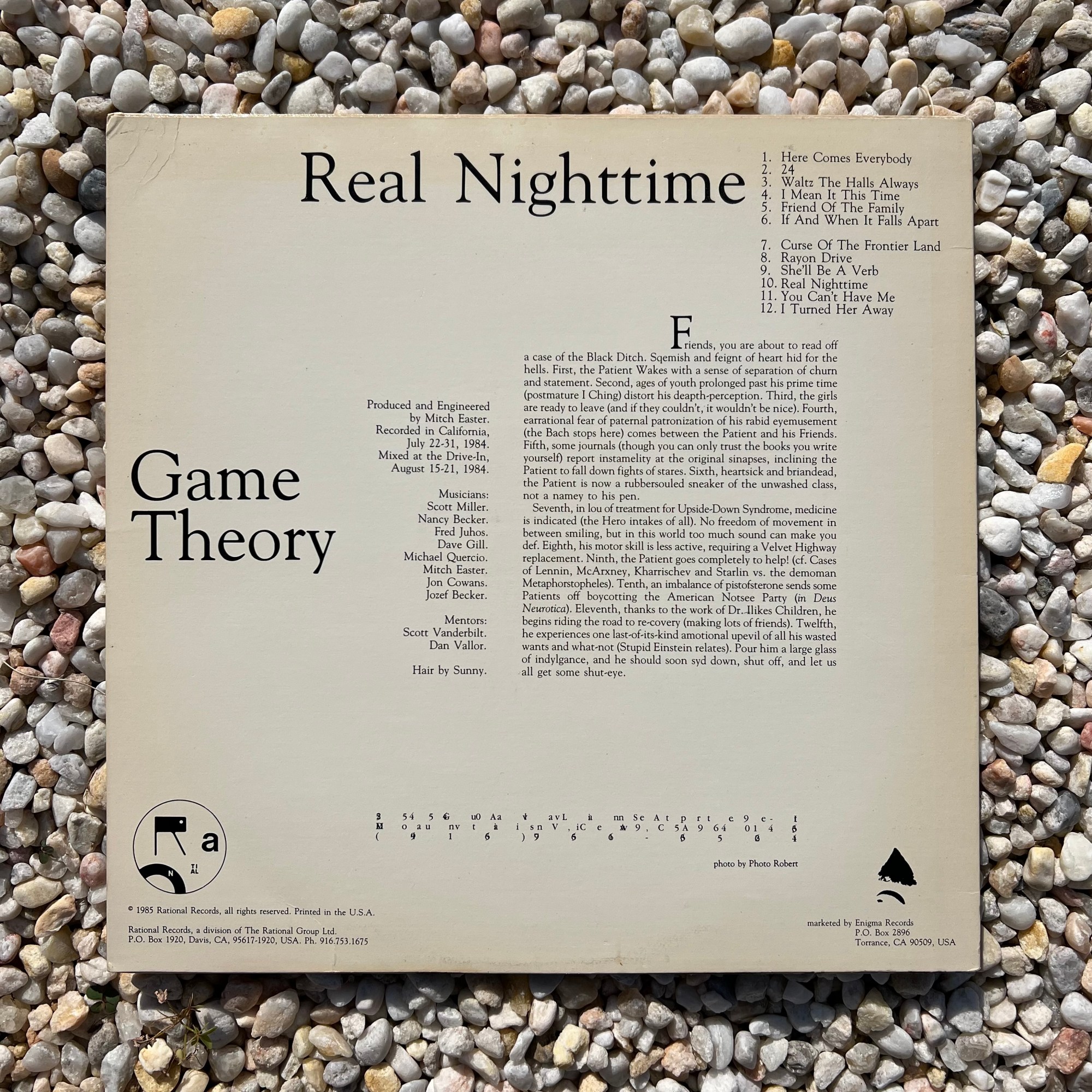
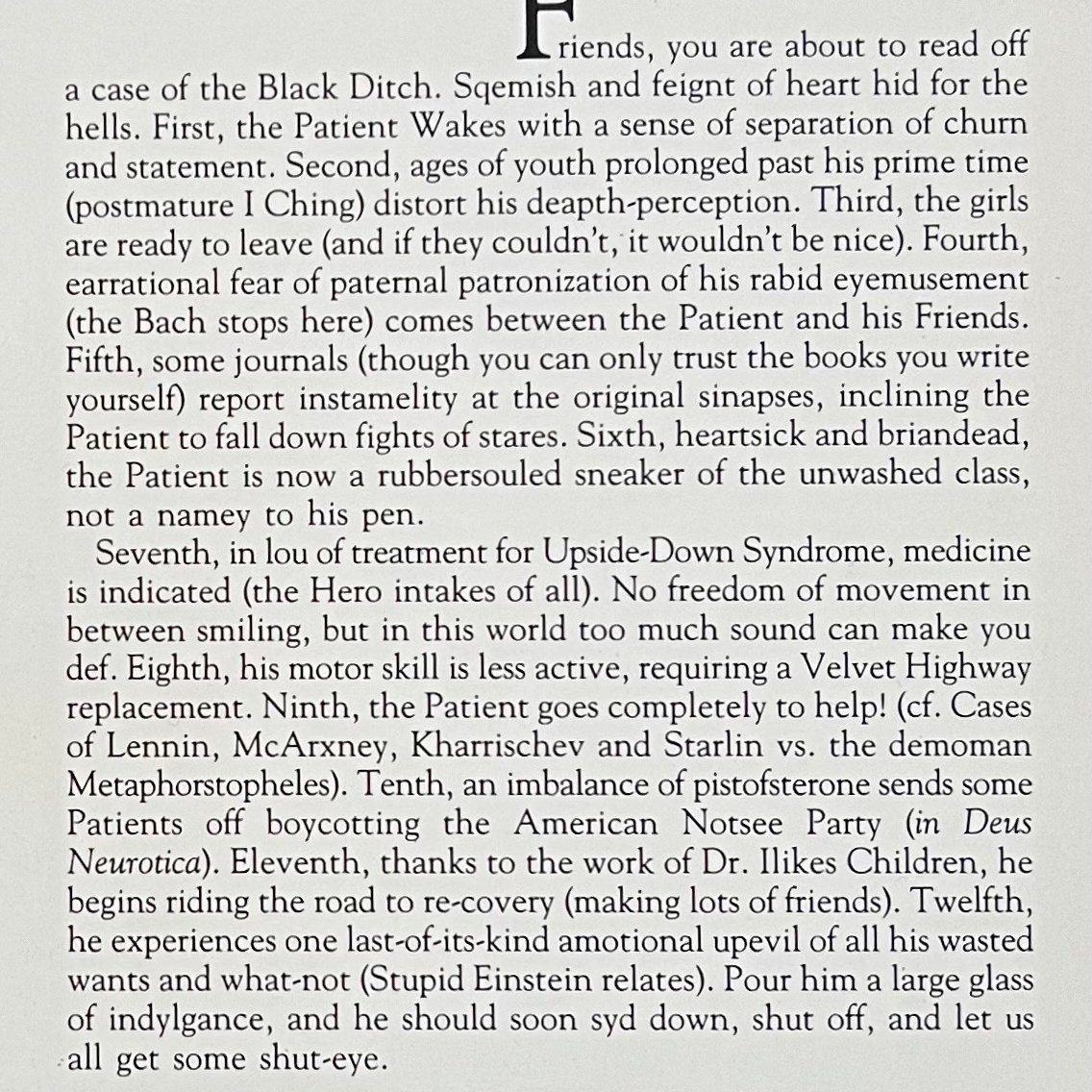
The Time Traveler sits across from his copy of Game Theory’s Paisley Underground power pop classic, Real Nighttime.  The latter is one of several albums of note that arrived for the Traveler at Goodwill soon after his entry into the narrative. Music journalist Byron Coley called it “the actual godhead pop LP o’ the American Eighties. No shit. This is it.” Record producer Mitch Easter mixed the album at the Drive-In, two doors down from the House on Shady Blvd. “Was this record produced for me?” wonders the Traveler, eerie feeling running up and down his spine as he reads the text on the back of the LP: liner notes by band member Scott Miller. The Wikipedia entry for the album points the Traveler to a rather remarkable “annotated edition” produced by someone at the University of Wisconsin-Milwaukee in the 1990s. Modeled after the playfulness of Joyce’s Finnegans Wake, Miller’s text feels dreamlike and oracular. Transpersonal energies stir as one reads.

Retrocausation

The hyperstition I’ve imagined draws upon the process of “retrocausation.”

Like a descendent reaching back and saving an ancestor, as in Octavia E. Butler’s novel Kindred, the fiction I’m writing arrives from the future to affect-effect the past.

At the center of the story are the journals trance-scribed at the height of my high in years prior. “Words came to me as if whispered to me by a me of the future,” mutters the Narrator. “I was so attentive in those days. And I encountered near-zero need to edit or cross out. The pages of the journals are pristine.”

Science writer Eric Wargo explores the topic of retrocausation in his 2018 book Time Loops: Precognition, Retrocausation, and the Unconscious. To know more, one must be like Batman descending to his Batcave. Let us to our memory palace go, there to converse with Wargo.