The Traveler claims to have departed the space-time of the dinner party by boarding a vehicle he built in his laboratory. The machine resembles a bicycle. By sitting upon it and manipulating a pair of levers, the Traveler observes his life-world transforming rapidly all around him, the whole flashing as in a sequence of motion studies projected onto a kind of spherical surround. It’s as if the Traveler has drawn around himself a magic circle, like the kind described by Johan Huizinga in Homo Ludens and Mircea Eliade in The Sacred and the Profane. He sees land transformed over hundreds of thousands of years, while he himself sits safely (albeit uncomfortably), within the circle drawn by his machine, occupying a sphere of local, personal, existential time, divorced from the duration of the years passing around him.
Tag: Weird Fiction
Narrating an Act of Time Travel
How does one narrate an act of time travel? And who is one’s audience? In Wells’s The Time Machine, narration unfolds by way of a story within a story. There’s the narrator, a cautious-but-ultimately-optimistic attendee at a series of dinner parties, who speaks only in the book’s intro and conclusion; and then there’s the host of these parties, the Time Traveler. The core of the novel consists of the account given by this latter figure upon his return from the future.
Entry of the Ghost into the Narrative
The Ghost reminds me of me. There it is dancing alone in my apartment, singing “I want you to hold me,” as the Violent Femmes do on their song “American Music.” The Ghost thinks its lovers speak to it through the songs on its radio.
It sets forth each night assured of this, listening as one such lover follows “Gold Soundz” and “A Pillar of Salt” with “Lariat” and “Web in Front.” “If it means I get to hear you singing to me,” reasons the Ghost, “if it means our last words weren’t wasted, then so be it.”
Inspired by the aforementioned, Ghost decides on a whim to live well again. It comes and goes as it pleases amid the timestream of its ghosting, resolved in each instance to rip it up and start again.
Replace “Old Sounds” With “Gold Soundz”
“Going back to old sounds won’t help,” thinks the Time Traveler. “Do so and the Narrator stands revealed as a bloody mother fucking asshole.”
The Narrator, not quite omniscient and thus taken aback by the thought, asks of his sub-creation, “You think so?” “What, then?” he wonders. “Do we edit the entries to make me likable? What would we write instead?”
Thus it happens, thinks the Traveler. “The Ghost would have to enter into the narrative,” he says. We know for certain that some such being spoke to us via auditory hallucination, don’t we? And we know as well that it was already there, doing its work upon us in the house, prior to our introduction to marijuana. The latter didn’t invent the Ghost — but it amplified it. It gave it back its voice. Let us open ourselves to the Ghost, then, and recognize it as a potential for apartness within us that is always-already part of us. Once we accept all that is loop-like, all that is like Ouroboros in our nature, we reveal ourselves as we are, infinite: a single, transtemporal, interdimensional being, enunciating itself across time.
Confronting the Obstacle
One version of the narrative begins with the Narrator rereading old trance-scripts, feeling unhappy with his former self’s negative self-image. He arrives to a realization of how much of an obstacle he was to his flourishing. The Narrator wonders: should I “burn the diaries,” as Canadian poet Moyra Davey recommends? Should I edit, revise, re-sequence events? Is that how one creates an Alter-Destiny?
The Text and Its Author
The Narrator admits that it wasn’t until well after the end of his stay on Shady that he first came to think of the place as haunted.
“Drug-induced trances revived my writing practice during the years of my tenancy,” confesses the Narrator. “It was as if a voice spoke to me,” he says, “telling me what to write.”
“The Text I produced during those years,” exclaims the Narrator, “was in all sincerity written by the home itself, was it not?”
“I should think so,” opines the Traveler, “though I know neither the how nor the why, neither the here nor the there of it. It was written by the home…or by the spirits who dwell therein.”
“Spirits, then, if you must,” nods the Narrator, with what may in hindsight seem a touch too much vigor. “Yes, perhaps! The one explanation makes near as much sense as the other. Let us see!”
Frequently Asked Questions
Some of us are wondering: Who is the Narrator? Who tells the story, and to whom?
Is the tale told at a remove by a skeptic? By a future occupant who, moved into the home at a distant date, discovers a former occupant’s trance-scripts, the latter having been stored either in a box in the attic or in a time capsule in the yard?
Does the home make similar events occur as these terma or “treasure-texts” reenter history?
Is the story a cautionary tale? A warning? A case study?
Is the Narrator a time detective? Has he been sent from the future to investigate a Text written by one of the home’s former occupants: a wizard who went missing from known timelines after claiming to have devised a working means of time travel?
Is the Narrator a postmodern schizophrenic? Twenty-first Century Schizoid Man? Is part of him a time traveler wanting to go back to live his past differently? What would he change?
The act of retrospection must be dramatized. Let us assume first, then, that the House on Shady Boulevard is a time loop. People who live in the home oscillate to its frequencies. They relive its ecstasies and traumas — though always with a difference. The tale, then, is one told by someone who, years after his time living in the home on Shady, attempts, through writing, to avoid the past’s recurrence.
The Wizard’s Tastes, as Expressed Through Interior Design
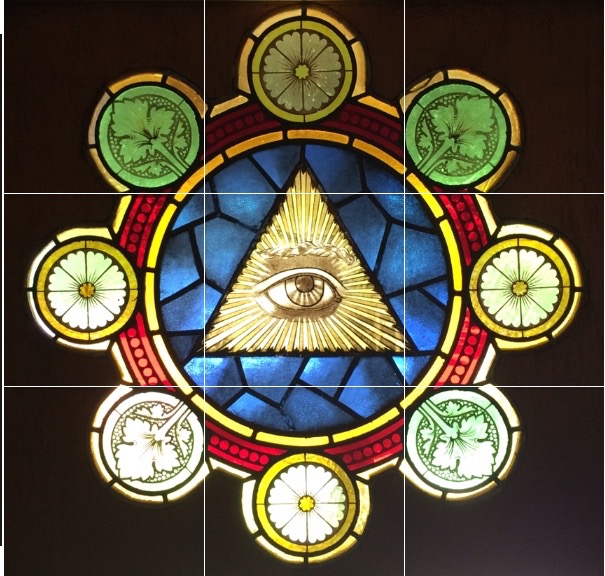
In design terms, the Wizard’s tastes skewed toward the epic, the ornate — total art! cosmic syncretism! He hung large antique mirrors on walls in three of the home’s rooms; he filled most of the home’s windows with stained glass, including a large window at the front of the house featuring an image of the Eye of Providence — the latter retrieved, I’m told, from either a former church or a former Masonic Temple. From the ceilings of those of the home’s rooms adorned with foxed mirrors, he added dazzling, many-armed, many-bulbed chandeliers — beautiful, gaudy, dusty old things! The home’s several built-in bookcases may have been of his making as well — as were one room’s shelves sized for storage of records. The most characteristic of his contributions, though, was the imp crouched atop the home’s door bell, or the pair of werewolves carved into the corners of a mantle atop one room’s fireplace.


The Move-In
When Sarah and I first moved in, we hired a team of local movers to help us unload. One of the movers took one look at the werewolves, and one look at the Eye of Providence, and said, “Y’all ought to have a preacher come and bless this place.”
Weird Occurrences
Suffice to say, we had some weird occurrences there at the home we rented on Shady. None of it seemed malevolent in intent — just a bit weird. I developed a writing practice during my time there involving self-induced trance states, similar to the surrealist practice of “automatic writing.” I experienced auditory hallucinations, where it felt like I was hearing voices. Some of this was admittedly disconcerting at first. I realized almost immediately, however, that I could write some of it down. I could take notes like a kind of sleuth. And so, a Text began to germinate — one I transcribed gratefully, in a state of silent absorption as I listened.
Hence these trance-scripts.
As for the house, Frank sold it when we moved out — and from what I’ve heard, he tempered the decor when preparing to put the place on the market. Thankfully, however, I have some photos of how it looked when I was there.
I have the photos…and I have the Text.
 Trance-Scripts