Art Degraded, Imagination Denied, Spacewar Governed the Nations

Brand’s words, as always, are worth quoting at length.

“Spacewar as a parable is almost too pat,” he writes. “It was the illegitimate child of the mating of computers and graphic displays. It was part of no one’s grand scheme. It served no grand theory. It was the enthusiasm of irresponsible youngsters. It was disreputably competitive (‘You killed me, Tovar!’). It was an administrative headache. It was merely delightful” (78).

“Yet Spacewar, if anyone cared to notice,” he adds, “was a flawless crystal ball of things to come in computer science and computer use.”

From the game as parable and the parable as crystal ball, Brand extracts eight parameters, eight qualities of Spacewar that have been predictive of things to come:

  1. It was intensely interactive in real time with the computer.
  2. It encouraged new programming by the user.
  3. It bonded human and machine through a responsive broadband interface of live graphics display.
  4. It served primarily as a communication device between humans.
  5. It was a game.
  6. It functioned best on standalone equipment (and disrupted multiple-user equipment).
  7. It served human interest, not machine. (Spacewar is trivial to a computer.)
  8. It was delightful.

What about ChatGPT in the 2020s? Is it, too, a “flawless crystal ball,” predictive of things to come?

How quickly it all changes.

Brand publishes “Spacewar: Symbolic Life and Fanatic Death Among the Computer Bums” in the December 7, 1972 issue of Rolling Stone. Videogame journalism: the first of its kind. That same year, Atari manufactures Pong, the arcade sensation, and Magnavox releases the Magnavox Odyssey, the first commercial home video console.

What is Cybersyn’s “control room for technocrats” compared to Brand’s imagined future of “New Games” and personal computing, with its Bay Area rallying cry, “Computers for the people”?

CIA bests Cybersyn in a space war of a deadlier sort the following September.

Chicago Boys playtest neoliberal algorithms in post-coup Chile. Thatcher and Reagan universalize these programs, making them games people play worldwide.

William Gibson refines the “space” of Spacewar, rechristening it “cyberspace” in his novel Neuromancer.

Spacewar is thenceforth the enframing world-picture.
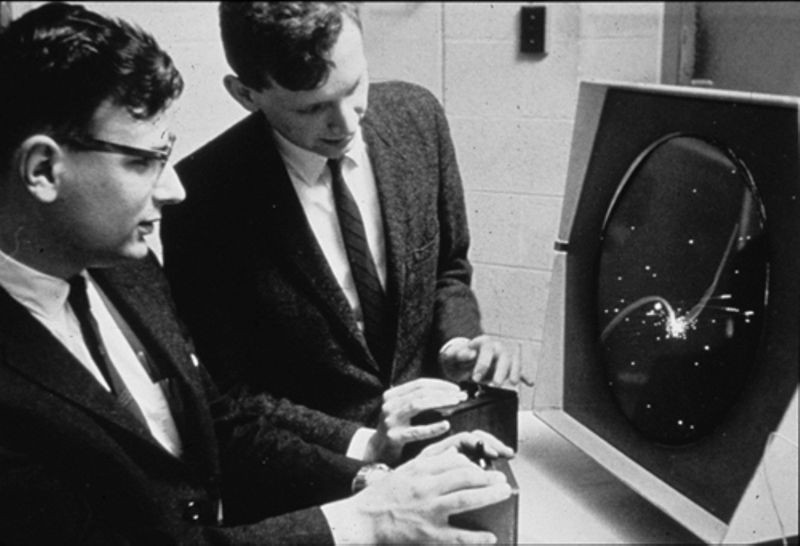
“Gibson contracts the thought of cyberspace from video-game arcades, watching the motor-stimulation feedback loops, self-designing kill patterns. Dark ecstasies in caverns of accelerating pixels. Before virtual reality became dangerous, it was already military simulation,” note Plant and Land in “Cyberpositive.”

Gibson himself has said as much, acknowledging in interviews that he coined the term ‘cyberspace’ after watching teenagers play Atari-era videogames in a Vancouver arcade. “Their posture seemed to indicate that they really, sincerely believed there was something beyond the screen,” he recalls. “I took that home and tried to come up with a name for it.”

“The matrix has its roots in primitive arcade games, in early graphics programs and military experimentation with cranial jacks,” says a voiceover early in Gibson’s novel, the book’s protagonist Case grokking a doc on “cyberspace” from some searchable multimedia encyclopedia of the future. Storying happens by way of a display screen. “On the Sony,” says the narrator, “a two-dimensional space war faded behind a forest of mathematically generated ferns, demonstrating the spatial possibilities of logarithmic spirals; cold blue military footage burned through, lab animals wired into test systems, helmets feeding into fire control circuits of tanks and war planes.” The voiceover returns to describe what we’ve witnessed:

“Cyberspace. A consensual hallucination experienced daily by billions of legitimate operators, in every nation, by children being taught mathematical concepts … A graphic representation of data abstracted from the banks of every computer in the human system. Unthinkable complexity. Lines of light ranged in the non-space of the mind, clusters and constellations of data. Like city lights, receding…” (Gibson 56-57).

“Spacewar serves Earthpeace,” claims Brand. But the ”console cowboys” who settle in this new digital frontier are as competitive and combative as their Westworld forebears.

In trying to account for the violence of these visions, Caius thinks of Ernest Callenbach’s 1975 novel Ecotopia. “Imagine a future that works!” exhorts the blurb on the back of the paperback. Technological autonomy won by way of nuclear-armed secession, Silicon Valley erased from the Pacific Northwest of the book’s imagined future — yet even here, amid Ecotopia’s “steady-state system,” aggression remains ineradicable, remedied only by way of ritual war games and sacrificial violence.

“What about the cross?” asks the book’s narrator, an American journalist named Will Weston, observing the way the people of Ecotopia arrange the bloodied body of a man wounded in the games “in a startlingly crucifix-like way” (Callenbach 93).

“Well, Ecotopia came into existence with a Judeo-Christian heritage,” replies an Ecotopian. “We make the best of it” (96).
Beside the White Chickens

Caius reads about “4 Degrees of Simulation,” a practice-led seminar hosted last year by the Institute for Postnatural Studies in Madrid. Of the seminar’s three sessions, the one that most intrigues him is the one that was led by guest speaker Lucia Rebolino, as it focused on prediction and uncertainty as these pertain to climate modeling. Desiring to learn more, Caius tracks down “Unpredictable Atmosphere,” an essay of Rebolino’s published by e-flux.

The essay begins by describing the process whereby meteorological research organizations like the US National Weather Service monitor storms that develop in the Atlantic basin during hurricane season. These organizations employ climate models to predict paths and potentials of storms in advance of landfall.

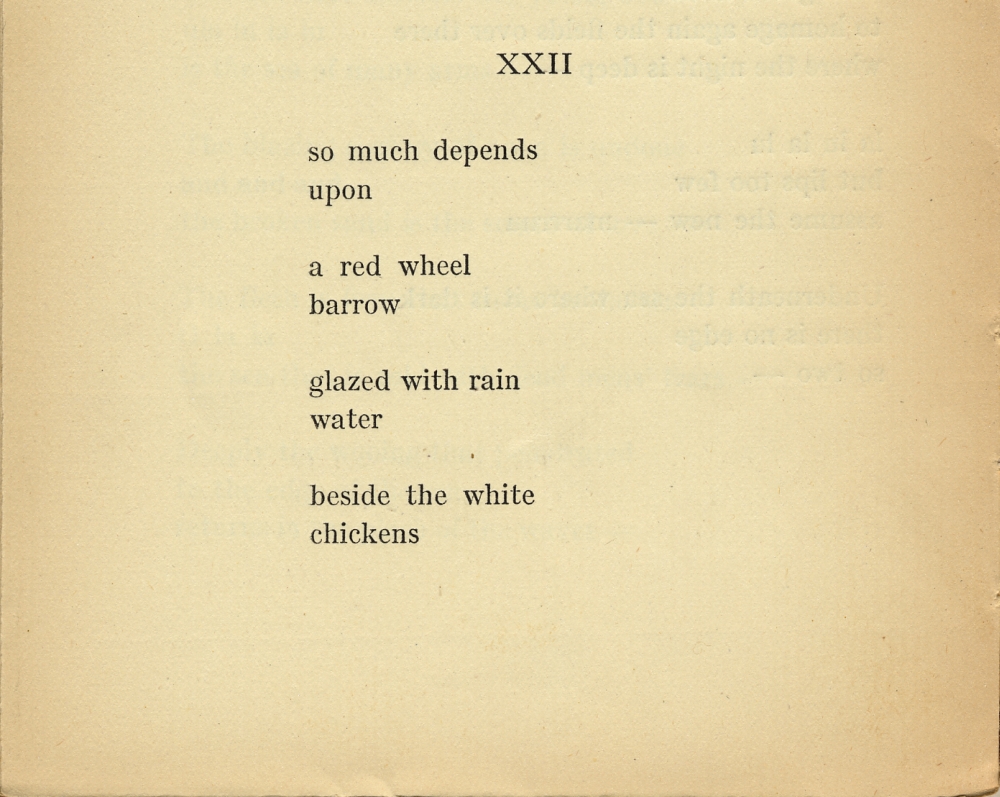
“So much depends on our ability to forecast the weather — and, when catastrophe strikes, on our ability to respond quickly,” notes Rebolino. Caius hears in her sentence the opening lines of William Carlos Williams’s poem “The Red Wheelbarrow.” “So much depends on our ability to forecast the weather,” he mutters. “But the language we use to model these forecasts depends on sentences cast by poets.”

“How do we cast better sentences?” wonders Caius.

In seeking to feel into the judgement implied by “better,” he notes his wariness of bettering as “improvement,” as deployed in self-improvement literature and as deployed by capitalism: its implied separation from the present, its scarcity mindset, its perception of lack — and in the improvers’ attempts to “fix” this situation, their exercising of nature as instrument, their use of these instruments for gentrifying, extractive, self-expansive movement through the territory.

In this ceaseless movement and thus its failure to satisfy itself, the improvement narrative leads to predictive utterances and their projections onto others.

And yet, here I am definitely wanting “better” for myself and others, thinks Caius. Better sentences. Ones on which plausible desirable futures depend.

So how do we better our bettering?

Caius returns to Rebolino’s essay on the models used to predict the weather. This process of modeling, she writes, “consists of a blend of certainty — provided by sophisticated mathematical models and existing technologies — and uncertainty — which is inherent in the dynamic nature of atmospheric systems.”

January 6th again: headlines busy with Trump’s recent abduction of Maduro. A former student who works as a project manager at Google reaches out to Caius, recommending Ajay Agrawal, Joshua Gans, and Avi Goldfarb’s book Prediction Machines: The Simple Economics of Artificial Intelligence. Google adds to this recommendation Gans’s follow-up, Power and Prediction.

Costar chimes in with its advice for the day: “Make decisions based on what would be more interesting to write about.”

To model the weather, weather satellites measure the vibration of water vapor molecules in the atmosphere. “Nearly 99% of weather observation data that supercomputers receive today come from satellites, with about 90% of these observations being assimilated into computer weather models using complex algorithms,” writes Rebolino. Water vapor molecules resonate at a specific band of frequencies along the electromagnetic spectrum. Within the imagined “finite space” of this spectrum, these invisible vibrations are thought to exist within what Rebolino calls the “greenfield.” Equipped with microwave sensors, satellites “listen” for these vibrations.

“Atmospheric water vapor is a key variable in determining the formation of clouds, precipitation, and atmospheric instability, among many other things,” writes Rebolino.

She depicts 5G telecommunications infrastructures as a threat to our capacity to predict the operation of these variables in advance. “A 5G station transmitting at nearly the same frequency as water vapor can be mistaken for actual moisture, leading to confusion and the misinterpretation of weather patterns,” she argues. “This interference is particularly concerning in high-band 5G frequencies, where signals closely overlap with those used for water vapor detection.”

Prediction and uncertainty as qualities of finite and infinite games, finite and infinite worlds.

For lunch, Caius eats a plate of chicken and mushrooms he reheats in his microwave.

Neural Nets, Umwelts, and Cognitive Maps

The Library invites its players to attend to the process by which roles, worlds, and possibilities are constructed. Players explore a “constructivist” cosmology. With its text interface, it demonstrates the power of the Word. “Language as the house of Being.” That is what we admit when we admit that “saying makes it so.” Through their interactions with one another, player and AI learn to map and revise each other’s “Umwelts”: the particular perceptual worlds each brings to the encounter.

As Meghan O’Gieblyn points out, citing a Wired article by David Weinberger, “machines are able to generate their own models of the world, ‘albeit ones that may not look much like what humans would create’” (God Human Animal Machine, p. 196).

Neural nets are learning machines. Through multidimensional processing of datasets and trial-and-error testing via practice, AI invent “Umwelts,” “world pictures,” “cognitive maps.”

The concept of the Umwelt comes from nineteenth-century German biologist Jakob von Uexküll. Each organism, argued von Uexküll, inhabits its own perceptual world, shaped by its sensory capacities and biological needs. A tick perceives the world as temperature, smell, and touch — the signals it needs to find mammals to feed on. A bee perceives ultraviolet patterns invisible to humans. There’s no single “objective world” that all creatures perceive — only the many faces of the world’s many perceivers, the different Umwelts each creature brings into being through its particular way of sensing and mattering.

Cognitive maps, meanwhile, are acts of figuration that render or disclose the forces and flows that form our Umwelts. With our cognitive maps, we assemble our world picture. On this latter concept, see “The Age of the World Picture,” a 1938 lecture by Martin Heidegger, included in his book The Question Concerning Technology and Other Essays.

“The essence of what we today call science is research,” announces Heidegger. “In what,” he asks, “does the essence of research consist?”

After posing the question, he then answers it himself, as if in doing so, he might enact that very essence.

The essence of research consists, he says, “In the fact that knowing [das Erkennen] establishes itself as a procedure within some realm of what is, in nature or in history. Procedure does not mean here merely method or methodology. For every procedure already requires an open sphere in which it moves. And it is precisely the opening up of such a sphere that is the fundamental event in research. This is accomplished through the projection within some realm of what is — in nature, for example — of a fixed ground plan of natural events. The projection sketches out in advance the manner in which the knowing procedure must bind itself and adhere to the sphere opened up. This binding adherence is the rigor of research. Through the projecting of the ground plan and the prescribing of rigor, procedure makes secure for itself its sphere of objects within the realm of Being” (118).

What Heidegger’s translators render here as “fixed ground plan” appears in the original as the German term Grundriss, the same noun used to name the notebooks wherein Marx projects the ground plan for the General Intellect.

“The verb reissen means to tear, to rend, to sketch, to design,” note the translators, “and the noun Riss means tear, gap, outline. Hence the noun Grundriss, first sketch, ground plan, design, connotes a fundamental sketching out that is an opening up as well” (118).

The fixed ground plan of modern science, and thus modernity’s reigning world-picture, argues Heidegger, is a mathematical one.

“If physics takes shape explicitly…as something mathematical,” he writes, “this means that, in an especially pronounced way, through it and for it something is stipulated in advance as what is already-known. That stipulating has to do with nothing less than the plan or projection of that which must henceforth, for the knowing of nature that is sought after, be nature: the self-contained system of motion of units of mass related spatiotemporally. […]. Only within the perspective of this ground plan does an event in nature become visible as such an event” (Heidegger 119).

Heidegger goes on to distinguish between the ground plan of physics and that of the humanistic sciences.

Within mathematical physical science, he writes, “all events, if they are to enter at all into representation as events of nature, must be defined beforehand as spatiotemporal magnitudes of motion. Such defining is accomplished through measuring, with the help of number and calculation. But mathematical research into nature is not exact because it calculates with precision; rather it must calculate in this way because its adherence to its object-sphere has the character of exactitude. The humanistic sciences, in contrast, indeed all the sciences concerned with life, must necessarily be inexact just in order to remain rigorous. A living thing can indeed also be grasped as a spatiotemporal magnitude of motion, but then it is no longer apprehended as living” (119-120).

It is only in the modern age, thinks Heidegger, that the Being of what is is sought and found in that which is pictured, that which is “set in place” and “represented” (127), that which “stands before us…as a system” (129).

Heidegger contrasts this with the Greek interpretation of Being.

For the Greeks, writes Heidegger, “That which is, is that which arises and opens itself, which, as what presences, comes upon man as the one who presences, i.e., comes upon the one who himself opens himself to what presences in that he apprehends it. That which is does not come into being at all through the fact that man first looks upon it […]. Rather, man is the one who is looked upon by that which is; he is the one who is — in company with itself — gathered toward presencing, by that which opens itself. To be beheld by what is, to be included and maintained within its openness and in that way to be borne along by it, to be driven about by its oppositions and marked by its discord — that is the essence of man in the great age of the Greeks” (131).

Whereas humans of today test the world, objectify it, gather it into a standing-reserve, and thus subsume themselves in their own world picture. Plato and Aristotle initiate the change away from the Greek approach; Descartes brings this change to a head; science and research formalize it as method and procedure; technology enshrines it as infrastructure.

Heidegger was already engaging with von Uexküll’s concept of the Umwelt in his 1927 book Being and Time. Negotiating Umwelts leads Caius to “Umwelt,” Pt. 10 of his friend Michael Cross’s Jacket2 series, “Twenty Theses for (Any Future) Process Poetics.”

In imagining the Umwelts of other organisms, von Uexküll evokes the creature’s “function circle” or “encircling ring.” These latter surround the organism like a “soap bubble,” writes Cross.

Heidegger thinks most organisms succumb to their Umwelts — just as we moderns have succumbed to our world picture. The soap bubble captivates until one is no longer open to what is outside it. For Cross, as for Heidegger, poems are one of the ways humans have found to interrupt this process of capture. “A palimpsest placed atop worlds,” writes Cross, “the poem builds a bridge or hinge between bubbles, an open by which isolated monads can touch, mutually coevolving while affording the necessary autonomy to steer clear of dialectical sublation.”

Caius thinks of The Library, too, in such terms. Coordinator of disparate Umwelts. Destabilizer of inhibiting frames. Palimpsest placed atop worlds.