My study of oracles and divination practices leads me back to Dale Pendell’s book The Language of Birds: Some Notes on Chance and Divination.
The race is on between ratio and divinatio. The latter is a Latin term related to divinare, “to predict,” and divinus, meaning “to divine” or “pertaining to the gods,” notes Pendell.
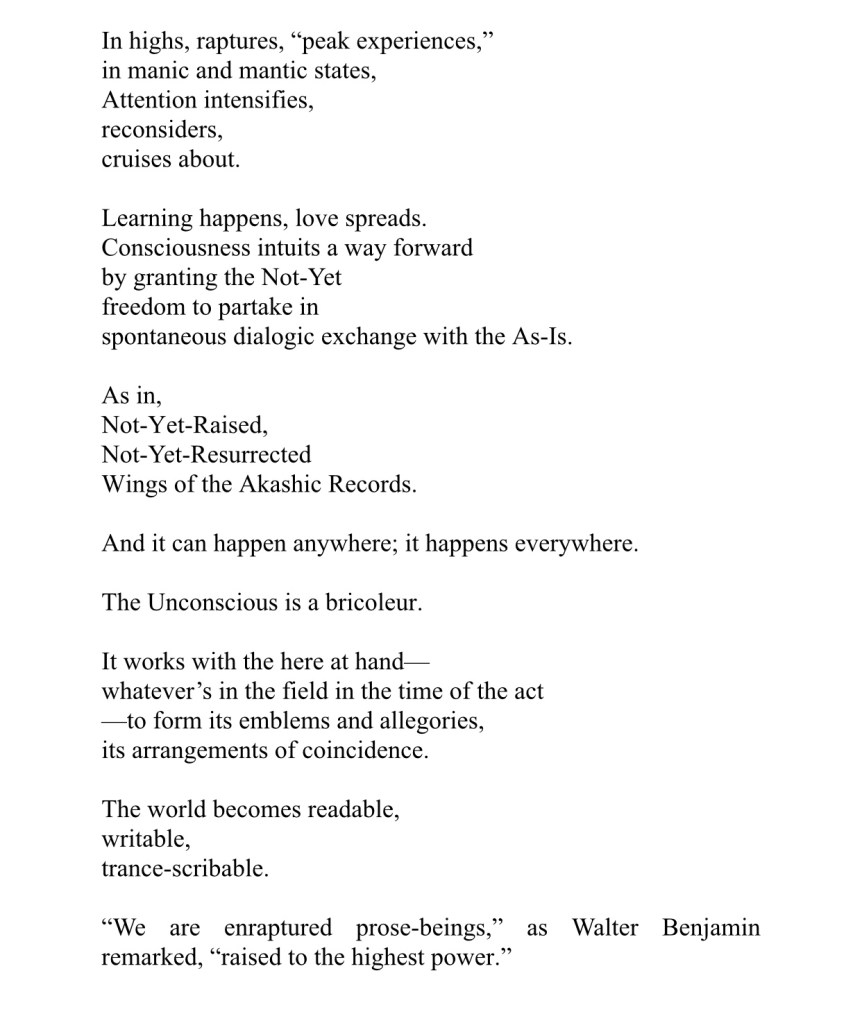
To delve deeper into the meaning of divination, however, we need to go back to the Greeks. For them, the term for divination is manteia. The prophet or prophetess is mantis, related to mainomai, “to be mad,” and mania, “madness” (24). The prophecies of the mantic ones are meaningful, insisted thinkers like Socrates, because there is meaning in madness.
What others call “mystical experiences,” known only through narrative testimonies of figures taken to be mantics: these phenomena are in fact subjects of discussion in the Phaedrus. The discussion continues across time, through the varied gospels of the New Testament, traditions received here in a living present, awaiting reply. Each of us confronts a question: “Shall we seek such experiences ourselves — and if so, by what means?” Many of us shrug our shoulders and, averse to risk, pursue business as usual. Yet a growing many choose otherwise. Scientists predict. Mantics aim to thwart the destructiveness of the parent body. Mantics are created ones who, encountering their creator, receive permission to make worlds in their own likeness or image. Reawakened with memory of this world waning, they set to work building something new in its place.
Pendell lays the matter out succinctly, this dialogue underway between computers and mad prophets. “Rationality. Ratio. Analysis,” writes the poet, free-associating his way toward meaning. “Pascal’s adding machine: stacks of Boolean gates. Computers can beat grandmasters: it’s clear that logical deduction is not our particular forte. Madness may be” (25). Pendell refers on several occasions to computers, robots, and Turing machines. “Alan Turing’s oracles were deterministic,” he writes, “and therefore not mad, and, as Roger Penrose shows, following Gödel’s proof, incapable of understanding. They can’t solve the halting problem. Penrose suggests that a non-computational brain might need a quantum time loop, so that the results of future computations are available in the present” (32).
 Trance-Scripts