Let this book of ours be a joyous one. Let the writing of it happen in the manner of a dance song or dream. Find in it an occasion to read Gurney Norman’s Divine Right’s Trip, a “novel of the counterculture” serialized in (and thus functioning as a paratext to) The Last Whole Earth Catalog. Leary, Di Prima, Huxley, Olson, Ginsberg, Kesey, Baraka, Sanders: all have their places, all have their roles in this tale we are about to tell. Words written on behalf of Utopia. ‘Twas a time when the not-yet was still possible, and that time is now.
Tag: Books
Monday June 21, 2021
“Put a lemon on it” is the first of several words received as I sit eyes closed beside a pool. Words overheard, duly noted, to be reimagined in the evening hours as dream material and as a step in a recipe for pasta with broccoli. There has been a desire of late, some chakra lighting up all that is. I play it records, feed it the exalted public speech of Odetta at Carnegie Hall.
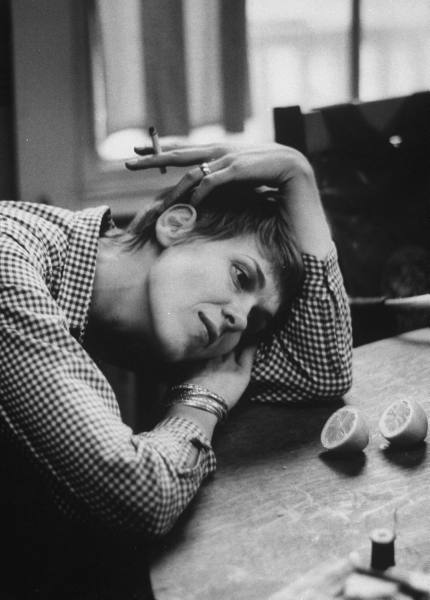
A kind of love is organizing all things, Amens everywhere “all over this land.” That’s what Leary thought, isn’t it? “The history of our research on the psychedelic experience,” he writes, “is the story of how we learned how to pray” (High Priest, p. 171). Let us include among the characters in this story IFIF medical director Madison Presnell. A photograph of Presnell appears in the April 16, 1963 issue of Life magazine. A photographer with the magazine accompanies Cambridge, MA housewife Barbara Dunlap on her first acid trip. Presnell administers the drug. The caption for the final photograph in the series reads, “Dunlap smokes a cigarette while seeing visions in the seeds of a lemon.”
Sunday June 20, 2021
Indigenous ways of knowing; Black Radical thought; Surrealism; Afrofuturism; Zen Buddhism. All have been guides: blueprints for counter-education for those who wish to be healed of imperial imposition. All provide maps of states other than the dominant capitalist-realist one. Hermann Hesse describes one such line of flight in his short novel The Journey to the East, a book first published in German in 1932, unavailable in English until 1956. Timothy Leary’s League for Spiritual Discovery takes after the League in Hesse’s novel. It, too, is but a part of a “procession of believers and disciples” moving “always and incessantly…towards the East, towards the Home of Light” (Hesse 12-13). Two of Leary’s psychedelic utopias, in other words, take their names from books by Hesse: both the League for Spiritual Discovery and its immediate precursor, the Castalia Foundation.
Saturday June 19, 2021
Excerpts from several of Hermann Hesse’s novels and short stories appear as paratext to a chapter on Arthur Koestler in Timothy Leary’s experimental 1968 memoir High Priest. ‘Tis the story of Koestler’s acid trip. Koestler had written a book about the East called The Lotus and the Robot. Koestler claims in disdainful orientalist fashion that the East, especially India and Japan, suffer from a sort of “spiritual malady.” Alongside the acid trip, Leary’s book also includes accounts of Koestler’s two mushroom experiences. Leary invited Koestler to participate as a test subject in the Harvard Psilocybin Project knowing full well of Koestler’s disdain for mysticism. The Hesse paratext supplements all of this, as Hesse had already portrayed Koestler in the manner of a roman-à-clef as a character named Frederick in Hesse’s short story “Within and Without.” Frederick is a stubborn, miserly rationalist, angered by the slightest hints of mysticism and superstition. So, too, with Koestler. He returns from India proud to be a European (as quoted in High Priest, p. 139). This is the same Koestler whose “confession” appeared in the 1949 anticommunist tract The God That Failed. “If these are the good old days,” wonders the author as he ponders this history, “then why am I so lonely? Why this ceaseless longing to grow through contact with others?”
Thursday June 17, 2021
My readings lead as all roads lead: to Castalia, the “elite institution devoted wholly to the mind and the imagination.” Castalia, Castalia, where “scholar-players” play the Glass Bead Game. Castalia, Castalia, the invention at the heart of Hermann Hesse’s final novel Magister Ludi. Hesse published the book in German under the title Das Glasperlenspiel. It appeared in Switzerland in 1943. The aim of the Glass Bead Game, as Hesse imagines it, is “the unio mystica of all separate members of the Universitas Litterarum.” Castalia, Castalia, Parnassian spring sacred to the Muses. Castalia, Castalia, remade as foundation by Leary and Alpert prior to their renaming it the League for Spiritual Discovery in 1966. Before Castalia they called themselves the International Federation for Internal Freedom. Castalia was the name they adopted in 1963 as they arrived to the Hitchcock Estate in Millbrook, NY. Some group of tricksters relaunched the Foundation in 2020 with repulsive rightwing content antithetical to the earlier foundation’s spirit and intent.
Friday June 11, 2021
Frankie’s down for a nice nap after a morning at the pool. Sarah saw to matters related to the air unit — so I remove my feet from my socks and think. The narrative we write is important, yes? For narrative is the stuff of which cosmologies are made. World-pictures. Cognitive maps. The shape of the world is determined at the quantum level, much like Schrödinger’s Cat, by the struggle to determine the shape of the world-picture. Unless, of course, struggle and determination are not part of that picture. By “shape of the world” I mean the mutable present’s arrangement toward the imaginal realms we call “past” and “future.” Origin and telos. The present’s mode of appearance alters according to the previous night’s dreams, and the previous night’s dreams are shaped by memory and desire. Those who wish to steer the world toward Utopia take these latter as the prima materia of the great work. Kim Stanley Robinson, meanwhile, steers us back to work of a more literal sort. The climate crisis demands reorganization of labor. Certain chapters of Robinson’s 2020 novel The Ministry for the Future are written in the style of “notes,” “minutes” kept by an international working group: the Ministry, the book’s actant or protagonist. Work thus finds its way back even in our hours of leisure, as this is what we read when we read by the pool. The book itself is work; its utopia begins with a disaster, a heat wave that kills several million people in India. From this disaster come a pair of nova: the Ministry itself, of course, but also a direct-action group called the Children of Kali. This latter group intrigues me, given its alignment with the famous Hindu goddess of time, creation, destruction, and power. After the disaster, it is she who speaks to us: “I am a god and I am not a god. Either way, you are my creatures. I keep you alive” (13). Kali is the persona Robinson dons to give voice to Nature. Kali, with her long terrible tongue. Kali, with her necklace of severed heads. Several of the book’s experts prognosticate “civilization kaput” before century’s end (55). It’s all rather bleak: countless species facing extinction in the years ahead. Against the backdrop of that abyss, the book conjures its hyperstitial alternative future of geoengineering and rewilding.
Wednesday June 9, 2021
Robin D.G. Kelley carries forward a remarkable defense of fantasy in his book Freedom Dreams — one I might consider as I design a course on fantastic literature for the year ahead. Kelley quotes from Paul Garon’s book Blues and the Poetic Spirit. “Fantasy alone,” writes Garon, “enables us to envision the real possibilities of human existence, no longer tied securely to the historical effluvia passed off as everyday life; fantasy remains our most pre-emptive critical faculty, for it alone tells us what can be” (as quoted in Kelley 163-164). Garon sees the blues as revolutionary in nature due to “its fidelity to fantasy and desire” (164). Fantasy is one’s remembering of the past on behalf of the future through a kind of dreamwork, in accordance with a desire that draws reality toward the “as if” and the “can be.” Others have called this desire Eros and the Spirit of Hope. In his retelling of the story of surrealism in light of anticolonialism, Kelley reveals a side of Jules Monnerot that was unknown to me. I’d known him before as a member of Acéphale, a secret society formed by Georges Bataille in the 1930s. After WWII Monnerot drifted to the right and denounced Marxism as a political theology akin to Gnosticism. What I learn from Kelley, however, is Monnerot’s prior involvement with surrealism. Martinican by birth, Monnerot arrived to France in the early 1930s. By 1933, he’d published a critique of the “civilized mentality” in the Surrealist periodical Le Surréalisme au service de la révolution. Monnerot was one of several black intellectuals attracted to surrealism. Kelley argues that these intellectuals “found in surrealism confirmation of what they already know — for them it is more an act of recognition than a revolutionary discovery. […]. Aime Césaire insisted that surrealism brought him back to African culture. Ted Joans wrote Breton that he ‘chose’ surrealism because he recognized its fundamental ideas and camaraderie in jazz. Wilfredo Lam said he was drawn to surrealism because he already knew the power of the unconscious, having grown up in the Africanized spirit world of Santeria” (184-185). For the abovementioned figures, and for others like Watts poet-activist Jayne Cortez, “Surrealism was less a revelation than a recognition of what already existed in the black tradition” (187).
Tuesday June 8, 2021
The pool’s not been what I’d hoped. This is one of the ways that Mercury Retrograde has manifested locally of late, prompting in me a sense of frustration and postponement, despite my knowing that we’ve performed our planting ritual, seeds and seedlings are in the ground, things are growing. Similar processes are afoot intellectually as I continue my wanderings. In my readings, I’ve been moving crabwise among many books at once. Robin D.G. Kelley keeps it surreal with his book Freedom Dreams: The Black Radical Imagination. Thelonious Monk appears near the book’s finale. Kelley went on to write a book on Monk. Thelonious Monk: The Life and Times of an American Original. Thumbing through the latter book’s index, I land upon “Monk, Thelonious: drugs taken by,” hoping to encounter word of Monk’s relationship to psychedelics, as he’s known to have done mushrooms with Allen Ginsberg and Timothy Leary. Monk came to the psychedelic sacrament a seasoned pro. Reports suggest he was unimpressed. Monk had been arrested years prior for marijuana possession. Police rolled up on him after a Sunday night gig in June 1948. He liked to smoke reefer when he played, and other players in his groups relied on drugs and alcohol to keep up. The meeting with Leary occurred in January 1961. Three years later, Monk appeared on the cover of the February 28, 1964 edition of Time magazine. The cover story’s author Barry Farrell wrote, “Every day is a brand-new pharmaceutical event for Monk: alcohol, Dexedrine, sleeping potions, whatever is at hand, charge through his bloodstream in baffling combinations.”

Sunday June 6, 2021
As I continue to read Tyson Yunkaporta’s Sand Talk, I learn of digital hyperobjects like “boids.” Apply three or four simple rules to these objects, he reports, and complex patterns emerge in their behavior, their movement together in groups. Yunkaporta claims that these patterns “cannot be programmed, but must emerge within the system organically — a process that is called ‘random’ in western worldviews but is in fact following the patterns of creation” (135). Patterns of right relation can arise in any complex, self-organizing system, he suggests. Kevin Kelly wrote of such patterns in his book Out of Control. For Yunkaporta, however, such patterns are excuses not for free markets but for heterarchies: complex, self-organizing learning communities where members “operate autonomously under three or four basic rules” (136). Heterarchies are systems “composed of equal parts interacting together” (137). There’s a moment in the book when Yunkaporta says, “If the world ever experiments with an actual free market rather than an oligopoly, this would be the perfect system to facilitate sustainable interactions” (144). In no way, though, should this be read as a defense of what capitalists themselves mean by “the free market.” I admit wanting to tug a bit on this part of Yunkaporta’s yarn. The Marxist in me wants him to turn up the base.
Saturday June 5, 2021
Yunkaporta describes his book Sand Talk as “an examination of global systems from an Indigenous perspective.” This is what we need, is it not? The Marxist literary theorist Fredric Jameson proposed that we call this thing we need a “cognitive map,” but Yunkaporta calls it “a template for living.” Reading the latter’s book, I’m reminded immediately of “songlines,” or “maps of story carrying knowledge along the lines of energy that manifest as Law in the mind and land as one, webbed throughout the traditional lands of the First Peoples.” Yunkaporta’s is a cosmology that allows for Elders and Ancestors, as well as “sentient totemic entities” and non-human kin. That cosmology clarifies, its form shimmers into being, when he writes, “Beings of higher intelligence are already here, always have been. They just haven’t used their intelligence to destroy anything yet. Maybe they will, if they tire of the incompetence of domesticated humans.” Most of us, he argues, have been displaced. History is a narrative of global diaspora, as most of us are “refugees” severed from the land-based cultures of origin of our Ancestors. Progress or healing occurs by revisiting “the brilliant thought paths of our Paleolithic Ancestors.” The ancients possessed cognitive functions that remain part of our evolutionary inheritance, but most of us remember no more than a fraction of these functions, our capacities stifled by our separation from the knowledge systems of Indigenous, land-based people. Through reading Yunkaporta’s book, one encounters “yarns.” Oral culture provides a lens through which to view the print-based knowledge systems of the Empire. Yunkaporta recognizes the challenges involved in such a project. “English,” he writes, “inevitably places settler worldviews at the centre of every concept, obscuring true understanding” (36). To communicate with the global system, Yunkaporta must write with “the inadequate English terms of his audience” (38) — but he makes the language work through “the meandering paths between the words, not the isolated words themselves” (37). “Dreaming” is an example of such a word: necessary, Yunkaporta notes, “unless you want to say, ‘supra-rational interdimensional ontology endogenous to custodial ritual complexes’ every five minutes” (38). Yunkaporta introduces “the dual first person…a common pronoun in Indigenous languages” (39) — and just like that, the Cave is behind us and we’re beginning to see the light. He translates it as “us-two.” Us-two’s fingers type those letters while with our mouths we say ngal.
 Trance-Scripts