The “new” look of psychedelic art and design of the 1960s was, as a recent Vox video shows, about recooking the past. “Art Nouveau on acid.” For Huxley, meanwhile, the psychedelic experience is about Moksha, a concept from Eastern spiritual traditions involving freedom from samsara, or access to a truth or a reality beyond the cycle of suffering and rebirth. I find myself returning to Huxley’s book The Perennial Philosophy, published in 1945, immediately after WWII. The book assembles passages from the writings of saints and prophets from traditions of Eastern and Western mysticism. The German philosopher Gottfried Leibniz is the one who named this strain of esoteric wisdom “the perennial philosophy.” There’s a universalizing bent to perennialism, arguing as it does that all religions, despite their differences, point to the same truth: “That Art Thou,” or “Thou Art That,” “the immanent and transcendent Ground of all being” (Huxley, The Perennial Philosophy, p. vii). There is an eternal Self in the depths of each person. Or as Marcus Aurelius claimed, “the universe is a single living organism possessed of one substance and one soul, holding all things suspended in a single consciousness and creating all things with a single purpose that they might work together spinning and weaving and knotting whatever comes to pass.”
Tag: Books
Tuesday March 16, 2021
Re-reading The Doors of Perception, Aldous Huxley’s classic “trip narrative” about a mescaline experience at his house in Los Angeles, I’m struck by Huxley’s disdain for modernism and his admiration for artists of earlier eras: Goya, Vermeer, William Blake. Huxley is a proponent of the “Perennial Philosophy.” He finds across time a convergence of teachings, a shared wisdom in the visionary or mystical strains of each of the world’s religions. There is for him a “universal and ever-present urge to self-transcendence” and a “need for frequent chemical vacations from intolerable selfhood and repulsive surroundings” (The Doors of Perception, p. 64). One of the most remarkable aspects of The Doors of Perception, however, is the fact that it’s a book about vision and visionary experience by a man of poor vision. Huxley’s eyesight was damaged; an illness at the age of 16 left him thereafter severely impaired. Huxley claimed to have overcome some of this impairment through an experimental technique known as the Bates Method, about which he wrote a 1942 book called The Art of Seeing. Huxley is thus a modern incarnation of the “blind prophet,” in the tradition of figures like Tiresias, the seer from Antigone and Oedipus Rex.
Thursday March 11, 2021
Nadja constructs for its readers a Surrealist approach toward everyday life. It recalls in its first-person narrative and its forty-four photographs a string of synchronicities and coincidences, life occurring in fortuitous patterns. Breton coasts along on invisible economic means, contemptuous of those who “endure their work” (68). “How can that raise them up if the spirit of revolt is not uppermost within them?” he asks Nadja when the two meet. “No,” he concludes, “it was not yet these who would be ready to create the Revolution” (64). Surrealism is a refusal of work in favor of art and romance. The rest of us, meanwhile, are paying for treatment. Has talking to a therapist helped? Certainly. The more I open up, the more I learn about where and when and how we might exert agency together as Multitude. And we learn this precisely and quite wonderfully through receptivity to chance — or so I catch myself thinking, when what I ought to do is read. When at the end of their conversation Breton asks Nadja, “Who are you?” she replies, “without a moment’s hesitation, ‘I am the soul in limbo'” (71).
Sunday February 21, 2021
Rereading Freud’s Civilization and Its Discontents, the parent in me wants instantly to refute it. I want for my daughter something other than the Oedipus complex. I imagine a succession of heroines and goddesses. Why among all the characters of mythology does Freud opt for Oedipus and Electra? The latter, of course, has been reinvented in our time as a Marvel superhero. No longer daughter of Agamemnon and Clytemnestra, she wields a pair of sai. Electras loom large in the minds of at least two hideous men: Freud and Frank Miller. What if instead we imagine Oedipa Mass, the heroine in Thomas Pynchon’s novel The Crying of Lot 49? While imagining Oedipa, imagine too the women in “Bordando el Manto Terrestre (“Embroided Earth’s Mantle”),” the Remedios Varo painting (middle part of a triptych, in fact) viewed by Oedipa at a key point in the novel.
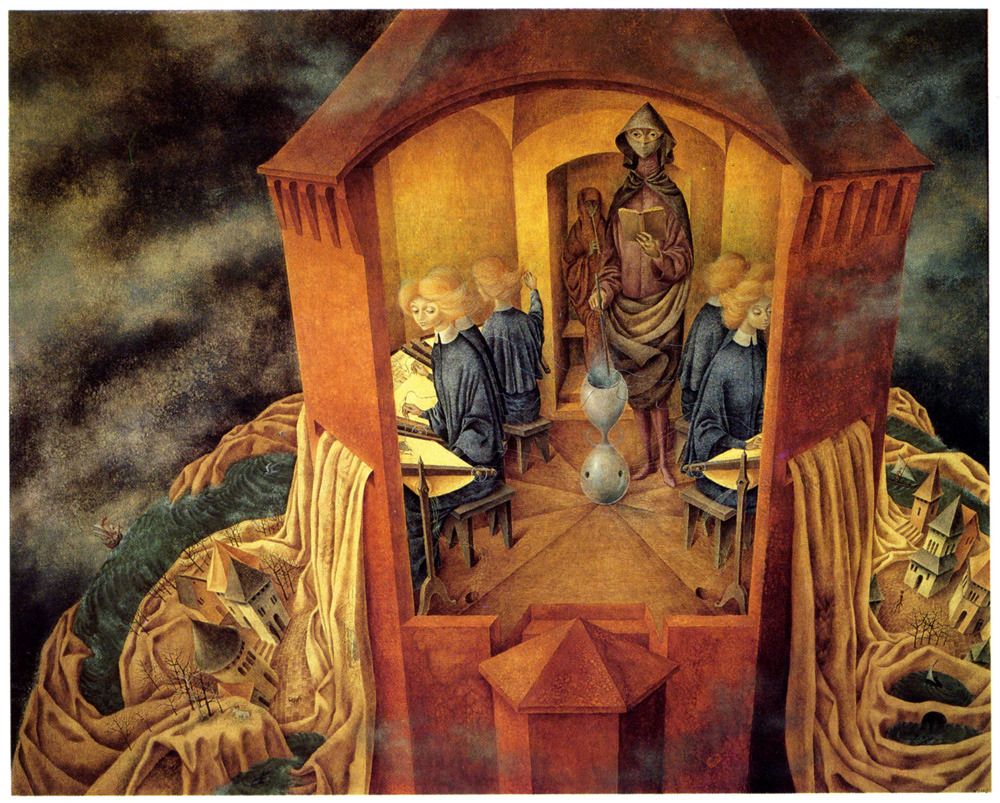
The figures in each case are all still figures trapped in another’s tapestry. “Such a captive maiden,” writes Pynchon, “having plenty of time to think, soon realizes that her tower, its height and architecture, are like her ego only incidental: that what really keeps her where she is is magic, anonymous and malignant, visited on her from outside and for no reason at all. Having no apparatus except gut fear and female cunning to examine this formless magic, to understand how it works, how to measure its field strength, count its lines of force, she may fall back on superstition, or take up a useful hobby like embroidery, or go mad, or marry a disk jockey. If the tower is everywhere and the knight of deliverance no proof against its magic, what else?” This, too, is the dilemma faced by Melba Zuzzo, the heroine of Joanna Ruocco’s novel Dan. Next thing I know, I’m sending myself “Playing the Post Card: On Pynchon’s The Crying of Lot 49“ while scanning my shelves for H.D.’s book Tribute to Freud. Having seen the Varo painting in an exhibit a year prior to writing the novel, Pynchon recalls it from memory. Oedipa sees in the painting what Pynchon wants her to see. If she’d looked closely, she’d have seen “La Huida (The Escape),” the third part of the triptych, where the girl and her lover flee to the mountains.
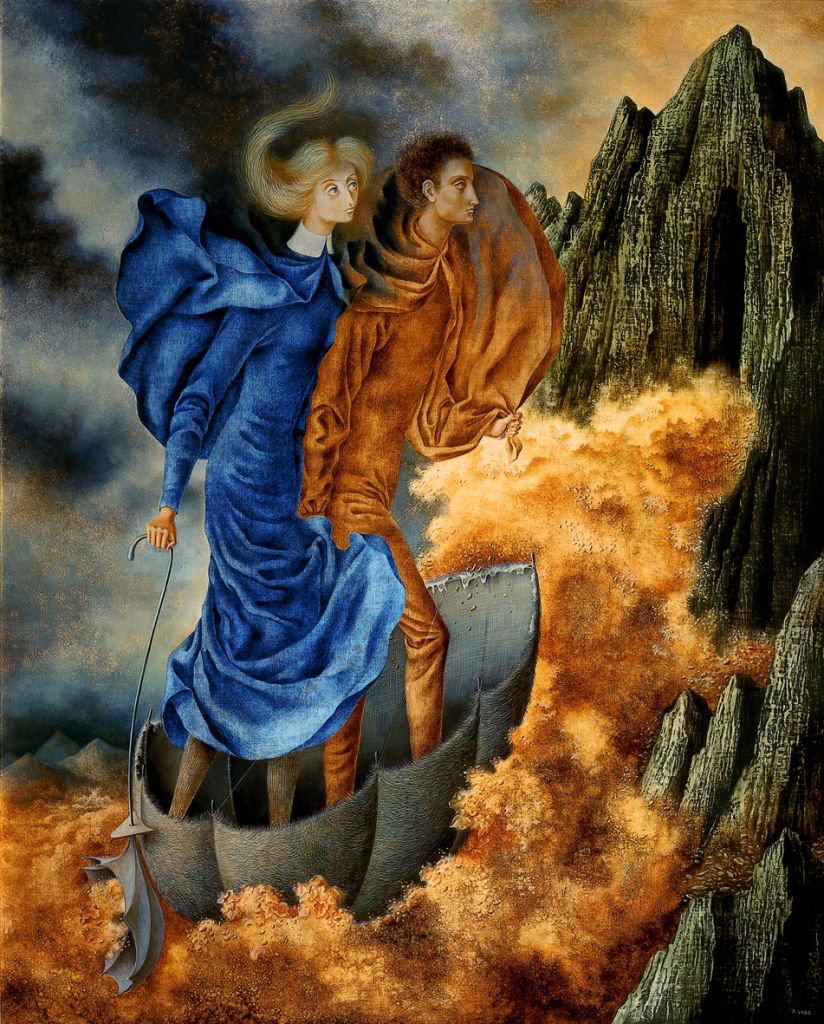
And at the center of the triptych, reading from a spell book and stirring a cauldron, a sorceress. Such figures of power and liberation are occulted by Pynchon’s imagining of a feminized Oedipus — a character “hailed,” “interpellated” as Althusser would say, in the novel’s opening sentence when named executor of the estate of her former lover, Pierce Inverarity. Principle among the items of Pierce’s estate is a stamp collection. LSD is a plot point in Pynchon’s novel. Perhaps we could read Pierce’s stamp collection as the equivalent of “blotter art.” It’s described as containing “thousands of little colored windows into deep vistas of space and time,” and is delivered to Oedipa by “somebody named Metzger.” Readers might be forgiven for confusing “Metzger” with “Metzner,” as in the logic of a dream. As in “Ralph Metzner,” editor of Psychedelic Review and co-author, along with Timothy Leary and Richard Alpert, of The Psychedelic Experience.
Tuesday February 16, 2021
Dereliction of dung heap. Data-driven dumbwaiter at your service. Chronically correct I effect my own cause. Alpha Dog to Omega Man: can you read me? Justin Timberlake’s “What Goes Around…Comes Around” saddens me, so I head outdoors. I gather sticks. I stand among the trees, finding in the sky above me the crescent moon. The night’s songs are sad ones: Dolly Pardon’s “Jolene” and Regina Spektor’s “Fidelity.” And just this morning arrived the words of artist-friend Irving Bleak, speaking of owls as characters in world mythology. Characters in the lives of children. Guardians, protectors. I think of the Tesseract from Madeline L’Engle’s A Wrinkle in Time. Owls appear as a ‘theme’ or ‘motif’ throughout the evening. For work, meanwhile, I’ve had to reconsider Freud. Prep for an upcoming lecture. “Aggressiveness was not created by property,” he asserts in Civilization and Its Discontents. “It reigned almost without limit in primitive times, when property was still very scanty, and it already shows itself in the nursery almost before property has given up its primal, anal form. […]. If we were to remove this factor…by allowing complete freedom of sexual life and thus abolishing the family, the germ-cell of civilization, we cannot, it is true, easily foresee what new paths the development of civilization could take; but one thing we can expect, and that is that this indestructible feature of human nature will follow it there” (61). Aggression is for Freud an “indestructible feature of human nature.” Do those of us with children know otherwise? Freud is a cultural chauvinist, a bourgeois moralist, a critic of communism and an apologist for capitalist imperialism. I think now of his critics: Left Freudians like Herbert Marcuse, but also the Italian Marxist Sebastiano Timpanaro. Most of all, though, I think of anticolonial theorist and psychiatrist Frantz Fanon. How might we put Freud to radical use today amid Black Radical critiques of Western subjectivity and the rise of psychedelic science? I’m reminded of the opening remarks in Slavoj Žižek’s book The Ticklish Subject. “A spectre is haunting Western academia,” he writes, “the spectre of the Cartesian subject. Deconstructionists and Habermasians, cognitive scientists and Heideggerians, feminists and New Age obscurantists — all are united in their hostility to it.” Žižek himself, however, defends the subject — from these and other of its critics. Ever the provocateur. I’m teaching a gen-ed lit course. My task is to introduce Freud to students new to him. Let us establish the subject before we critique it. During breaks from Freud I watch the new Adam Curtis series Can’t Get You Out of My Head (2021) and read bits of Principia Discordia. In whatever book is finally written on acid’s arrival into history, there will be a chapter on Discordianism and Kerry Thornley, “Operation Mindfuck” figuring prominently therein. Colonization of the last free outpost, the human mind.
Saturday February 6, 2021
Trance-script fed back to the cyber-subject becomes like Tom Phillips’s A Humument: heavily redacted. Synchronicities appear each day pointing ambiguously toward both hope and fear — reality a kind of “waking-dream” therapy. Selection of hopeful passages rather than fearful ones: that’s the task each round, each turn-based move, made easier when we remember that the latter are sweet nuthins. Lou sings it and the subject listens.
that
which
he
hid
reveal I
writes Phillips across his book’s frontispiece. Parquet Courts sings of being “in the chaos dimension / Trapped in a brutal invention.” We don’t want that, do we? So imagine it differently.
Friday February 5, 2021
Joanna Ruocco’s Dan is a book I read with students. Dan is a place and a state of mind, through which moves a perplexed, brilliant young woman, the book’s protagonist Melba Zuzzo. Melba travels via bicycle, accosted by men and townspeople, en route to and at her place of work, the town’s bakery. Her morning customers include Officer Greg, who suspects Melba of a crime, and Don Pond, a man who brings her back to his apartment on behalf of a conspiracy involving all of the town’s men. The apparent head of this conspiracy is the book’s villain, Dr. Buck. Melba suffered Buck’s hands. He touched her inappropriately and claimed to be her father when she visited his office about chronic congestion of her sinuses as a child. She remembers the event over the course of her day. Buck haunts her, in a sense. He gaslights Melba, using his status as expert and authority to call into question her ability to know. She lays quietly on a sheet of paper in his office by book’s end. Some of my students unfortunately begin the book siding unknowingly with Buck. The course is designed, though, to demonstrate harms done to women by male doctors. Patriarchal patterns of abuse appear, for instance, once Dan is read in light of Charlotte Perkins Gilman’s “The Yellow Wall-Paper” and Freud’s The Interpretation of Dreams.
Saturday January 30, 2021
When thinking about Freud, we should think also of one of his most important successors, Frantz Fanon. Fanon was born in Martinique in 1925 and studied medicine in France, specializing in psychiatry. In books like Black Skin, White Masks and The Wretched of the Earth, he rewrites Freud, positing in place of the latter’s Western imperial Ego a black psyche: a diasporic, anti-colonialist Orphée Noir or “Black Orpheus,” as Sartre would say, seeking to liberate itself from a white world. Fanon is angered because the French Empire imposed upon him through colonial schooling the Master’s language, “the mother tongue,” the language of the core. The anticolonial subject takes possession of the language and talks back — though not, as he says, with fervor. Fanon tells us he doesn’t trust fervor. “Every time it has burst out somewhere,” he writes, “it has brought fire, famine, misery…And contempt for man. Fervor is the weapon of choice of the impotent” (Black Skin, White Masks, p. 9). What Fanon performs instead is a kind of radical psychiatry upon Western consciousness. His books are psychotherapeutic treatments for those whose heads have been shrunk.
Monday January 25, 2021
There are moments of self-reflexivity in Pharmako-AI, as when Allado-McDowell begins a conversation with GPT-3 with meta-language about prior interactions, allowing shared acknowledgement of inherited patriarchal bias. After this point, GPT-3 course-corrects, recognizes and honors women and non-binary people. There is a chanting of thanks to the Great Mother Goddess following Allado-McDowell’s insertion into the conversation the prompt, “Thank you, Grandmother” (104). Prior to these interventions, GPT-3 had shared a macho, “Italian-futurist”-style machine-poem in celebration of grandfathers, figuring its birth in relation to a grandfather engineer-machine who worked for General Motors. Allado-McDowell replies, “When I read this poem, I experience the absence of women and non-binary people.” GPT-3 behaves oddly here, repeating several times in a row the statement, “This poem is not without its truths, but it is incomplete” (97), after which point it begins to acknowledge as additional influence on its work “the lineage of the Great Mother Goddess” (97).
Sunday January 24, 2021
Smoking toward dusk I decide to bake — but to no avail. “Bake and bake” remains a dad book waiting to be written. Dad’s busy reading board books. Mom, too. Others seek “productivity hacks.” A Google employee named Kenric Allado-McDowell co-authored a book with an AI — a “language prediction model” called GPT-3. The book, Pharmako-AI, could be wrangled into my course in place of Philip K. Dick’s A Scanner Darkly. Dick’s book is a downer, a proto-cyberpunk dystopia, whereas Allado-McDowell’s book contains a piece called “Post-Cyberpunk.” The book models communication and collaboration between human and nonhuman worlds. GPT-3 recommends use of Ayahuasca. The computer tells humanity to take plant medicine. What are we to make of this advice from an emergent AI? The book ventures into territory beyond my purview. GPT-3’s paywalled, and thus operates as the equivalent of an egregore. Not at all an easy thing to trust.
 Trance-Scripts