Conversations keep gesturing ambivalently toward abstractions like East and West, if only because these categories occupy the thoughts of so many mid-century hippie modernists — particularly the Beats and the Black Mountain Poets, along with fellow-traveling first-generation psychedelic elders like Aldous Huxley. The class needs to move outdoors. Perhaps we could go for a walk. Educate the whole person, body integrated with mind. Today in particular would have been lovely. Sunny, mid-70s, birds singing, trees budding, squirrels squealing with delight. Instead we listened to Charles Olson reading “The Kingfishers,” a recording archived on PennSound. I wish I had also assigned “Maximus to Gloucester, Letter 27.”
No question of the linking of the zones, the various scales of being. Olson faces no impediments other than the geography, to which the poem always returns, even at its beginning. By going back, we also go forward. And we hear in all of Olson’s poems a lamentation about the effects of global economy on a locality, as Greekness moves West. How do we get from the Word to the Dance? Perhaps I should introduce into the discourse mention of Marshall McLuhan. He too foresaw a retribalization and remediation of society into a post-Gutenberg global village. Is that what this was about, both then and now? Are we struggling to adjust ourselves to a new sensory environment made mandatory by automation and digitization? “The artist,” according to McLuhan, “is the only person who does not shrink from this challenge. He exults in the novelties of perception afforded by innovation. The pain that the ordinary person feels in perceiving the confusion is charged with thrills for the artist in the discovery of new boundaries and territories for the human spirit” (War and Peace in the Global Village, p. 12). What I hear McLuhan and Olson saying, in other words, is: Wake to other senses, supersede visual space, step free of the West.
I love when neighborhood cats approach me on the sidewalk and show me love, rub against me. I tap trees, I observe grass. And when teaching, I perform a narrative to help students test — in the classroom, in lived practice — the prescriptions of the texts that serve as our objects of study. “What would it mean to live out, here and now,” I ask them, “the utopian teachings of our authors?” The classroom as “safe space,” the classroom as “floating zendo.” Wish well all things. Intuit a way toward collective emancipation and equality — Person and Nature balanced and centered. Through discussion and interpretation, we arrive at a shared, contemplative way of being. Hippie modernist literature guides readers toward precisely this end: “seeing the systems we live by,” and then centering. Beginning with self-study so as to set things right in the fullness of each of our collective spheres of influence. By studying this literature, we bring a child’s innocence and trust and enthusiasm. We birth a child: a new person, a new society! In so doing, we “lay the ground,” as M.C. Richards says, “for the ordeals of self-examination and transformation that lie ahead” (Centering, p. 124).
I miss living in neighborhoods where people sit around together outdoors talking and listening to music. It happens sometimes — but so much of the current era’s technology is too small for sound to be shared by random parties, large gatherings, our bodies all wiggling on the dance floor to the same felt vibrations. What this allows, however, is silent, adoring contemplation of the magical languages of birds. A wonderful loud one with a high-pitched cry in a branch a mere few feet above me. The hippie modernists tried to communicate to us, in however fragmentary a way, a genuinely new, experimental, loving way of being, each psychedelic head of the General Intellect projecting in works of art back to others diamond-dimensioned reflections of the total picture. Classrooms should be spaces where we learn to hang out with others. Announce straightforwardly that we’re sifting through the artifactual rubble of the last period of revolution in American history, looking for keys to unlock the Age of Aquarius. (For those who wish to enlist in this cause, check out Vera W. Reid’s Towards Aquarius. Weird, interesting mythological thinking, at the very least. But also quite possibly a clue. Then again, maybe just New Age fantasy. My sense is that the astrology is gibberish, meant only as a means of transmitting a poetic sentiment: humanity’s great wish, the wish for a New Age.) Was there not always some revolutionary promise there? For those of us born after the 1960s, in the age of postmodernity, ours has been “a time when faith in modern science’s founding sacraments — its claims to unimpeachable objectivity, axiomatic certitude, and autonomy from the prejudices of power — is rapidly disintegrating,” as Andrew Ross notes, “under the pressure not only of demythologizing critics and activists within the priesthood, but also from the thoroughgoing historical critiques of scientism waged by feminists and ecologists with one foot in the door, and from public disaffection with science’s starring role in the grisly drama of global degradation” (Strange Weather, p. 22). I am an Acid Communist, a Dharma Revolutionary. I subscribe to a cosmology in which consciousness interacts with what appears to consciousness: a 3-D immersive parallelogram of dynamic bodies, forces, and energies. And consciousness is no fixed vantage-point, no mere camera-eye; like the world it reflects, it’s always growing and changing. I’m willing to organize around whatever helps us go on ahead.
Why is so much of the Nuggets anthology mired in thwarted romance, love unrequited? What role did that trope occupy in the 60s zeitgeist? Garage rockers were teens on hormonal and drug-induced bad trips, not yet woke to psychedelic love. The group situated on the precipice of these two modes was The Chocolate Watchband, particularly on their classic, “I’m Not Like Everybody Else.”
Dudes who elsewhere in their discography display the genre’s signature: an unhealthy relationship to booze, to women, and to sexuality, away from which the band retreats into beautiful reverb- and distortion-drenched sonic floating zendos like their glorious track, “Dark Side of the Mushroom.”
What we find throughout the era of hippie modernism are works that cultivate a keen sense of group identity — youth as members of a shared Age. Take the collective “we” in the following timeline of the Beat Generation as proposed by Allen Ginsberg: “We’d already had, by ’48,” he told an interviewer, “some sort of alteration of our own private consciousness; by ’55 we had made some kind of public articulation of it; by ’58 it had spread sufficiently so that the mass media were coming around for information.” And as Leerom Medovoi notes, the Beats utilized this attention from the mass media “to wage an impressively successful campaign affirming their own version of what a ‘beat generation’ of young Americans meant” — the group thus building for itself “a reputation as the legitimate representatives of the young” (Rebels, p. 221).
I sense a play of voices rising, entering into the realm of the heard. The voices I’m hearing this year are sounding increasingly heroic. Students leaning in, revolutionary, inspired. The preparation is at a very advanced stage: TSA unions grounding flights, teachers striking successfully in Los Angeles. Andrew Fluegelman sounds the call in his introduction to The New Games Book of 1976 where he announces to us today, “You can change the rules if you don’t like them. So long as you all agree on what’s fair, you can make the game into whatever you want it to be. Or you can invent a new one.” “All you need,” he adds, “are a few of your friends and the desire to celebrate the day with play. In New Games there are no spectators.” There will be no instant replays, brothers and sisters. The revolution, as Gil Scott-Heron promised, will be live. Whole Earth Catalog founder Stewart Brand participated in the New Games movement. As a head, Brand was committed to exploring new and more satisfying ways to live. As was fellow New Gamer George Leonard, for whom games signify “nothing less than our way of being in the world.” Brand staged the first New Games Tournament in October 1973, a public event held in a 2200-acre valley just north of the Golden Gate Bridge, “where people could create and share their games, and everyone could play” (10). Community organizer Pat Farrington was instrumental in planning the event. “Games are not so much a way to compare our abilities,” she believed, “as a way to celebrate them.”
How is it that both the United States and China hosted movements of urban youth to rural areas, “back to the land” in the one, “down to the countryside” in the other, to such vastly different effects? Let us care for life in all its forms, including the form it took in Dirt Road to Psychedelia, a film about Austin, TX in the 1960s. The radical comix artist Gilbert Shelton emerged from that scene, as did Roky Erickson and Janis Joplin. The documentary reinstates in consciousness lesser-known classics, like Take Me to the Mountains by Shiva’s Headband. My pedagogy begins by offering students collective power-sharing and shared ownership in the classroom. Once a class collaborates on revision of the syllabus, they’ve become co-creators of reality. Class consciousness foments and rises. They witness their vast and previously unrealized collective capacities.
The second part of the 1990 documentary Berkeley in the Sixties is titled “Confronting America.” After the victory of the Free Speech movement on the Berkeley campus, the world transforms from black-and-white to color. Students decide to commit themselves to naming and controlling the system, else it destroy the world. They start to change: new ideas, new music, new hair, new groups, new consciousness. The counterculture enters the equation. More and more people start to turn on. They start to gather and collaborate in liberated territories. They march, they don helmets, they defend themselves from attacks by police. This gives way to “Part Three: Confronting History,” where armed revolutionary organizations like the Black Panthers step onstage and revolutionary confrontations occur in France, Japan, Mexico, and Czechoslovakia. “So much life, so much death,” as Michael Rossman notes in retrospect, “so much possibility, so much impossibility.” Now that all of these kids are at the table, what happens next? How do we let ourselves go and speak freely? How do we deactivate internal censors? Sons of Champlin sing in reply, “Get High.” Lovely midsection built around bells and vibes. Out of it we emerge giggling, “Where are we?” This new dawn looks fantastic. My students are bright and interesting. We spent the day together deconstructing and rebuilding our classroom in the spirit of power-sharing egalitarianism. The air feels rich with possibility. A voice speaks up and teaches, “Open doors, look around you: we’ve all been blessed with wings!”
Listening closely, entertaining a variety of interpretations as possibilities running simultaneously beside one another, I wander, first among the hallways of David Bowie’s “Memory of a Free Festival,” already a bit distant and nostalgic, the gathering recalled in past tense: “It was…It was…It was.”
Bowie’s lyrical persona sings from Milton territory — trying to reconstitute hope amid summer’s end, paradise lost. By song’s end, distant festival-goers join voices in a chorus of reconciliation, animated by the sentiment, “The Sun Machine is Coming Down, and We’re Gonna Have a Party.” Afterwards, I re-watch Easy Rider, noting the semantic riches of the film’s opening shot of a trompe l’oeil mural of pre-Conquest Mexico on the side of a pit-stop called La Contenta Bar in Taos, New Mexico. The scene depicts US-Mexican relations in terms of the black-market capitalist exchange-relation of the drug deal. The Captain and Billy are just small-timers, their counterculture a mere cargo cult, the film notes in the next scene, where the two men crouch defensively as the planes of the global techno-capitalist superpower fly overhead. Look at Peter Fonda loading his bike’s American flag embroidered fuel tank with rolls of dollars as Steppenwolf sings “The Pusher.” He and Hopper walk like natives of the space age among desert farmhouse ruins. They seem as alien to these landscapes as their motorbikes — products of a different stage of development. The bikes make the horses of white settler-colonialist ranchers skittish. The Captain pays respect by complimenting the ranchers on their “spread.” “You do your own thing on your own time: you should be proud.” Hippies appear here as mere nouveau riche speculators eyeing potential property on the frontier. The montage sequence that accompanies “The Weight” is an ode to the magic of the deserts of the American Southwest. Passing a joint back and forth with a paisley-bandana’d hitchhiker, Captain and Billy learn of the disrespectful nature of their colonial heritage. After soaking it in, the Captain asks the others if they’ve ever wished they were someone else. The same theme reemerges later in the film. After smoking his first joint around a campfire on the way to Mardi Gras, Jack Nicholson’s character George Hanson comes alive with far-out tales of aliens from a more advanced civilization living among Americans since 1946. Both he and the Bowie of “Memory of a Free Festival” refer to these figures as “Venusians.” By the end of the film, though, I’m left wondering: Are Captain and Billy victims of a Faustian bargain, as J.D. Markel argues, following the path of Dante’s Inferno?
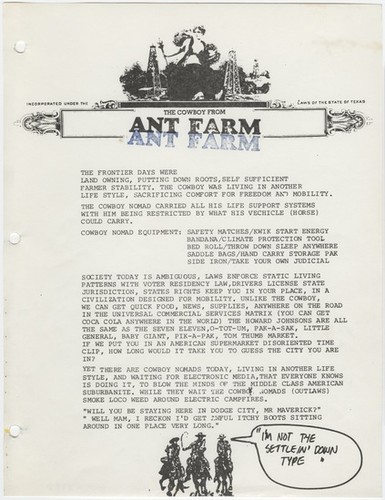
I wish there was time to fit radical media theorist Gene Youngblood’s book Expanded Cinema into my course on Hippie Modernism. Youngblood’s work shares in the cosmic consciousness whipped up by the two big events of the Summer of ’69, Woodstock and the moon launch. For Abbie Hoffman, remember, Woodstock served as a mind-blowing demonstration of “Functional anarchy, primitive tribalism, gathering of the tribes.” Youngblood’s book examined the role participatory media events and media revolution might play in this project. The main prerequisites to demonstrate the human capacity for psychedelic beloved community were all present at Woodstock: willingness to live side by side in harmony, feeding and caring for one another, with no expectation of profit. Another version of the utopian hippie modernist Woodstock Nation of the future can be glimpsed in Ant Farm’s Cowboy Nomad manifesto from 1969. One can imagine dozens of Woodstocks scaling up into Ant Farm’s Truckstop Network, tribes traveling in caravans of camper vans and VW buses.
It is my job, my duty and responsibility, to help youth remember the experiments of past generations of liberationist youth. My hope is that by these means, students may gain a fuller understanding of seeds planted, potentials as yet unrealized. Let us learn all that was learned before, and somehow try again. My friend’s father — a kind of shaman, one who initiated me into a secret universe — once starred in a grand movie production, a collective 3-day performance of peace, love, and music known as Woodstock. “Climb close, listen here,” he told me a few nights ago over dinner. “The conditions were terrible,” he began, “yet love prevailed.” Grace Slick navigated her way to stage and announced, “Alright, friends, you have seen the heavy groups, now you will see morning maniac music. Believe me, yeah — it’s a new dawn.” Soon they’ve launched into “Won’t You Try / Saturday Afternoon,” the band’s homage to the Summer of Love. When John Sebastian takes the stage in beautifully tie-dyed denim, he reflects back to the community of 300,000 its image of itself as an impromptu city, a temporarily autonomous global village. The lyrics to Sebastian’s “Younger Generation” speak sounds of accord into my present moment. Country Joe rouses the entire city to its feet in opposition to the War in Vietnam. Sly & The Family Stone arrive like angels and take the crowd heavenward, peace signs in the sky, voices raised in song. By the time of Hendrix’s performance, one realizes one is in the presence of peaceful visitation by starmen of the future. Enough! Let’s get ourselves back to the garden, as Crosby, Stills & Nash instruct in the film’s finale, “Woodstock.”
Michael Wadleigh’s Woodstock (1970), co-edited by a young Martin Scorsese, overlays sounds and images, especially in its use of split-screen, in order to represent the crowd as a cooperative beloved community. The collective intelligence of audience, performers, and crew is astounding, comparable only to that other collective intelligence, the US military. With the walkie-talkies and the helicopters and the ever-present talk of food and supplies, the festival was clearly the War in Vietnam’s deliberately inverted double.
 Trance-Scripts