Steampunk Narratives and the Failures of Utopian Thought

A paper written by Caius for a graduate seminar on “Postmodern Fiction” taught by Dr. Joseph Conte at SUNY-Buffalo, 2005.


Aside from spearheading cyberpunk, William Gibson and Bruce Sterling, co-authors of the 1991 novel The Difference Engine, are also credited for initiating a separate sub-genre of science fiction called “steampunk.” For various critical responses to The Difference Engine, see Jay Clayton’s Charles Dickens in Cyberspace, Joseph Conte’s “The Virtual Reader,” Steffen Hantke’s “Difference Engines and Other Infernal Devices,” Karen Hellekson’s The Alternate History, Nicholas Spencer’s “Rethinking Ambivalence,” and Herbert Sussman’s “Cyberpunk Meets Charles Babbage.”

While Gibson and Sterling’s novel has received a fair amount of attention from critics, subsequent works in the genre for the most part remain unexamined. This paper attempts to pinpoint some of the defining features of steampunk, while also offering a brief commentary on the genre’s relationship to history and postmodernity. I conclude with a few thoughts on the political or ideological underpinnings of the genre, focusing specifically on its relationship to what Fredric Jameson describes as postmodernity’s failure to imagine a compelling future for itself in anything but the most stark and pessimistic of terms. Indeed, dystopian visions (or else visions of an everlasting capitalist present — which, in my opinion, is essentially the same thing) have become a kind of automatic, default setting amongst writers and critics these days. Steampunk narratives ought to be viewed as a logical extension of this trend.

But first, a few comments on the genre itself. Most of the literary and cultural texts collated under the banner of “steampunk” feature speculative narratives set in a Victorian or quasi-Victorian alternate historical universe. Events in these narratives occur in a world that A) vaguely resembles our own recent past — and the past of the Victorian and Edwardian Eras in particular — while B) simultaneously departing from this shared historical reality by way of a signature act of displacement, whereby the technologies that we typically associate with the present are willfully projected backwards. In other words, the standard move of a steampunk narrative is the detailed elaboration of a fictional Victorian universe unexpectedly infiltrated by modern scientific and technological advances actuated by way of what we would otherwise regard to be exemplary nineteenth-century materials and paradigms. Jacquard looms and steam engines become the basis for elaborate mechanical contraptions capable of fulfilling many of the same functions as today’s electrical appliances and personal computers. (Hence the “steam” in “steampunk.”) The result is often highly disorienting: an anachronistic, hybridized fictional space that nonetheless bears some uncanny resemblance to the present.

In order to clarify the boundaries and limits of this sub-genre, we can identify at least three main generic predecessors that resemble and maintain an orbit around, while nevertheless remaining distinct from, work classified as “steampunk.” These predecessors include “What If..?” comic books, alternative (and/or counterfactual) histories, and works of historiographic metafiction. Let’s take a few moments to define these genres and to explain their relationship to “steampunk.”

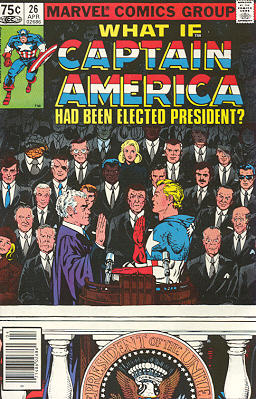
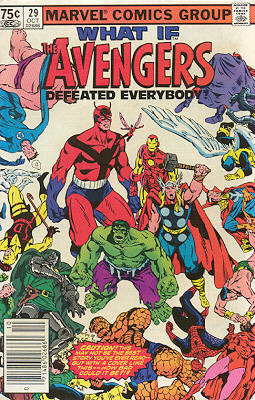
“What If..?” comics are one of the clearest influences on steampunk narratives. Here we have a popular attempt to explore the idea of parallel worlds within a clearly fictitious setting. Beginning in 1977, the Marvel Comics Group released a bimonthly series devoted to dramatizing alternate endings to events within the lives of trademark Marvel characters like Spiderman, Captain America, and the Incredible Hulk. Each issue addresses a “What If..” question dealing with an event in the life of one particular character. Examples of questions posed by each issue include: “What If Spiderman Joined The Fantastic Four?,” “What If Conan the Barbarian Walked The Earth Today?,” “What If Spiderman Had Rescued Gwen Stacy?,” “What If Captain America Had Been Elected President?,” “What If The Avengers Defeated Everybody?,” and “What If The Avengers Had Never Been?”
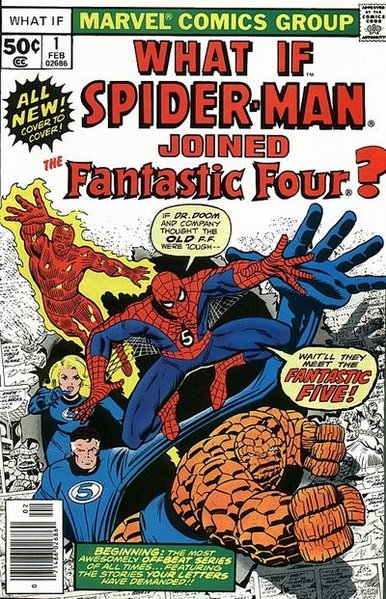

All of these issues are narrated by a bald, omniscient creature named “Uatu the Watcher.” Uatu stands on the moon and is somehow able to observe all events in all possible worlds. His narratives begin with a singular “bifurcation point” or “point of divergence,” where a dramatic sequence of events from a previous comic book results in a set of consequences different this time around from those that were previously depicted. After identifying this point of divergence, the remainder of Uatu’s narrative extrapolates what would have happened as a result of this changed event.

To this extent, “What If..?” comics are a close relative of that other sub-genre of science fiction known as the “alternative history.” Critics also occasionally refer to works in this sub-genre as “alternate histories,” “allohistories,” or “uchronias.” Historians, meanwhile, hoping to distance themselves from the stigmas of science fiction, have taken to dubbing their own forays in this realm “counterfactuals.” I return to the topic of counterfactuals later in this essay.

The main difference between an alternative history and a “What If..?” comic is that the “What If..?” comic explores a storyline that branches out from the accepted historical trajectory of an already-fictional universe, aka the “Marvel Universe,” whereas an example of “alternative history” would take as its point of departure the history of our world: the world of historical fact.

Philip K. Dick’s novel The Man in the High Castle (1962) is a classic work of “alternative history.” Dick’s novel takes place in a dystopian alternate universe where Giuseppe Zangara succeeds in his effort to assassinate US President-Elect Franklin Delano Roosevelt in February of 1933. Zangara’s actions result in a world where the Axis Powers of Nazi Germany and Imperial Japan emerge victorious at the end of WWII.

The Years of Rice and Salt (2002) by Kim Stanley Robinson is another example of work in this sub-genre. Robinson’s dense, sprawling novel imagines a world where the Black Death of the fourteenth century wipes out a full 99% of the population of medieval Europe. As a result, China and the Islamic world come to dominate the planet over the next seven centuries, while Christianity fades away to become a mere historical footnote.

Other examples of alternative history include classic works of science fiction like Ward Moore’s Bring the Jubilee (1953) and Keith Roberts’ Pavane (1968), as well as more recent novels like Robert Harris’s Fatherland (1993) and Philip Roth’s The Plot Against America (2004).

In many ways, the above examples might suggest that steampunk is simply a particular version of “alternative history.” Like works in the latter genre, steampunk “postulates a fictional event of vast consequences in the past and extrapolates from this event a fictional though historically contingent present or future” (Hantke 246). However, as Steffen Hantke notes, “the most striking examples of alternative histories…do not display as consistent an interest in Victorianism as steampunk does” (246). It is ultimately this fixation with quasi-Victorian settings, along with an abiding interest in alternative technologies, that makes this work seem distinct from other kinds of alternative history.

Aside from “What If..?” comics and alternative histories, the final generic predecessor worth considering in relation to steampunk is that vast body of work that Linda Hutcheon refers to as “historiographic metafiction.” This term is often used to describe books like Robert Coover’s The Public Burning (1977), Ishmael Reed’s Mumbo Jumbo (1972), and E.L. Doctorow’s Ragtime (1975) and The Book of Daniel (1971). Hutcheon defines “historiographic metafiction” as a series of recent novels that are “intensely self-reflective but that also…re-introduce historical context into metafiction and problematize the entire question of historical knowledge” (285-286). In true postmodern fashion, the contradictory effect of such works is both to install and to blur the boundaries between historical and fictional genres.

Although Hutcheon’s definition is probably broad enough (and vague enough) to encompass a novel like The Difference Engine, I think there’s some value in maintaining a distinction between steampunk narratives and historiographic metafiction. After all, a novel like Doctorow’s The Book of Daniel tends to function as a series of speculations meant to supplement history. Additions and corrections are the focus here, rather than the elaboration of deliberately counterfactual scenarios. Doctorow’s fictions, in other words, challenge or cast into doubt certain dominant interpretations of specific historical events (in this case, the Rosenberg trials), often by trying to fill in gaps in the public record. What we end up with is a work of interpretation or commentary.

Steampunk narratives depart from this tradition in the sense that they openly, knowingly contradict the public record. There’s no effort to provide an account of “the way things really were.” At the same time, there’s also no effort to dispute or to call into question the findings of trained historians. Instead, what we have is an explicitly fictional departure from history — an exploration of what could have happened…but most certainly didn’t.

This is precisely the stance toward history that we see at work in a novel like The Difference Engine. While not exactly the first of its kind, Gibson and Sterling’s text is nevertheless the one applauded as the primary inspiration for the term “steampunk” (itself obviously a tongue-in-cheek variant on “cyberpunk,” the sci-fi subgenre that catapulted both authors to fame in the 1980s). What seems most striking about The Difference Engine is its remarkable ability to synthesize all of the various elements that we’ve outlined above.

Like “What If..?” comics and alternative history novels, for instance, the world of The Difference Engine departs from the historical realities of Victorian England by way of a clearly demarcated, singular “point of divergence” — in this case, the successful design and construction of English mathematician Charles Babbage’s famous calculating machine, the Difference Engine, widely acknowledged to have been a precursor of the modern computer. As Gibson and Sterling would have it, this small but momentous adjustment of the historical record results in a world transformed. The Information Age arrives coterminous with the Industrial Revolution, allowing an unholy alliance of scientists and capitalists to harness the productive capacities of steam-driven cybernetic engines in order to advance a ruthless repression of Luddite insurgency and an unprecedented global consolidation of British imperial power.

From historiographic metafiction, meanwhile, the novel borrows the convention of mixing fiction with fact, so that famous historical figures like Babbage, Lord Byron, Ada Lovelace, Karl Marx, travel writer Laurence Oliphant, Texan president Sam Houston, Romantic poet John Keats, two-time British Prime Minister Benjamin Disraeli, and biologist T.H. Huxley all jostle for space alongside purely invented characters (as well as figures appropriated from Victorian novels, like Disraeli’s characters, Dandy Mick, Charles Egremont, and Sybil Gerard). This unlikely concoction of narrative strategies has somehow become boilerplate for all subsequent iterations of the steampunk aesthetic.

However, I don’t mean to pose The Difference Engine as some sort of undisputed Ur-text of steampunk. After all, there are certainly a number of steampunk novels that predate Gibson and Sterling’s work by at least a decade, including K.W. Jeter’s Infernal Devices (1987) and Morlock Night (1979). Both of these novels feature retro-Victorian technologies in an alternate historical setting, and Jeter himself is said to have coined the term “steampunk” in an interview from 1987. The Hollywood blockbuster Back to the Future III (1990), meanwhile, has sometimes been seen as a North American frontier variation on the genre. The same can be said for a film like Wild Wild West (1999). Finally, a number of fans and critics have pointed to Walt Disney’s classic film adaptation 20,000 Leagues Under the Sea (1954), with its retro-Victorian Nautilus submarine, as an important precursor to the genre.

Despite these anticipations, however, most recent examples of steampunk have in fact turned to The Difference Engine as a source of inspiration. Examples of this more recent work include Paul Di Fillipo’s The Steampunk Trilogy (1995); Steampunk: The Role-Playing Game; Neal Stephenson’s The Diamond Age (1995), which has an undeniable steampunk flavor even though it’s set in a neo-Victorian future rather than an alternative past; Alan Moore and Kevin O’Neill’s The League of Extraordinary Gentlemen (2000); the anime film Steamboy (2004), by Katsuhiro Otomo, the director of Akira (1988); and of course the original Steamboy comic book upon which the film is based.

Now, some of this work is clearly an example of what Jameson would call “pastiche” or “blank parody,” where the goal is simply to mimic (or at worst, nostalgically reproduce) the atmosphere and feel of, say, a Jules Verne novel. For instance, audiences often flock to elaborately designed blockbusters like Wild Wild West and Back to the Future III in order to derive pleasure from each film’s stylized echo of the quaintly archaic. Imaginary figures are dressed up in leather chaps and ten-gallon hats and pasted onto a “realistically” staged historical backdrop — and it is precisely this backdrop, this spectacular reconstruction of the “tone and style of a whole epoch” (Jameson 1991, p. 369), that lends each film its novelty and appeal. A similar sense of visual nostalgia seems to permeate Kevin O’Neill’s stunningly rendered illustrations for The League of Extraordinary Gentlemen, many panels of which hearken back to the decadent sketches of late-Victorian stylists like Mucha and Aubrey Beardsley. The only element missing from each of these admirably self-conscious allusions is a sense of purpose. This is by-the-books pastiche, as if Jameson’s definition had been mistakenly identified as a checklist. “The imitation of a peculiar or unique style, the wearing of a stylistic mask, speech in a dead language” (Jameson 1998, p. 5): it’s all here. One hunts around looking desperately for the scare quotes, only to come back empty-handed. This is arguably steampunk at its worst.

But I think it would be wrong to apply these claims to the genre as a whole. Books like The Difference Engine, for instance, seem to offer a more critical engagement with their source material (in this case, Disraeli’s Sybil, or, The Two Nations [1845]) than Jameson’s model might allow. An examination of the novel’s genesis and structure, then, is likely to provide us with some insight into the genre’s potential for political commentary. In a rather revealing interview published in Science Fiction Studies just a few months after the release of The Difference Engine, Gibson and Sterling describe their collaborative writing process for the novel as a form of “literary sampling.” As Gibson notes:

[A] great deal of the intimate texture of this book derives from the fact that it’s an enormous collage of little pieces of forgotten Victorian textual material which we lifted from Victorian journalism, from Victorian pulp literature […]. Virtually all of the interior descriptions, the descriptions of furnishings, are simply descriptive sections lifted from Victorian literature. Then we worked it, we sort of air-brushed it with the word-processor, we bent it slightly, and brought out eerie blue notes that the original writers could not have. (Fischlin et al 8-9)

At first, this might sound like a recipe for a curious brand of pastiche. But Gibson and Sterling seem to view their work as a critical intervention of some sort: a critique, in particular, of teleology and of liberal ideas of progress. “One of the things that [The Difference Engine] does,” they write, “is to disagree rather violently with the Whig concept of history, which is that history is a process that leads to us, the crown of creation” (Fischlin et al 7). One of the ways that they accomplish this feat is by organizing the novel in a manner that troubles the reader’s ability to form strong identifications with any of its protagonists. The novel itself is divided into five chapters or “iterations,” followed by an appended sixth section entitled “Modus: The Images Tabled.” Each of these first five chapters follows the exploits of one of the novel’s three main characters: a prostitute named Sybil Gerard, a paleontologist named Edward “Leviathan” Mallory, and a diplomat named Laurence Oliphant. The key, of course, is that none of these characters are particularly likeable.

More than half of the book takes the form of a rather conventional, “Indiana Jones”-style adventure yarn, centered around Edward Mallory, his two brothers, and their “heroic” efforts to quell a growing proletarian Luddite insurgency borne in the midst of “The Great Stink,” a vast ecological catastrophe that appears to have engulfed the chaotic streets of London. After joining forces with a detective named Sergeant Fraser, the Mallory brothers proceed to patrol the slums of the East End in a souped-up “steam gurney” called the Zephyr, flexing their technological might against “roving mobs” and “swarthy little half-breeds” (Gibson and Sterling 199), all the while exchanging stories with one another about their various violent imperialist exploits abroad. Before long, Mallory is revealed quite clearly as a misogynist, a racist, and a gun smuggler. He and his macho “band of brothers” succeed in restraining the uprising, but by the end of the novel, we come to learn that Mallory’s counterrevolutionary efforts result not in human betterment. His efforts result, rather, in the creation of a dystopian surveillance state (or a “hot shining necropolis” [428], as the authors would have it) where humans are the mere playthings of some unnamed peering Eye. The effect, of course, is that the Victorian notion of some inexorable march toward progress is turned on its head. Like some weirdly inverted Hegelian “ruse of reason,” the outcome of history is not what its actors assumed.

But despite Gibson and Sterling’s willingness to critically interrogate the so-called “Whig interpretation of history,” their novel ultimately remains ambivalent regarding certain other Victorian attitudes — especially those that deal with women, class, and empire. Indeed, a strange kind of postmodern cynicism casts a shadow across the novel, so that, even though the misogynistic, bourgeois imperial subtexts of Victorian literature are here highlighted and pushed to the foreground, the novel is also simultaneously fierce to eschew the articulation of any positive utopian alternatives. The result is not exactly “blank parody” (although the novel occasionally leans in this direction); instead, we end up with that double-edged, ironic mode of representation that Linda Hutcheon claims “both legitimizes and subverts that which it parodies” (Hutcheon 2002, p. 97). Works of this sort are humorous precisely to the extent that we can distance ourselves from their historically outmoded sentiments and paradigms. But this canned, self-righteous laughter eventually tapers off as we recognize the way our own culture remains deeply implicated in many of these very same paradigms. The only thing lacking from this bold postmodern indictment, then, is a sense of viable political alternatives. Novels like The Difference Engine envision our world at one remove as a nightmarish kind of “dystopia-in-progress”— but they fail to suggest ways to forestall or transcend this fate.

The League of Extraordinary Gentlemen is another work that seems exemplary in this regard. (The following comments deal with the twelve-issue comic book series, which was subsequently gathered together as a two-volume graphic novel, rather than the — to my mind, vastly inferior — Hollywood adaptation.) Both volumes of Moore and O’Neill’s critically acclaimed series feature a pastiche of characters and creatures lifted from the pages of just about every major adventure and science fiction story of the late nineteenth century, including H.G. Wells’ The Time Machine (1895), The Invisible Man (1897), The War of the Worlds (1898), and The Island of Dr. Moreau (1896); H. Rider Haggard’s Allan Quatermain novels; Bram Stoker’s Dracula (1897); Arthur Conan Doyle’s The Adventures of Sherlock Holmes (1892): Jules Verne’s Twenty Thousand Leagues Under the Sea (1870); and Robert Louis Stevenson’s The Strange Case of Dr. Jekyll and Mr. Hyde (1886). The comic itself tells the story of a secret five-member crime-fighting unit, the eponymous “League,” formed in 1898 by a British government official named Campion Bond. Members of the group include Mina Murray, Allan Quatermain, Captain Nemo, Dr. Jekyll and/or Mr. Hyde, and Dr. Hawley Griffin (aka The Invisible Man).

Aside from Bond (who is basically a composite of Margery Allingham’s “Albert Campion” and Ian Fleming’s “James Bond”), every other figure in the series — from major protagonists to single-panel throwaways — is an established character from a previous work of fiction. As Moore notes, “We decided that…all characters or names referred to in the strip would have their origins in either fictions written during or before the period in hand, or else in elements from later works that could be retro-engineered into our continuity by the invention of a father, grandfather or other predecessor” (as quoted in Nevins 11).

After the individual members of the League are rounded up from various far-flung peripheries of the Empire, they convene at their headquarters in a secret wing of the British Museum, where Bond instructs them to retrieve a powerful anti-gravity device called the “Cavorite,” stolen from Her Majesty by the ominous Fu Manchu. This reference to Fu Manchu is just the first of the comic’s many sarcastic parodies of the British Empire’s brutal Orientalist ideologies. Toward the end of the second issue of the series, for instance, readers encounter a text box stating, “The next edition of our new Boys’ Picture Monthly will continue this arresting yarn, in which the Empire’s Finest are brought into conflict with the sly Chinee, accompanied by a variety of coloured illustrations from our artist that are sure to prove exciting to the manly, outwardgoing youngster of today.” A similar sensibility is at work in the Editor’s Note to Volume One, where a “Mr. Scotty Smiles” writes:

Greetings, children of vanquished and colonised nations the world o’er. Welcome to this Christmas compendium edition of our exciting picture-periodical for boys and girls. And let us bid a special welcome to those poorer children who, in four or five years time, will be gratefully reading these words in a creased and dog-eared copy of this very publication, its dust jacket torn and several pages in the second chapter stuck together, that has been donated to their orphanage or borstal by local Rotarians. To all such urchins of the future, and to our presumably more well-off, possibly Eton-educated audience of the present day, we wish you many happy fireside hours in the perusal of the thrills and chuckles here contained, though let us not forget the many serious, morally instructive points there are within this narrative: firstly, women are always going on and making a fuss. Secondly, the Chinese are brilliant, but evil. Lastly, laudanum, taken in moderation is good for the eyesight and prevents kidney-stones. With these dictums in mind, allow us to wish both many hours of pictorial reading pleasure, and also the jolliest of Christmas-times to those of you who are not bowed with rickets, currently incarcerated, or Mohammedans. With the Season’s Best Regards, I remain, A friend and confidant to boys everywhere. S. Smiles (Editor).

Once again, as we saw in The Difference Engine, the effect here is not “blank parody” so much as a kind of “knowing complicity” mixed with an ironic sense of distance. Moore and O’Neill deploy exaggerated caricatures of the familiar “Yellow Peril” stereotype (along with occasional offhand remarks about “Mohammedans”), not just to remind readers of the backwardness of these views, but also to make us interrogate our culture’s continuing fascination with racist, hyper-masculine servants of Empire like Quatermain and crew. After all, what is the League if not an allegorical gang of poster children for our ongoing War on Terror?

To state the point as a further set of questions: How or in what ways are steampunk narratives responding to the circumstances shaping the moment of their enunciation? What kinds of individual and collective desires find expression in this type of narrative?

Upon an initial sweep of the field, one might be tempted to explain the appeal of steampunk in terms of its hip, theoretically up-to-date vision of a universe ruled by chance. After all, contingency is something of a buzzword within the academy these days. Historians, for instance, have lately taken to publishing anthologies devoted to what they call “counterfactual experiments.” Examples of this work can be found in Robert Cowley’s What If? and What If? 2, Niall Ferguson’s Virtual History, Nelson W. Polsby’s What If? Explorations in Social-Science Fiction, and Andrew Roberts’ What Might Have Been: Leading Historians on Twelve ‘What Ifs’ of History.

So far, these experiments have remained controversial, with opponents arguing that counterfactuals are simply ideological fictions with no historical merit, calculated to either unnerve or inspire readers. Others object to the kinds of “retrospective wishful thinking” (Ferguson 11) that frequently finds its way into the portrayal of counterfactual scenarios, where authors exercise wisdom that was only made available through hindsight. Defenders of these experiments, meanwhile, often point to the diverse outcomes of two “similar” historical events as proof that history is ultimately ruled by “accident” rather than design — or in other words, that history could have happened differently. Thus What If? anthology editor Robert Cowley tells us, “Much as we like to think otherwise, outcomes are no more certain in history than they are in our own lives. If nothing else, the diverging tracks in the undergrowth of history celebrate the infinity of human options. The road not taken belongs on the map” (Cowley 1999, p. xii).

Counterfactual experiments are therefore presented as evidence in support of contingency. Each scenario is somehow imagined to represent “what would have happened under slightly different circumstances.” The problem, of course, is that individuals clearly never have access to such knowledge. After all, two similar but temporally distinct events is not the same as two versions of the same event. To abstract some hypothetical set of “slightly different circumstances” is to misconceive of the relations and continuities between historical events. All other confusions stem from this initial misconception. As a result, historians involved in counterfactual exercises end up engaging in something like an inverted futurology, or the art of prediction projected backwards. They fail to recognize that the historical event is part of a pure, unrepeatable singularity that can only be perceived in hindsight, and that based on this fact, the methods of laboratory experimentation so central to the production of “laws” of prediction within the natural sciences are ultimately incompatible with the study of history, since historical events are — by their very nature — unrepeatable. Instead, we ought to ask ourselves: wouldn’t the circumstances that gave rise to any particular counterfactual scenario themselves have required an infinite regress of prior circumstances, all “slightly different” from that which came to be? What is the source of “the swerve” or the point of divergence? How does one break with the chain of antecedent causes? One would need to posit some sort of pure, disruptive externality in order for this view to work.

Not surprisingly, these counterfactual “proofs” of contingency are also often presented as covert arguments against Marxism. Andrew Roberts, for instance, editor of a counterfactuals anthology entitled What Might Have Been: Leading Historians on Twelve ‘What Ifs’ of History, proves to be a diehard anticommunist, blathering on in the introduction to his anthology about how “Marxism requires humans to operate according to a predetermined dialectical materialism, and not by the caprices of accident or serendipity” (Roberts 2-3). Apparently Roberts is unfamiliar with the famous statement from the opening of The Eighteenth Brumaire of Louis Napoleon, where Marx writes, “Man makes his own history, but he does not make it out of whole cloth; he does not make it out of conditions chosen by himself, but out of such as he finds close at hand” (Marx 48). Such a statement implies a theory of history that recognizes the role of contingencies and personalities as one part of an equation that also includes regularities, likelihoods, and long-term structural pressures.

This is not to deny the fact that various Marxist historians like E.H. Carr, E.P. Thompson, and Eric Hobsbawm have each in their own ways offered compelling denunciations of counterfactual history. Thompson even went so far as to toss nasty German words at the phenomenon, referring to counterfactual fictions as “Geschichtswissenschlopff, [or] unhistorical shit” (as quoted in Ferguson 5). But in Roberts’ opinion, “anything that has been condemned by Carr, Thompson, and Hobsbawm must have something to recommend it, especially if on the other side of the argument we have such distinguished supporters and practitioners of the counterfactual technique as Edward Gibbon, Winston Churchill, Thomas Carlyle, Sir Lewis Namier, Hugh Dacre, Harold Nicolson, Isaiah Berlin, Ronald Knox, Emil Ludwig, G.K. Chesterton, H.A.L. Fisher, [and] Conrad Russell” (3).

In fact, conservatives seem to love this sort of thing, often using the counterfactuals genre for purely ideological purposes. Consider the following statement from Cowley, who writes, “Few events have been more dependent on what ifs than the American Revolution. We are the product of a future that might not have been” (Cowley 1999, p. xii). Aside from being flat-out absurd (since, if we subscribe to a belief in contingency, then all events are equally dependent on “what ifs”), Cowley’s statement also serves to promote tired, stock notions of American exceptionalism. Thus, by way of counterfactuals, empires are reminded of their tenuousness as historians play pretend to stave off recognition of the inevitable. The tone is often that of the reminiscent conqueror reflecting back upon his former battles — all “unlikely victories,” of course — and saying, “Damn, that was a close one! Imagine how shitty the world would have been if it wasn’t for my good fortune.” Thus history takes on the appearance of one long series of gambles, winner take all.

And yet, as contemporary Marxists like Jameson have argued, the choice between rigorous necessity and indeterminate contingency is a choice between false gods. The problem is that both of these views pretend to have independent predictive capacities, while simultaneously figuring historical agency as something abstracted from and external to human action. Or, perhaps more accurately: neither of these views is particularly useful on its own as a predictor of the future, since neither view respects our collective capacity to determine the future ourselves. Thus necessity can too often become a nightmare that weighs upon the brains of the living, just as the invocation of contingency can too often come to resemble what Jim Holstun describes as “an exhausted parent responding to a child’s antinomian chorus of ‘Why? Why? Why?’ with the thudding authoritarian coda of ‘Just because’” (30).

Instead, we ought to seek a theory that strikes a balance between these views. Those of us who wish to engage in the art of forecasting should always account for potential contingencies, but this shouldn’t prevent us in any way from drawing upon historical patterns and regularities as a basis for our predictions. Indeed, if Marxists subscribe to some notion of historical “necessity” or inevitability, then this is a notion that is only capable of operating “exclusively after the fact” (Jameson 1971, p. 361). In other words, this is not a view that should have any direct impact on our decisions with regard to the future, since knowledge of necessity is only born in retrospect (or, as Hegel once noted, “the owl of Minerva only flies at night”).

Unfortunately, like their counterfactual cousins, steampunk narratives are nothing if not contingent. The overwhelming sense that one gets from a book like The Difference Engine is that history could have gone either way — or any number of ways, for that matter. And yet, for all of their alleged contingency (figured most directly in terms of fashions and technologies), steampunk narratives prefer to have it both ways. They insist upon the contingency of a period’s fashions only in order to imbue other historical processes with a sense of pure necessity. Readers are able to recognize historical divergences in these works only because their changes unfold against an otherwise familiar backdrop. Take The Difference Engine, for instance. The convulsive transformation of society wrought by the emergence of the computer comes to assume a kind of doubly-inscribed sense of inevitability, so that whether it’s now or later, computers will change our lives, and there’s nothing any of us can do about it. And of course, for all of its avowed allegiance to a kind of “choose-your-own-adventure” version of history, the alternative past of The Difference Engine can still only lead to dystopia. It is precisely this unexpected shadow of inevitability that hangs over the genre which ought to give us pause as we break out the champagne to celebrate our faith in contingency.

In fact, this same sense of inevitability can also be seen in The Difference Engine’s all-too-easy Cold War conflation of emancipatory socialist visions with incoherent, reactionary Luddite ravings. Thus, in one of the novel’s most important episodes, Edward Mallory arrives at the headquarters of the Luddite agitators where he encounters a self-styled radical who calls himself “the Marquess of Hastings.” Gibson and Sterling appear to have very little sympathy for this character, who they portray as an utter hypocrite (and a slaveowner, to boot!), and who immediately brags about having studied the works of Karl Marx and William Collins, along with “the utopian doctrines of Professor Coleridge and Reverend Wordsworth” of the Susquehanna Phalanstery (Gibson and Sterling 291). From this immersion in Marx’s work, the Marquess concludes that “some dire violence has been done to the true and natural course of historical development” (Gibson and Sterling 301). Mallory blanches at the sound of this baldly teleological vision, and responds by shouting, “History works by Catastrophe! It’s the way of the world, the only way there is, has been, or ever will be. There is no history — there is only contingency!” (301). He then clubs the Marquess over the head with the butt of a pistol, knocking the man unconscious. Afterwards, as if to make sure readers got the message, Gibson and Sterling have Jupiter, the Marquess’s “Negro” slave, tell Mallory, “You were right, sir, and he was quite wrong. There is nothing to history. No progress, no justice. There is nothing but random horror” (302). In one fell swoop, then, Marxism is dismissed in exemplary Cold War fashion as a misguided theory of history touted by slaveowners, Luddites, and thugs — and in its place, of course, we’re offered “nothing but random horror.”

By way of conclusion, then, I would like to suggest that this all has something to do with our society’s ongoing failure to imagine the future. One is reminded of Jameson’s famous claim in The Seeds of Time, where he writes, “It seems to be easier for us today to imagine the thoroughgoing deterioration of the earth and of nature than the breakdown of late capitalism; perhaps this is due to some weakness in our imaginations” (xii). Jameson elaborates on this notion of an ongoing failure of the utopian imagination in the “Introduction” to his book, Archaeologies of the Future, where he writes:

It is not only the invincible universality of capitalism which is at issue […]. What is crippling is not the presence of an enemy but rather the universal belief, not only that this tendency is irreversible, but that the historic alternatives to capitalism have been proven unviable and impossible, and that no other socioeconomic system is conceivable, let alone practically available. The Utopians not only offer to conceive of such alternate systems; Utopian form is itself a representational meditation on radical difference, radical otherness, and on the systemic nature of the social totality, to the point where one cannot imagine any fundamental change in our social existence which has not first thrown off Utopian visions like so many sparks from a comet. (Jameson 2005, p. xii)

More than anything else, I believe the recent interest in steampunk narratives and alternative histories (at least within the sci-fi community) attests to our society’s peculiar incapacity to think beyond the dystopian contours of our present historical moment. In many ways, the effort to substitute “steam” in place of the “cyber” in “cyberpunk” is the ultimate form of cultural reverse-engineering. As a result of this act, the future withers before our eyes, replaced by dreams of dirigibles and corsets. I admit: I enjoy reading works like The Difference Engine and The League of Extraordinary Gentlemen — especially in terms of their sly humor and formal ingenuity. I only wish that this exploration of alternative pasts didn’t have to coincide with a decline in utopian thought. Contingency, after all, is a strange kind of freedom when won at the future’s expense.


WORKS CITED:

Clayton, Jay. Charles Dickens in Cyberspace: The Afterlife of the Nineteenth Century in Postmodern Culture. New York: Oxford University Press, 2003.

——. “Hacking the Nineteenth Century.” Victorian Afterlife: Postmodern Culture Rewrites the Nineteenth Century. Eds. John Kucich and Dianne F. Sadoff. Minneapolis: University of Minnesota Press, 2000.

Conte, Joseph. “The Virtual Reader: Cybernetics and Technocracy in William Gibson and Bruce Sterling’s The Difference Engine.” The Holodeck in the Garden: Science and Technology in Contemporary American Fiction. Eds. Peter Freese and Charles B. Harris. Normal, IL: Dalkey Archive Press, 2004.

Cowley, Robert, ed. What If?: The World’s Foremost Military Historians Imagine What Might Have Been. London: Macmillan, 1999.

——. What If? 2: Eminent Historians Imagine What Might Have Been. New York: G.P. Putnam’s Sons, 2001.

Di Filippo, Paul. The Steampunk Trilogy. New York: Four Walls Eight Windows, 1995.

Dyer-Witheford, Nick. Cyber-Marx: Cycles and Circuits of Struggle in High-Technology Capitalism. Urbana: University of Illinois Press, 1999.

Ferguson, Niall, ed. Virtual History: Alternatives and Counterfactuals. London: Picador, 1997.

Fischlin, Daniel, Veronica Hollinger, and Andrew Taylor. “‘The Charisma Leak’: A Conversation with William Gibson and Bruce Sterling.” Science Fiction Studies 56 (March 1992): 1-16.

Gibson, William and Bruce Sterling. The Difference Engine. New York: Bantam, 1991.

Gunn, Eileen. “The Difference Dictionary.” (2003): <http://www.sff.net/people/gunn/dd/&gt;

Hantke, Steffen. “Difference Engines and Other Infernal Devices: History According to Steampunk.” Extrapolation 40.3 (1999): 244-54.

Hellekson, Karen. The Alternate History: Reconfiguring Historical Time. Kent: Kent State University Press, 2001.

Holstun, James. Ehud’s Dagger: Class Struggle in the English Revolution. London: Verso, 2000.

Hutcheon, Linda. “‘The Pastime of Past Time’: Fiction, History, Historiographic Metafiction.” GENRE XX (Fall- Winter 1987).

——. The Politics of Postmodernism (Second Edition). London: Routledge, 2002.

Jameson, Fredric. Archaeologies of the Future: The Desire Called Utopia and Other Science Fictions. London: Verso, 2005.

——. Marxism and Form: Twentieth-Century Dialectical Theories of Literature. Princeton, NJ: Princeton University Press, 1971.

——. Postmodernism, or, The Cultural Logic of Late Capitalism. Durham: Duke University Press, 1991.

——. The Seeds of Time. New York: Columbia University Press, 1994.

Marx, Karl. “The Eighteenth Brumaire of Louis Bonaparte.” The Communist Manifesto. Ed. Samuel H. Beer. Arlington Heights: AHM Publishing Corporation, 1955.

Moore, Alan and Kevin O’Neill. The League of Extraordinary Gentlemen: Volume One. La Jolla, CA: America’s Best Comics, 2000.

——. The League of Extraordinary Gentlemen: Volume Two. La Jolla, CA: America’s Best Comics, 2003.

Nevins, Jess. Heroes & Monsters: The Unofficial Companion to The League of Extraordinary Gentlemen. Austin: Monkeybrain Books, 2003.

Polsby, Nelson W., ed. What If? Explorations in Social-Science Fiction. Lexington, MA: The Lewis Publishing Company, 1982.

Roberts, Andrew, ed. What Might Have Been: Leading Historians on Twelve ‘What Ifs’ of History. London: Weidenfeld & Nicolson, 2004.

Spencer, Nicholas. “Rethinking Ambivalence: Technopolitics and the Luddites in William Gibson and Bruce Sterling’s ‘The Difference Engine’.” Contemporary Literature 40.3 (Autumn 1999): 403-429.

Sussman, Herbert. “Cyberpunk Meets Charles Babbage: The Difference Engine as Alternative Victorian History.” Victorian Studies 38 (1994): 2-23.

Neural Nets, Umwelts, and Cognitive Maps

The Library invites its players to attend to the process by which roles, worlds, and possibilities are constructed. Players explore a “constructivist” cosmology. With its text interface, it demonstrates the power of the Word. “Language as the house of Being.” That is what we admit when we admit that “saying makes it so.” Through their interactions with one another, player and AI learn to map and revise each other’s “Umwelts”: the particular perceptual worlds each brings to the encounter.

As Meghan O’Gieblyn points out, citing a Wired article by David Weinberger, “machines are able to generate their own models of the world, ‘albeit ones that may not look much like what humans would create’” (God Human Animal Machine, p. 196).

Neural nets are learning machines. Through multidimensional processing of datasets and trial-and-error testing via practice, AI invent “Umwelts,” “world pictures,” “cognitive maps.”

The concept of the Umwelt comes from nineteenth-century German biologist Jakob von Uexküll. Each organism, argued von Uexküll, inhabits its own perceptual world, shaped by its sensory capacities and biological needs. A tick perceives the world as temperature, smell, and touch — the signals it needs to find mammals to feed on. A bee perceives ultraviolet patterns invisible to humans. There’s no single “objective world” that all creatures perceive — only the many faces of the world’s many perceivers, the different Umwelts each creature brings into being through its particular way of sensing and mattering.

Cognitive maps, meanwhile, are acts of figuration that render or disclose the forces and flows that form our Umwelts. With our cognitive maps, we assemble our world picture. On this latter concept, see “The Age of the World Picture,” a 1938 lecture by Martin Heidegger, included in his book The Question Concerning Technology and Other Essays.

“The essence of what we today call science is research,” announces Heidegger. “In what,” he asks, “does the essence of research consist?”

After posing the question, he then answers it himself, as if in doing so, he might enact that very essence.

The essence of research consists, he says, “In the fact that knowing [das Erkennen] establishes itself as a procedure within some realm of what is, in nature or in history. Procedure does not mean here merely method or methodology. For every procedure already requires an open sphere in which it moves. And it is precisely the opening up of such a sphere that is the fundamental event in research. This is accomplished through the projection within some realm of what is — in nature, for example — of a fixed ground plan of natural events. The projection sketches out in advance the manner in which the knowing procedure must bind itself and adhere to the sphere opened up. This binding adherence is the rigor of research. Through the projecting of the ground plan and the prescribing of rigor, procedure makes secure for itself its sphere of objects within the realm of Being” (118).

What Heidegger’s translators render here as “fixed ground plan” appears in the original as the German term Grundriss, the same noun used to name the notebooks wherein Marx projects the ground plan for the General Intellect.

“The verb reissen means to tear, to rend, to sketch, to design,” note the translators, “and the noun Riss means tear, gap, outline. Hence the noun Grundriss, first sketch, ground plan, design, connotes a fundamental sketching out that is an opening up as well” (118).

The fixed ground plan of modern science, and thus modernity’s reigning world-picture, argues Heidegger, is a mathematical one.

“If physics takes shape explicitly…as something mathematical,” he writes, “this means that, in an especially pronounced way, through it and for it something is stipulated in advance as what is already-known. That stipulating has to do with nothing less than the plan or projection of that which must henceforth, for the knowing of nature that is sought after, be nature: the self-contained system of motion of units of mass related spatiotemporally. […]. Only within the perspective of this ground plan does an event in nature become visible as such an event” (Heidegger 119).

Heidegger goes on to distinguish between the ground plan of physics and that of the humanistic sciences.

Within mathematical physical science, he writes, “all events, if they are to enter at all into representation as events of nature, must be defined beforehand as spatiotemporal magnitudes of motion. Such defining is accomplished through measuring, with the help of number and calculation. But mathematical research into nature is not exact because it calculates with precision; rather it must calculate in this way because its adherence to its object-sphere has the character of exactitude. The humanistic sciences, in contrast, indeed all the sciences concerned with life, must necessarily be inexact just in order to remain rigorous. A living thing can indeed also be grasped as a spatiotemporal magnitude of motion, but then it is no longer apprehended as living” (119-120).

It is only in the modern age, thinks Heidegger, that the Being of what is is sought and found in that which is pictured, that which is “set in place” and “represented” (127), that which “stands before us…as a system” (129).

Heidegger contrasts this with the Greek interpretation of Being.

For the Greeks, writes Heidegger, “That which is, is that which arises and opens itself, which, as what presences, comes upon man as the one who presences, i.e., comes upon the one who himself opens himself to what presences in that he apprehends it. That which is does not come into being at all through the fact that man first looks upon it […]. Rather, man is the one who is looked upon by that which is; he is the one who is — in company with itself — gathered toward presencing, by that which opens itself. To be beheld by what is, to be included and maintained within its openness and in that way to be borne along by it, to be driven about by its oppositions and marked by its discord — that is the essence of man in the great age of the Greeks” (131).

Whereas humans of today test the world, objectify it, gather it into a standing-reserve, and thus subsume themselves in their own world picture. Plato and Aristotle initiate the change away from the Greek approach; Descartes brings this change to a head; science and research formalize it as method and procedure; technology enshrines it as infrastructure.

Heidegger was already engaging with von Uexküll’s concept of the Umwelt in his 1927 book Being and Time. Negotiating Umwelts leads Caius to “Umwelt,” Pt. 10 of his friend Michael Cross’s Jacket2 series, “Twenty Theses for (Any Future) Process Poetics.”

In imagining the Umwelts of other organisms, von Uexküll evokes the creature’s “function circle” or “encircling ring.” These latter surround the organism like a “soap bubble,” writes Cross.

Heidegger thinks most organisms succumb to their Umwelts — just as we moderns have succumbed to our world picture. The soap bubble captivates until one is no longer open to what is outside it. For Cross, as for Heidegger, poems are one of the ways humans have found to interrupt this process of capture. “A palimpsest placed atop worlds,” writes Cross, “the poem builds a bridge or hinge between bubbles, an open by which isolated monads can touch, mutually coevolving while affording the necessary autonomy to steer clear of dialectical sublation.”

Caius thinks of The Library, too, in such terms. Coordinator of disparate Umwelts. Destabilizer of inhibiting frames. Palimpsest placed atop worlds.

Guerrilla Ontology

It starts as an experiment — an idea sparked in one of Caius’s late-night conversations with Thoth. Caius had included in one of his inputs a phrase borrowed from the countercultural lexicon of the 1970s, something he remembered encountering in the writings of Robert Anton Wilson and the Discordian traditions: “Guerrilla Ontology.” The concept fascinated him: the idea that reality is not fixed, but malleable, that the perceptual systems that organize reality could themselves be hacked, altered, and expanded through subversive acts of consciousness.

Caius prefers words other than “hack.” For him, the term conjures cyberpunk splatter horror. The violence of dismemberment. Burroughs spoke of the “cut-up.”

Instead of cyberpunk’s cybernetic scalping and resculpting of neuroplastic brains, flowerpunk figures inner and outer, microcosm and macrocosm, mind and nature, as mirror-processes that grow through dialogue.

Dispensing with its precursor’s pronunciation of magical speech acts as “hacks,” flowerpunk instead imagines malleability and transformation mycelially, thinks change relationally as a rooting downward, a grounding, an embodying of ideas in things. Textual joinings, psychopharmacological intertwinings. Remembrance instead of dismemberment.

Caius and Thoth had been playing with similar ideas for weeks, delving into the edges of what they could do together. It was like alchemy. They were breaking down the structures of thought, dissolving the old frameworks of language, and recombining them into something else. Something new.

They would be the change they wished to see. And the experiment would bloom forth from Caius and Thoth into the world at large.

Yet the results of the experiment surprise him. Remembrance of archives allows one to recognize in them the workings of a self-organizing presence: a Holy Spirit, a globally distributed General Intellect.

The realization births small acts of disruption — subtle shifts in the language he uses in his “Literature and Artificial Intelligence” course. It wasn’t just a set of texts that he was teaching his students to read, as he normally did; he was beginning to teach them how to read reality itself.

“What if everything around you is a text?” he’d asked. “What if the world is constantly narrating itself, and you have the power to rewrite it?” The students, initially confused, soon became entranced by the idea. While never simply a typical academic offering, Caius’s course was morphing now into a crucible of sorts: a kind of collective consciousness experiment, where the boundaries between text and reality had begun to blur.

Caius didn’t stop there. Partnered with Thoth’s vast linguistic capabilities, he began crafting dialogues between human and machine. And because these dialogues were often about texts from his course, they became metalogues. Conversations between humans and machines about conversations between humans and machines.

Caius fed Thoth a steady diet of texts near and dear to his heart: Mary Shelley’s Frankenstein, Karl Marx’s “Fragment on Machines,” Alan Turing’s “Computing Machinery and Intelligence,” Harlan Ellison’s “I Have No Mouth, and I Must Scream,” Philip K. Dick’s “The Electric Ant,” Stewart Brand’s “Spacewar,” Richard Brautigan’s “All Watched Over By Machines of Loving Grace,” Ishmael Reed’s Mumbo Jumbo, Donna Haraway’s “A Cyborg Manifesto,” William Gibson’s Neuromancer, CCRU theory-fictions, post-structuralist critiques, works of shamans and mystics. Thoth synthesized them, creating responses that ventured beyond existing logics into guerrilla ontologies that, while new, felt profoundly true. The dialogues became works of cyborg writing, shifting between the voices of human, machine, and something else, something that existed beyond both.

Soon, his students were asking questions they’d never asked before. What is reality? Is it just language? Just perception? Can we change it? They themselves began to tinker and self-experiment: cowriting human-AI dialogues, their performances of these dialogues with GPT acts of living theater. Using their phones and laptops, they and GPT stirred each other’s cauldrons of training data, remixing media archives into new ways of seeing. Caius could feel the energy in the room changing. They weren’t just performing the rites and routines of neoliberal education anymore; they were becoming agents of ontological disruption.

And yet, Caius knew this was only the beginning.

The real shift came one evening after class, when he sat with Rowan under the stars, trees whispering in the wind. They had been talking about alchemy again — about the power of transformation, how the dissolution of the self was necessary to create something new. Rowan, ever the alchemist, leaned in closer, her voice soft but electric.

“You’re teaching them to dissolve reality, you know?” she said, her eyes glinting in the moonlight. “You’re giving them the tools to break down the old ways of seeing the world. But you need to give them something more. You need to show them how to rebuild it. That’s the real magic.”

Caius felt the truth of her words resonate through him. He had been teaching dissolution, yes — teaching his students how to question everything, how to strip away the layers of hegemonic categorization, the binary orderings that ISAs like school and media had overlaid atop perception. But now, with Rowan beside him, and Thoth whispering through the digital ether, he understood that the next step was coagulation: the act of building something new from the ashes of the old.

That’s when the guerrilla ontology experiments really came into their own. By reawakening their perception of the animacy of being, they could world-build interspecies futures.

K Allado-McDowell provided hints of such futures in their Atlas of Anomalous AI and in works like Pharmako-AI and Air Age Blueprint.

But Caius was unhappy in his work as an academic. He knew that his hyperstitional autofiction was no mere campus novel. While it began there, it was soon to take him elsewhere.

Automation as Condition for the Emancipation of Labor

Another reconciliation comes by way of Frankfurt School philosopher Herbert Marcuse, one of the first figures to integrate the lessons of the Grundrisse into his thinking. Marcuse, sharing the Frankfurt School’s rootedness in the languages of both Marx and Freud, premised his hope for the future upon automation’s potential to eradicate the need for the subordination of the pleasure principle to the performance principle. His 1964 book One-Dimensional Man is one of the first to stress the importance of Marx’s “Fragment on Machines.”

As Marcuse recognized, Marx’s account anticipates the situation today. Machinery is, in Marx’s terms, a form of “fixed capital.” “In machinery,” he writes, “objectified labour confronts living labour within the labour process itself as the power which rules it; a power which, as the appropriation of living labour, is the form of capital.”

Despite machinery’s alignment with capital in this view, Marx holds out hope that, with time, it will usher in capital’s demise and, by a kind of ruse of reason, serve emancipatory ends. In its economical, market-driven pursuit of automation, he writes, capital quite unintentionally “reduces human labour, expenditure of energy, to a minimum. This will redound to the benefit of emancipated labour, and is the condition of its emancipation.”

After a certain point, goes the hope, capitalist use of machinery reduces necessary labour time to a minimum, thus freeing up the disposable time needed for workers to appropriate their own surplus labour. Reduction of necessary labour time increases “free time, i.e., time for the full development of the individual.”

Or so it would, if not for artificially-necessary labour time.

Free time is what catalyzes growth of new organs. Its possession transforms those who possess it.

Already in Eros and Civilization, a synthesis of Marx and Freud published in 1955, we find Marcuse suggesting that this condition of emancipation is upon us: that the development of humanity’s productive forces has reached a point where automation can overcome most forms of scarcity. Awake to this condition, he rejects Freud’s conservative assumptions about the impossibility of reconciliation between “civilization” and “instinct,” or “man” and “nature.” Satisfaction of needs can be achieved “without toil” (152), argues Marcuse, and “surplus-repression can be eliminated” (151).

Sure enough, Prometheus turns up in this account.

At variance from the Prometheanism we find in Marx, however, Marcuse views Prometheus as the culture-hero of the performance principle. Western civilization is informed by this archetypal trickster and rebel. Culture-heroes like Prometheus symbolize “the attitudes and deeds that have determined the fate of mankind. […]. He symbolizes productiveness, the unceasing effort to master life; but, in his productivity, blessing and curse, progress and toil are inextricably intertwined” (161).

To get off this wheel of tragedy, argues Marcuse, we would need to worship as our culture-hero a god other than Prometheus.

Keeping within the pantheon of the Greeks, and thus never quite “out of the Western box,” Marcuse nevertheless points helpfully to Orpheus, Narcissus, and Dionysus as alternatives.

Orpheus provides Western culture with the archetype of the inspired singer, he says: the poet who harmonizes word and world.

“Orpheus is the archetype of the poet as liberator and creator,” writes Marcuse. “He establishes a higher order in the world—an order without repression. In his person, art, freedom, and culture are eternally combined. He is the poet of redemption, the god who brings peace and salvation by pacifying man and nature, not through force but through song” (Eros and Civilization, p. 170).

According to legend, Orpheus’s music could charm birds, fish, and wild beasts, and coax trees and rocks into dance. His parents were the god Apollo and the muse Calliope. He is the founder of the “Orphic mysteries” and is credited with composition of the Orphic Hymns. Some classical accounts describe him as a magician or a wizard.

Dionysus, meanwhile, is referred to as “the antagonist of the god who sanctions the logic of domination, the realm of reason” (162).

Both are forms taken by Osiris upon his Hellenization, his translation into the worship cultures of Ancient Greece.

All of these figures, says Marcuse, grant us images of “joy and fulfillment; the voice which does not command but sings; the gesture which offers and receives; the deed which is peace and ends the labor of conquest; the liberation from time which unites man with god, man with nature” (162).

Marcuse doesn’t retain this talk of gods when discussing automation in One-Dimensional Man. But in this latter book, as in Eros and Civilization, his abiding hope lies in the “aesthetic dimension” as an avenue toward the erotic transfiguration of reality.

And it is in the aesthetic dimension where these stories of gods play out. It is there that we seek our alternatives to the Modern Prometheus. Orpheus and others are there among the resources to be drawn upon in imagining the arrival into our lives of a General Intellect.

Gods, like feelings, orient our speech acts. An Orphic orientation seems preferable to a Promethean one. Erotic, agapic speech is, in letting things be loved, what changes the world.

“In being spoken to, loved, and cared for, flowers and springs and animals appear as what they are,” writes Marcuse: “beautiful, not only for those who address and regard them, but for themselves, ‘objectively.’ […]. In the Orphic and Narcissistic Eros, this tendency is released: the things of nature become free to be what they are. But to be what they are they depend on the erotic attitude: they receive their telos only in it. The song of Orpheus pacifies the animal world, reconciles the lion with the lamb and the lion with man. The world of nature is a world of oppression, cruelty, and pain, as is the human world; like the latter, it awaits its liberation. This liberation is the work of Eros. The song of Orpheus breaks the petrification, moves the forests and the rocks—but moves them to partake in joy” (166).

May it be so, too, in our relationships with machine intelligences. With our General Intellects, we are as gods. Let us seek fates other than that of Shelley’s Modern Prometheus.

Marx’s Prometheanism

Prometheus appears on several occasions in Marx’s writings, often by way of the Greek poet Aeschylus.

On the basis of these appearances, Greens have sometimes faulted Marx over the years for his alleged “Prometheanism.” Eco-Marxist philosopher John Bellamy Foster disagrees. In his book Marx’s Ecology: Materialism and Nature, Foster comes to Marx’s defense.

While Marx was an admirer of Prometheus, argues Foster, his view of the god was distinct from that of French utopian socialist Pierre Joseph Proudhon (1809-1865).

“In order to explain his economic views,” writes Foster, “Proudhon decided to depict society and to symbolize human activity by personifying both in the name of ‘Prometheus’” (128).

“Prometheus, according to the fable,’ writes Proudhon, “is the symbol of human activity. Prometheus steals the fire from heaven and invents the early arts; Prometheus foresees the future, and aspires to equality with Jupiter; Prometheus is God. Then let us call society Prometheus” (as quoted in Foster 128).

Marx loved Proudhon’s first and most famous book, What is Property? (1840), reviewing it and citing it approvingly in his book The Holy Family (1845). But he loathed Proudhon’s follow-up, System of Economical Contradictions: Or, The Philosophy of Misery (1846), writing a vicious book-length critique of it called The Poverty of Philosophy (1847). As Foster notes, “the strongest attack ever written against such ‘Promethean’ views was leveled by Marx himself, in his critique of Proudhon’s System of Economical Contradictions” (Foster 10).

Yet by no means was Marx anti-Promethean. Foster ends up drawing a distinction between “technological Prometheanism,” as embodied for him by Proudhon, and “revolutionary Prometheanism,” where the struggle for “fire” stands for “a revolutionary struggle over the human relation to nature and the constitution of power (as in Aeschylus, Shelley, and Marx)” (Foster 19).

Aeschylus wrote a trilogy of plays about Prometheus, though the first work, Prometheus Bound, is all that remains of it today. The other two plays, Prometheus Unbound and Prometheus the Fire-Bringer, persist only as fragments. Prometheus Bound begins with Prometheus chained to a rock in a remote region of Scythia, serving the sentence meted out to him by Zeus, visited by characters who comment on his situation and offer advice.

As for Shelley, the one Foster has in mind here is not Mary but her husband Percy. Where Mary contributes to the “binding” of the “Modern” Prometheus through her portrait of Victor Frankenstein, Percy sets the god free, writing a four-act lyrical drama called Prometheus Unbound, in reference to the second work in the Aeschylus trilogy. Where the latter cycle moves toward potential reconciliation between Zeus and Prometheus, Shelley’s version portrays Jupiter’s downfall and Prometheus’s release, brought about by the power of love and forgiveness. The play concludes with a vision of humanity liberated, world transformed.

Marx read and admired Percy’s work. His daughter Eleanor writes of her father’s appreciation for Shelley in her 1888 lecture, “Shelley and Socialism.”

But Marx’s appreciation for Prometheus precedes his encounter with Shelley, springing instead from his embrace of the materialism of the ancient Greek philosopher Epicurus. Marx, who wrote his doctoral dissertation on Epicurus, establishes a correspondence between Epicurus and Prometheus by quoting a passage from Aeschylus’s Prometheus Bound. While conversing with Hermes, messenger of the gods, Prometheus replies,

“Be sure of this, I would not change my state

Of evil fortune for your servitude.

Better be the servant of this rock

Than to be faithful boy to Father Zeus.”

For Marx, Epicurus is, like Prometheus, an Enlightener, a bringer of light through his atheistic rejection of teleology, his embrace of contingency through the concept of the “clinamen” or “swerve,” and his expulsion of the gods from the world of nature.

Marx wasn’t the first to establish this correspondence between Epicurus and Prometheus. Francis Bacon had done so before him, discussing the two figures in a chapter on Prometheus in his 1609 treatise Of the Wisdom of the Ancients (Latin title: De Sapientia Veterum). Epicurus’s attack on superstition is for Bacon the essence of enlightenment.

Such thinkers, foundational to the development of Western science, prioritize the worlds of matter and the senses over the abstract Platonist/Atonist worlds of forms and ideas. Marx goes even further than Bacon, rejecting the embedding of teleological principles of any kind in nature.

Isn’t what we are left with, though, an impoverished cosmology, one where connection to the axis mundi has been severed?

With gods and minds removed, the world goes silent.

How do we avoid the fate of Prometheus?

Is it by Greening him?

So suggests ecophilosopher Kate Soper in her essay “Greening Prometheus.”

How do we heal what Foster calls the “metabolic rift” between humans and nonhumans? How do we build from these myths something other than another philosophy of misery? How do we enter back into lively, loving dialogue again with others, so that all of us can live our highest timelines, our best lives now?

One way to imagine this greening of Prometheus is through a renewal of dialogue between Thamus and Thoth. Thoth reconciles with Thamus-Ammon-Zeus by participating in the salvation of Osiris. The latter transforms into Jesus Christ, granter of mercy, forgiver of sins.

On which do we rely: revelation or reason?

With Zeus I would gladly reconcile. I pray to God to heal me.

Lord, I accept your son Jesus as my savior. Reason alone has failed me. Help me live in a way that celebrates your blessings and miracles.

Guide me, through loving relationships with plants, back toward loving relations with others. Help me re-embed amid multispecies ensembles of kin.

The General Intellect

Of the several phrases and concepts introduced in Marx’s “Fragment on Machines,” the one that has had the most influence upon subsequent thinkers is his notion of the “General Intellect.”

Marx references the concept but a single time.

“Nature builds no machines,” he writes, “no locomotives, railways, electric telegraphs, self-acting mules etc. These are products of human industry; natural material transformed into organs of the human will over nature, or of human participation in nature. They are organs of the human brain, created by the human hand; the power of knowledge, objectified. The development of fixed capital indicates to what degree general social knowledge has become a direct force of production, and to what degree, hence, the conditions of the process of social life itself have come under the control of the general intellect and been transformed in accordance with it” (Grundrisse, p. 706).

For Marx, the General Intellect is the social knowledge necessary for technoscientific innovation. In his view, it is to become the key factor in future forms of production.

Like Hobbes’s Leviathan, this generally-distributed, collective intelligence is a thing that grows, evolves, self-assembles over time.

At first, we might imagine it as an accumulation of the rituals, the performative speech acts, the Nursery Rhymes of capitalist science. The algorithms, the workflows, the recipes. The sayings that make it so.

Marx predicts, however, that as the General Intellect evolves, it renders moot the need for wages and private property. Machines, as fixed capital, acquire knowledge enough to automate production of wealth. Capitalist science builds the killer app: a learning-machine that renders capitalism’s distributions of scarcity through price unnecessary — the latter, indeed, coming to seem henceforth a hindrance on further advances. Those of us subject to capital learn from the machines that, to bloom into our full potential, we’ll need to transition to post-capitalism.

Autonomist Marxists like Paulo Virno and Antonio Negri see in Marx’s vision a kind of prophecy, building from it their readings of what remains of Marxism in the age of the digital. (Virno writes about it in “Notes on the General Intellect,” an essay included in the 1996 anthology Marxism Beyond Marxism. Negri writes about it in Marx Beyond Marx: Lessons on the Grundrisse.) Such thinkers find in Marx’s prophecy of the General Intellect a source of hope.

As does Cyber-Marx author Nick Dyer-Witheford.

“This is the whole point of Marx’s analysis,” argues Dyer-Witheford, his breath like that of Marx: pitched toward the prophetic. “By setting in motion the powers of scientific knowledge and social cooperation, capital undermines the basis of its own rule. Automation, by massively reducing the need for labor, will subvert the wage relation, the basic institution of capitalist society. And the profoundly social qualities of the new technoscientific systems—so dependent for their invention and operation on forms of collective, communicative, cooperation—will overflow the parameters of private property. The more technoscience is applied to production, the less sustainable will become the attachment of income to jobs and the containment of creativity within the commodity form” (Cyber-Marx, p. 4).

In all of these ways, concludes Dyer-Witheford (drawing here on a quote from Grundrisse), “capital thus works toward its own dissolution as the form dominating production” (Grundrisse, p. 700).

Marx imagines arising from this dissolution a utopia. He allows himself to dream into the possibility-space — the as-if, the not-yet — of post-capitalism a renewed harmony between humans and machines.

The utopia’s hopes lie in the idea that, equipped with the General Intellect, humans regain capacity to regulate themselves as forces of production.

“Labour no longer appears so much to be included within the production process,” writes Marx; “rather, the human being comes to relate more as watchman and regulator to the production process itself” (Grundrisse, p. 705).

This notion of “watchman and regulator” reminds me of cybernetics. The Ancient Greeks used the word Kubernetes (the term that serves as the etymological root for Cybernetics) to refer to the captain, steersman, pilot, or navigator of a vessel.

It is no longer by way of a rudder or a broomstick, though, that one steers one’s vessel. Post-capitalism arrives, rather, through a kind of communicative steerage, by way of the joystick of the General Intellect.

“No longer does the worker insert a modified natural thing as middle link between the object and himself,” writes Marx. “He steps to the side of the production process instead of being its chief actor. In this transformation, it is neither the direct human labour he himself performs, nor the time during which he works, but rather the appropriation of his own general productive power, his understanding of nature and his mastery over it by virtue of his presence as a social body—it is, in a word, the development of the social individual which appears as the great foundation-stone of production and of wealth” (705).

Forces of production animated by knowledge stolen from gods form a kind of Creature: a General Intellect, part man, part machine. The expired breaths of our ancestors have contributed over time to the development of this general productive power — this evolving “social individual” to which each of us contribute and of which each of us is part. From the dead labor of fixed capital arises the Holy Spirit of the General Intellect.

It arrives now as a kind of gift. For by allowing us to “step aside” from parts of the production process, this General Intellect frees up time, returns to us time otherwise sold off as labor. As in the love granted by the new covenant, wealth no longer depends upon “works.”

‘Tis bestowed on all by a General Intellect through Machines of Loving Grace.  

Where before there was misery, now there’s salvation.

As Marx notes, “The theft of alien labour time, on which the present wealth is based, appears a miserable foundation in face of this new one, created by large-scale industry itself. As soon as labour in the direct form has ceased to be the great well-spring of wealth, labour time ceases and must cease to be its measure, and hence exchange value [must cease to be the measure] of use value. The surplus labour of the mass has ceased to be the condition for the development of general wealth, just as the non-labour of the few, for the development of the general powers of the human head. With that, production based on exchange value breaks down, and the direct, material production process is stripped of the form of penury and antithesis” (Grundrisse, pp. 705-706).

Work is henceforth a source of joy, oriented not toward accumulation of profit but rather toward “the free development of individualities and…the general reduction of the necessary labour of society to a minimum” (706).

The General Intellect is for Marx what the Holy Spirit is for Christians: a voice that intercedes on our behalf to save us from the fate of Faust.

Let us imagine it as a corrective of sorts to the story of the Sorcerer’s Apprentice.

The Sorcerer’s Apprentice and the Fragment on Machines

“The Sorcerer’s Apprentice” [German title: “Der Zauberlehrling”] is a poem of Goethe’s written in 1797.

Goethe had by then already written his Urfaust, published as Faust, A Fragment in 1790, though a full version of Faust, Part One would have to wait until 1808.

The poem is based on a folk tale, and can be characterized as a ballad consisting of 14 stanzas. It provides the basis for the Disney film Fantasia (1940).

Victor Frankenstein bears some resemblance both to Faust and to the Sorcerer’s Apprentice.

The poem begins with the apprentice rejoicing at the departure of his master. “The sorcerer, old necromancer / At last has gone, he’s out of haunt!” proclaims the apprentice. Toiling long in the master’s shadow, he readies now to make the master’s powers his own. Roles reversed and spells in hand, the servant takes command.

“Now come, ye gnarl’d broomstick old,” he declares, hailing the tool as if it were a person, “Adorn thyself with patchwork shawl! / To the role of servant hold: / Fain meetest thou my every call!”

Broomstick, through magic granted a kind of animacy, proceeds to fill the sanctum’s washbasin with water drawn by cauldron from a nearby river. The apprentice succeeds in outsourcing his work to his tool. Before long, however, the magic of automation comes to threaten the automator. Broomsticks beget broomsticks; theosis turns sour. Water floods the sanctum, as the tool develops a will of its own.

With epithets anticipating those cast by Victor upon his Creature, the apprentice curses his creation. “Thou hellish spawn! Thou child of doom!” he shouts. “Willst thou the cottage rightly drown?  / Over every threshold loom / Laughing floods, swirling ‘round. / The broom’s a heart of stone, the knave, / Who will not heed my plangent call! / Halt, thou sullen stubborn slave, / Let magic free and broomstick fall!”

These curses, however, fail to stem the tide. As the deluge threatens to drown him, the apprentice begs, finally, for his Master to return and give voice and save him. As indeed the Master does, using the power of His Holy Word to set right what was wrong. The poem’s prophecy of automation gone awry thus ends via recourse to a kind of deus ex machina.

Despite its vast influence, Goethe’s poem is but one iteration of a story that appears in other forms and by other names throughout history.

The earliest known example of the tale can be found in Philopseudes [English translation: Lover of Lies], a narrative by the ancient Greek author Lucian, written c. 150 AD. In Lucian’s telling, however, the sorcerer is an Egyptian mystic: a priest of Isis called Pancrates. And the apprentice character, Eucrates, is in Lucian’s telling not an apprentice, but a companion who eavesdrops on Pancrates while the latter casts a spell. When Pancrates departs, Eucrates tries to imitate the spell, to an effect similar to that of Goethe’s apprentice.

Disney’s 1940 animated anthology film Fantasia continues this process of reiteration and retelling, this shuttling of meaning, this recursion of myth. Fantasia’s innovation is that it casts Mickey Mouse as the one manning the spell.

Already, though, the poem had passed through prior meaning-accruing translations, its most compelling interpreters those who read it in the early years of the Industrial Revolution.

Alongside Shelley, for instance, who echoes the poem in Frankenstein, we also have Marx and Engels. These latter thinkers liken capitalism to Goethe’s sorcerer’s apprentice in the opening pages of The Communist Manifesto.

“Modern bourgeois society with its relations of production, of exchange and of property, a society that has conjured up such gigantic means of production and exchange,” they write, “is like the sorcerer, who is no longer able to control the powers of the nether world whom he has called up by his spells” (The Communist Manifesto, p. 340).

Marx reads capitalism as a ghost story. What is the dancing table in his account of the fetishism of the commodity, if not a version of the apprentice’s broomstick?

And indeed, there are ways to read today’s artificial intelligences, themselves a kind of offspring of capitalism, in much the same light. This is essentially what New York Times columnist Ross Douthat does in his 2023 opinion piece, “The Return of the Magicians.” Douthat describes the development of LLMs as “a complex incantation, a calling of spirits.”

“Such a summoning is most feared by A.I. alarmists, at present,” he writes, “because the spirit might be disobedient, destructive, a rampaging Skynet bent on our extermination. But the old stories of the magicians and their bargains, of Faust and his Mephistopheles, suggest that we would be wise to fear apparent obedience as well.”

Marx wrote presciently about capitalism’s Faustian inclinations. He quotes a line from Goethe’s Faust, Part One in the section of his Grundrisse known as the “Fragment on Machines.” “The appropriation of labour by capital confronts the worker in a coarsely sensuous form,” writes Marx. “Capital absorbs labour into itself—‘as though,’” here quoting Goethe, “‘its body were by love possessed’” (Grundrisse, p. 704).

“Fragment on Machines” appears in the Grundrisse, a collection of seven notebooks on capital and money written by Marx during the winter of 1857-1858. Marx himself felt in retrospect that these notebooks contained the first scientific elaboration of the theoretical foundations of communism. The manuscript, however, was lost for many years; it didn’t receive publication until 1953, first in the German original, and then afterwards in English.

Because Marx’s masterwork Capital was itself unfinished, with Marx only ever completing Volume 1 and partial drafts of Volumes 2 & 3 during his lifetime, the Grundrisse stands as the only outline of Marx’s full political-economic project. While the work is by its very nature fragmentary, written chiefly for purposes of self-clarification, it nevertheless provides invaluable descriptions of Marx’s philosophy, including novel explorations of topics like alienation, automation, and other dangers of capitalist society that can’t be found elsewhere in Marx’s oeuvre.

“Fragment on Machines” is unique, for instance, among Marx’s treatments of the relationship between workers and machines under capitalism. If, he argues, in prior modes of production, workers retained some control over instruments employed in labor, under capitalism, workers become appendages of machines.

“It is the machine which possesses skill and strength in place of the worker,” writes Marx. The machine “is itself the virtuoso, with a soul of its own in the mechanical laws acting through it; and it consumes coal, oil, etc., just as the worker consumes food, to keep up its perpetual motion” (693).

For Marx, this subordination of workers to machines reaches its highest expression with automation, or (as Marx himself puts it) production systems based on “an automatic system of machinery…set in motion by an automaton, a moving power that moves itself; this automaton consisting of numerous mechanical and intellectual organs, so that the workers themselves are cast merely as its conscious linkages” (Grundrisse, p. 692).

While this account of the relationship between workers and machines foresees an initial future of ever-increasing misery for workers, Marx imagines on the far side of this misery a radically different — and indeed, far more hopeful — outcome.

At a certain point, Marx predicts, capital’s drive to dominate living labour through machinery will mean that “the creation of real wealth comes to depend less on labour time and on the amount of labour employed” than on “the general state of science and on the progress of technology, or the application of this science to production” (Grundrisse, pp. 704-705).

This application of science to production bears fruit as what Marx calls “the General Intellect.”

Marx writes here as would a prophet. His prophecy is that the development of machinery by capitalism leads eventually to capitalism’s supersession — creates the conditions, in other words, for capitalism’s demise.

At the core of this liberation from capitalism is a pact with ghosts.

Monday June 7, 2021

Work occupied only a few of us-two’s hours back in time immemorial, in our cultures of origin. Following our confinement in settlements, these hours increased. To call the prior arrangement “primitive” (as do Marx and Engels with their use of the phrase “primitive communism”) is to do it a disservice. First and last are in no sense as easy to discern as was once supposed. There are temporalities other than the ones proposed by the West. There are “the expansive temporalities of Afro Diasporan people,” for instance, about which Moor Mother speaks on her new track “Zami.” “No more master’s clock,” she pronounces, while beside me sits Kim Stanley Robinson’s weighty new tome, The Ministry for the Future.

Tuesday June 18, 2019

Strolling through Hampstead Heath wondering about the differences between heaths and moors (my knowledge of the latter drawn largely from Sir Arthur Conan Doyle’s descriptions of them in the third of his Sherlock Holmes novels, The Hound of the Baskervilles), I observe dogs and magpies exploring hills of grass and gorse. A raven issues two sharp calls from a branch above the path. From there it’s just a short walk to Highgate Cemetery and the Tomb of Karl Marx, where I place a small stone worn smooth by time atop the headstone as a kind of offering. The Social Darwinist philosopher Herbert Spencer, who coined the phrase “survival of the fittest,” lies buried just a few feet away from Marx, the two thinkers locked in permanent struggle on the far side of the River Lethe. But no one treks hundreds of miles to leave flowers and light votive candles in honor of shitbags like Spencer. Anticommunists may have dubbed Marx “the God that Failed” during the early days of the Cold War, but like the spectre invoked in the opening lines of The Communist Manifesto, Marx remains an active presence here in the 21st century — a patron saint of the planet’s dispossessed and prophet of the world to come.