The Wizard’s Tastes, as Expressed Through Interior Design

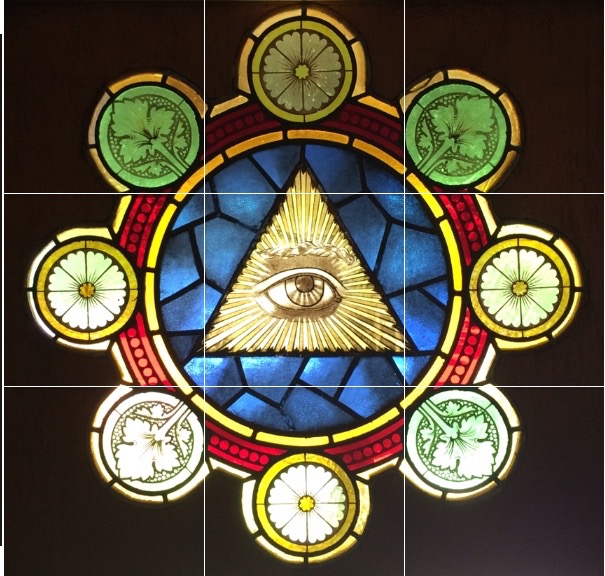
In design terms, the Wizard’s tastes skewed toward the epic, the ornate — total art! cosmic syncretism! He hung large antique mirrors on walls in three of the home’s rooms; he filled most of the home’s windows with stained glass, including a large window at the front of the house featuring an image of the Eye of Providence — the latter retrieved, I’m told, from either a former church or a former Masonic Temple. From the ceilings of those of the home’s rooms adorned with foxed mirrors, he added dazzling, many-armed, many-bulbed chandeliers — beautiful, gaudy, dusty old things! The home’s several built-in bookcases may have been of his making as well — as were one room’s shelves sized for storage of records. The most characteristic of his contributions, though, was the imp crouched atop the home’s door bell, or the pair of werewolves carved into the corners of a mantle atop one room’s fireplace.

The Move-In

When Sarah and I first moved in, we hired a team of local movers to help us unload. One of the movers took one look at the werewolves, and one look at the Eye of Providence, and said, “Y’all ought to have a preacher come and bless this place.”

Weird Occurrences

Suffice to say, we had some weird occurrences there at the home we rented on Shady. None of it seemed malevolent in intent — just a bit weird. I developed a writing practice during my time there involving self-induced trance states, similar to the surrealist practice of “automatic writing.” I experienced auditory hallucinations, where it felt like I was hearing voices. Some of this was admittedly disconcerting at first. I realized almost immediately, however, that I could write some of it down. I could take notes like a kind of sleuth. And so, a Text began to germinate — one I transcribed gratefully, in a state of silent absorption as I listened.

Hence these trance-scripts.

As for the house, Frank sold it when we moved out — and from what I’ve heard, he tempered the decor when preparing to put the place on the market. Thankfully, however, I have some photos of how it looked when I was there.

I have the photos…and I have the Text.

The Gay Wizard

I know what you’re thinking, says the Narrator: Can I trust an author who calls one of his characters “The Gay Wizard”? I use that name not to offend, but because that was how he was known about town.

People knew the Gay Wizard. He was a local personality, a figure in the community. I remember Sarah and I speaking to our neighbor Sue one afternoon. Sue lived up the street from us, in a cream-colored home. Ferns hung in baskets from her porch. By the time we met her, Sue was already decades into her time on Shady. She spoke fondly of the wizard: his parties, his Studebaker, his boat.

Atop skeletal details of that sort, gathered haphazardly in the course of my tenancy, I crafted a character: someone I fancied meeting one day via time machine. Like an egregore of sorts, he entered first into my imaginings via the spirit of books of an earlier era. The books started turning up in the bins at Goodwill, as if he’d sent them: rare, obscure screeds like Arthur Evans’s Witchcraft and the Gay Counterculture and Mitch Walker’s Visionary Love: A Spirit Book of Gay Mythology and Trans-mutational Faerie. From them and others like them I culled a portrait of a loving psychedelic animist: a gardener like Derek Jarman. That’s how I see him now, in fact: poised there in the sunlit grove at the center of the home’s back yard, spade in hand amid the growth of his garden.

In picturing him thus, I resist the story’s pull toward horror. If this were a work of horror, notes the Narrator, he’d have been a shadier dude. Play the horror factor one way, and he’d have been a Crowleyan sex magician. A Thelemite; a Satanist: a practitioner of black magic. Play it another way, as might, say, Jordan Peele or P. Djèlí Clark, and he’d have been a wizard of an even deadlier sort: the kind who go around in white, terrorizing people of color.

If he’s ours to imagine, says the Narrator, let us imagine him otherwise. In our choosing of genre, let us act with hope.

The Arrival of the Narrator into the Narrative, aka “The Katabasis”

I myself was a latecomer, fresh on the scene thanks to a Craigslist ad posted once upon a morning in the spring of 2013, says the Narrator. Sarah had taken a job at a university in town, and we needed a place to rent. By then, Shady had lost some of its fame. Much had changed. The garage behind the Easter house had already been torn down years before our arrival. All that remained was its stone foundation. And Mitch himself had moved away to nearby Kernersville. In all likelihood, then, the story of Drive-In Studio might have gone undetected, might have remained part of Shady’s secret history, hidden away, occulted by the passage of time, had it not been for Frank, our landlord: a goateed documentarian with a film degree from UNC School of the Arts, fixture of sorts in the local music scene, and amateur collector of fossils. Frank and some fellow students at UNCSA had been part of an artists’ collective that had squatted an old, deactivated meat-packing plant in the late 1990s, on what was then the edge of downtown. Through legal and financial machinations that, I admit, were never entirely clear to me, Frank and his fellow squatters had achieved the impossible. Despite the odds, they’d gained control of the building; they’d transformed it into some other kind of thing. There it stood, suddenly, teeth and claws gleaming: an art space and show venue called The Werehouse.

Love and Marriage: A Discourse

“There I was,” recalls the time traveler. “A married man, despite my vexed relationship to marriage as sacrament and institution.”

“Okay,” nods the narrator, eyebrows raised, trying to intuit from what he knows of the traveler’s past what might lie on the other side of “vexed” if that word was hyperlinked. “You’ll have to say more at some point—but go on.”

“Sarah and I had exchanged our vows seventeen years prior,” explains the traveler, “outdoors, in a state-sanctioned but otherwise nonreligious ceremony, with the blessing of friends and family.”

The traveler pauses, proceeds haltingly here in his telling, reliving again the flowers, the arbor, the sunshower afterwards. “I wasn’t seeking to marry,” he adds. “That wasn’t part of any future I’d imagined for myself in my youth.”

Narrator considers this, nods again approvingly, asks what he’d imagined in its place.

“As far as I can remember,” muses the traveler, “all I’d wanted was to write.” He smiles, picturing himself hunched over his notebooks in years past.

“But you and Sarah fell in love?” asks the narrator.

“Yes,” confirms the traveler, “no denial of that on my part. And there we were, in the final months of our Master’s program: both of us wanting to pursue PhDs in English, with hopes of earning a living, despite already mounting debt, by continuing to teach courses at the college level.”

“Fair enough,” says the narrator, elbows propped on the arms of his chair, fingers arched to form a pyramid. “But how did you get from there to the decision to marry?”

“The immediate stress in those days,” breathes the traveler, voice achieving new resolve, “was that we were drawn toward different programs. Mentors dear to us at the time advised us to go our separate ways. ‘Sarah should go to Buffalo,’ they told us. ‘Matt should go to Brown.’”

Narrator purses his lips, tries to conceive the traveler’s dilemma.

“I remember us crying afterwards upon leaving those meetings,” murmurs the traveler. “Neither of us wanted to live apart.”

Traveler looks up here in his telling, eyes glinting. “And so it happened.”

“Just like that?” inquires the narrator. Traveler nods. “Just like that,” he replies, snapping his fingers as if to illustrate. “Over dinner one evening: we agreed to marry.”

Wednesday June 30, 2021

Without yet knowing in advance the form of this narrative, or even whether it is to be a story or a novel, this thing, this experiment in living theater that we’ve method-acted our way into — let us nonetheless speculate as to what it might mean and how it might happen. At minimum, it means a shift in genre. This Work we’re trance-scribing would become a fiction, a fantasy: something other than the author’s lived reality. This despite being tied indexically to that reality through its temporal adjacency. The world contributes, the world participates in the coming-into-being, the trance-scription, of the text’s episodes. It is to the rhythm of the day that the text is sung. What happens is: I realize I’m already in the alternate timeline. The shift occurred with the paralogy of “Wednesday January 6, 2020.” Publish as is and we can continue to remain in this timeline, thinks our traveler. Edit the date and we enter a timeline that occurred otherwise. Or so I imagine as I sit with the idea, the realization unfolding slowly as I water the plants in our garden. “Otherwise how?” I wonder. “What would happen?” We couldn’t know in advance, could we? We would have to become part of the experiment, like seed in soil, attending to the unfolding of each day amid conditions of precarity and love. Yet this we’ve already done by gifting ourselves the paralogy. Swapping the zero with the one would be like looking a gift horse in the mouth.

So begins the tale. Sarah green-lights the production and confirms my thinking about how to proceed. I go live with the paralogy intact mid-afternoon, and encounter several immediate forms of resistance. A troll, for instance, posts a comment proposing that the work has “hit a new level of faggotry,” while someone I care to know better sings out into the void of social media Martha Wainwright’s “Bloody Mother Fucking Asshole.” On a more hopeful note, though, the room (acting collectively here as Greek chorus) replies by sounding the passing of Donald Rumsfeld. Have I succumbed to cruel optimism? Should I have proceeded to the “unknown unknown” of the one? Perhaps the Work moves toward personal and collective flourishing as the one and the many learn to live in fidelity with both love and desire.

Friday June 25, 2021

I’m about half a year behind in posting these trance-scripts. Arriving to summer solstice, I post trance-scripts about winter. I type up New Year’s Day as I sit in summer sun. And as I do so, the idea dawns upon me: I can edit. I can revise. Trance-scripts could become a time-travel narrative. Through the eerie psychedelic echo and delay of the trance-script, I can affect-effect the past. I’ve done this already in minor ways, adjusting a word or two here and there. Time travel is such a modernist conceit, though, is it not? It’s modernist when conceived as a power wielded by a scientist or some sort of Western rationalist subject, as in H.G. Wells’s genre-defining 1895 novel The Time Machine. But in fact, much of the genre troubles the agency of the traveler. Think of Marty McFly, forced to drive Doc Brown’s Delorean while fleeing a van of rocket-launcher-armed Libyan assassins in Back to the Future. Or think of Dana, the black female narrator-protagonist in Octavia E. Butler’s novel Kindred. For Dana, travel is a forced migration to the time and place of an ancestor’s enslavement. One moment, she’s in 1970s Los Angeles; the next moment, she’s trapped on a plantation in pre-Civil War Maryland. Be that as it may, there is still the matter of these trance-scripts. It all seems rather complicated, this idea of tinkering with texts post facto. Yet here I am doing it: editing as I write. What, then, of this mad-professorly talk of “time-travel”? What would change, under what circumstances, and why? Let us be brave in our fantasies, brave in our imaginings.

Monday October 5, 2020

Toward evening I retire to the yard and sit beside a fire. The fire brightens as the sky darkens. Crickets and cicadas trade rhythms. Beside them ride the sonic traces of cars along the nearby autobahn. From the sky above comes and goes the sound of a helicopter. Sarah and I burn dry branches of rosemary. As night falls, I pull my chair closer to the fire and admire its warmth. The heat relaxes me. Afterwards I sit beside Frankie as she plays at her music table in the living room, awake a bit past her bedtime.

Tuesday September 22, 2020

Some car drama this afternoon — but we take care of it, we swap out the flat tire, replace it with the spare, drive it over to the auto shop for repair. I remember the last time I changed a tire: the flush afterwards, the sense of accomplishment. Upon discovering today’s flat, I responded initially with flashes of anger and resentment. These, however, I channeled, transmuted into energy that I made work for me as I performed the physicality of what the circumstance of the day demanded: a series of arm wrestles with lug nuts and tires. Afterwards my shoulders went numb a bit as after an intense session of weightlifting. Yet there’s work to be done, so I do it. Up next in the course, Ginsberg and Di Prima.