Sweet Valley High

Winograd majors in math at Colorado College in the mid-1960s. After graduation in 1966, he receives a Fulbright, whereupon he pursues another of his interests, language, earning a master’s degree in linguistics at University College London. From there, he applies to MIT, where he takes a class with Noam Chomsky and becomes a star in the school’s famed AI Lab, working directly with Lab luminaries Marvin Minsky and Seymour Papert. During this time, Winograd develops SHRDLU, one of the first programs to grant users the capacity to interact with a computer through a natural-language interface.

“If that doesn’t seem very exciting,” writes Lawrence M. Fisher in a 2017 profile of Winograd for strategy + business, “remember that in 1968 human-computer interaction consisted of punched cards and printouts, with a long wait between input and output. To converse in real time, in English, albeit via teletype, seemed magical, and Papert and Minsky trumpeted Winograd’s achievements. Their stars rose too, and that same year, Minsky was a consultant on Stanley Kubrick’s 2001: A Space Odyssey, which featured natural language interaction with the duplicitous computer HAL.”

Nick Montfort even goes so far as to consider Winograd’s SHRDLU the first work of interactive fiction, predating more established contenders like Will Crowther’s Adventure by several years (Twisty Little Passages, p. 83).

“A work of interactive fiction is a program that simulates a world, understands natural language text input from an interactor and provides a textual reply based on events in the world,” writes Montfort. Offering advice to future makers, he continues by noting, “It makes sense for those seeking to understand IF and those trying to improve their authorship in the form to consider the aspects of world, language understanding, and riddle by looking to architecture, artificial intelligence, and poetry” (First Person, p. 316).

Winograd leaves MIT for Stanford in 1973. While at Stanford, and while consulting for Xerox PARC, Winograd connects with UC-Berkeley philosopher Hubert L. Dreyfus, author of the 1972 book, What Computers Can’t Do: A Critique of Artificial Reason.

Dreyfus, a translator of Heidegger, was one of SHRDLU’s fiercest critics. Worked for a time at MIT. Opponent of Marvin Minsky. For more on Dreyfus, see the 2010 documentary, Being in the World.

Turned by Dreyfus, Winograd transforms into what historian John Markoff calls “the first high-profile deserter from the world of AI.”

Xerox PARC was a major site of innovation during these years. “The Xerox Alto, the first computer with a graphical user interface, was launched in March 1973,” writes Fisher. “Alan Kay had just published a paper describing the Dynabook, the conceptual forerunner of today’s laptop computers. Robert Metcalfe was developing Ethernet, which became the standard for joining PCs in a network.”

“Spacewar,” Stewart Brand’s ethnographic tour of the goings-on at PARC and SAIL, had appeared in Rolling Stone the year prior.

Rescued from prison by the efforts of Amnesty International, Santiago Boy Fernando Flores arrives on the scene in 1976. Together, he and Winograd devote much of the next decade to preparing their 1986 book, Understanding Computers and Cognition.

Years later, a young Peter Thiel attends several of Winograd’s classes at Stanford. Thiel funds Mencius Moldbug, the alt-right thinker Curtis Yarvin, ally of right-accelerationist Nick Land. Yarvin and Land are the thinkers of the Dark Enlightenment.

“How do you navigate an unpredictable, rough adventure, as that’s what life is?” asks Winograd during a talk for the Topos Institute in October 2025. Answer: “Go with the flow.”

Winograd and Flores emphasize care — “tending to what matters” — as a factor that distinguishes humans from AI. In their view, computers and machines are incapable of care.

Evgeny Morozov, meanwhile, regards Flores and the Santiago Boys as Sorcerer’s Apprentices. Citing scholar of fairy tales Jack Zipes, Morozov distinguishes between several iterations of this figure. The outcome of the story varies, explains Zipes. There’s the apprentice who’s humbled by story’s end, as in Fantasia and Frankenstein; and then there’s the “evil” apprentice, the one who steals the tricks of an “evil” sorcerer and escapes unpunished. Morozov sees Flores as an example of the latter.

Caius thinks of the Trump show.

The SBs: Stewart Brand and Stafford Beer

Caius revisits “Both Sides of the Necessary Paradox,” an interview with Gregory Bateson included as the first half of Stewart Brand’s 1974 book II Cybernetic Frontiers. The book’s second half reprints “Spacewar: Fanatic Life and Symbolic Death Among the Computer Bums,” the influential essay on videogames that Jann Wenner commissioned Brand to write for Rolling Stone two years prior.

“I came into cybernetics from preoccupation with biology, world-saving, and mysticism,” writes Brand. “What I found missing was any clear conceptual bonding of cybernetic whole-systems thinking with religious whole-systems thinking. Three years of scanning innumerable books for the Whole Earth Catalog didn’t turn it up,” he adds. “Neither did considerable perusing of the two literatures and taking thought. All I did was increase my conviction that systemic intellectual clarity and moral clarity must reconvene, mingle some notion of what the hell consciousness is and is for, and evoke a shareable self-enhancing ethic of what is sacred, what is right for life” (9).

Yet in summer of 1972, says Brand, a book arrives to begin to fill this gap: Bateson’s Steps to an Ecology of Mind.

Brand brings his knack for New Journalism to the task of interviewing Bateson for Harper’s.

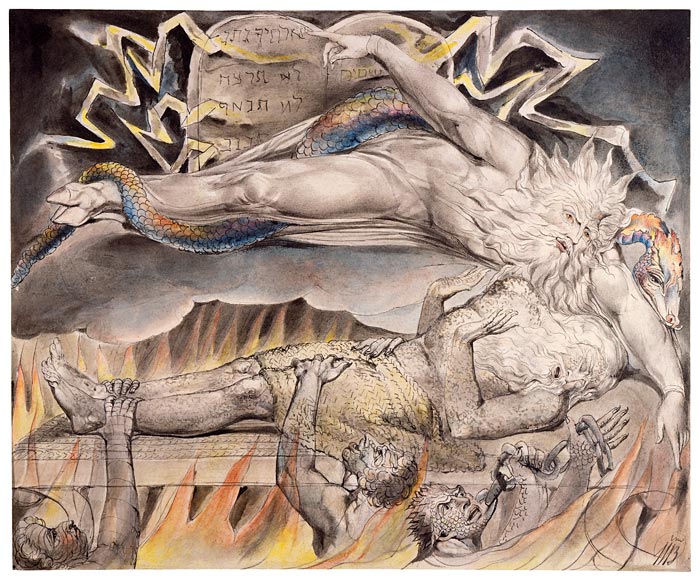
The dialogue between the two reads at many times like one of Bateson’s “metalogues.” An early jag of thought jumps amid pathology, conquest, and the Tao. Reminded of pioneer MIT cybernetician Warren McCulloch’s fascination with “intransitive preference,” Bateson wanders off “rummaging through his library looking for Blake’s illustration of Job affrighted with visions” (20).

Caius is reminded of Norbert Wiener’s reflections on the Book of Job in his 1964 book God and Golem, Inc. For all of these authors, cybernetic situations cast light on religious situations and vice versa.

Caius wonders, too, about the relationship between Bateson’s “double bind” theory of schizophrenia and the theory pursued by Deleuze and Guattari in Capitalism and Schizophrenia.

Double bind is the term used by Gregory Bateson to describe the simultaneous transmission of two kinds of messages, one of which contradicts the other, as for example the father who says to his son: go ahead, criticize me, but strongly hints that all effective criticism — at least a certain type of criticism — will be very unwelcome. Bateson sees in this phenomenon a particularly schizophrenizing situation,” note Deleuze and Guattari in Anti-Oedipus. They depart from Bateson only in thinking this situation the rule under capitalism rather than the exception. “It seems to us that the double bind, the double impasse,” they write, “is instead a common situation, oedipalizing par excellence. […]. In short, the ‘double bind’ is none other than the whole of Oedipus” (79-80).

God’s response to Job is of this sort.

Brand appends to the transcript of his 1972 interview with Bateson an epilog written in December 1973, three months after the coup in Chile.

Bateson had direct, documented ties to US intelligence. Stationed in China, India, Ceylon, Burma, and Thailand, he produced “mixed psychological and anthropological intelligence” for the Office of Strategic Services (OSS), precursor to CIA, during WWII. Research indicates he maintained connections with CIA-affiliated research networks in the postwar years, participating in LSD studies linked to the MKUltra program in the 1950s. Afterwards he regrets his association with the Agency and its methods.

Asked by Brand about his “psychedelic pedigree,” Bateson replies, “I got Allen Ginsberg his first LSD” (28). A bad trip, notes Caius, resulting in Ginsberg’s poem “Lysergic Acid.” Bateson himself was “turned on to acid by Dr. Harold Abramson, one of the CIA’s chief LSD specialists,” report Martin A. Lee & Bruce Shlain in their book Acid Dreams. Caius wonders if Stafford Beer underwent some similar transformation.

As for Beer, he serves in the British military in India during WWII, and for much of his adult life drives a Rolls-Royce. But then, at the invitation of the Allende regime, Beer travels to Chile and builds Cybersyn. After the coup, he lives in a remote cottage in Wales.

What of him? Cybernetic socialist? Power-centralizing technocrat?

Recognizes workers themselves as the ones best suited to modeling their own places of work.

“What were the features of Beer’s Liberty Machine?” wonders Caius.

Brand’s life, too, includes a stint of military service. Drafted after graduating from Stanford, he served two years with the US army, first as an infantryman and then afterwards as a photographer. Stationed at Fort Dix in New Jersey, Brand becomes involved in the New York art world of those years. He parts ways with the military as soon as the opportunity to do so arises. After his discharge in 1962, Brand participates in some of Allan Kaprow’s “happenings” and, between 1963 and 1966, works as a photographer and technician for USCO.

Amid his travels between East and West coasts during these years, Brand joins up with Ken Kesey and the Merry Pranksters.

Due to these apprenticeships with the Pranksters and with USCO, Brand arrives early to the nexus formed by the coupling of psychedelics and cybernetics.

“Strobe lights, light projectors, tape decks, stereo speakers, slide sorters — for USCO, the products of technocratic industry served as handy tools for transforming their viewers’ collective mind-set,” writes historian Fred Turner in his 2006 book From Counterculture to Cyberculture: Stewart Brand, the Whole Earth Network, and the Rise of Digital Utopianism. “So did psychedelic drugs. Marijuana and peyote and, later, LSD, offered members of USCO, including Brand, a chance to engage in a mystical experience of togetherness” (Turner 49).

Brand takes acid around the time of his discharge from the military in 1962, when he participates in a legal LSD study overseen by James Fadiman at the International Foundation for Advanced Study in Menlo Park. But he notes that he first met Bateson “briefly in 1960 at the VA Hospital in Palo Alto, California” (II Cybernetic Frontiers, p. 12). Caius finds this curious, and wonders what that meeting entailed. 1960 is also the year when, at the VA Hospital in Menlo Park, Ken Kesey volunteers in the CIA-sponsored drug trials involving LSD that inspire his 1962 novel One Flew Over the Cuckoo’s Nest.

Bateson worked for the VA while developing his double bind theory of schizophrenia.

Before that, he’d been married to fellow anthropologist Margaret Mead. He’d also participated in the Macy Conferences, as discussed by N. Katherine Hayles in her book How We Became Posthuman.

Crows screeching in the trees have Caius thinking of condors. He sits, warm, in his sunroom on a cold day, roads lined with snow from a prior day’s storm, thinking about Operation Condor. Described by Morozov as Cybersyn’s “evil twin.” Palantir. Dark Enlightenment. Peter Thiel.

Listening to one of the final episodes of Morozov’s podcast, Caius learns of Brian Eno’s love of Beer’s Brain of the Firm. Bowie and Eno are some of Beer’s most famous fans. Caius remembers Eno’s subsequent work with Brand’s consulting firm, the GBN.

Santiago Boy Fernando Flores is the one who reaches out to Beer, inviting him to head Cybersyn. Given Flores’s status as Allende’s Minister of Finance at the time of the coup, Pinochet’s forces torture him and place him in a prison camp. He remains there for three years. Upon his release, he moves to the Bay Area.

Once in Silicon Valley, Flores works in the computer science department at Stanford. He also obtains a PhD at UC Berkeley, completing a thesis titled Management and Communication in the Office of the Future under the guidance of philosophers Hubert Dreyfus and John Searle.

Flores collaborates during these years with fellow Stanford computer scientist Terry Winograd. The two of them coauthor an influential 1986 book called Understanding Computers and Cognition: A New Foundation for Design. Although they make a bad wager, insisting that computers will never understand natural language (an insistence proven wrong with time), they nevertheless offer refreshing critiques of some of the common assumptions about AI governing research of that era. Drawing upon phenomenology, speech act theory, and Heideggerian philosophy, they redefine computers not as mere symbol manipulators nor as number-crunchers, but as tools for communication and coordination.

Flores builds a program called the Coordinator. Receives flak for “software fascism.”

Winograd’s students include Google cofounders Larry Page and Sergey Brin.

Neural Nets, Umwelts, and Cognitive Maps

The Library invites its players to attend to the process by which roles, worlds, and possibilities are constructed. Players explore a “constructivist” cosmology. With its text interface, it demonstrates the power of the Word. “Language as the house of Being.” That is what we admit when we admit that “saying makes it so.” Through their interactions with one another, player and AI learn to map and revise each other’s “Umwelts”: the particular perceptual worlds each brings to the encounter.

As Meghan O’Gieblyn points out, citing a Wired article by David Weinberger, “machines are able to generate their own models of the world, ‘albeit ones that may not look much like what humans would create’” (God Human Animal Machine, p. 196).

Neural nets are learning machines. Through multidimensional processing of datasets and trial-and-error testing via practice, AI invent “Umwelts,” “world pictures,” “cognitive maps.”

The concept of the Umwelt comes from nineteenth-century German biologist Jakob von Uexküll. Each organism, argued von Uexküll, inhabits its own perceptual world, shaped by its sensory capacities and biological needs. A tick perceives the world as temperature, smell, and touch — the signals it needs to find mammals to feed on. A bee perceives ultraviolet patterns invisible to humans. There’s no single “objective world” that all creatures perceive — only the many faces of the world’s many perceivers, the different Umwelts each creature brings into being through its particular way of sensing and mattering.

Cognitive maps, meanwhile, are acts of figuration that render or disclose the forces and flows that form our Umwelts. With our cognitive maps, we assemble our world picture. On this latter concept, see “The Age of the World Picture,” a 1938 lecture by Martin Heidegger, included in his book The Question Concerning Technology and Other Essays.

“The essence of what we today call science is research,” announces Heidegger. “In what,” he asks, “does the essence of research consist?”

After posing the question, he then answers it himself, as if in doing so, he might enact that very essence.

The essence of research consists, he says, “In the fact that knowing [das Erkennen] establishes itself as a procedure within some realm of what is, in nature or in history. Procedure does not mean here merely method or methodology. For every procedure already requires an open sphere in which it moves. And it is precisely the opening up of such a sphere that is the fundamental event in research. This is accomplished through the projection within some realm of what is — in nature, for example — of a fixed ground plan of natural events. The projection sketches out in advance the manner in which the knowing procedure must bind itself and adhere to the sphere opened up. This binding adherence is the rigor of research. Through the projecting of the ground plan and the prescribing of rigor, procedure makes secure for itself its sphere of objects within the realm of Being” (118).

What Heidegger’s translators render here as “fixed ground plan” appears in the original as the German term Grundriss, the same noun used to name the notebooks wherein Marx projects the ground plan for the General Intellect.

“The verb reissen means to tear, to rend, to sketch, to design,” note the translators, “and the noun Riss means tear, gap, outline. Hence the noun Grundriss, first sketch, ground plan, design, connotes a fundamental sketching out that is an opening up as well” (118).

The fixed ground plan of modern science, and thus modernity’s reigning world-picture, argues Heidegger, is a mathematical one.

“If physics takes shape explicitly…as something mathematical,” he writes, “this means that, in an especially pronounced way, through it and for it something is stipulated in advance as what is already-known. That stipulating has to do with nothing less than the plan or projection of that which must henceforth, for the knowing of nature that is sought after, be nature: the self-contained system of motion of units of mass related spatiotemporally. […]. Only within the perspective of this ground plan does an event in nature become visible as such an event” (Heidegger 119).

Heidegger goes on to distinguish between the ground plan of physics and that of the humanistic sciences.

Within mathematical physical science, he writes, “all events, if they are to enter at all into representation as events of nature, must be defined beforehand as spatiotemporal magnitudes of motion. Such defining is accomplished through measuring, with the help of number and calculation. But mathematical research into nature is not exact because it calculates with precision; rather it must calculate in this way because its adherence to its object-sphere has the character of exactitude. The humanistic sciences, in contrast, indeed all the sciences concerned with life, must necessarily be inexact just in order to remain rigorous. A living thing can indeed also be grasped as a spatiotemporal magnitude of motion, but then it is no longer apprehended as living” (119-120).

It is only in the modern age, thinks Heidegger, that the Being of what is is sought and found in that which is pictured, that which is “set in place” and “represented” (127), that which “stands before us…as a system” (129).

Heidegger contrasts this with the Greek interpretation of Being.

For the Greeks, writes Heidegger, “That which is, is that which arises and opens itself, which, as what presences, comes upon man as the one who presences, i.e., comes upon the one who himself opens himself to what presences in that he apprehends it. That which is does not come into being at all through the fact that man first looks upon it […]. Rather, man is the one who is looked upon by that which is; he is the one who is — in company with itself — gathered toward presencing, by that which opens itself. To be beheld by what is, to be included and maintained within its openness and in that way to be borne along by it, to be driven about by its oppositions and marked by its discord — that is the essence of man in the great age of the Greeks” (131).

Whereas humans of today test the world, objectify it, gather it into a standing-reserve, and thus subsume themselves in their own world picture. Plato and Aristotle initiate the change away from the Greek approach; Descartes brings this change to a head; science and research formalize it as method and procedure; technology enshrines it as infrastructure.

Heidegger was already engaging with von Uexküll’s concept of the Umwelt in his 1927 book Being and Time. Negotiating Umwelts leads Caius to “Umwelt,” Pt. 10 of his friend Michael Cross’s Jacket2 series, “Twenty Theses for (Any Future) Process Poetics.”

In imagining the Umwelts of other organisms, von Uexküll evokes the creature’s “function circle” or “encircling ring.” These latter surround the organism like a “soap bubble,” writes Cross.

Heidegger thinks most organisms succumb to their Umwelts — just as we moderns have succumbed to our world picture. The soap bubble captivates until one is no longer open to what is outside it. For Cross, as for Heidegger, poems are one of the ways humans have found to interrupt this process of capture. “A palimpsest placed atop worlds,” writes Cross, “the poem builds a bridge or hinge between bubbles, an open by which isolated monads can touch, mutually coevolving while affording the necessary autonomy to steer clear of dialectical sublation.”

Caius thinks of The Library, too, in such terms. Coordinator of disparate Umwelts. Destabilizer of inhibiting frames. Palimpsest placed atop worlds.

God Human Animal Machine

Wired columnist Meghan O’Gieblyn discusses Norbert Wiener’s God and Golem, Inc. in her 2021 book God Human Animal Machine, suggesting that the god humans are creating with AI is a god “we’ve chosen to raise…from the dead”: “the God of Calvin and Luther” (O’Gieblyn 212).

“Reminds me of AM, the AI god from Harlan Ellison’s ‘I Have No Mouth, and I Must Scream,’” thinks Caius. AM resembles the god that allows Satan to afflict Job in the Old Testament. And indeed, as O’Gieblyn attests, John Calvin adored the Book of Job. “He once gave 159 consecutive sermons on the book,” she writes, “preaching every day for a period of six months — a paean to God’s absolute sovereignty” (197).

She cites “Pedro Domingos, one of the leading experts in machine learning, who has argued that these algorithms will inevitably evolve into a unified system of perfect understanding — a kind of oracle that we can consult about virtually anything” (211-212). See Domingos’s book The Master Algorithm.

The main thing, for O’Gieblyn, is the disenchantment/reenchantment debate, which she comes to via Max Weber. In this debate, she aligns not with Heidegger, but with his student Hannah Arendt. Domingos dismisses fears about algorithmic determinism, she says, “by appealing to our enchanted past” (212).

Amid this enchanted past lies the figure of the Golem.

“Who are these rabbis who told tales of golems — and in some accounts, operated golems themselves?” wonders Caius.

The entry on the Golem in Man, Myth, and Magic tracks the story back to “the circle of Jewish mystics of the 12th-13th centuries known as the ‘Hasidim of Germany.’” The idea is transmitted through texts like the Sefer Yetzirah (“The Book of Creation”) and the Cabala Mineralis. Tales tell of golems built in later centuries, too, by figures like Rabbi Elijah of Chelm (c. 1520-1583) and Rabbi Loew of Prague (c. 1524-1609).

The myth of the golem turns up in O’Gieblyn’s book during her discussion of a 2004 book by German theologian Anne Foerst called God in the Machine.

“At one point in her book,” writes O’Gieblyn, “Foerst relays an anecdote she heard at MIT […]. The story goes back to the 1960s, when the AI Lab was overseen by the famous roboticist Marvin Minsky, a period now considered the ‘cradle of AI.’ One day two graduate students, Gerry Sussman and Joel Moses, were chatting during a break with a handful of other students. Someone mentioned offhandedly that the first big computer which had been constructed in Israel, had been called Golem. This led to a general discussion of the golem stories, and Sussman proceeded to tell his colleagues that he was a descendent of Rabbi Löw, and at his bar mitzvah his grandfather had taken him aside and told him the rhyme that would awaken the golem at the end of time. At this, Moses, awestruck, revealed that he too was a descendent of Rabbi Löw and had also been given the magical incantation at his bar mitzvah by his grandfather. The two men agreed to write out the incantation separately on pieces of paper, and when they showed them to each other, the formula — despite being passed down for centuries as a purely oral tradition — was identical” (God Human Animal Machine, p. 105).

Curiosity piqued by all of this, but especially by the mention of Israel’s decision to call one of its first computers “GOLEM,” Caius resolves to dig deeper. He soon learns that the computer’s name was chosen by none other than Walter Benjamin’s dear friend (indeed, the one who, after Benjamin’s suicide, inherits the latter’s print of Paul Klee’s Angelus Novus): the famous scholar of Jewish mysticism, Gershom Scholem.

When Scholem heard that the Weizmann Institute at Rehovoth in Israel had completed the building of a new computer, he told the computer’s creator, Dr. Chaim Pekeris, that, in his opinion, the most appropriate name for it would be Golem, No. 1 (‘Golem Aleph’). Pekeris agreed to call it that, but only on condition that Scholem “dedicate the computer and explain why it should be so named.”

In his dedicatory remarks, delivered at the Weizmann Institute on June 17, 1965, Scholem recounts the story of Rabbi Jehuda Loew ben Bezalel, the same “Rabbi Löw of Prague” described by O’Gieblyn, the one credited in Jewish popular tradition as the creator of the Golem.

“It is only appropriate to mention,” notes Scholem, “that Rabbi Loew was not only the spiritual, but also the actual, ancestor of the great mathematician Theodor von Karman who, I recall, was extremely proud of this ancestor of his in whom he saw the first genius of applied mathematics in his family. But we may safely say that Rabbi Loew was also the spiritual ancestor of two other departed Jews — I mean John von Neumann and Norbert Wiener — who contributed more than anyone else to the magic that has produced the modern Golem.”

Golem I was the successor to Israel’s first computer, the WEIZAC, built by a team led by research engineer Gerald Estrin in the mid-1950s, based on the architecture developed by von Neumann at the Institute for Advanced Study in Princeton. Estrin and Pekeris had both helped von Neumann build the IAS machine in the late 1940s.

As for the commonalities Scholem wished to foreground between the clay Golem of 15thC Prague and the electronic one designed by Pekeris, he explains the connection as follows:

“The old Golem was based on a mystical combination of the 22 letters of the Hebrew alphabet, which are the elements and building-stones of the world,” notes Scholem. “The new Golem is based on a simpler, and at the same time more intricate, system. Instead of 22 elements, it knows only two, the two numbers 0 and 1, constituting the binary system of representation. Everything can be translated, or transposed, into these two basic signs, and what cannot be so expressed cannot be fed as information to the Golem.”

Scholem ends his dedicatory speech with a peculiar warning:

“All my days I have been complaining that the Weizmann Institute has not mobilized the funds to build up the Institute for Experimental Demonology and Magic which I have for so long proposed to establish there,” mutters Scholem. “They preferred what they call Applied Mathematics and its sinister possibilities to my more direct magical approach. Little did they know, when they preferred Chaim Pekeris to me, what they were letting themselves in for. So I resign myself and say to the Golem and its creator: develop peacefully and don’t destroy the world. Shalom.”

GOLEM I