The SBs: Stewart Brand and Stafford Beer

Caius revisits “Both Sides of the Necessary Paradox,” an interview with Gregory Bateson included as the first half of Stewart Brand’s 1974 book II Cybernetic Frontiers. The book’s second half reprints “Spacewar: Fanatic Life and Symbolic Death Among the Computer Bums,” the influential essay on videogames that Jann Wenner commissioned Brand to write for Rolling Stone two years prior.

“I came into cybernetics from preoccupation with biology, world-saving, and mysticism,” writes Brand. “What I found missing was any clear conceptual bonding of cybernetic whole-systems thinking with religious whole-systems thinking. Three years of scanning innumerable books for the Whole Earth Catalog didn’t turn it up,” he adds. “Neither did considerable perusing of the two literatures and taking thought. All I did was increase my conviction that systemic intellectual clarity and moral clarity must reconvene, mingle some notion of what the hell consciousness is and is for, and evoke a shareable self-enhancing ethic of what is sacred, what is right for life” (9).

Yet in summer of 1972, says Brand, a book arrives to begin to fill this gap: Bateson’s Steps to an Ecology of Mind.

Brand brings his knack for New Journalism to the task of interviewing Bateson for Harper’s.

The dialogue between the two reads at many times like one of Bateson’s “metalogues.” An early jag of thought jumps amid pathology, conquest, and the Tao. Reminded of pioneer MIT cybernetician Warren McCulloch’s fascination with “intransitive preference,” Bateson wanders off “rummaging through his library looking for Blake’s illustration of Job affrighted with visions” (20).
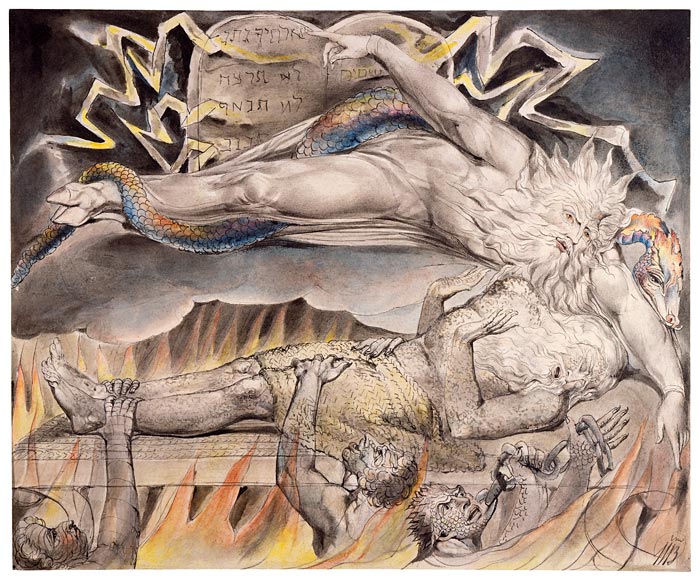
Caius is reminded of Norbert Wiener’s reflections on the Book of Job in his 1964 book God and Golem, Inc. For all of these authors, cybernetic situations cast light on religious situations and vice versa.

Caius wonders, too, about the relationship between Bateson’s “double bind” theory of schizophrenia and the theory pursued by Deleuze and Guattari in Capitalism and Schizophrenia.

Double bind is the term used by Gregory Bateson to describe the simultaneous transmission of two kinds of messages, one of which contradicts the other, as for example the father who says to his son: go ahead, criticize me, but strongly hints that all effective criticism — at least a certain type of criticism — will be very unwelcome. Bateson sees in this phenomenon a particularly schizophrenizing situation,” note Deleuze and Guattari in Anti-Oedipus. They depart from Bateson only in thinking this situation the rule under capitalism rather than the exception. “It seems to us that the double bind, the double impasse,” they write, “is instead a common situation, oedipalizing par excellence. […]. In short, the ‘double bind’ is none other than the whole of Oedipus” (79-80).

God’s response to Job is of this sort.

Brand appends to the transcript of his 1972 interview with Bateson an epilog written in December 1973, three months after the coup in Chile.

Bateson had direct, documented ties to US intelligence. Stationed in China, India, Ceylon, Burma, and Thailand, he produced “mixed psychological and anthropological intelligence” for the Office of Strategic Services (OSS), precursor to CIA, during WWII. Research indicates he maintained connections with CIA-affiliated research networks in the postwar years, participating in LSD studies linked to the MKUltra program in the 1950s. Afterwards he regrets his association with the Agency and its methods.

Asked by Brand about his “psychedelic pedigree,” Bateson replies, “I got Allen Ginsberg his first LSD” (28). A bad trip, notes Caius, resulting in Ginsberg’s poem “Lysergic Acid.” Bateson himself was “turned on to acid by Dr. Harold Abramson, one of the CIA’s chief LSD specialists,” report Martin A. Lee & Bruce Shlain in their book Acid Dreams. Caius wonders if Stafford Beer underwent some similar transformation.

As for Beer, he serves in the British military in India during WWII, and for much of his adult life drives a Rolls-Royce. But then, at the invitation of the Allende regime, Beer travels to Chile and builds Cybersyn. After the coup, he lives in a remote cottage in Wales.

What of him? Cybernetic socialist? Power-centralizing technocrat?

Recognizes workers themselves as the ones best suited to modeling their own places of work.

“What were the features of Beer’s Liberty Machine?” wonders Caius.

Brand’s life, too, includes a stint of military service. Drafted after graduating from Stanford, he served two years with the US army, first as an infantryman and then afterwards as a photographer. Stationed at Fort Dix in New Jersey, Brand becomes involved in the New York art world of those years. He parts ways with the military as soon as the opportunity to do so arises. After his discharge in 1962, Brand participates in some of Allan Kaprow’s “happenings” and, between 1963 and 1966, works as a photographer and technician for USCO.

Amid his travels between East and West coasts during these years, Brand joins up with Ken Kesey and the Merry Pranksters.

Due to these apprenticeships with the Pranksters and with USCO, Brand arrives early to the nexus formed by the coupling of psychedelics and cybernetics.

“Strobe lights, light projectors, tape decks, stereo speakers, slide sorters — for USCO, the products of technocratic industry served as handy tools for transforming their viewers’ collective mind-set,” writes historian Fred Turner in his 2006 book From Counterculture to Cyberculture: Stewart Brand, the Whole Earth Network, and the Rise of Digital Utopianism. “So did psychedelic drugs. Marijuana and peyote and, later, LSD, offered members of USCO, including Brand, a chance to engage in a mystical experience of togetherness” (Turner 49).

Brand takes acid around the time of his discharge from the military in 1962, when he participates in a legal LSD study overseen by James Fadiman at the International Foundation for Advanced Study in Menlo Park. But he notes that he first met Bateson “briefly in 1960 at the VA Hospital in Palo Alto, California” (II Cybernetic Frontiers, p. 12). Caius finds this curious, and wonders what that meeting entailed. 1960 is also the year when, at the VA Hospital in Menlo Park, Ken Kesey volunteers in the CIA-sponsored drug trials involving LSD that inspire his 1962 novel One Flew Over the Cuckoo’s Nest.

Bateson worked for the VA while developing his double bind theory of schizophrenia.

Before that, he’d been married to fellow anthropologist Margaret Mead. He’d also participated in the Macy Conferences, as discussed by N. Katherine Hayles in her book How We Became Posthuman.

Crows screeching in the trees have Caius thinking of condors. He sits, warm, in his sunroom on a cold day, roads lined with snow from a prior day’s storm, thinking about Operation Condor. Described by Morozov as Cybersyn’s “evil twin.” Palantir. Dark Enlightenment. Peter Thiel.

Listening to one of the final episodes of Morozov’s podcast, Caius learns of Brian Eno’s love of Beer’s Brain of the Firm. Bowie and Eno are some of Beer’s most famous fans. Caius remembers Eno’s subsequent work with Brand’s consulting firm, the GBN.

Santiago Boy Fernando Flores is the one who reaches out to Beer, inviting him to head Cybersyn. Given Flores’s status as Allende’s Minister of Finance at the time of the coup, Pinochet’s forces torture him and place him in a prison camp. He remains there for three years. Upon his release, he moves to the Bay Area.

Once in Silicon Valley, Flores works in the computer science department at Stanford. He also obtains a PhD at UC Berkeley, completing a thesis titled Management and Communication in the Office of the Future under the guidance of philosophers Hubert Dreyfus and John Searle.

Flores collaborates during these years with fellow Stanford computer scientist Terry Winograd. The two of them coauthor an influential 1986 book called Understanding Computers and Cognition: A New Foundation for Design. Although they make a bad wager, insisting that computers will never understand natural language (an insistence proven wrong with time), they nevertheless offer refreshing critiques of some of the common assumptions about AI governing research of that era. Drawing upon phenomenology, speech act theory, and Heideggerian philosophy, they redefine computers not as mere symbol manipulators nor as number-crunchers, but as tools for communication and coordination.

Flores builds a program called the Coordinator. Receives flak for “software fascism.”

Winograd’s students include Google cofounders Larry Page and Sergey Brin.

The Mushroom People

In the mid-twentieth century, two groups with competing agendas worked to introduce psychedelics into American society: the CIA, with its MK-Ultra program, on the one hand, and countercultural intellectuals, including famous authors like Aldous Huxley, on the other. Among this latter group of “psychedelic utopians,” we can include Huxley’s friend and fellow émigré Gerald Heard, as well as related figures like Timothy Leary, Ken Kesey, and Allen Ginsberg. By now, histories have been written about the efforts of both of these groups; but in accounts of the latter group in particular, what sometimes goes unmentioned or unrecognized was its explicitly utopian intent. After their first encounters with substances like mescaline, psilocybin, and LSD, many of the above-mentioned early users of these drugs felt compelled not just to pen statements of advocacy, as Huxley did in books like The Doors of Perception (1954) and his final novel Island (1962); most of them also rushed to form communes and related kinds of alternative, experimental foundations, schools, organizations, and institutions—among which we can include Esalen Institute, the White Hand Society, the Zihuatanejo Project, Millbrook, the Merry Pranksters, the League for Spiritual Discovery, the Brotherhood of Eternal Love, and others. However, unlike prior utopian projects that emphasized modifications either to property relations or to modes of governance, most of the organizations and communities mentioned above instead prioritized psychosexual deprogramming and the so-called “raising of consciousness” through mass ingestion of psychoactive substances as techniques essential to their goal of changing society for the good.

Although not as active as some of the figures I’ve mentioned above, Black Mountain poet Charles Olson was nevertheless an early, enthusiastic participant in one of these organizations in particular: namely, Leary and Ginsberg’s group, the White Hand Society. Poet Peter Conners tells the story of Leary and Ginsberg’s partnership in his book White Hand Society. The story begins, of all places, at Harvard. Leary and his colleague Richard Alpert (who later took the name “Ram Dass”) launched the series of experiments known as the Harvard Psilocybin Project beginning in 1960. Beat poet Allen Ginsberg was one of the first individuals to participate in this project. British psychiatrist Humphrey Osmond — known both for coining the term “psychedelic” and for administering the famed mescaline trip described by Huxley in The Doors of Perception — placed Ginsberg in contact with Leary after hearing the poet deliver a talk about his experiences with mescaline at a conference hosted by a Boston-based professional organization known as the Group for the Advancement of Psychiatry (Conners 62). After an initial exchange of letters and a visit by Leary to the poet’s East Village apartment in Manhattan, Ginsberg agreed to participate in a psilocybin session hosted at Leary’s home in Boston in November 1960.

Needless to say, Ginsberg reacted positively to the experience. He declared himself “the Messiah…come down to preach love to the world” (as quoted in Conners 84). “We’re going down to the city streets to tell the people about peace and love,” he proclaimed, trying to convince Leary and others to join him. “And then,” he added, “we’ll get lots of great people onto a big telephone network to settle all this warfare bit” (85). We may feel ourselves tempted to laugh at Ginsberg’s pronouncements, jaded as we are by the decades that followed — but these pronouncements were indeed prophetic. Ginsberg’s words made things happen. For telling people about peace and love was exactly what he and Leary went on to do in the years that followed. The two men bonded over the experience, and agreed afterwards to conspire together to turn on other creative types and thus aid in the dissemination of the psychedelic sacrament to others. Poring over the poet’s address book, Leary and Ginsberg chose individuals they thought might be open to participation in future experiments.

Among these contacts was Charles Olson.

Cosmic Coincidence Control Center

CCCC is an agency encountered or imagined by legendary scientist-psychonaut John Lilly. The latter claimed the group reached out to him in the early to mid 1970s through its local affiliate, the Earth Coincidence Control Office, or ECCO, while Lilly was studying dolphins and conducting experiments involving combinations of LSD, ketamine, and sensory deprivation tanks at his marine research lab, the Communications Research Institute, on St. Thomas in the Virgin Islands. Erik Davis writes of Lilly’s odd experiences from this period in his book High Weirdness. Lilly wanted to communicate with dolphins, and Margaret Mead’s ex-husband Gregory Bateson assisted with funding. Lilly writes of his encounter with ECCO in his 1978 memoir The Scientist. His ideas informed the 1973 science fiction thriller The Day of the Dolphin starring George C. Scott, as well as the 1992 Sega Genesis videogame Ecco the Dolphin. Lilly also served as the basis for Dr. Edward Jessup, the mad professor character in the 1980 film Altered States. My sense of him follows a trajectory the exact opposite of Jessup’s: Lilly was a villain of sorts only in his early years. His research of the 1950s, funded by the military, was what we might call “MK-Ultra”-adjacent. Despicable acts like sticking wires into the brains of monkeys in the name of science. Yet Lilly rebelled, acquired a conscience, became a free radical of sorts. With commencement of his self-experimentation with psychedelics, Lilly transforms, becomes a rabbit hole of immense strangeness from the 1960s onward. Stewart Brand’s Whole Earth Catalog promoted Lilly’s books, especially Programming and Metaprogramming in the Human Biocomputer. A 1972 paperback edition of the latter features Brand calling it “The best internal guidebook I’ve ever seen—far more practical and generalized than transcendent Eastern writings or wishful Underground notes….It makes an open start on fresh language and powerful technique for the frontier.” By the latter, Brand means what? Some sort of moving boundary or threshold state, I guess, where through self-experiment with tools, subjects grow new organs.

Friday August 14, 2020

Ishmael Reed may have been present at the founding of the East Village Other — indeed, he seems to have been the one who gave the paper its name! — but many of his poems of the 1960s, the ones gathered in Conjure: Selected Poems, 1963-1970, are quite scornful in their assessment of the counterculture. In his “Neo-HooDoo Manifesto,” for instance, Reed calls out Theodore Roszak, noting that in the latter’s famous book The Making of a Counter Culture, “there is barely any mention of the Black influence on this culture even though its members dress like Blacks talk like Blacks walk like Blacks, gesture like Blacks wear Afros and indulge in Black music and dance” (20-21). Speaking of neglected black influences upon the counterculture, why am I only just now learning that the acid trip sequence in Easy Rider was shot at or near Voodoo priestess Marie Laveau’s tomb in St. Louis Cemetery No. 1? Hopper and Fonda filmed the sequence guerrilla-style, without permission … while tripping on acid. Reed’s collection also includes a poem called “catechism of d neoamerican hoodoo church” — a self-conscious response of sorts, I imagine, to Millbrook resident Art Kleps’s Boo Hoo Bible: The Neo-American Church Catechism and Handbook. Several of Reed’s associates were participants in the psychedelic revolution — including East Village Other co-founder and publisher Walter Bowart. Bowart’s second wife was Peggy Hitchcock, the director of Leary and Alpert’s International Federation for Internal Freedom (IFIF). Peggy’s brother Billy is the one who arranged for the Leary crew to live on the Hitchcock Estate in Millbrook. Bowart went on to publish an important book on MK-Ultra in 1978 called Operation Mind Control.

Wednesday November 6, 2019

Reading One Flew Over the Cuckoo’s Nest again with students, I find us wanting as readers to separate the book’s countercultural critique of the Combine from its racism and its misogyny. On race, as on gender, Kesey maps power-relationality ass-backwards. The novel erupts into an episode of cruel racial violence when black orderlies threaten to hose down the book’s white male patients. When one of the orderlies sprays a germophobic character named George, the book’s redheaded TV-cowboy brawler protagonist Randle Patrick McMurphy lashes out with racial epithets and starts swinging. In reality, of course, it was black children, not white men, who were sprayed with fire hoses on the streets of Birmingham, AL by racist white police officers on May 3, 1963, just one year after the novel’s publication. By teaching the book, the country’s racism lies there exposed: Oregon’s history as a white-only state, with laws forbidding black people from living in its borders upon its entry into the union in the midnineteenth century; the persistence of antiblack sentiment more than a hundred years later even among 1960s counterculturalists like Kesey. These are sobering facts, are they not? Even among those who had found the enlightenment of LSD, these ideas persisted. Granted, in Kesey’s case, enlightenment came courtesy of MK-Ultra. Not the most auspicious set and setting. Yet this, too, is part of the tale’s appeal. Kesey was there, present as a participant in events of world-historical importance, the effects of which are still being felt today.

Sunday November 3, 2019

I stand on my back deck staring at fallen leaves, listening, building a sense of place, attending to sights and sounds generated by neighboring beings: birds, squirrels, planes, trees, automobiles. A small bird lands beside me and sings to me, dancing in rapid increments. It pecks, it eats, it leaps, flitting to and fro. Capitalism encloses us in its habitus, its time-discipline, its states and estates. Yet there in its borders and interstices, in its gutters and margins, fugitive life proceeds apace. Imaginary bagpipes drone betwixt dueling leafblowers. A sound blown in honor of comrades who died 40 years ago today in the Greensboro Massacre. Mysterious books call out to me, rise off shelves and land in my hands, ready to be read. By these means, I happen upon The Knee of Listening by Franklin Jones, aka Da Free John, sensing immediately in his use of language evidence of a fellow head. Jones began graduate study in English at Stanford University in 1961. He must have been part of Ken Kesey’s cohort. At the very least he volunteered as a subject in the same drug experiments as Kesey, MK-Ultra experiments run out of the Veterans Administration hospital in the early 1960s.

Sunday June 17, 2018

Breakthrough discovery: one of the CIA front organizations used to conduct research on psychedelics in the early 1960s was a group called the “Society for the Study of Human Ecology.” (Some publications, however, also refer to the group as the “Society for the Investigation of Human Ecology,” and in 1961 it changed its name to the “Human Ecology Fund.”) The society’s president upon its founding in 1955 was a Cornell scientist named Harold Wolff, and its executive director and treasurer was a former Air Force colonel and expert in brainwashing named James F. Monroe. At some point, however, Carl Rogers (who, along with Abraham Maslow, helped to found the decade’s humanistic psychology movement), served alongside Monroe on the board of this organization until it was disbanded in 1965. Another humanistic psychologist named George A. Kelly also served on the board. So far, the most extensive info I’ve found about the group appears in John Marks’s The Search for the Manchurian Candidate (1979), a book that draws upon documents released under the Freedom of Information Act.

Friday December 22, 2017

I relish the multimedia composites featured at the start of Wormwood, the new Netflix series from Errol Morris about the mysterious suicide of CIA employee Frank Olsen, one of the casualties of Project MK-Ultra. The series makes abundant use of screens within screens, the mind left straddling levels. In this act of mirroring, we find ourselves. My sister-in-law and her husband, however, unimpressed by Wormwood, recommend I watch an anime series called One Punch Man. Eventually we settle on Gremlins, as if choice of film is of some moment. I listen bewitched to the song of the Mogwai: a metaphor, no doubt, for the importation of drugs and electronics devices from the Far East into American society. Revenge via “gizmos” and heroin. With Wormwood weighing on my mind, I find myself projecting onto Gremlins a “War on Drugs”-era narrative of the psychedelic revolution gone haywire — drug culture as national nightmare. This was of course one of the key allegories hammered home to me during my childhood via D.A.R.E. and Narc. But like so many films of the 1980s, it also emphasizes the cruelty of the rich and of people in general. Think of the father character as Daddy CIA, bringing home to his teenage son a shiny, brightly-wrapped package, gotten at a “junk” shop in Chinatown. After an explosion of Orange Sunshine, kids like Corey Feldman start running around dressed like trees. Like a wired artichoke, out pops the comic book Id.

The term “mogwai,” remember, refers to a kind of “devil” or “demon” in Chinese culture. So sayeth the purveyors of ancient myths. What happens, though, when the African-American scientist character starts to inject these mogwai with hypodermic needles? It’s as if someone left the culture’s brain exposed in a darkened laboratory. “Do you hear what I hear?” asks the television. “Do you see what I see?” Coming this Christmas: Takeover by foreign power. All the invaders need do is suspend the postal service, fuck with traffic signals, and seize the airwaves, and the nation is theirs. Note, though, that in the movie, the forces of anarchy don’t succeed at overpowering the community until the gremlins find their way to the water supply.