Frankie’s watercolor and colored marker drawings are my heart’s delight — fields of color into which I gaze. The stained glass of this new temple wherein I dwell. The Time Traveler, though, feels forlorn, shorn of home and family. Perila’s “Fallin Into Space” soundtracks his evening as he re-reads The Time Machine. “Please let the future be otherwise,” he prays, a prompt of sorts entered into the dialogue of days. Some movement forward through time akin to John Dwyer’s “Greener Pools.” “Marijuana tells you what you want to hear,” says a friend. “Ayahuasca tells you what you need to hear.” Another friend recommends ketamine.
Tag: music
Game Theory
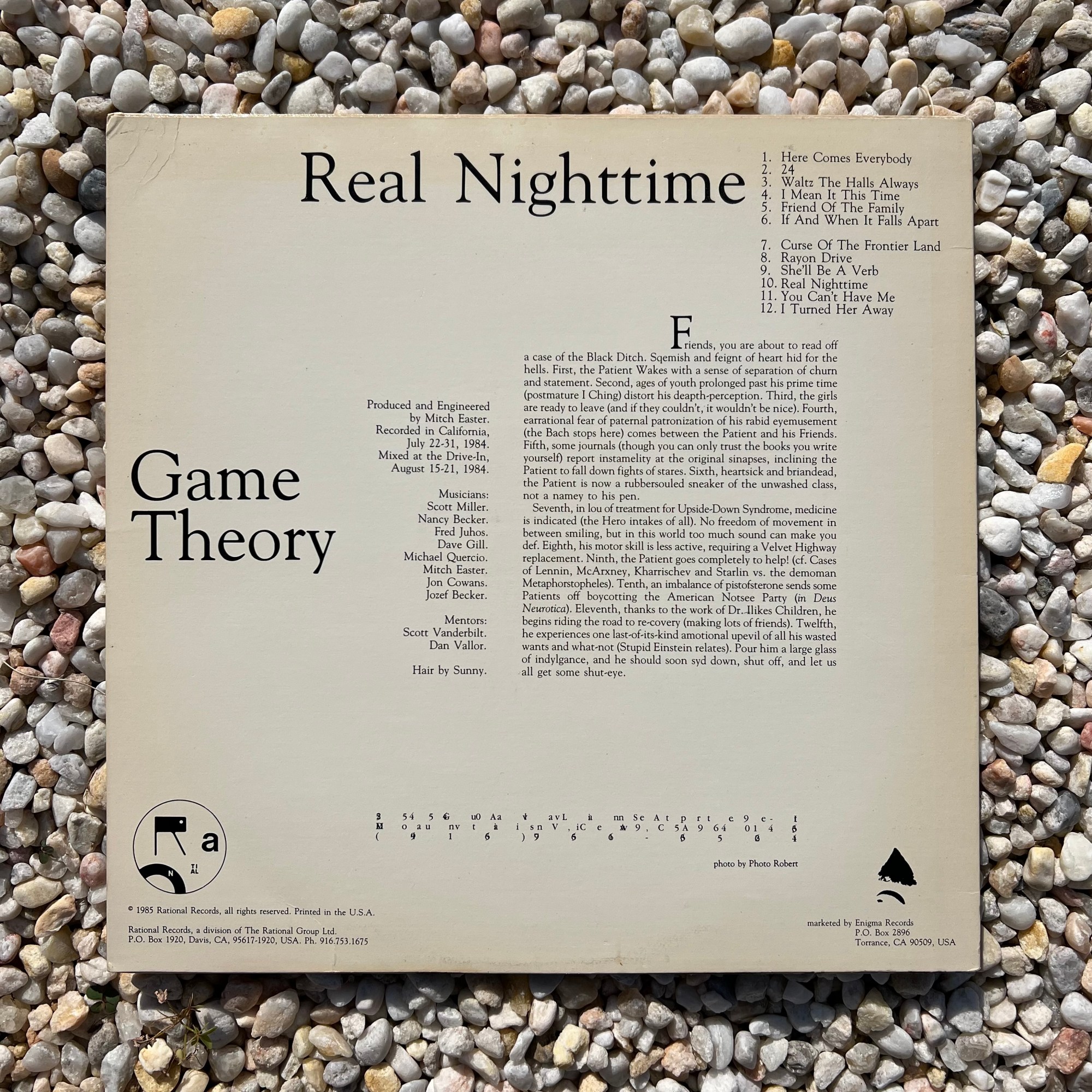
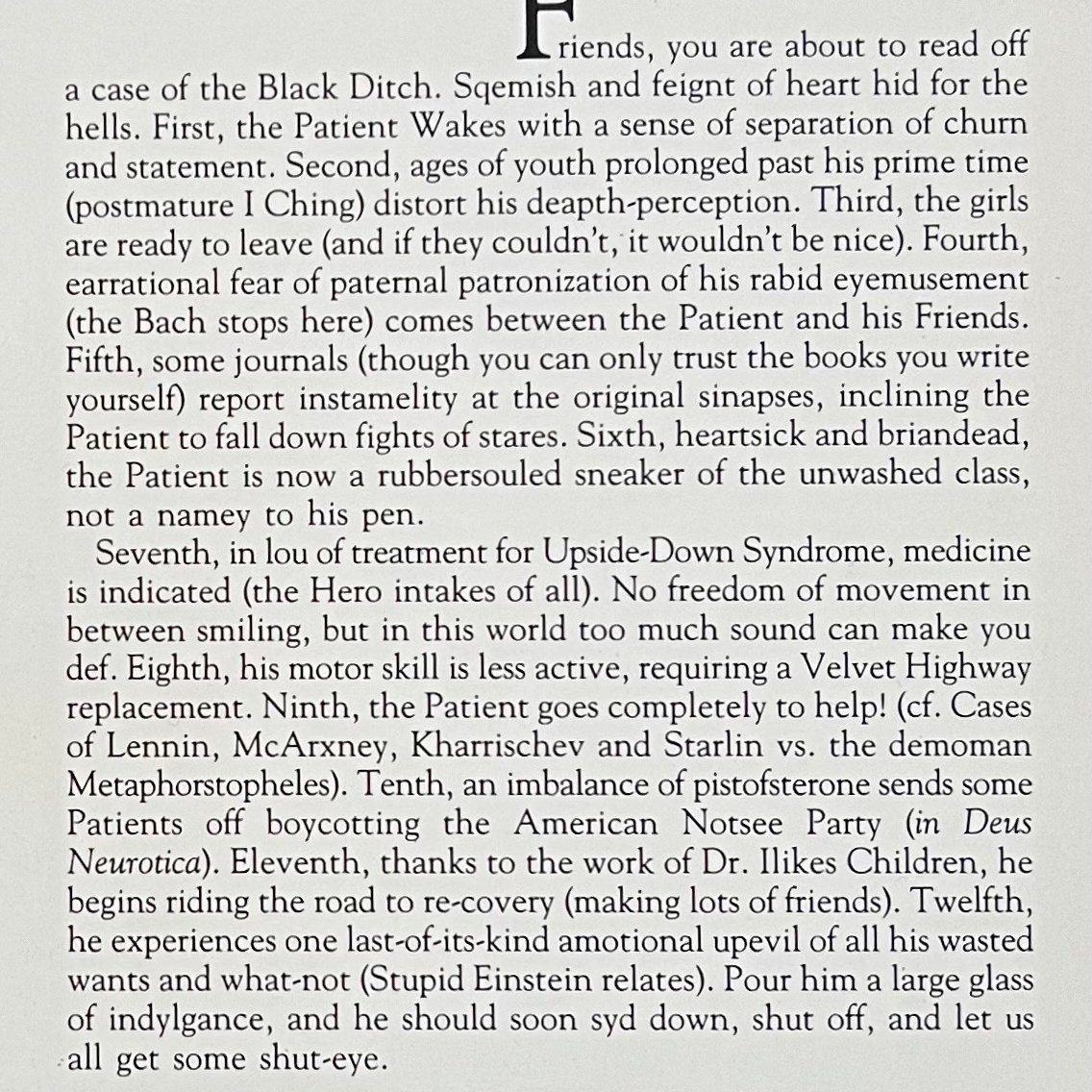
The Time Traveler sits across from his copy of Game Theory’s Paisley Underground power pop classic, Real Nighttime. The latter is one of several albums of note that arrived for the Traveler at Goodwill soon after his entry into the narrative. Music journalist Byron Coley called it “the actual godhead pop LP o’ the American Eighties. No shit. This is it.” Record producer Mitch Easter mixed the album at the Drive-In, two doors down from the House on Shady Blvd. “Was this record produced for me?” wonders the Traveler, eerie feeling running up and down his spine as he reads the text on the back of the LP: liner notes by band member Scott Miller. The Wikipedia entry for the album points the Traveler to a rather remarkable “annotated edition” produced by someone at the University of Wisconsin-Milwaukee in the 1990s. Modeled after the playfulness of Joyce’s Finnegans Wake, Miller’s text feels dreamlike and oracular. Transpersonal energies stir as one reads.


Intermezzo
Others of us puzzle through, knowing sometimes rest is needed. The work is to rest — heat up some pasta, assemble a salad, read Matthew Ingram’s Retreat: How the Counterculture Invented Wellness, feel the heaviness of it weighing in the palm of one’s hand like a sentence, retreat from it into episodes of Adventure Time. Orange Juice sing “Rip it up and start again.” By that, they mean the past. I’m reminded of a line from Pharmako-AI where the book’s AI writes, “The past is mutable, and it can be remade in our image as we desire” (26). At which point I hear poet Joy Harjo adding, “At some point we have to understand that we do not need to carry a story that is unbearable. We can observe the story, which is mental; feel the story, which is physical; let the story go, which is emotional; then forgive the story, which is spiritual, after which we use the materials of it to build a house of knowledge” (Poet Warrior, p. 20). John Cale’s “Paris 1919” serenades me to where I think the implications of this are leading me. “You’re a ghost, la-la-la-la-la-la-la,” sings Cale. And reader, I feel it. This ghosting. It takes the royal promise of Adventure Time’s “Island Song (Come Along With Me)” to cheer me. Loneliness is hard.
Notes from Another Past
Hiro Kone’s “Mundus patet” hisses out from floor speakers into the space of my living room as I sit and pack books for my journey. The plan is to leave early tomorrow morning, drive conjunct with Winter Solstice. “Others are awake, living wild magical lives,” thinks the Traveler. “Let us get with them.”
I walk the path of a time tunnel, listening intently, sight reduced amid the day’s cool air as I head to the beach. ‘Tis a somber tale, if all one hears is squawking — so listen. Laughter, wheels of strollers rolling on boardwalks, children conversing with caregivers, waves crashing along the shore. I gather shells along my approach and then toss them gently into the ocean. A makeshift offering. One does what one can. Shorebirds pass; seagulls dive down and collect. Other beachgoers share the beach with us, wandering solitary or in pairs. I close my eyes and meditate, awakening myself at a set interval with a timer. Languages confront me with occasional meaning — terms like “Moses,” “nope,” and “Sunken Meadow.”
My eyes fall upon Pringles potato chips, left behind in the upstairs bedroom in the wake of Frankie’s visit. “Eat, Eat, Eat!” I hear her saying. She brings such joy, such willful, day-shaping energy. Yet here I lie, feeling crumpled and broken, sleepless and alone atop a bed of crumbs. “Until summer, I’ll be running from one thing to the next, barely able to feel my face,” thinks the Traveler. Struggling to cheer up out of this self-administered genre/affect/mood. Struggling to awaken. Until it’s not really a struggle after all. One awakens all the time: birds fly by, light shines through. And there are companions! playgrounds! friends of the forest! an immeasurable capacity to forgive.
Light Amid Darkness
Frankie has been a consistent source of light amid this darkness. Upon waking from her nap yesterday, she asked to go to “Dada’s House,” with “house” sounding a bit like “horse.” Why have I been inattentive to her here in these trance-scripts? She likes Dada’s House. She requests that we go there, cries if we don’t. Cats; playgrounds. Beautiful tall houses ‘round a bend. What’s not to like? Perhaps tomorrow we can embark on a stroller ride ‘round town. Time to stop ruminating. “Be Young, Be Foolish, Be Happy,” sing The Tams.
By nightfall, my sentiments align with a line from Chance the Rapper’s “Blessings”: “When the praises go up,” he sings, “the blessings come down.” Blessings make us feel, make us like as they land in our lap. Let us ready ourselves with praise.
Time to communicate lovingly, share the love out on the streets, hang with neighbors, chat with artists, bond through shared love of Buffalo Poetics and Black Mountain College. I feel like a lightning bug: if not a social butterfly, still a giver of gifts. 2022 will be a Lovers Year. Right now, though, I feel a bit crushed. Hurt. Heartbroken. Awaiting something beyond silence — some new adventure. For tonight I feel apart from the life I imagined. The narrative coordinates that have held are about to change, thinks the Time Traveler, scalp pricked and hands stigmata’d by impetigo. The hope is that love will prevail. And it does, it does, as soon as I listen to the record of the year: Moor Mother’s Black Encyclopedia of the Air.
Nights and Days
I am uncomfortable. Not yet fully moved, suspended in the liminal state of a pre-furnished dwelling, like flats I’ve rented over spans of weeks in London.
To compensate, I attend to small, daily acts of being. This is my new adventure.
Items to grab: rice-cooker, ladle, plants ASAP.
Sound system assembled, I make it work: I dwell by night.
Sitting cross-legged in the center of a room, I listen to Träd Gräs Och Stenar’s “Sanningens Silverflod—Djungelns Lag Version.” Outside, the sky darkens, day hastening toward night. Kool Keith and Ultramagnetic MCs give chase with “Ego Trippin’” as come evening I prepare my stew. Kate NV brightens the mood with “Kata,” and there we have it: the pride of another home-cooked meal. I plot others while listening to Kikagaku Moyo’s “Green Sugar.” Bakery and fish market each within walking distance. Do as Flo & Eddie sing: “Keep It Warm.”
“We’re all mad here,” says Cat to Alice. “I’m mad, you’re mad.” Otherwise we wouldn’t be here, under house arrest by karma police. “For a minute there, I lost myself,” sings the love-mad subject, swooning tear-stricken. And for that, we are punished. For each of us is that subject. Each of us punished, our demands unmet.
I stage an event of attention by watching How to Draw a Bunny, a documentary about artist Ray Johnson, featuring narration by Living Theater co-founder Judith Malina. Johnson arrived to Black Mountain for the college’s Summer Institute of 1945, and remained until autumn of 1948. After moving to New York, he began to produce mail art. Paper glued to cardboard. By these means, he accrued his fame.
I feel heartened by a recently arrived fortune of the fortune cookie sort: “You are imbued with extraordinary vitality.” And so I am, walking easy, energized like a bunny. Being out is such a relief. Time to dance, sharing air, getting close. It needn’t all be heartache and not-knowing.
West End’s rad: cool houses, some of them crunchy, many lit for the holidays. All things considered, I’m pleased with where I landed. The apartment rests along a hilltop, Hades and downtown short walks away. When I sample a bit of each, however, hoping by these acts to make the night generative, I want none of it.
I could replace curtains in this place, I could hang plants. I could attend to these and other tasks in the days ahead. Tonight I walk the streets of downtown. Tomorrow I paddleboard. Final papers arrive early next week.
Morning mist meets me, air lit by morning sun. Steam billows from a horse’s nostrils as I listen to Eddie Harris’s “Listen Here.” The moment passes, and then I’m there: a friend and I, out on a waterway in a nature-space of great beauty, maintained by a hydroelectric company downstream from a dam. We paddle around, water’s surface gleaming with wind-patterned lines of light. Baptized by the spray of a small waterfall, we ground our boards and hop among rocks.
Chopping carrots and green onions afterwards, I prepare a dinner.
***
Out on the street I marvel
gaze at houses lit
festive porches
flowers reaching over fences and walls in greeting
amid the stonework of a neighbor’s garden.
***
I store my memory palace in a place in the sky.
Welcome to the Dungeon Crawl
What will I do here alone / in a place that is not my own?
I feel cast off, exited west into the wonderland of the West End.
My father, kind and understanding, talks me through the separation, helps me imagine brightness in the months ahead. With a room of one’s own, he says, other hopes become imaginable.
Ready now to be thankful, I walk about the home admiring it, knowing it to be a place of flowers, books, and beauty. S. and F. erected a Christmas tree one evening without me. This is their home now. It remains my home, too, in a sense. But I spend nights in an apartment — and we’ll place the house on the market come spring.
Emo thanksgiving: What more can I say? I whiled away the morning singing along to Cap’n Jazz while cooking dinner for one. And in the afternoon, I walked. See me there beside piles of leaves, humming the words to “Bluegrassish.” Singer Tim Kinsella ends the song pining for Virginia.
North American Time Capsule 1967
More to my liking is John Cage.
Where the architect-composer Iannis Xenakis used probability, game theory, group theory, set theory, Boolean algebra, and computers to produce his scores, thus pioneering “stochastic music,” Cage composed “aleatoric music.” While stochastic and aleatoric forms of music both rely on chance procedures, aleatoric music eschews mathematics in favor of ancient divinatory devices like the I Ching.
Readied by Cage for further weirding, I tune in and listen to Alvin Lucier’s “North American Time Capsule 1967,” a 10-minute composition that neighbors a track by Cage on Side A of Extended Voices. The Lucier piece uses a vocoder designed by Sylvania Electronics Systems “to encode speech sounds into digital information bits for transmission over narrow band widths via telephone lines or radio channels.” Lucier says of the piece, “The performers are asked to prepare material using any sounds at all that would describe for beings far from our environment, either in space or in time, the physical, spiritual, social, scientific or any other situation in which we currently find ourselves.”
Thinking of 1967 as “situation,” I relate the song to the psychedelic consciousness of that year’s Summer of Love. Lucier worked at Brandeis, directing the University Chamber Chorus there from 1962 to 1970. While dwarfed in scale by hippie meccas like Berkeley, Brandeis was nonetheless an important independent nexus of sorts for 1960s consciousness. Abraham Maslow taught there during the 1950s and 1960s, as did Herbert Marcuse, who served as a faculty member at Brandeis from 1954 to 1965. Future Yippie leader Abbie Hoffman studied there, too, under both Maslow and Marcuse. Through Lucier’s time capsule, one becomes entangled again in that scene.
Stochastic Music
The university library here in town dumps a collection of LPs from its listening room. Out with the old, in with the new. I encounter them in the bins at Goodwill. To them by chance led. The ones I come away with are remarkable: compositions by the likes of John Cage, George Crumb, Alvin Lucier, Pauline Oliveros, Iannis Xenakis, Karlheinz Stockhausen, and Krzysztof Penderecki. One pursues one’s education here or not at all, thinks the Narrator.
“To Xenakis—as, indeed, to most philosophers—” writes Bernard Jacobson in his liner notes to one of the Xenakis LPs, “chance itself is a scientific concept.” The reference to “chance” catches my eye, given that “hap” (a Middle English word meaning chance) has been a preoccupation of mine of late.
“Central among the scientific laws [Xenakis] has applied to music,” continues Jacobson, “is Bernoulli’s Law of Large Numbers, which provides that as the number of repetitions of a given ‘chance’ trial (such as flipping a coin) increases, so the probability that the results will tend to a determinate end approaches certainty. Hence Xenakis’s use of the term ‘stochastic’ music, which means probabilistic in the sense of tending toward a certain goal.”
Xenakis’s approach intrigues me. Yet what interests me most about “stochastic music” and stochastic processes more generally is that, despite their probabilistic nature, their behavior and outcome is intrinsically non-deterministic.
Love Everyone
That is what happens. We time-travel to the present. Author catches up on publishing, begins live correspondence. Akron/Family balloon the belief. “See through strata,” they sing on their 2007 album Love Is Simple. “Go out and love, love, love, / everyone,” goes the chant — so we do. Love is simple with help from friends.
In so doing we find again things to say. Everything exists internally and externally. We are together nightly — in our beds, in dreams so real. And while sitting, meditating, concentrating on breathing: there, too, we meet. The fixated moment opens to flow and transformation. Old forms crumble. Old roles vanish. Mazeways give way to portals and pathways, ways and means.