Initiation

The ancient Greeks imagined Tartaros as a pit, an anti-sky, an inverted dome beneath the earth. According to the Orphics and the mystery schools, however, Tartaros is not just a place housing criminals and monsters; rather, it is itself a kind of being: “the un-bounded first-existing entity from which the Light and the Cosmos are born.” Typhon, meanwhile, is this entity’s progeny; Typhon is the son of Tartaros and Gaia. He was the last god to challenge the supremacy of Zeus. When defeated by the latter’s thunderbolts, he was cast back into the pit from whence he came.

Readings of “MAXIMUS, FROM DOGTOWN—IV” hinge upon what one makes of the father chained in Tartaros. Grieve-Carlson entertains an interpretation different from the one I offer. In his view, “the father chained in Tartaros is not Typhon but rather Kronos, Zeus’s father. […]. Typhon appears much later in the poem, when Earth conceives him in an ‘act of love’ with Tartaros” (Grieve-Carlson 146). He argues that Olson re-tells the myth of Typhon just as Hesiod did. Typhon is violent and aggressive and would have become a tyrant over gods and men had Zeus not defeated him.

I think there’s more at stake here, however, than Grieve-Carlson lets on. As I see it, the problem with his reading is that he never grapples with the poem’s status as a letter of sorts mailed to the Psychedelic Review. Neither he nor the other critics he surveys ever address how the poem might be read in light of the circumstances of its publication.

Evidence to support my view appears elsewhere in Olson’s writings. Olson echoes in his “Letter to Elaine Feinstein” of May 1959, for instance, the same Zeus / Typhon battle that comes to occupy him in “MAXIMUS, FROM DOGTOWN—IV.” The ultimate “content” to which the poet gives form, sez Olson, is “multiplicity: originally, and repetitively, chaos—Tiamat: wot the Hindo-Europeans knocked out by giving the Old Man (Juice himself) all the lightning” (29). Hearing “Juice” as a homonym for “Zeus,” we find in Tiamat a twin for Typhon. While Tiamat was for ancient Mesopotamians a primordial goddess of the sea, and Typhon a monstrous serpent-god for the ancient Greeks, both are embodiments of chaos. Tiamat’s battle with Marduk is as much a version of ChaosKampf as is Typhon’s battle with Zeus.

The important point is that, for Olson, Chaos is the original condition of existence. It precedes Order. Order is formed — made, not found — and it is the duty of the poet to make it. This is what Olson hoped to communicate to the mushroom people.

Grieve-Carlson concludes his essay by describing the reading of The Maximus Poems as a form of “initiation,” as Olson writes as one initiated, one able to see and say in a special way. Olson makes use of a “metanastic poetics,” or “the technique of the mystic who returns, as a stranger in his own land, to tell about what he knows” (Martin, as quoted in Grieve-Carlson 148).

This reference to reading The Maximus Poems as a form of “initiation” intrigues me, as the writer other than Olson most closely associated with reinvention of Typhon is the British ceremonial magician Kenneth Grant (1924-2011). The latter led the Typhonian Ordo Templi Orientis (TOTO), a magical organization connected with Aleister Crowley’s Thelema religion. Grant was an apprentice of Crowley’s and a close friend of another famous twentieth-century occultist, Austin Osman Spare. Scholars like Henrik Bogdan refer to the occult current that springs from Grant as the “Typhonian tradition.” Grant announced the arrival of this tradition in 1973 and went on to write the nine books of his three Typhonian Trilogies.

Although influenced by Crowley and Thelema, Grant departs from other Thelemic currents by welcoming communication with “extraterrestrial entities” as a valid source of occult knowledge. The Typhonian tradition also embraces aspects of the Cthulhu mythos of horror writer H.P. Lovecraft.

While Grant’s announcement succeeds Olson’s poem by a decade, his ideas appear to have been informed by experiences not unlike Olson’s. Grant experimented with psychedelics in the 1960s, and included a chapter in his 1972 book The Magical Revival titled “Drugs and the Occult.”

And while I haven’t found any evidence suggesting that Grant knew anything of Olson’s work, Olson did have some interest in gnosticism and the occult. “Bridge-Work,” a short reading list of Olson’s dated “March, 1961” includes a reference to Crowley. Maud says Olson encountered Crowley’s The Book of Thoth (1944) while studying Tarot in the 1940s. Sources suggest that “Bridge-Work” was written with the help of Olson’s friend, Boston-based occult poet Gerrit Lansing. The copy of The Book of Thoth read by Olson probably belonged to Lansing. (See Division Leap’s A Catalog of Books From the Collection of Gerrit Lansing.) Olson was also deeply invested in Gnosticism in the years immediately before and after his sessions with Leary, and embraced Jung’s theory of synchronicity in the wake of those sessions. See the final essays in a volume of Olson’s called Proprioception (Four Seasons, 1965).

Grant’s innovation is to identify “the arch-monster Typhon, opponent to Zeus according to the Greek mythology…with the Egyptian goddess Taurt” (Bogdan 326). The latter is interpreted by Grant to be either the mother of Set or a feminine aspect of Set. “To Grant,” writes Bogdan, “the worship of Taurt or Typhon represented the oldest form of religion known to mankind, a religion centered on the worship of the stars and the sacred powers of procreation and sexuality” (Bogdan 326). Set, too, is an important figure in Grant’s system. “Grant maintained,” writes Bogdan, “that the Typhonian Tradition, and in particular the god Set, represents the ‘hidden,’ ‘concealed’ or repressed aspect of our psyche which it is vital to explore in order to reach gnosis or spiritual enlightenment” (Bogdan 326).

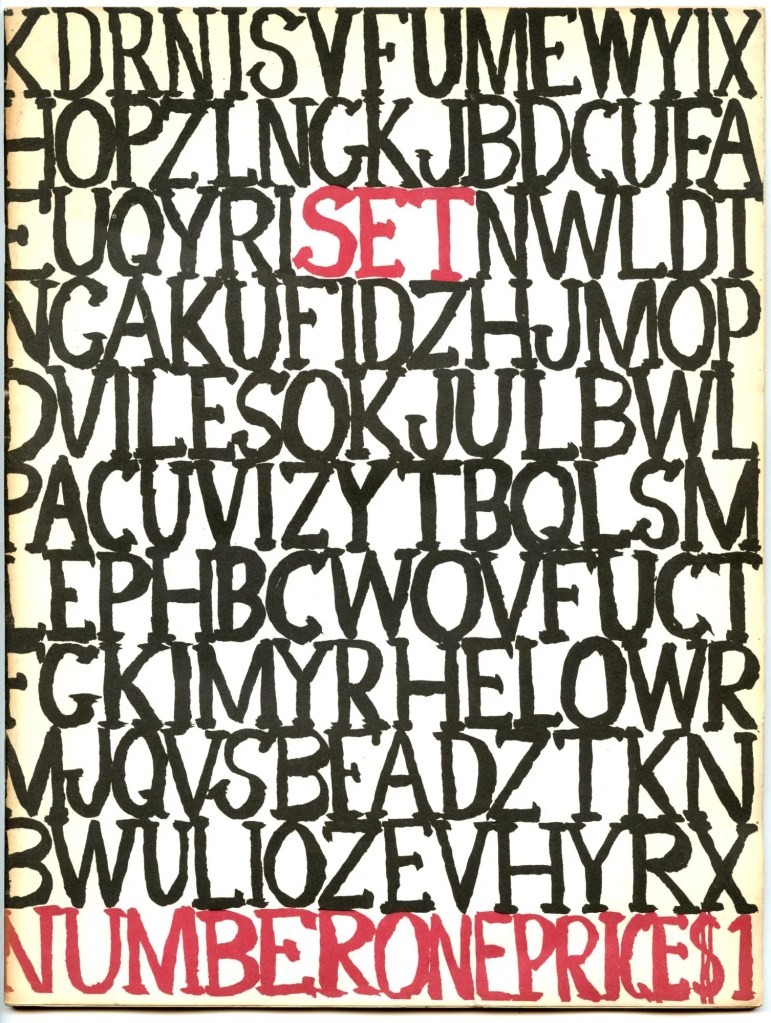
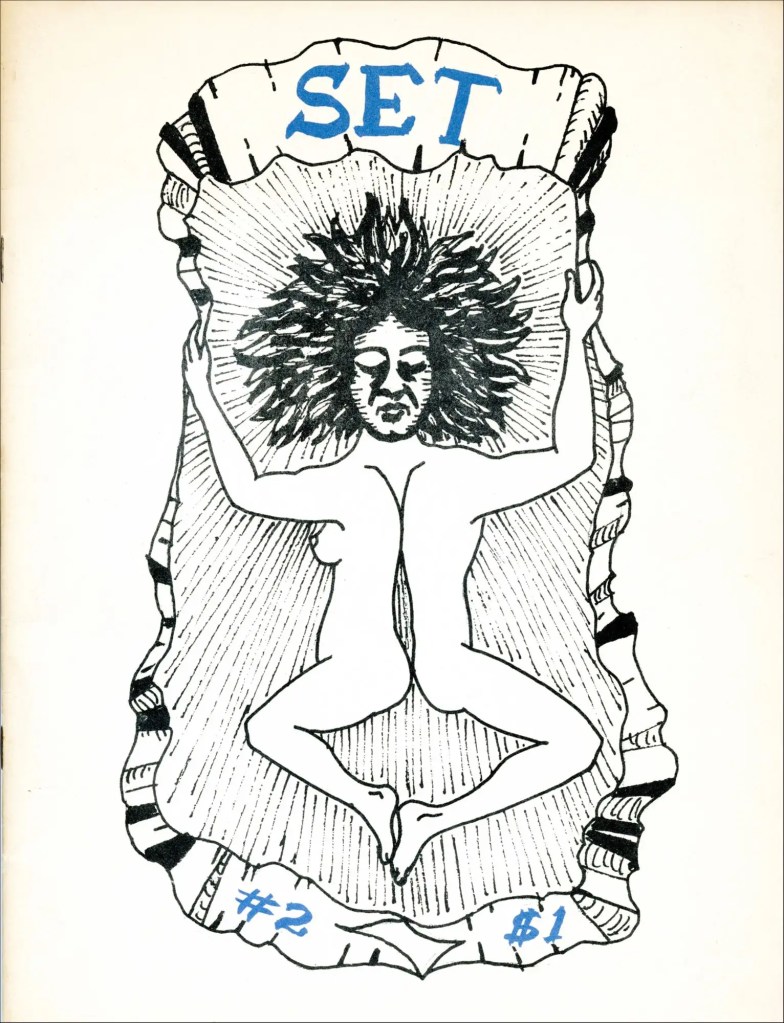
Lansing’s work seems to anticipate Grant’s in several ways. The two both think it important to honor the Egyptian god Set, for instance, with Lansing naming his early-60s poetry journal SET after him. And Grant’s focus on the Qliphoth, or the underground portion of the Tree of Life, seems present in the title of Lansing’s 1966 poetry collection The Heavenly Tree Grows Downward. For more on the “tree that grows downward,” Pierre Joris recommends looking at a section of Jung’s Alchemical Studies called “The Inverted Tree.”

Postmodern Liturgy

Our father, who is also in / Tartaros chained in being
—Charles Olson, “MAXIMUS, FROM DOGTOWN—IV”

The poem opens like a prayer — but twisted, inverted, hurled downwards into the pit.

This is not the Father of Heaven. Not the lawgiving patriarch of Christian theology. This is the Father beneath the foundations: a presence chained in Tartaros, the precondition of Order, the progenitor of Chaos, silence, breath. The reversal is stark — and crucial.

In this fourth installment, we turn to MAXIMUS, FROM DOGTOWN—IV” itself, a poem Olson described as “deliberately” given not to any old little magazine, but to The Psychedelic Review: “the one that the mushroom people edited.” And yet the poem contains no mention of mushrooms, no obvious gestures toward psychedelia.

What it gives us instead is myth in shards — a Hesiodic echo refracted through twentieth-century American poetics, emerging from a poet who had tasted the mushroom and returned not with visions, but with an ancient voice.

It is the use of the Lord’s Prayer that first signals the poem’s intent to unmake received forms.

The Father is not enthroned. He is entombed.

We remember, with Hesiod, that Tartaros is not merely hell. It is primordial. Deeper than Hades. Older than the Olympians. It is the chaos-place, the pit where Typhon returns after being struck down. It is the place of potentiality before form.

In Olson’s cosmology, this is where the real work begins.

Dogtown — abandoned settlement, stony ruin, former commons — is the psychic mirror of Tartaros. Olson walks it as ritual. He listens to the wind. He reads the stone. He opens the field of composition to receive myth not as allegory, but as event — a rematerialization of chaos in language.

In his poem, Zeus is not hero, not savior. He is the figure of domination — the lightning-armed force that imposes order upon the manifold. Olson knows this force. He has seen it in history, in empire, in himself. He has seen it in Koestler’s terror and in the glassy optimism of the technocratic age.

What Olson gives the mushroom people is a warning: beware the thunderbolt that burns away multiplicity. Beware the system that names chaos “evil.” Beware the will to cohere when it comes at the cost of forgetting.

And yet, there is no hatred here. No bombast. Only voice.

The poem sings, hisses, growls. It walks the edge of lyric and liturgy.

Typhon, when he arrives in the poem, does so not as monster but as signal. His body is the syntax of the ungovernable. His voices — animal, elemental, unspeakable — are the chorus Olson dares to channel.

Grieve-Carlson argues that Olson follows Hesiod closely, that he upholds the cosmology of order. But I read the poem differently.

To me, Olson invokes Hesiod not to ratify the myth, but to activate it. To re-constellate it. To speak it into a new moment — the moment of Dogtown, of postmodern ruin, of psychedelic reentry.

The important point is that, for Olson, Chaos is the original condition of existence. Order is not found. It is made. And it is the poet’s duty to make it — again and again — from the materials of breath, myth, and memory.

Thus the poem becomes not explanation, but theogony — a breathing-forth of being from the pit of the real.

Olson offers no easy answers to the mushroom people. He offers no program, no doctrine, no trip report. He offers them this: a field. A myth. A prayer to the father in Tartarus.

And through it, he calls them — calls us — to make meaning from the underside. To shape voice from fire and stone. To reclaim chaos not as enemy, but as source.

This is the poem’s gift.
This is its weight.
This is its light beneath the pit.

From Black Mountain to White Hand

As Yépez has noted, Olson is an epistolary poet (The Empire of Neomemory, p. 11). Many of Olson’s works are written as letters. Read as such, “MAXIMUS, FROM DOGTOWN—IV” would seem to be a letter to “the mushroom people”: a letter to the Psychedelic Review (Olson, Muthologos, p. 185). The poet says as much during an interview that took place at his home in Gloucester in 1966. Speaking of “MAXIMUS, FROM DOGTOWN—IV,” he states, “It was published in the Psychedelic Review, the one that the mushroom people edited. I deliberately did it, by the way. They asked me for a poem ‘cause I’d been under the early experiments on the poets and the mushroom. And I deliberately gave them this” (185). Interestingly enough, however, the poem makes no mention of mushrooms, nor does it include any obvious or explicit nod to psychedelic experience. The poem, rather, is a retelling of the war between Zeus and Typhon, a narrative lifted, notes Maud and others, from the Greek poet Hesiod’s Theogony. Typhon is a demigod of sorts: a monstrous serpentine giant who attempted to overthrow Zeus for supremacy of the cosmos. Later traditions associate Typhon with the Egyptian god Set. Some also view him as a precursor of sorts to Milton’s Satan. The main question we’ll want to ask, then, is, “Why was Olson thinking about Typhon? And why did he think this retelling of the Typhon myth suitable for “the mushroom people”?

To begin to answer these questions, we need to reflect for a moment on where and how the mushroom people became the mushroom people. Leary first received word of the effects of psychedelic mushrooms from his friend, a researcher investigating the psychology of creativity named Frank Barron. The latter had learned about mushrooms in 1959, while interviewing a psychiatrist who was using and studying them in Mexico. Barron brought a batch back with him to Berkeley, where he tried them later that year. He then shared news of his experience with Leary. The latter was doubtful at first, until having a similar experience himself the following year in August 1960 during a visit to Cuernavaca. In both cases, the men are purchasing the mushrooms from curanderas or folk healers. Curanderas like the famous María Sabina, in other words, are the ones passing the mushroom along to Westerners. These curanderas transmit the seeds of psychedelic revolution to the West via a series of USAmerican intellectuals who, like tourists, spend time abroad vacationing in Mexico.

Charles Olson had made a similar journey a decade earlier — as did Beat writer William S. Burroughs. The latter went to South America in search of yagé, or what we now call ayahuasca. Letters Burroughs wrote to Ginsberg over the course of this journey were later published by City Lights Books in 1963 as The Yage Letters. One might profit by reading Burroughs and Ginsberg’s Yage Letters alongside Olson and Creeley’s Mayan Letters. For now, though, we must focus on Olson.

During a brief interval in his time at Black Mountain College, Olson and his wife Connie decided to spend the first five months of 1951 living in Lerma, a small fishing village in Campeche. Olson’s letters to the poet Robert Creeley during this time in Mexico became the substance of Mayan Letters, published in 1953. And in fact, one of the first uses of the term “postmodern” appears in a letter of Olson’s written to Creeley in August 1951, shortly after Olson’s time in Mexico. Here, in other words, is a poet whose encounters with Mexico contribute to the birth of the postmodern. Yet Olson’s use of the postmodern was far more expansive and ambitious than that of his successors. As George F. Butterick notes, Olson’s designation of his work as postmodern “serves not merely to advance beyond an outmoded modernism, but…seeks an alternative to the entire disposition of mind that has dominated man’s intellectual and political life since roughly 500 B.C.” (Butterick 5). Olson would go on to use the term again in print in a piece he wrote on November 4, 1952 titled “The Present is Prologue.” Marxist historian Perry Anderson refers to this piece, published in 1955, as the first to use “postmodern” in the sense of “an aesthetic theory linked to a prophetic history” — i.e., as “an agenda allying poetic innovation with political revolution” (The Origins of Postmodernity, p. 12). By the early 1960s, Olson began to manifest this agenda through his participation in the psychedelic revolution. Which returns us now to our main concern: the experiences themselves.

Chaos Before the Gods

To understand “DOGTOWN—IV,” we must first meet Typhon.

He appears late in Hesiod’s Theogony, a fiery final opponent, son of Earth (Gaia) and Tartarus, “conceived in an act of love” between matter and abyss. Hesiod calls him a “fearful dragon,” a hundred-headed monstrosity whose eyes flash flame, whose tongues flicker, whose voices shift wildly — sometimes intelligible, sometimes bull-roared, lion-lunged, or hissed in storm.

Typhon, in other words, is not a symbol. He is a polyvocal event. An insurgency of sound. A figure of ontological excess.

“And there were voices in all his dreadful heads which uttered every kind of sound unspeakable,” writes Hesiod; “for at one time they made sounds such that the gods understood, but at another, the noise of a bull bellowing in proud, ungovernable fury… and again, at another, he would hiss, so that the high mountains re-echoed.”
(Theogony, trans. Evelyn-White)

Typhon threatens not merely Olympus, but the very idea of divine order. He is chaos not as absence but as pluripotent potential. Fire and breath. Voice and unmaking.

And for Olson — poet of proprioception, initiand of the mushroom — this is the mythic substance most suitable to his altered state.

Let us pause, though, and ask with Olson: Why would Earth love Tartarus?

It’s a strange phrase in Hesiod. “Gaia from her love of Tartarus.” Tartarus is the deepest abyss, a pit beneath all pits. The Greeks imagined it not merely as punishment, but as anti-space — the unbounded, unstatistical underside of being. Olson, ever the etymologist of the unconscious, seizes on this.

In “DOGTOWN—IV,” he writes:

“Our father, who is also in / Tartaros chained in being…”
(Maximus IV, ll. 333–334)

This is Olson’s parody of the Lord’s Prayer. But unlike the Christian God above, Olson’s father is below — the primordial pit, the place before measure, the place of hunger, chaos, and unformed form. Tartarus is a womb. An inversion of heaven. And Typhon, its child, is the convulsed birth of multiplicity.

What Olson sees — and what most critics miss — is that Typhon is not simply a villain in this cosmology. He is a challenge. A necessary crisis. A daemon of disruption.

Gary Grieve-Carlson, one of Olson’s most careful readers, insists that Olson admired Hesiod for his “will to cohere” — his vision of cosmos arising out of chaos. But I suspect Olson’s attachment to Hesiod is more ambivalent. He sees in Hesiod both the first cosmology and the first repressions: the moment chaos is narrated as a threat, and order enthroned.

So Olson takes Hesiod’s Theogony and folds it — remixes it. He retains the sequence (Chaos, then Earth, then Tartarus, then Love), but recasts the power dynamics. Typhon becomes not the failed usurper but the dark mirror of Maximus himself: the one who would speak many voices, walk many lands, breathe from the bottom up.

And in choosing this myth to send to The Psychedelic Review, Olson makes his wager clear: the psychedelic does not simply uplift — it ungrounds. It returns us to Tartarus. To the chthonic, the unmetabolized, the monstrous within.

This is why Typhon matters now more than ever. He is climate chaos, algorithmic multiplicity, ecstatic polyphony. He is the real beneath the rational. The daemon of the Anthropocene.

And Olson, emerging from Dogtown with psilocybin still in his system, names him.

Not to celebrate him.

Not to slay him.

But to write with him.

The Labyrinth and the Light

We begin in the Labyrinth.

Not the labyrinth of mere confusion — but the labyrinth of myth, of force, of breath, of ancestral return. The labyrinth of Charles Olson’s Maximus, and specifically “MAXIMUS, FROM DOGTOWN—IV,” a poem written in the early 1960s, at the height of the first psychedelic renaissance.

This poem, published in the third issue of The Psychedelic Review in 1964, arrives to us like a cipher, a mythic communiqué, mailed from the ruins of a colonial commons, encoded in the voice of a poet who walked granite trails while recovering from chemical initiation.

It is, in many ways, a letter sent to the mushroom people.

This series of posts — fragments of an unfinished but now reawakened paper I began in Fall 2022 — seeks to interpret “DOGTOWN—IV” as a psychedelic poem, a theogonic composition shaped by Olson’s experiments with synthetic psilocybin during his sessions with Timothy Leary and the Harvard crew in 1960–61. But unlike the effusive trip reports of Beat writers like Allen Ginsberg or the utopian manifestos of Leary, Olson’s response to psychedelia is strange, mythological, and subterranean.

There are no rainbows in “DOGTOWN—IV.” No electric Kool-Aid. No declarations of ego-death.

What there is, instead, is a retelling of Hesiod’s myth of Typhon — the serpentine, fire-eyed, many-voiced monster birthed by Earth and Tartarus. Olson’s version is fragmented, gnarled, obscure. But it is also urgent, rooted, and alive.

So why this poem? Why Typhon? Why send such a myth to The Psychedelic Review, a journal edited by Leary’s cohort and read by initiates of a blossoming chemical counterculture?

To answer these questions, we must retrace the steps of Olson’s initiation.
We must follow the winding trails of Dogtown.
We must listen to the poet’s own words, spoken under the mushroom’s influence:

“The startling & unbelievable first impression of going under the mushroom… is that everyone & everything is nothing but itself… there’s nothing at all to worry about… no sweat of any sort called for… it’s all too real and way beyond any attitude or seeking some greater or bigger answer.”
(Olson, as quoted in Conners 106)

This is the tone of someone who’s touched the ineffable — and returned with it clenched not in his hand, but buried in his throat, transformed into breath.

In this series, I argue that “DOGTOWN—IV” is Olson’s mythopoetic response to the psychedelic experience — but one shaped by his unique cosmology, his investment in ancient myth, and his suspicion of liberal-progressive “trip culture.” While others turned on and tuned in, Olson turned downward — into Tartarus, into Chaos, into the pre-logos dark from which all things emerge.

This is not a dismissal of psychedelia. It is its deepening.

This series unfolds in seven movements, each exploring a facet of Olson’s relationship with myth, madness, and the mushroom. It is a metanastic walk through the labyrinth — a return through Olson’s theogony toward the real task of the poet: not to escape into light, but to make meaning from the dark. To say what is.

Like the desert mystics of yore, the poet’s role is to “keep the edges hot.”

This series begins at one such edge — where myth meets mushroom, where Hesiod meets Leary, where Olson, like Maximus, writes from the underworld back toward the surface.

Welcome to the labyrinth.
Let us walk it together.

Magic as Paralogical Retort

Early on in the semester ahead, we’ll need to discuss magic, positing the latter as a paralogical retort to the patriarchal Royal Society and its imperial science. Also a coping strategy, a response to lives disrupted by war, authors displaced and dispossessed, as in the case of Cavendish. Magic is a way of knowing and doing that persists and evolves alongside the New Science, refusing and contesting the latter’s bid for supremacy. Tolkien takes up much the same cause in his poem “Mythopoeia,” written following a discussion with C.S. Lewis and Hugo Dyson. In the course of this famed discussion, Lewis is said to have denounced myths, describing the latter as “lies breathed through silver.” Tolkien’s poem replies in character, its words spoken by “Philomythos” (or “myth-lover”) to Lewis’s “Misomythos” (or “myth-hater”). Tolkien composed the poem in heroic couplets, the preferred meter of British Enlightenment poets, so as to critique the latter on its own turf.

Hey! Orpheus

Sometime afterwards I recall “Hey! Orpheus,” a song by Michelle Mae’s group The Make-Up.

Vocalist Ian Svenonius’s Prince-like, Eros-stricken shrieks of pain — a signature of his performance ever since the days of his band Nation of Ulysses — are put to good use throughout amid a sound aligned with and inspired by organ-laden psychedelic pop groups of the late 1960s. Michelle slides her finger down the neck of her bass and sets the song in motion, with drummer Steve Gamboa and the rest of the band leaping forth to join her moments later.

The band adopts the guise of a collective subject — Earthlings, mortals, “We the Living” — singing through Ian to an Orpheus other than the Black Orpheus of midcentury France.

“Hey! White Orpheus,” he sings,

“Do you remember us?

We’re up in the sunlight.

You’re down in the furnace.

Hey! White Orpheus,

in the Earth’s crust,

open up all the doors,

come on and bury us.

Living there, down below,

gave your soul to Pluto,

all for your Eurydice.

I want to eat pomegranate seeds.

White Orpheus,

don’t be so jealous.

Up here it’s the age of elephant ears

laced with angel dust.

Hey! White Orpheus,

from dawn to dusk,

you’re oblivious

to anything other than

your sacrifice for love.

Living among stalagmite floors,

bellows pumping Devil’s calls.

To be like you, what must I do?

I wanna eat the pomegranate, too.”

Organist James Canty interrupts to deliver a punchy, powerful organ solo mid-song — perfect for a work that revels in speed and brevity. Contemplating the song now, though, I find myself wondering after the whiteness of its Orpheus. Why does the band recast the color of Orpheus from black to white?

Black Orpheus is a 1959 film made in Brazil by French filmmaker Marcel Camus. The film reimagines the myth of Orpheus set amid a favela in Rio de Janeiro, so it has its hero Orfeo descend into the underworld by attending a Macumba ritual to save his lover Eurydice on the night of Carnival.

The Make-Up, meanwhile, a band based in Washington, DC, preached a variant of liberation theology that they took to calling “Gospel Yeh-Yeh.” Might their recasting of the color of Orpheus teach us something about the tenets of the band’s theology?

My inquiry leads me to “Black or White Orpheus: Votive Transmutation Shrine,” a 34-minute jam by Portland-based artists Corum & Zurna.

Orpheus in Hades’ Lounge

There’s a parking, a journeying outward. Up and out we launch past West End Mill Works, off on tonight’s adventure, beginning with an evening stroll. Graffiti marks the spot. Stream to one side of us, water rushing over rocks. Spotify shifts from Steely Dan’s “King of the World” to Jan Hammer Group’s “Don’t You Know,” voices and cars in the distance. Looking both ways, we cross the street and rush down onto a shaded path through a nearby park, crickets singing in parallax with Neil Young’s “Computer Age.” We turn off the song and continue for a moment in silence. Upon arrival to a crossroads, we ask of each other (like Ginsberg to Whitman in Ginsberg’s “A Supermarket in California”), “Which way now?” Looking up, we rise and step proudly toward pink clouds. Conversation turns toward Old & Used Books as we pass a graffiti-clad muffler shop. Bulldog with paintbrush arrives as comic relief — reality for a moment a goofy animal fable whodunit. We grab beers as day turns to night. Ginsberg’s “lights out” reverberates, hangs in the air after us having heard earlier in the day Let’s Active’s “Orpheus in Hades’ Lounge,” featuring hometown hero Mitch Easter.

Can Orpheus be told anew? We recall to each other the character’s many forms. Jean Cocteau’s Orpheus (1950), Marcel Camus’s Black Orpheus (1959). Also Jean-Paul Sartre’s essay of that name. And let us not forget Samuel R. Delany’s Lo Lobey, the Orphic protagonist at the heart of Delany’s 1967 novel The Einstein Intersection. Hoots is a Hades’ Lounge, is it not, with its red light hanging above its corner booth? So we think as we drink, glorying finally in each other’s presence. “What would happen if our Time Traveler were to stage the scene again?” wonders the Narrator, listening alone now, seated at the same booth many months hence. With “King of the World” still fresh in our ears, members of Steely Dan singing, “No marigolds in the promised land; there’s a hole in the ground where they used to grow,” we restate the refrain of Jan Hammer Group’s “Don’t You Know.” Amid Orpheus wailing away on his flute come the words, “You’re to know that I love you. You’re to know that I care.”

Sunday February 21, 2021

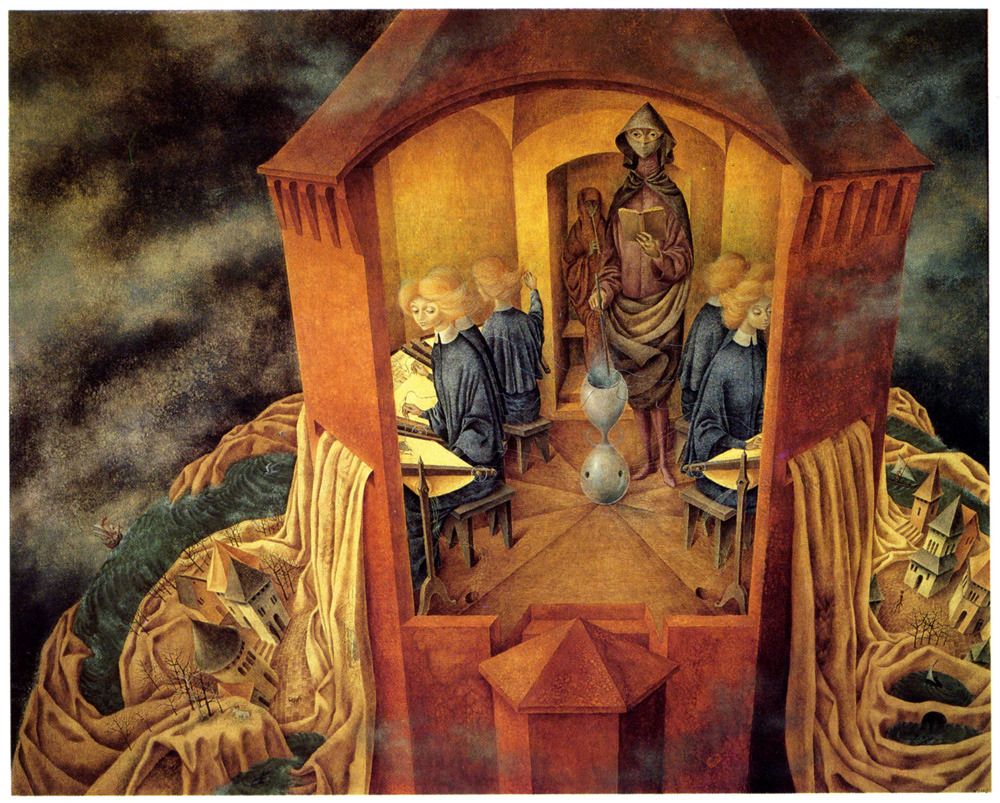
Rereading Freud’s Civilization and Its Discontents, the parent in me wants instantly to refute it. I want for my daughter something other than the Oedipus complex. I imagine a succession of heroines and goddesses. Why among all the characters of mythology does Freud opt for Oedipus and Electra? The latter, of course, has been reinvented in our time as a Marvel superhero. No longer daughter of Agamemnon and Clytemnestra, she wields a pair of sai. Electras loom large in the minds of at least two hideous men: Freud and Frank Miller. What if instead we imagine Oedipa Mass, the heroine in Thomas Pynchon’s novel The Crying of Lot 49? While imagining Oedipa, imagine too the women in “Bordando el Manto Terrestre (“Embroided Earth’s Mantle”),” the Remedios Varo painting (middle part of a triptych, in fact) viewed by Oedipa at a key point in the novel.

The figures in each case are all still figures trapped in another’s tapestry. “Such a captive maiden,” writes Pynchon, “having plenty of time to think, soon realizes that her tower, its height and architecture, are like her ego only incidental: that what really keeps her where she is is magic, anonymous and malignant, visited on her from outside and for no reason at all. Having no apparatus except gut fear and female cunning to examine this formless magic, to understand how it works, how to measure its field strength, count its lines of force, she may fall back on superstition, or take up a useful hobby like embroidery, or go mad, or marry a disk jockey. If the tower is everywhere and the knight of deliverance no proof against its magic, what else?” This, too, is the dilemma faced by Melba Zuzzo, the heroine of Joanna Ruocco’s novel Dan. Next thing I know, I’m sending myself “Playing the Post Card: On Pynchon’s The Crying of Lot 49 while scanning my shelves for H.D.’s book Tribute to Freud. Having seen the Varo painting in an exhibit a year prior to writing the novel, Pynchon recalls it from memory. Oedipa sees in the painting what Pynchon wants her to see. If she’d looked closely, she’d have seen “La Huida (The Escape),” the third part of the triptych, where the girl and her lover flee to the mountains.

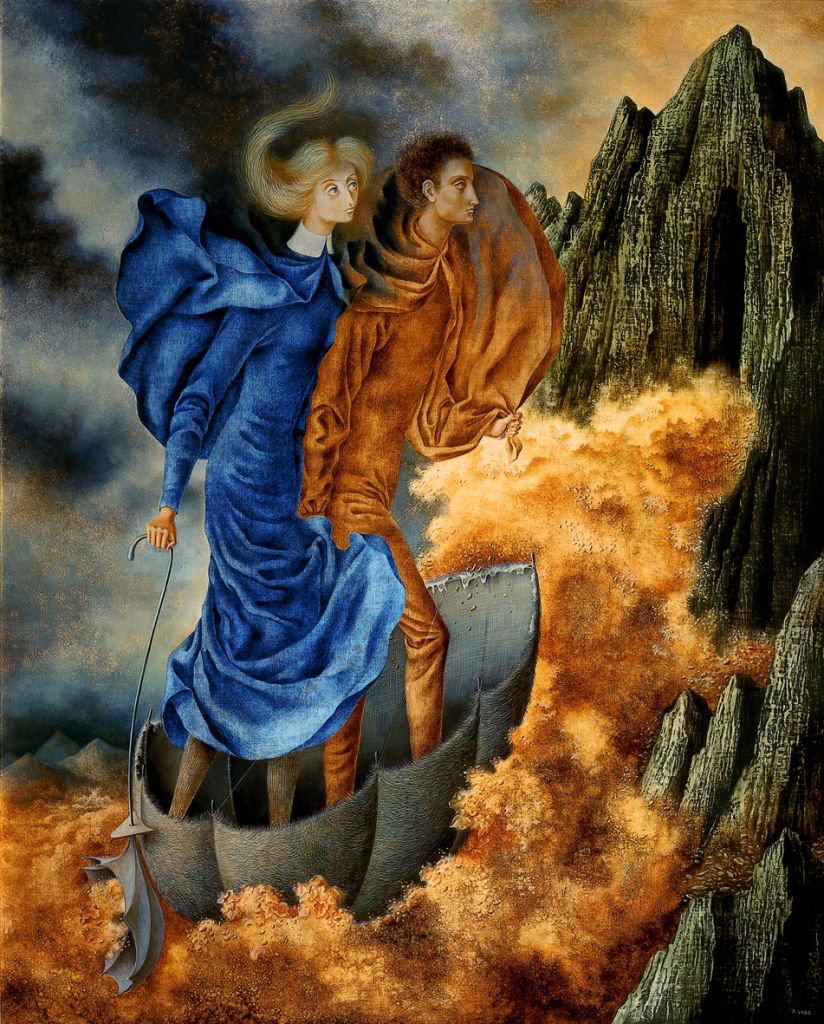
And at the center of the triptych, reading from a spell book and stirring a cauldron, a sorceress. Such figures of power and liberation are occulted by Pynchon’s imagining of a feminized Oedipus — a character “hailed,” “interpellated” as Althusser would say, in the novel’s opening sentence when named executor of the estate of her former lover, Pierce Inverarity. Principle among the items of Pierce’s estate is a stamp collection. LSD is a plot point in Pynchon’s novel. Perhaps we could read Pierce’s stamp collection as the equivalent of “blotter art.” It’s described as containing “thousands of little colored windows into deep vistas of space and time,” and is delivered to Oedipa by “somebody named Metzger.” Readers might be forgiven for confusing “Metzger” with “Metzner,” as in the logic of a dream. As in “Ralph Metzner,” editor of Psychedelic Review and co-author, along with Timothy Leary and Richard Alpert, of The Psychedelic Experience.