Healing Words


Where something taken to be history takes the form of a world on fire, catalog of events adding up in tedious barrage, as in Billy Joel’s grim 1989 song “We Didn’t Start the Fire.” Joel grew up on Long Island, along the beaches, as did I. Beaches were closed the summer prior to the song’s release due to “Syringe Tides.” Hypodermics from Fresh Kills Landfill in New Jersey washed up along the shore — an event Joel cites in his litany. The fears stirred by the event were compounded by the era’s Reagan-administration-escalated AIDS crisis. The event filled me with concern — motivated the pen of my middle-school self to draw a political cartoon: a small surfer dwarfed by a wave of waste. Surfer stares glumly out the picture toward the viewer. And here I am now, most of my day spent grading student responses, thinking about it again, not just because of the Joel song, which appeared as the subject of a student’s response, but also because a colleague submitted for approval a course examining literary imaginings of the end of the world. The Jewish festival of Sukkot minds me to be grateful for my home, and all who help me to maintain it.
Upon a whim, I pick up and read from The Complete Poems of Emily Dickinson a poem selected at random, as in wherever my thumb happens to land, containing the lines:
Prayer is the little implement
Through which Men reach
Where Presence — is denied them.
They fling their Speech
By means of it — in God’s ear—
If then He hear
This sums the Apparatus
Comprised in Prayer—
“Why must longings be irreconcilable — why ‘Presence denied’?” I wonder afterwards.
“Why ask why? ‘Tis so,” sayeth the Fates in reply. Yet one can make of Fate a place one avoids, a spatiotemporal coordinate that one eludes like a fugitive. With Fred Moten, for instance, we can “consent not to be a single being.”
Frankie gravitates toward particular books of poetry, pulling from among a bookcase of several hundred the same ones these last few days: Joan Retallack’s How to Do Things With Words and a Penguin Classics reprint of the first edition of Walt Whitman’s Leaves of Grass. What can I say — the kid’s got great taste. She hands them to me, and the look in her eyes suggests I should read them, so I do. When I’ve taught Whitman in the past, I’ve used a different edition. Perhaps I should change it up. Celebrate that opening stanza of “Song of Myself” — but question its atomic physics. Though it’s as if Whitman knows of what becomes of and follows from his Manhattan and its projection in the next century. Yet he rejects it as mere talk:
“I have heard what the talkers were talking…the talk of the beginning and the end,
But I do not talk of the beginning or the end.
There was never any more inception than there is now,
Nor any more youth or age than there is now;
And will never be any more perfection than there is now,
Nor any more heaven or hell than there is now.”
My imprisoned cousin and I have begun an email correspondence. It is to him that I write the following:
Does write make right?
“Damned sure it does! / so one hopes”
seems inappropriate as a response.
So what is?
When the trance-script writes itself, it writes the following:

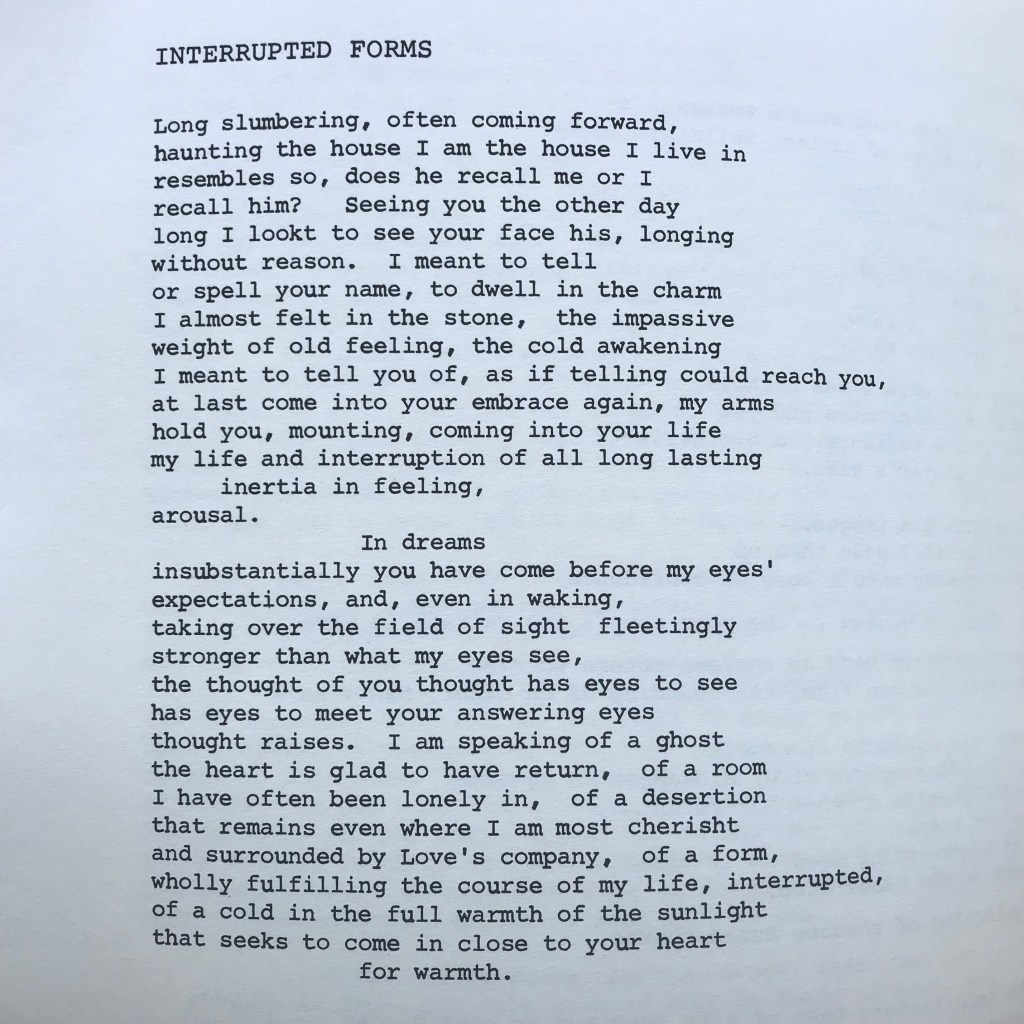
Devin’s essay “The Needs of Ghosts” turns upon “Interrupted Forms,” a poem by Robert Duncan, included at the start of the latter’s Poems from the Margins of Thom Gunn’s “Moly.”
Given its dedication to one who is both there and not there, ‘tis a poem that is both desirous and recollective simultaneously.
Into the situation of Duncan’s poem, I project this character of mine, the Gay Wizard — the ghost who haunts “The House on Shady Blvd.”
Of him, or of a ghost of similar make, Duncan writes as follows:
Long slumbering, often coming forward,
haunting the house I am the house I live in
resembles so, does he recall me or I
recall him?
Wanting today to alter the condition set upon me by the ghosting of me by others, I sing the poem to those I love. I sing it to you, dear reader, “as if telling could reach you,” hoping against hope you have ears to hear.

for all who move
and all that is still
on this world that spins
for plants that grow up poles
tendrils running
skyward through metal
silhouettes of birds
for the wow of each day
last night’s full moon in Aquarius
genres that allow us to receive our fellow beings.
Gratitude, too,
to the goldenrod
and the Queen Anne’s lace
and the wind in the trees.
Gratitude to all who care for the garden
and report of its flourishing.
Gratitude to the cosmos,
the great human and nonhuman multitude,
manifold persons and beings
gathered here
aboard Spaceship Earth
and Beyond.

Mow the lawn
goes the tune
of much of the afternoon.
And when not mowing,
I’m grading,
eyes roving
toward evening
whereupon,
once arrived,
I watch a show of discovery:
witches
outing and moving out
half-woke
via cauda pavonis—
prima materia transmuted,
person transformed—
grass a kind of catalyst.
A quivering cartoon mouth sings a tune,
kissing cousin of the Rolling Stones “mouth and lips” logo
floating disembodied amid space scenes and stairways
the ascents and descents of an inner construction site
platforms, plateaus
arranged along the face of a pyramid.
Sun-heads and Moon-heads wave from adjacent stairwells
That final ordnance
a spry sparrow of a chapbook,
as set in its way as Zen in the Art of Archery
but healthy as a hound,
a quick study.
I’m missing following you
dear seeker
dear who.
What was then is now
not a bear but a trap—
calculations, credit
And thus
“Moral”: stand there, act that
From beyond
“right/wrong,”
“Which first, meat or engine?”
welcome, give rise, help raise