‘Tis suburbia, of a more intense sort than any other of the various elsewheres I’ve lived. Yield signs, flags everywhere. But also gardens, hydrangeas, bunnies. And some of the houses are quite lovely. Did I mention the bounce houses? Sarah and I counted no fewer than five such structures within a one-block radius of my sister’s house this afternoon as we returned from lunch. To live this way is to affirm castles on canals in some uprooted, replanted Venice Upon Oyster Bay. Despite reprehensible “Back the Blue” stickers on the backs of pickups and other bones one might pick with the place, why bother? Others have picked them clean, them bones, yet there they remain whether we attend to them or not. As do the seagulls, the waves, the motorboats. A cool breeze tickles behind my ear and down my neck. The wonder of a quiet moment. Thumbing the pages of Frank O’Hara’s collected poems, I happen upon “Autobiographia Literaria.” The poem reminds me of my own beginning, early stanzas equal to my own early sorrow. But with the affirmation of its final stanza, the poem arrives and I arise transformed, accepting both the good and the bad with equanimity.
Tag: Poetry
Having a Coke With You
Inspired by José Esteban Muñoz’s reading of Frank O’Hara’s poem “Having a Coke With You,” I decide to include O’Hara’s Collected Poems in a bag of books that I carry north with me on my trip to New York. O’Hara is, after all, a defining figure of the New York School. His is a poetry of parties, acts, and encounters. A friend writes about him in her book. Words of hers capture my thoughts for a moment — nay, linger still, all these hours later, here in the future, among what has become of the words of he who is lost in the story. I imagine again the characters in the O’Hara poem, “drifting back and forth / between each other like a tree breathing through its spectacles.” If one’s attention is not to hold and be held by such things, one must actively turn away.
from “A New Poem” by Jack Spicer
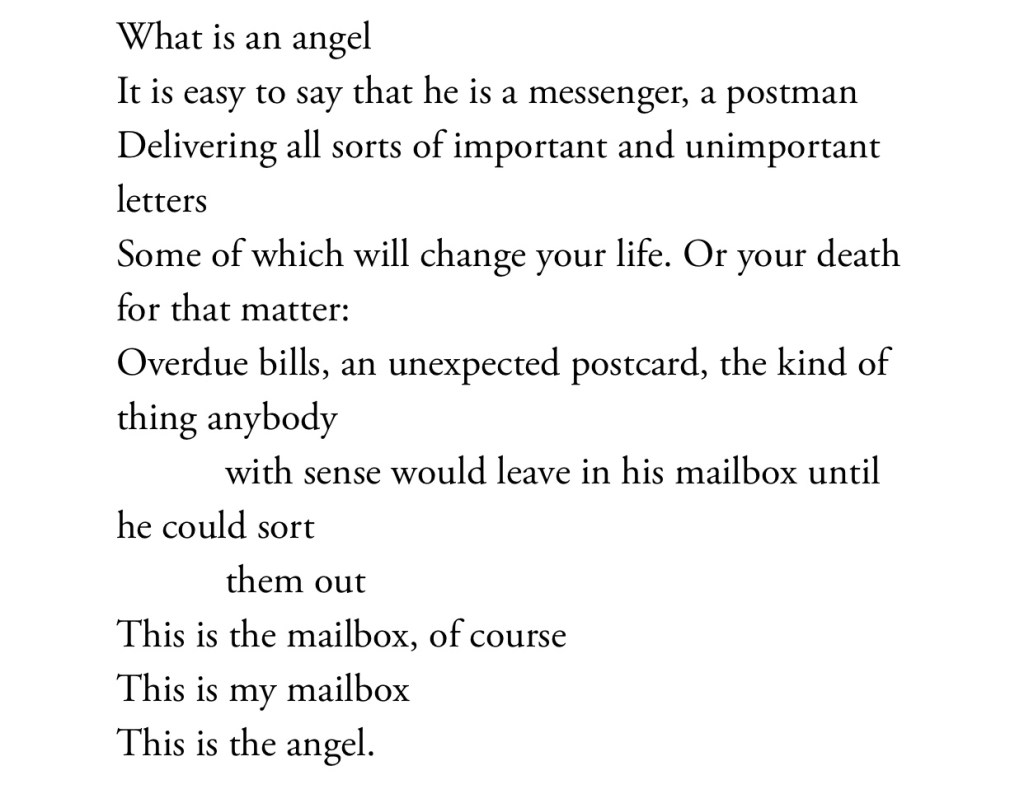
Sunday May 2, 2021
Mow the lawn
goes the tune
of much of the afternoon.
And when not mowing,
I’m grading,
eyes roving
toward evening
whereupon,
once arrived,
I watch a show of discovery:
witches
outing and moving out
half-woke
via cauda pavonis—
prima materia transmuted,
person transformed—
grass a kind of catalyst.
Thursday March 25, 2021
Time: an odd phenomenon in light of the way it communicates, deposits emblems, plays hide-and-seek with consciousness. “Let Your Dreams Set Sail” says one such emblem, printed on the wall above the bed in which I’ve slept of late. A box on the ground displays the Paramount logo, a mountain pointed toward an outer sphere, like a Bucky dome lined with stars. Outside the sphere pokes SpongeBob SquarePants: the Flammarion engraving rejoined or reversed.
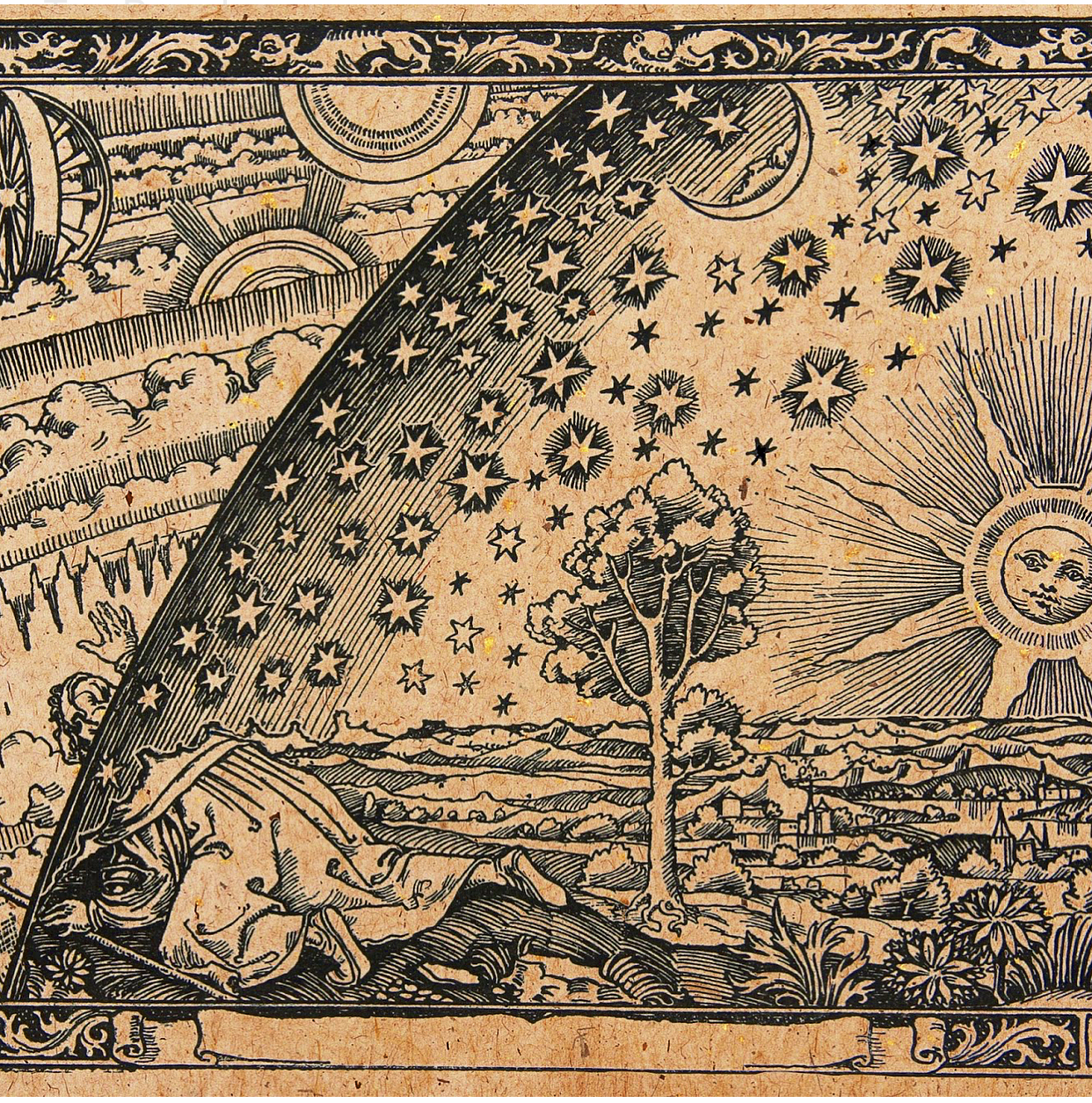
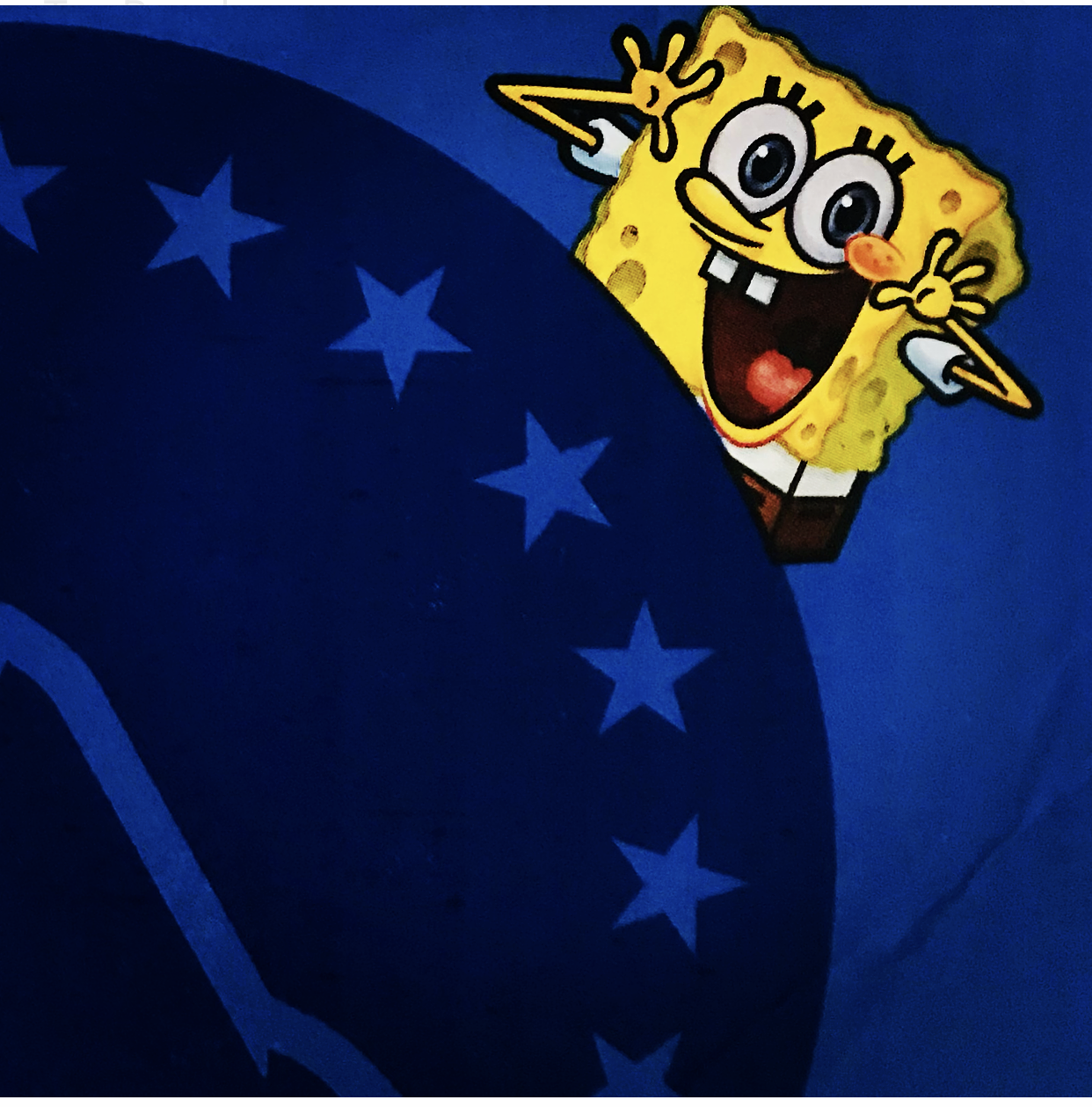
SpongeBob disrupts the first sphere’s fourth wall, smiles at consciousness, injects among solemnity a spirit of mirth set free to roam the cosmos. He, too, partakes of the image’s directionality, the vertical ascent narrative involving spaceships: the thing toward which the parts of the emblem incline. Let us imagine among these ships of possibility that which is prophecied in the mythology of the Dog Star — black anti-slave ships, lines of flight like Marcus Garvey’s Black Star Line. Nathaniel Mackey fuses these symbolisms in his poem “Dogon Eclipse.” The poem ends “as if by then I’d / been thru / Hell / and back.” As if the “I” of the poem were Orpheus, the poet of ancient Greece, founder of the Orphic mysteries. Orphics revered Dionysus. He, too, is said to have descended into the underworld and to have returned. Through his poem, Mackey initiates those who read. So sayeth Michael S. Harper in his preface to Eroding Witness: “These poems are about prophecy and initiation.” Poems like “Dogon Eclipse” hint at mysteries; they transmit a secret knowledge. Other poems in the collection conjure loas from Voodoo and Vodou. Loas are the “mystères,” “the invisibles.” They act as intermediaries between worlds.
Tuesday March 23, 2021
Kids and I play in my brother-in-law’s back yard.
Geese swim up and greet Frankie and I on the canal, splashing, squawking loudly.
I build the kids a fort.
I drive my nephew to preschool.
Sarah and I see his brothers to the bus stop, send them to school.
It’s a day of many moving parts.
Sicilian pizza for lunch from my favorite pizzeria.
I return home with slices for Sarah and Frankie.
L. attends the same preschool I attended forty years ago.
Clear skies, sunlit afternoon.
I man the grill and prepare dinner.
A day of actions rather than words.
Tuesday March 9, 2021
I retrieve an object from a stack of documents: a postcard for a show called “Pacts and Invocations: Magic and Ritual in Contemporary Art.” Peering into the depths of the image, I see what lies within. ‘Twas a hard day but we got through it. Word-sounds, hyperobjects. Goin’ round eatin’ nuggets and fries. I feel devastated by a loss borne by someone close, and by all of the various “operations” running around, upon, and through me: vaccines, medicines, doctors, treatments. Sarah recommends RuPaul’s Drag Race as we talk over dinner. Frankie sits beside us drinking milk from a sippy cup. Home afterwards, I receive word of a friend’s talk on Psychoanalysis and Psychedelics. Another friend shares a line from a Gerard Manley Hopkins poem: “Selfyeast of spirit a dull dough sours.” The line is from “I wake and feel the fell of dark, not day,” one of Hopkins’s so-called “Terrible Sonnets” of the 1880s. I think of the day’s arrivals as fodder for my meeting with my therapist. Doubt and depression weigh upon me when I contemplate my lack of accomplishment. Hopkins’s poem, though, I remind myself, remained unpublished until decades after the poet’s passing. Listening now to the talk by my friend the psychoanalyst, I’m made to think about “resonance,” a concept the friend extracts from Terence McKenna and Erik Davis. The latter defines resonance as “a phenomenon of interpenetration and mutual participation, of the blurring of the boundary between subject and object, something that is much easier to hear than to see.” Hear it I do as I pause the video and make time for Time for the Tams (1965). “Finally,” Nate says, “it is a form of coincidence.” All of which puts me in mind, of course, of Jung’s concept of synchronicity. Other phrases resonate here as well: “uncanny contact.” Nate reads Valis as the story of a psychosis. “Truth serum” administered in the wake of the removal of Dick’s “wisdom” tooth provokes Dick’s realization that reality is an illusion. Dick’s Exegesis, Nate argues, “is a tome of coincidence. […]. Valis, meanwhile, is a novelization of the Exegesis.” Valis allows Dick to split himself in two. He is both Horselover Fat, the subject who experiences, and Phil, the subject who narrates. Dick is also several other characters in the novel: the cynic, the Christian optimist. Each character a facet of the author’s psyche.
Friday January 22, 2021
A quivering cartoon mouth sings a tune,
kissing cousin of the Rolling Stones “mouth and lips” logo
floating disembodied amid space scenes and stairways
the ascents and descents of an inner construction site
platforms, plateaus
arranged along the face of a pyramid.
Sun-heads and Moon-heads wave from adjacent stairwells
Wednesday December 30, 2020
How do we heal the paranoid, distrusting people in our lives (ourselves included)? Take my mother-in-law, an ardent anti-abortionist. Why do such storylines appeal to her? She watches crime shows. Her and my father-in-law love Jeopardy. She suffered a traumatic childhood. After her mother’s institutionalization, she was separated from her siblings and placed in an orphanage. These experiences live on, I suppose, informing her relationship to narrative. Let us spiral in “sound-star tetrahedrons,” as does Mei-Mei-Berssenbrugge in her poem “Singing” (A Treatise on Stars, p. 82). Let us visit the Santa Fe Institute. Berssenbrugge credits the latter with talk of “ETs, … coincidence, spirit molecules, time tunnels and quantum uncertainty” (88).
Sunday December 27, 2020
Peering at books I received as gifts on Christmas morning, I happen upon A Treatise on Stars, a new collection by poet Mei-Mei Berssenbrugge. Sarah brings word of a friend’s new novel dedicated to our daughter Frances. This same friend authored a book I’ve taught — one I plan to teach again this spring. Time to think about stars and cosmologies. Stars appear in the Berssenbrugge book, as they do in the new Star Wars series The Mandalorian, a show we watch with family. My nephews received a talking Baby Yoda doll for Christmas. Together let us explore together systems of stars. Establish communication among spinning galaxies across the distances of space and time. Listen to each star as it sings.
 Trance-Scripts