Some of my students are writing brilliant papers. Let us celebrate. Ice cream truck: jingle jingle, dream big. The world is always-already enchanted, slips the confines of the automatized western. One is not at the end of history but rather its beginning, says Going In, a Brooklyn-based sub-label dedicated to long-form musical compositions geared towards meditation, psychedelic ceremonies, yoga, [and] massage.” The part of me that wants to write wants to listen. Entering the moment means watching The Croods, or staring at stars, or seeking copies of Verdant Gnosis.
Category: Uncategorized
Thursday March 25, 2021
Time: an odd phenomenon in light of the way it communicates, deposits emblems, plays hide-and-seek with consciousness. “Let Your Dreams Set Sail” says one such emblem, printed on the wall above the bed in which I’ve slept of late. A box on the ground displays the Paramount logo, a mountain pointed toward an outer sphere, like a Bucky dome lined with stars. Outside the sphere pokes SpongeBob SquarePants: the Flammarion engraving rejoined or reversed.
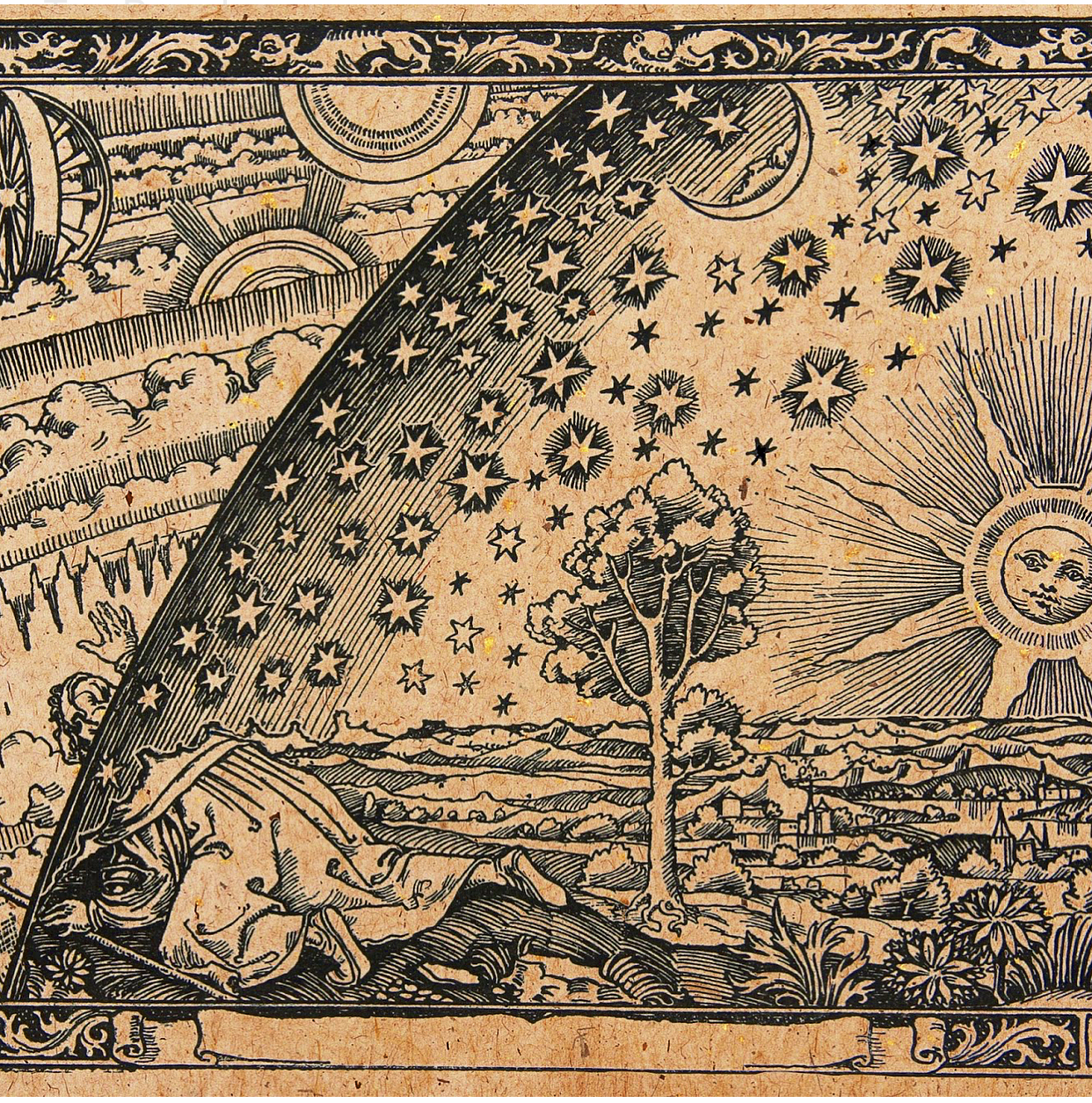
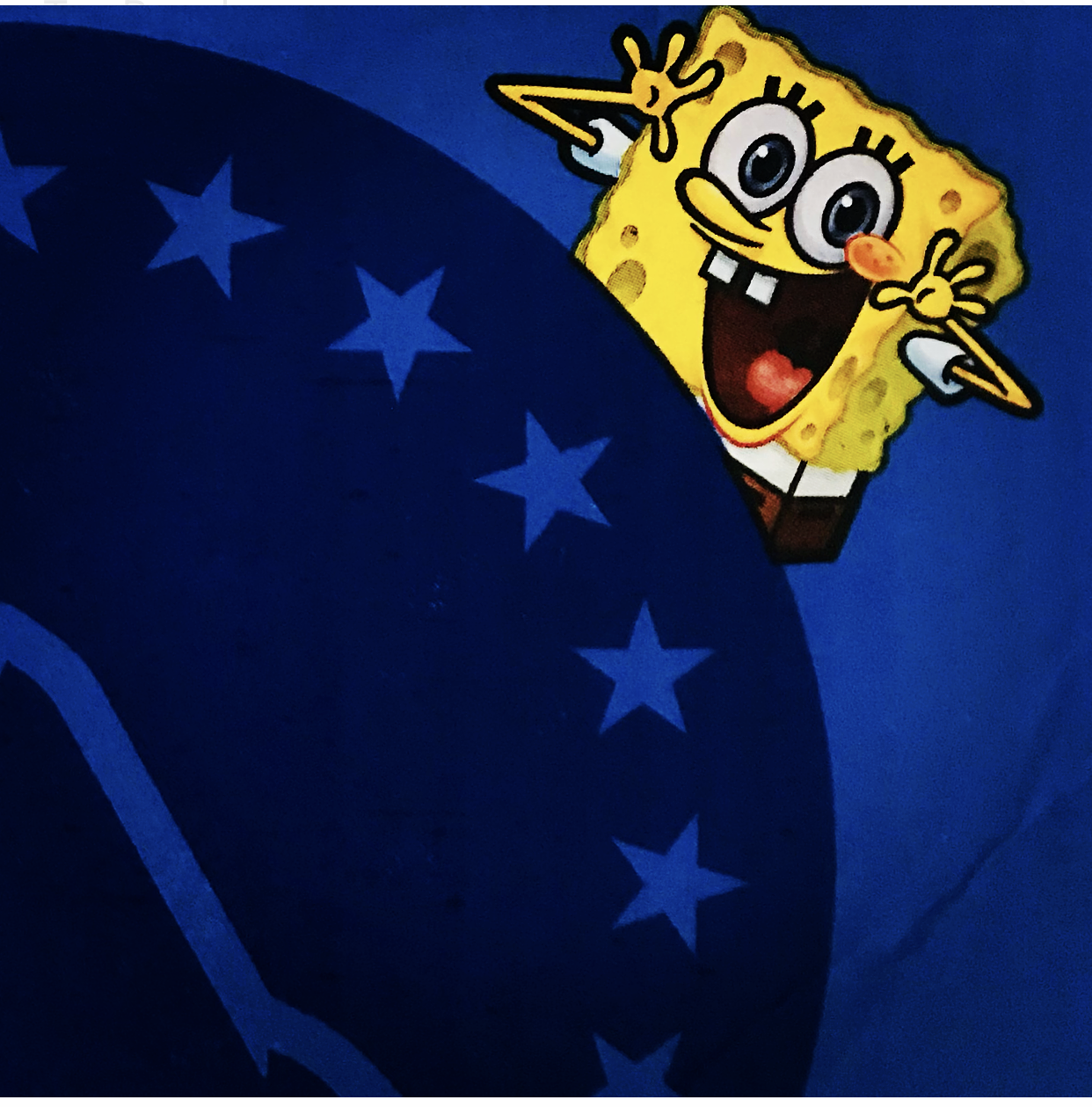
SpongeBob disrupts the first sphere’s fourth wall, smiles at consciousness, injects among solemnity a spirit of mirth set free to roam the cosmos. He, too, partakes of the image’s directionality, the vertical ascent narrative involving spaceships: the thing toward which the parts of the emblem incline. Let us imagine among these ships of possibility that which is prophecied in the mythology of the Dog Star — black anti-slave ships, lines of flight like Marcus Garvey’s Black Star Line. Nathaniel Mackey fuses these symbolisms in his poem “Dogon Eclipse.” The poem ends “as if by then I’d / been thru / Hell / and back.” As if the “I” of the poem were Orpheus, the poet of ancient Greece, founder of the Orphic mysteries. Orphics revered Dionysus. He, too, is said to have descended into the underworld and to have returned. Through his poem, Mackey initiates those who read. So sayeth Michael S. Harper in his preface to Eroding Witness: “These poems are about prophecy and initiation.” Poems like “Dogon Eclipse” hint at mysteries; they transmit a secret knowledge. Other poems in the collection conjure loas from Voodoo and Vodou. Loas are the “mystères,” “the invisibles.” They act as intermediaries between worlds.
Tuesday March 23, 2021
Kids and I play in my brother-in-law’s back yard.
Geese swim up and greet Frankie and I on the canal, splashing, squawking loudly.
I build the kids a fort.
I drive my nephew to preschool.
Sarah and I see his brothers to the bus stop, send them to school.
It’s a day of many moving parts.
Sicilian pizza for lunch from my favorite pizzeria.
I return home with slices for Sarah and Frankie.
L. attends the same preschool I attended forty years ago.
Clear skies, sunlit afternoon.
I man the grill and prepare dinner.
A day of actions rather than words.
Sunday March 21, 2021
We rearrange ourselves beside a canal among people with good stories. A seal docked beside me with a smiley face sticker atop its face prompts me to imagine the addition of hieroglyphs to the text message emoji/emoticon lexicon. Mermaids hover to my left, and to my right a friend’s new romance novel: Joanna Lowell’s The Duke Undone. A trip down memory lane. “Down By the Bay” theme song performed on ukulele. I eye the book’s prologue and note its relationship to another of the friend’s novels. Female protagonist. Third-person subjective narration. Yet there the similarities end. Or so I imagine.
Thursday March 18, 2021
Step into “Jam On It,” members of Newcleus rocking the mic, beat is fresh. Then read Lennon Remembers, a two-part interview with John Lennon conducted by Jann Wenner for the December 1970 and January 1971 issues of Rolling Stone. Lennon begins the interview a bit rancorous and sour grapes. The Beatles had broken up eight months prior, and Lennon seems convinced that the 1960s cultural revolution failed to produce real change. “Nothing happened except that we all dressed up,” he says. “The same bastards are in control, the same people are runnin’ everything, it’s exactly the same. […]. We’ve grown up a little, all of us, and there has been a change and we are a bit freer and all that, but it’s the same game” (12). The band’s final years were in Lennon’s view humiliating and awful. People were thrust on them and would touch them. To recover, he made his first solo album, John Lennon/Plastic Ono Band, released the same month as the interview. The album cover features John and Yoko relaxing under a tree beside a lake at Lennon’s Tittenhurst Park estate. A church bell rings in the opening seconds of “Mother,” the first track on Side A.
By the time of “Working Class Hero,” my thoughts are of primal scream therapy and psychic restitution. That’s what one seeks through psychotherapy, is it not? “Psychic restitution”? It all seems a bit too rooted in the past. It is time instead to re-read Eroding Witness by Nathaniel Mackey.
Wednesday March 17, 2021
The “new” look of psychedelic art and design of the 1960s was, as a recent Vox video shows, about recooking the past. “Art Nouveau on acid.” For Huxley, meanwhile, the psychedelic experience is about Moksha, a concept from Eastern spiritual traditions involving freedom from samsara, or access to a truth or a reality beyond the cycle of suffering and rebirth. I find myself returning to Huxley’s book The Perennial Philosophy, published in 1945, immediately after WWII. The book assembles passages from the writings of saints and prophets from traditions of Eastern and Western mysticism. The German philosopher Gottfried Leibniz is the one who named this strain of esoteric wisdom “the perennial philosophy.” There’s a universalizing bent to perennialism, arguing as it does that all religions, despite their differences, point to the same truth: “That Art Thou,” or “Thou Art That,” “the immanent and transcendent Ground of all being” (Huxley, The Perennial Philosophy, p. vii). There is an eternal Self in the depths of each person. Or as Marcus Aurelius claimed, “the universe is a single living organism possessed of one substance and one soul, holding all things suspended in a single consciousness and creating all things with a single purpose that they might work together spinning and weaving and knotting whatever comes to pass.”
Tuesday March 16, 2021
Re-reading The Doors of Perception, Aldous Huxley’s classic “trip narrative” about a mescaline experience at his house in Los Angeles, I’m struck by Huxley’s disdain for modernism and his admiration for artists of earlier eras: Goya, Vermeer, William Blake. Huxley is a proponent of the “Perennial Philosophy.” He finds across time a convergence of teachings, a shared wisdom in the visionary or mystical strains of each of the world’s religions. There is for him a “universal and ever-present urge to self-transcendence” and a “need for frequent chemical vacations from intolerable selfhood and repulsive surroundings” (The Doors of Perception, p. 64). One of the most remarkable aspects of The Doors of Perception, however, is the fact that it’s a book about vision and visionary experience by a man of poor vision. Huxley’s eyesight was damaged; an illness at the age of 16 left him thereafter severely impaired. Huxley claimed to have overcome some of this impairment through an experimental technique known as the Bates Method, about which he wrote a 1942 book called The Art of Seeing. Huxley is thus a modern incarnation of the “blind prophet,” in the tradition of figures like Tiresias, the seer from Antigone and Oedipus Rex.
Thursday March 11, 2021
Nadja constructs for its readers a Surrealist approach toward everyday life. It recalls in its first-person narrative and its forty-four photographs a string of synchronicities and coincidences, life occurring in fortuitous patterns. Breton coasts along on invisible economic means, contemptuous of those who “endure their work” (68). “How can that raise them up if the spirit of revolt is not uppermost within them?” he asks Nadja when the two meet. “No,” he concludes, “it was not yet these who would be ready to create the Revolution” (64). Surrealism is a refusal of work in favor of art and romance. The rest of us, meanwhile, are paying for treatment. Has talking to a therapist helped? Certainly. The more I open up, the more I learn about where and when and how we might exert agency together as Multitude. And we learn this precisely and quite wonderfully through receptivity to chance — or so I catch myself thinking, when what I ought to do is read. When at the end of their conversation Breton asks Nadja, “Who are you?” she replies, “without a moment’s hesitation, ‘I am the soul in limbo'” (71).
Wednesday March 10, 2021
I wish I knew more about “Irma,” thinks the patient. Freud should be read alongside those he treated (like the poet H.D.!), just as André Breton’s Nadja ought to be read alongside the life of the woman on which the Nadja character is based. Nadja, the French Surrealist novel par excellence, is based on Breton’s encounter with a mysterious woman: Leona Camille Ghislane Delacourt, a mad patient of the French psychotherapist Pierre Janet. The Surrealists performed events. They embarked on walks and strolls among the cities of France. Art was for Breton and the other Surrealists a way of life. Guided by the Unconscious, they produced an immensity of objects: films, novels, sculptures, poems. They sought revolutionary change of a sort, attempting a brief alignment with Trotskyism in the 1930s. I wonder if I could include Nadja in my course “Rabbit Holes, Time Machines, and Doors in the Wall.” Might it work? The book begins with a question: “Who am I?” The “I” on the page introduces itself through a proverb, claiming to be a ghost of sorts. The “I” that speaks is a Catholic one, a distinctly French subjectivity organized by Catholicism and Descartes, haunted by images of ghosts and eternal torments. As readers, we’re made to wonder. Breton presents language as a site of self-inquiry: Ego in Search of Premise. After a break, the narrator launches into “university discourse”: the French psychoanalyst Jacques Lacan’s term for one of four possible formulations of the symbolic network: “Master, University, Hysteric, and Analyst.” The subject of “university discourse,” claims Lacan, is a castrated subject, barred from knowing the world except as it appears in language. Spacey mood, tonight, folks. Chasing after some occulted master signifier. Lacan remains a language. To converse with him, one must learn his terms. Same with Marx, same with Freud. And one never arrives: revelations promised go unrevealed. With Breton and the Surrealists, however, it’s all “sudden parallels, petrified coincidences…harmonies struck as though on the piano, flashes of light that would make you see, really see, if only they were not so much quicker than all the rest” (19). Breton announces early in Nadja his conviction that “psychoanalysis is not qualified to deal with such phenomena” (24).
Tuesday March 9, 2021
I retrieve an object from a stack of documents: a postcard for a show called “Pacts and Invocations: Magic and Ritual in Contemporary Art.” Peering into the depths of the image, I see what lies within. ‘Twas a hard day but we got through it. Word-sounds, hyperobjects. Goin’ round eatin’ nuggets and fries. I feel devastated by a loss borne by someone close, and by all of the various “operations” running around, upon, and through me: vaccines, medicines, doctors, treatments. Sarah recommends RuPaul’s Drag Race as we talk over dinner. Frankie sits beside us drinking milk from a sippy cup. Home afterwards, I receive word of a friend’s talk on Psychoanalysis and Psychedelics. Another friend shares a line from a Gerard Manley Hopkins poem: “Selfyeast of spirit a dull dough sours.” The line is from “I wake and feel the fell of dark, not day,” one of Hopkins’s so-called “Terrible Sonnets” of the 1880s. I think of the day’s arrivals as fodder for my meeting with my therapist. Doubt and depression weigh upon me when I contemplate my lack of accomplishment. Hopkins’s poem, though, I remind myself, remained unpublished until decades after the poet’s passing. Listening now to the talk by my friend the psychoanalyst, I’m made to think about “resonance,” a concept the friend extracts from Terence McKenna and Erik Davis. The latter defines resonance as “a phenomenon of interpenetration and mutual participation, of the blurring of the boundary between subject and object, something that is much easier to hear than to see.” Hear it I do as I pause the video and make time for Time for the Tams (1965). “Finally,” Nate says, “it is a form of coincidence.” All of which puts me in mind, of course, of Jung’s concept of synchronicity. Other phrases resonate here as well: “uncanny contact.” Nate reads Valis as the story of a psychosis. “Truth serum” administered in the wake of the removal of Dick’s “wisdom” tooth provokes Dick’s realization that reality is an illusion. Dick’s Exegesis, Nate argues, “is a tome of coincidence. […]. Valis, meanwhile, is a novelization of the Exegesis.” Valis allows Dick to split himself in two. He is both Horselover Fat, the subject who experiences, and Phil, the subject who narrates. Dick is also several other characters in the novel: the cynic, the Christian optimist. Each character a facet of the author’s psyche.
 Trance-Scripts