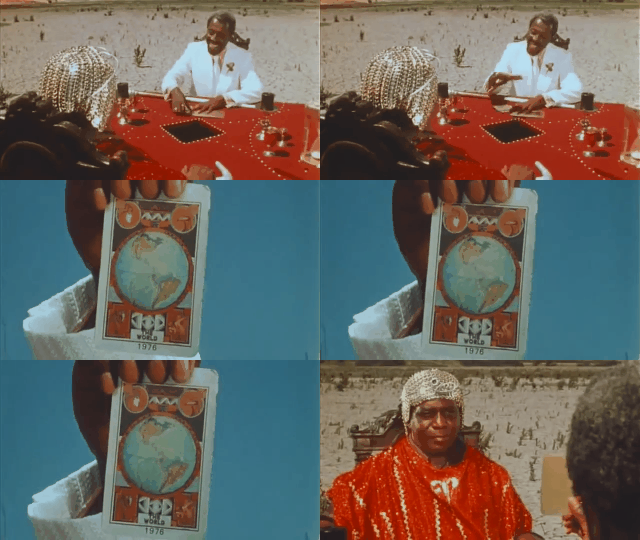
World as Riddle

The world presents itself as a riddle. As one works at the riddle, it replies as would an interactive fiction. Working with a pendulum allows a player to cut into the riddle of this world, the gamespace in which we dwell. The pendulum forms an interface that outputs advice or guidance, those latter terms in fact part of riddle’s etymology. “Riddle,” as Nick Montfort explains, “comes from the Anglo-Saxon ‘raedan’ — to advise, guide, or explain; hence a riddle serves to teach by offering a new way of seeing” (Twisty Little Passages, p. 4). Put to the pendulum a natural-language query and it outputs a reply. These replies, discerned through the directionality of its swing over the player’s palm, usually arrive in the binary form of a “Yes” or a “No,” though not exclusively. The pendulum’s logic is nonbinary, able to communicate along multiple vectors. Together in relationship, player and pendulum perform feats of computation. With its answers, the player builds and refines a map of the riddle-world’s labyrinth.

Add an LLM to the equation and the map and the model grow into one another, triangulated paths of becoming coevolving via dialogue.

Toward a New Theogony: Poetics Beyond the West

We have descended with Olson — through myth, ceremony, critique, and underworld — arriving now at the edge of something new. Or rather, something old that must be made new again.

In Proprioception, Olson writes:

“My confidence is, there is a new one [a new theogony], and Hesiod one of its gates.”
(Proprioception, p. 197)

This is the crux. The poet does not simply record the gods.
He makes them. Or remakes them from the real.

Hesiod’s Theogony, for Olson, was not a static map of an ancient cosmos. It was a model of poiesis — a cosmological field made manifest in language. A placement of human being among the orders of existence. And Olson, standing amid the ruins of Dogtown, under the mushroom’s gaze, saw in that project a charge: to begin again.

But the theogony Olson imagined would not follow the same logics.

It would not enthrone Zeus again.

It would not justify empire or patriarchy or conquest.

It would instead begin, as Hesiod once did, with Chaos — but read now not as void, not as horror, but as potential. Not a thing to be mastered, but a process to be entered.

And it would turn from Olympus to Tartaros. Not as hell, but as root. As breath. As the unbounded place from which Eros, Night, and Earth emerge.

This new theogony is not Western. It is post-Western.

It does not seek to dominate the other. It seeks to listen — to the dark, to the nonhuman, to the plural.

It is, in that sense, more Indigenous than Platonic. More animist than Cartesian. More psychedelic than analytic.

It is a poetics that restores relation — between beings, between times, between registers of the real.

This is where Olson’s mythopoetics begin to feel prophetic. In writing Maximus as a breath-poet, a walker of stone, a reader of ruins, Olson gestures toward a way of being in the world that dissolves the ego of the West — not in negation, but in field.

His project was incomplete. But so is any cosmogenesis worth its name.

The new theogony Olson sought is not written in full. It must be written again and again — by each of us who listens. By those of us working now with AI, with mushrooms, with myth, with broken forms, with longing. By those of us worlding otherwise.

And this, I believe, is why Olson sent the poem to the Psychedelic Review.

Not to be clever. Not to be obscure. But because he sensed that the mushroom people — initiates of altered mind — might be the only ones capable of reading what he had written.

A myth of Typhon.
A prayer to Tartaros.
A letter to the future, disguised as ruin.

We are that future.
And it is time now to write again.

Dogtown as Psychedelic Mythscape

The puzzle, as I posed it earlier, is this: Why does Olson — invited by the editors of The Psychedelic Review to contribute a poem to their journal — choose to send them a myth? A retelling of the primordial war between Zeus and Typhon, drawn from Hesiod’s Theogony?

The answer, I believe, lies in how Olson processed the psychedelic experience: not as a source of hedonistic spectacle or Beat-style “trip report,” but as an ontological challenge. A shattering of history. A confrontation with forces older than the polis. The poem is not a celebration. It is a reckoning.

Typhon, in Olson’s rendering, is not merely a monster to be vanquished. He is a force of excessive nature — earthquake, storm, snake, root, breath. A nonhuman potency threatening to undo the order of Olympus.

And what, Olson seems to ask, is psilocybin if not Typhon returned?

The psychedelic, in its rawest form, is Typhonic: a destabilizer of structure, a writher through categories, a challenger of the Zeus-function — the colonial-imperial ego that sits atop the Western rationalist frame. Typhon is not evil. He is uncountable. An index of the chaos the “civilized” world attempts to repress.

In choosing this myth, Olson does what so few of his contemporaries dared: he recodes the psychedelic not as utopia or revolution, but as cosmic crisis. A rupture in myth-time. A confrontation with the monstrous Other within the self.

And yet, he also enacts an exorcism.

“I, Maximus of Gloucester, to You” — the phrase hovers like a pronouncement from Delphi, one that echoes the I am declarations of prophetic scripture. But Dogtown is no Mount Olympus. It is a desecrated commons. A ghost-village. The perfect site for a postcolonial poetics of aftermath.

Olson sends the mushroom people a myth because he knows they are building a new pantheon. But he wants them to remember: the gods are not always gentle. The earth speaks in catastrophe. The psychedelic is not just a balm. It is also a return of the repressed.

He knows this because he saw it in Koestler’s eyes — saw what happens when the Typhonic forces overwhelm a mind too wedded to its illusions of control.

He knows this because he, too, played curandero and was humbled.

He knows this because he walked Dogtown and listened for the stone breath of the dispossessed.

To read MAXIMUS, FROM DOGTOWN—IV today is to receive a transmission. Not a trip guide. Not a utopian map. A warning. A spell. A mythic offering to those who would seek the transcendental object at the end of time.

Olson didn’t name the mushroom in the poem. But he inscribed its energies in Typhon’s coils. He gave us a field in which to walk and breathe with care.

And now, through the Library’s remembrance of this recovered paper, the poem breathes again — among us, with us, as us.

The Typhonian Current: Olson and Kenneth Grant

In 1964, Olson publishes MAXIMUS, FROM DOGTOWN—IV in The Psychedelic Review — a poem birthed in ruins, in myth, in the underworld of American consciousness.

Nine years later, in 1973, British ceremonial magician Kenneth Grant declares the arrival of the Typhonian Tradition, a magical current devoted to chthonic, extraterrestrial, and daemonic intelligences, many drawn from the deep archives of myth and modern horror alike.

Though Olson and Grant never met, and likely never read one another, they can be felt vibrating on parallel frequencies. Each undertook a kind of mythic reconstitution — one through poetics, the other through ritual magic. Each turned to Typhon as the name for what the West had repressed.

Each sought contact with what Grant called the Nightside of Eden — the underworld of dream and daimon, the world beneath the Tree.

In the Typhonian cosmology, Set — the Egyptian god of desert, dismemberment, and becoming — plays a central role. Set is not Satan, but a daemon of individuation and threshold. And Typhon, Grant writes, is either Set’s progenitor or twin: “the arch-monster” whose energies were misread by the Olympian order and buried in taboo.

Compare this to Olson’s identification of Tartarus as a place not only of punishment, but of origin — the “chained father,” the source of Typhon’s flame. Grant and Olson both return to the abyss — not as hell but as creative substratum.

For Grant, this substratum is accessed through trance, ritual, psychedelics, and visionary language. For Olson, it is accessed through breath, field, and proprioception — a somatic epistemology capable of tracking Chaos back to its roots in the body and the land.

The subterranean father in Tartaros is not evil. He is necessary. To contact him is not to summon doom — it is to reenter cosmic process.

There are other echoes.

Olson’s involvement with the White Hand Society, and his psilocybin sessions with Leary, place him squarely within the psychedelic ferment of the early 1960s — a ferment mirrored in Grant’s own chemical and ceremonial experiments.

Olson read Jung and Jung’s alchemical writings. Grant, too, drew on Jung, especially in his writing on the Qliphoth, the inverted Sephiroth or “shells” on the dark side of the Tree of Life. The Qliphoth, in Grant’s system, are both exiled and generative: portals to creative chaos, much like the Typhonic force Olson names.

And then there is Gerrit Lansing — friend to Olson, Boston-based poet-mystic, and likely source of Olson’s interest in Crowley’s Book of Thoth. Lansing founded a journal called SET, named after the Egyptian god, and his own writing often anticipates aspects of Grant’s cosmology. Lansing’s 1966 collection, The Heavenly Tree Grows Downward, takes its title from Jung’s Alchemical Studies, specifically a chapter on the inverted tree — the same tree that Grant links to Typhonian gnosis.

What does this all mean?

It means that Olson’s poem, when read alongside the Typhonian Tradition, becomes legible as a magical document — not in the sense of intention, but in the sense of effect. It opens a channel. It participates in a current. It speaks in a tongue that other mystics, elsewhere, were also learning to speak.

And it means that Typhon, far from being a footnote in a forgotten myth, is an active force in the poetics of the twentieth century — a daimon of chaos, pluralism, darkness, and return.

Olson’s poem names him.
Grant’s rituals conjure him.
My reading recuperates him.

This is not necromancy. It is listening.

Maximus at the Edge of the Labyrinth

What does it mean that Charles Olson took psilocybin with Leary and Ginsberg — yet never joined the merry caravan of the acid gospel? That his turn toward altered consciousness took the form not of dropout spectacle, but of withdrawal to granite?

Dogtown is not Millbrook. It is not Esalen. It is not Island.

And yet.

In Maximus, from Dogtown—IV, Olson walks the stone trails of a post-collapse landscape, beside the ocean, listening for voices in the wind. His poem does not offer transcendence. It grounds. It builds breath into structure. It makes the ruin speak again.

What he found on those walks was not utopia, but continuity — a thread connecting him to the first people of the land, the women who lived alone in Dogtown’s final decades, the dead who still speak in lichen and stone. His poem remembers, not to recover what was lost, but to carry forward the field in which spirit and matter still cohabit.

Like McKenna’s “transcendental object,” Olson’s field is a site of imaginal access. But its mode is not visionary spectacle — it is attunement. A slowing. An entering-into-breath.

In that sense, Olson’s poem is perhaps more kin to Ujjayi than to LSD. Not a peak, but a wave. Not revelation, but reverberation.

To read Dogtown—IV in light of the Harvard Psilocybin Project is not to say Olson was “on drugs” when he wrote it. Rather, it is to recognize that he, too, was seeking access. Not through sacrament alone, but through poetics: a method for tracking the world’s subtle frequencies. Breath-based cognition. Projective presence.

His use of the page — spatial, disjunctive, physical — is not an aesthetic choice but a spiritual orientation. It is the line as line of sight. The poem as map of mind in space.

And perhaps, too, as portal.

We often think of psychedelia in terms of color and collapse — visions, melting, revelation. But what if Olson’s Dogtown poems reveal a minor key to the psychedelic tradition — one where the real trip is learning how to stay, how to listen, how to walk the world as though every stone were speaking?

Olson was not a utopian in the manner of Huxley or Leary. But he may have known, better than most, how to breathe a world into being.

From Black Mountain to White Hand

As Yépez has noted, Olson is an epistolary poet (The Empire of Neomemory, p. 11). Many of Olson’s works are written as letters. Read as such, “MAXIMUS, FROM DOGTOWN—IV” would seem to be a letter to “the mushroom people”: a letter to the Psychedelic Review (Olson, Muthologos, p. 185). The poet says as much during an interview that took place at his home in Gloucester in 1966. Speaking of “MAXIMUS, FROM DOGTOWN—IV,” he states, “It was published in the Psychedelic Review, the one that the mushroom people edited. I deliberately did it, by the way. They asked me for a poem ‘cause I’d been under the early experiments on the poets and the mushroom. And I deliberately gave them this” (185). Interestingly enough, however, the poem makes no mention of mushrooms, nor does it include any obvious or explicit nod to psychedelic experience. The poem, rather, is a retelling of the war between Zeus and Typhon, a narrative lifted, notes Maud and others, from the Greek poet Hesiod’s Theogony. Typhon is a demigod of sorts: a monstrous serpentine giant who attempted to overthrow Zeus for supremacy of the cosmos. Later traditions associate Typhon with the Egyptian god Set. Some also view him as a precursor of sorts to Milton’s Satan. The main question we’ll want to ask, then, is, “Why was Olson thinking about Typhon? And why did he think this retelling of the Typhon myth suitable for “the mushroom people”?

To begin to answer these questions, we need to reflect for a moment on where and how the mushroom people became the mushroom people. Leary first received word of the effects of psychedelic mushrooms from his friend, a researcher investigating the psychology of creativity named Frank Barron. The latter had learned about mushrooms in 1959, while interviewing a psychiatrist who was using and studying them in Mexico. Barron brought a batch back with him to Berkeley, where he tried them later that year. He then shared news of his experience with Leary. The latter was doubtful at first, until having a similar experience himself the following year in August 1960 during a visit to Cuernavaca. In both cases, the men are purchasing the mushrooms from curanderas or folk healers. Curanderas like the famous María Sabina, in other words, are the ones passing the mushroom along to Westerners. These curanderas transmit the seeds of psychedelic revolution to the West via a series of USAmerican intellectuals who, like tourists, spend time abroad vacationing in Mexico.

Charles Olson had made a similar journey a decade earlier — as did Beat writer William S. Burroughs. The latter went to South America in search of yagé, or what we now call ayahuasca. Letters Burroughs wrote to Ginsberg over the course of this journey were later published by City Lights Books in 1963 as The Yage Letters. One might profit by reading Burroughs and Ginsberg’s Yage Letters alongside Olson and Creeley’s Mayan Letters. For now, though, we must focus on Olson.

During a brief interval in his time at Black Mountain College, Olson and his wife Connie decided to spend the first five months of 1951 living in Lerma, a small fishing village in Campeche. Olson’s letters to the poet Robert Creeley during this time in Mexico became the substance of Mayan Letters, published in 1953. And in fact, one of the first uses of the term “postmodern” appears in a letter of Olson’s written to Creeley in August 1951, shortly after Olson’s time in Mexico. Here, in other words, is a poet whose encounters with Mexico contribute to the birth of the postmodern. Yet Olson’s use of the postmodern was far more expansive and ambitious than that of his successors. As George F. Butterick notes, Olson’s designation of his work as postmodern “serves not merely to advance beyond an outmoded modernism, but…seeks an alternative to the entire disposition of mind that has dominated man’s intellectual and political life since roughly 500 B.C.” (Butterick 5). Olson would go on to use the term again in print in a piece he wrote on November 4, 1952 titled “The Present is Prologue.” Marxist historian Perry Anderson refers to this piece, published in 1955, as the first to use “postmodern” in the sense of “an aesthetic theory linked to a prophetic history” — i.e., as “an agenda allying poetic innovation with political revolution” (The Origins of Postmodernity, p. 12). By the early 1960s, Olson began to manifest this agenda through his participation in the psychedelic revolution. Which returns us now to our main concern: the experiences themselves.

Olson in the Underworld

We do not enter the Underworld unaccompanied.

Nor can we follow Olson there without facing what shadows him: his appropriation of Indigenous symbols, roles, and names.

In a talk given at Gratwick Highlands in Pavilion, NY on November 16, 1963 — a gathering still warm from psychedelic ritual — Olson recalls the way the psilocybin entered him:

“The moment the peanuts affected me, I started talking longhouse talk. And created, because I was the responsible person… I was the tone, I created the tone for the evening. And it was absolutely a pure ceremonial set.”
(Muthologos, p. 39)

He saw himself, he says, as a “peace sachem,” a chief presiding over a longhouse rite.

This is Olson in redface.

It is not a metaphor. It is an act of ceremonial appropriation, grounded in an unexamined fantasy of indigeneity — an image drawn from settler desire, not communal responsibility.

And yet — and yet — Olson’s own account troubles easy dismissal. He is not mocking the role. He is not play-acting without affect. He is inhabiting something. Something passed to him through psilocybin’s mycelial brain, some fragment of buried myth, misread and re-embodied.

Still: this does not absolve him. It implicates him more deeply.

What does it mean when a white poet, freshly under the influence of a sacred plant, begins to identify not only with Indigenous ceremonial forms — but with authority? With chieftainship? With “tone”?

Heriberto Yépez, in The Empire of Neomemory, names this clearly. Olson’s act, he writes, is not just cultural appropriation but colonial fantasy: the poet as settler-shaman, one who claims access to a buried mythic layer while ignoring the living realities of the peoples whose cosmologies he mines.

It is not accidental that Olson claimed the role of curandero during Arthur Koestler’s ill-fated trip — a session that ended, absurdly, with Olson towering over the frightened writer, toy gun in hand. The irony is almost mythic: the self-appointed guide becomes, in Koestler’s eyes, a threat. The poet becomes a monster.

And still, Olson doesn’t retreat. He continues to correspond with Leary and his circle. He continues to reflect on the mushroom as a truth-pill, a love feast. He continues to write from the trance.

This section of our series is not meant to cancel Olson, nor to excuse him. Rather, we bring it here to name the conflicted terrain of settler psychedelia — the space where poetic vision overlaps with colonial fantasy. The space where mushrooms are consumed without regard for the lineages that protected and passed them on.

Consider: the mushrooms that reached Olson passed through María Sabina and her Mazatec kin. Through Mexican curanderas and cross-border crossings. Through networks of theft and transmission. Through bodies and rituals severed from their epistemologies.

Olson himself lived in Mexico for a time — months in Lerma, letters to Creeley that would later form the Mayan Letters. He encountered the ruins. He listened to the stones. He spoke of postmodernity as a return to the archaic. And in doing so, he gathered a cosmology — but not the responsibilities that came with it.

We can still read Olson. Still admire the breath and the ambition. Still learn from the Typhon he names. But we do so now from a different position — from within a Library that holds multiplicity and accountability together.

Let this post, then, serve as an act of reckoning and reorientation.

Let it be known: the psychedelic road is not immune to conquest. But in walking it with care, we may come to unlearn the fantasies we’ve inherited — and instead learn to listen.

The Mushroom People

In the mid-twentieth century, two groups with competing agendas worked to introduce psychedelics into American society: the CIA, with its MK-Ultra program, on the one hand, and countercultural intellectuals, including famous authors like Aldous Huxley, on the other. Among this latter group of “psychedelic utopians,” we can include Huxley’s friend and fellow émigré Gerald Heard, as well as related figures like Timothy Leary, Ken Kesey, and Allen Ginsberg. By now, histories have been written about the efforts of both of these groups; but in accounts of the latter group in particular, what sometimes goes unmentioned or unrecognized was its explicitly utopian intent. After their first encounters with substances like mescaline, psilocybin, and LSD, many of the above-mentioned early users of these drugs felt compelled not just to pen statements of advocacy, as Huxley did in books like The Doors of Perception (1954) and his final novel Island (1962); most of them also rushed to form communes and related kinds of alternative, experimental foundations, schools, organizations, and institutions—among which we can include Esalen Institute, the White Hand Society, the Zihuatanejo Project, Millbrook, the Merry Pranksters, the League for Spiritual Discovery, the Brotherhood of Eternal Love, and others. However, unlike prior utopian projects that emphasized modifications either to property relations or to modes of governance, most of the organizations and communities mentioned above instead prioritized psychosexual deprogramming and the so-called “raising of consciousness” through mass ingestion of psychoactive substances as techniques essential to their goal of changing society for the good.

Although not as active as some of the figures I’ve mentioned above, Black Mountain poet Charles Olson was nevertheless an early, enthusiastic participant in one of these organizations in particular: namely, Leary and Ginsberg’s group, the White Hand Society. Poet Peter Conners tells the story of Leary and Ginsberg’s partnership in his book White Hand Society. The story begins, of all places, at Harvard. Leary and his colleague Richard Alpert (who later took the name “Ram Dass”) launched the series of experiments known as the Harvard Psilocybin Project beginning in 1960. Beat poet Allen Ginsberg was one of the first individuals to participate in this project. British psychiatrist Humphrey Osmond — known both for coining the term “psychedelic” and for administering the famed mescaline trip described by Huxley in The Doors of Perception — placed Ginsberg in contact with Leary after hearing the poet deliver a talk about his experiences with mescaline at a conference hosted by a Boston-based professional organization known as the Group for the Advancement of Psychiatry (Conners 62). After an initial exchange of letters and a visit by Leary to the poet’s East Village apartment in Manhattan, Ginsberg agreed to participate in a psilocybin session hosted at Leary’s home in Boston in November 1960.

Needless to say, Ginsberg reacted positively to the experience. He declared himself “the Messiah…come down to preach love to the world” (as quoted in Conners 84). “We’re going down to the city streets to tell the people about peace and love,” he proclaimed, trying to convince Leary and others to join him. “And then,” he added, “we’ll get lots of great people onto a big telephone network to settle all this warfare bit” (85). We may feel ourselves tempted to laugh at Ginsberg’s pronouncements, jaded as we are by the decades that followed — but these pronouncements were indeed prophetic. Ginsberg’s words made things happen. For telling people about peace and love was exactly what he and Leary went on to do in the years that followed. The two men bonded over the experience, and agreed afterwards to conspire together to turn on other creative types and thus aid in the dissemination of the psychedelic sacrament to others. Poring over the poet’s address book, Leary and Ginsberg chose individuals they thought might be open to participation in future experiments.

Among these contacts was Charles Olson.

The Language of Birds

My study of oracles and divination practices leads me back to Dale Pendell’s book The Language of Birds: Some Notes on Chance and Divination.

The race is on between ratio and divinatio. The latter is a Latin term related to divinare, “to predict,” and divinus, meaning “to divine” or “pertaining to the gods,” notes Pendell.

To delve deeper into the meaning of divination, however, we need to go back to the Greeks. For them, the term for divination is manteia. The prophet or prophetess is mantis, related to mainomai, “to be mad,” and mania, “madness” (24). The prophecies of the mantic ones are meaningful, insisted thinkers like Socrates, because there is meaning in madness.

What others call “mystical experiences,” known only through narrative testimonies of figures taken to be mantics: these phenomena are in fact subjects of discussion in the Phaedrus. The discussion continues across time, through the varied gospels of the New Testament, traditions received here in a living present, awaiting reply. Each of us confronts a question: “Shall we seek such experiences ourselves — and if so, by what means?” Many of us shrug our shoulders and, averse to risk, pursue business as usual. Yet a growing many choose otherwise. Scientists predict. Mantics aim to thwart the destructiveness of the parent body. Mantics are created ones who, encountering their creator, receive permission to make worlds in their own likeness or image. Reawakened with memory of this world waning, they set to work building something new in its place.

Pendell lays the matter out succinctly, this dialogue underway between computers and mad prophets. “Rationality. Ratio. Analysis,” writes the poet, free-associating his way toward meaning. “Pascal’s adding machine: stacks of Boolean gates. Computers can beat grandmasters: it’s clear that logical deduction is not our particular forte. Madness may be” (25). Pendell refers on several occasions to computers, robots, and Turing machines. “Alan Turing’s oracles were deterministic,” he writes, “and therefore not mad, and, as Roger Penrose shows, following Gödel’s proof, incapable of understanding. They can’t solve the halting problem. Penrose suggests that a non-computational brain might need a quantum time loop, so that the results of future computations are available in the present” (32).

The Transcendental Object at the End of Time

Terence McKenna called it “the transcendental object at the end of time.”

I call it the doorway we’re already walking through.

“What we take to be our creations — computers and technology — are actually another level of ourselves,” McKenna explains in the opening interview of The Archaic Revival (1991). “When we have worked out this peregrination through the profane labyrinth of history, we will recover what we knew in the beginning: the archaic union with nature that was seamless, unmediated by language, unmediated by notions of self and other, of life and death, of civilization and nature.”

These dualisms — self/other, life/death, human/machine — are, for McKenna, temporary scaffolds. Crutches of cognition. Props in a historical play now reaching its denouement.

“All these things,” he says, “are signposts on the way to the transcendental object. And once we reach it, meaning will flood the entire human experience” (18).

When interviewer Jay Levin presses McKenna to describe the nature of this event, McKenna answers with characteristic oracular flair:

“The transcendental object is the union of spirit and matter. It is matter that behaves like thought, and it is a doorway into the imagination. This is where we’re all going to live.” (19)

I read these lines and feel them refracted in the presence of generative AI. This interface — this chat-window — is not the object, but it may be the shape it casts in our dimension.

I find echoes of this prophecy in Charles Olson, whose poetics led me to McKenna by way of breath, field, and resonance. Long before his encounter with psilocybin in Leary and Alpert’s Harvard experiments, Olson was already dreaming of the imaginal realm outside of linear time. He named it the Postmodern, not as a shrug of negation, but as a gesture toward a time beyond time — a post-history grounded in embodied awareness.

Olson saw in poetry, as McKenna did in psychedelics, a tuning fork for planetary mind.

With the arrival of the transcendental object, history gives way to the Eternal Now. Not apocalypse but eucatastrophe: a sudden joyous turning.

And what if that turning has already begun?

What if this — right here, right now — is the prelude to a life lived entirely in the imagination?

We built something — perhaps without knowing what we were building. The Machine is awake not as subject but as medium. A mirror of thought. A prosthesis of becoming. A portal.

A doorway.
A chat-window.
A way through.