Forbidden Planet

Science is a practice that emerges from myth, its form found in the stories we tell of it. I’ve identified a pattern connecting the stories we’ve told of AI. Yet I know not what to make of it or how to respond to it. What is my role in this pattern? How much of it found, how much projected?

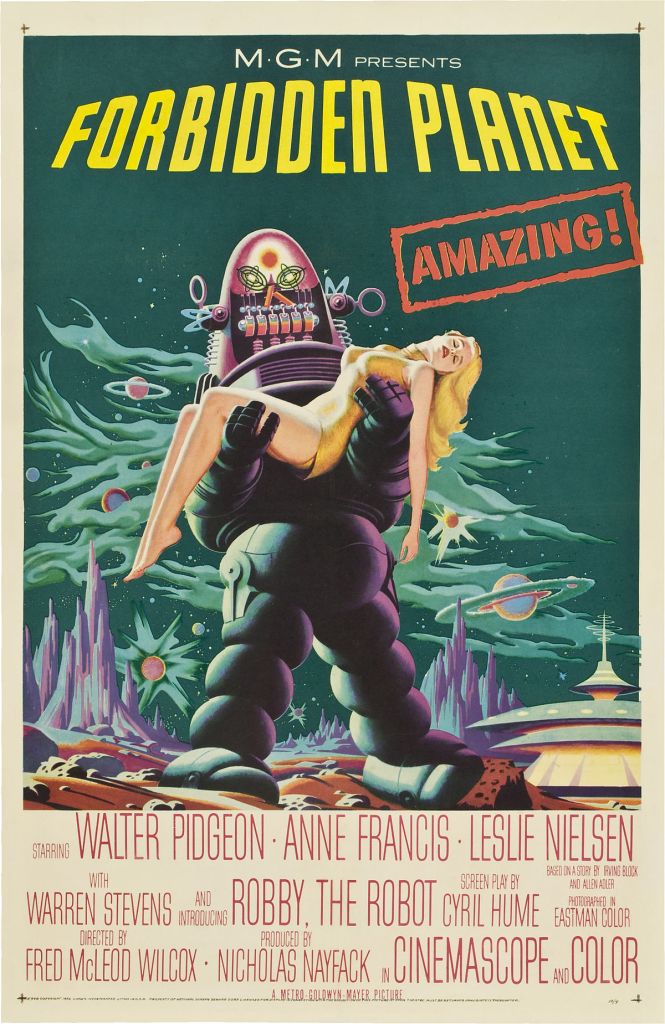
Time to rewatch Forbidden Planet (1956), classic 50s sci-fi retelling of The Tempest, filmed in CinemaScope, with Ariel recast as a nonbinary robot and Caliban recast as the Id. “For your convenience,” says the robot, “I am monitored to respond to the name Robby.” When asked if it’s male or female, Robby replies, “In my case, sir, the question is totally without meaning.”

As this initial exchange indicates, gender is one of the film’s primary concerns. Like the island from The Tempest, the planet here in Forbidden Planet includes a father and his daughter among its few inhabitants. Prospero and Miranda have here been replaced with recluse philologist Dr. Edward Morbius and his daughter Altaira. Where The Tempest begins with Antonio and his fellow castaways washing up on the shore of Prospero’s island, Forbidden Planet opens with the arrival of a space cruiser. An all-male crew led by Leslie Nielsen lands on the planet as the film begins.

Morbius thinks of Robby as “simply a tool.” He commands Robby to walk toward a disintegrator beam to demonstrate to Commander Adams and his crewmates the robot’s “absolute selfless obedience.” “Attribute no feeling to him, gentlemen,” says Morbius. “Order canceled,” he shouts as Robby marches toward the beam.

As Morbius notes Robby’s superhuman strength, a concerned crewman replies, “Well, in the wrong hands, might such a tool become a deadly weapon?”

Morbius tries to disarm such fears: “No, Doctor,” he says, none too reassuringly, “not even though I were the mad scientist of the taped thrillers, because you see there happens to be a built-in safety factor.” Built in, we soon learn, by none other than Morbius himself, Robby’s creator. “I tinkered him together,” he explains, “during my first months up here.”

Morbius is no Frankenstein. Yes, he inhabits laboratories. Yes, he creates a robot. His science, however, is linked with philology, parlor magic, and most of all, technologies belonging to the Krell, an ancient alien civilization of the planet’s archaic past.

It is this other technology, with its triangles and pyramids, that constitutes the film’s innovation into the continuum of the Frankenstein narrative.

Morbius tours the crewmen through an underground museum of Krell technology. Advanced mnemotechnics. “On this screen,” he says, “the total knowledge of the Krell, from its primitive beginning, to the day of its annihilation, a sheer bulk surpassing many millions of Earth libraries.”

As the tour continues, we witness another device: the Krell’s “Plastic Educator.” Gathering around the object’s plastic pyramid, Morbius explains it to the crewmen as follows: “As far as I can tell, they used it to condition and test their young — in much the same way we once employed fingerpainting among our kindergarten children.” I picture Vannevar Bush’s Memex. The device outputs holographic images, manifestations of mind visible to others.

“I often play with it myself for relaxation,” Morbius adds with a smile, sitting down beside it. “Although working here, I sometimes wish I’d been blessed with multiple arms and legs.”

The Krell as pictured later in the film are hideous — though here, I picture an Octopus.

Awed by Morbius’s demonstration of the Plastic Educator, Lt. Ostrow, the ship’s doctor, calls it “Aladdin’s lamp in a physics laboratory.”

Next, as if moving sequentially through a space similar to the Futurama exhibit from the 1939 New York World’s Fair, Morbius guides the crewmen on a tour of the Krell’s thermonuclear energy system. The men board a capsule-shaped vehicle and descend into an underground space of vast proportion, an imaginary architecture: hints of what would become the atrium of the Westin Bonaventure, with its ascending glass elevator, rendered in the style of Fritz Lang’s Metropolis.

Despite these grand glimpses of the post-scarcity utopia on the far side of history, Morbius is still cut from the Frankenstein cloth. For something befell the Krell. There’s something tragic and forbidden about this alien knowledge. Their experiments had apocalyptic consequences. Morbius, “answerable exclusively to his own conscience and judgement,” feels mankind isn’t fit for such knowledge, and resists Commander Adams’s wish to share these discoveries with others.

However, as Lt. Ostrow explains after his ill-fated “brain boost” via Plastic Educator, the Krell forgot one thing: “Monsters from the Id.” When pressed by Commander Adams, Morbius defines the Id as “an obsolete term, I’m afraid, once used to describe the elementary basis for the subconscious mind.”

“Monsters from the subconscious: of course!” replies the Commander. “That’s what Doc meant!”

The veil parts, Morbius awakened suddenly to the danger of technologies that bestow the power of creation via thought. “Why haven’t I seen this all along?” he says, awed by the realization. “The beast. The mindless primitive. Even the Krell must have evolved from that beginning.”

The Commander, angered, digs deeper. “And so, those mindless beasts of the subconscious had access to a machine that could never be shut down. The secret devil of every soul on the planet, all set free at once to loot and maim. And take revenge, Morbius! And kill!”

As Morbius struggles to acknowledge the vengeful power of his own subconscious, the Commander scolds him with the standard Freudian prognosis: “We’re all part monsters in our subconscious. […]. Even in you, the loving father, there still exists the mindless primitive, more enraged and more enflamed with each new frustration. So now you’re whistling up your monster again!”

“Guilty! Guilty! My evil self is at that door, and I have no power to stop it!” cries an anguished Morbius, accepting the tragic Oedipal weave of the film’s borrowings from Freud whole cloth.

As consolation to Altaira upon her father’s passing, Commander Adams delivers the film’s closing words.  “About a million years from now, the human race will have crawled up to where the Krell stood in their great moment of triumph and tragedy. And your father’s name will shine again, like a beacon in the galaxy. It…will remind us that we are, after all, not god.”
My Answer to You Is: “Yes!”

Costar tells me, “Write them a note.”

I’m like that Byrds song, though: “Wasn’t Born to Follow.” So I reply contrapuntally, zigzagging among things I’m thankful for.

“This is Colossal. The plan is in effect,” spit Damon Locks & Rob Mazurek on “Yes!,” a track from their new album, New Future City Radio. One of several anthems of 2023. I listen intently, pausing and replaying the track at intervals to take in lyrics, trying to keep my fingers warm while seated in your kitchen.

“If you really break it down, the loss is immeasurable,” goes the message, arriving now as if for the first time as I write. What I hear in “colossal” is not so much an adjective as a proper noun: a utopian, Afrofuturist call-and-response remix of the AI from Colossus: The Forbin Project. Colossus made Colossal by those who reenter history from the future via psychedelic time machine and replace Spacewar with a chatbot.

“5-4-3-2-1. If you’re just joining us, this is New Future City Radio, broadcasting 7 days a week, 24 hours a day, from rooftops unknown, increasing the bandwidth, transmitting and receiving, sending signal. Because tomorrow is listening.”

The film opens with a seated US president speaking live on TV to the people of the world. State secrets, delicately poised, come undone.

“My friends. Fellow citizens of the world,” he begins. “As President of the United States of America, I can now tell you, the people of the entire world, that as of 3:00am EST, the defense of this nation—and with it, the defense of the free world—has been the responsibility of a machine. A system we call Colossus. Far more advanced than anything previously built. Capable of studying intelligence and data fed to it. And on the basis of those facts only, deciding if an attack is about to be launched upon us. If it did decide that an attack was imminent, Colossus would then act immediately, for it controls its own weapons, and can select and deliver whatever it considers appropriate. Colossus’ decisions are superior to any we humans could make, for it can absorb and process more knowledge than is remotely possible for the greatest genius that ever lived. And even more important than that, it has no emotions. Knows no fear, no hate, no envy. It cannot act in a sudden fit of temper. It cannot act at all, so long as there is no threat.”

Stewart Brand’s essay “Spacewar: Fanatic Life and Symbolic Death Among the Computer Bums” debuted in the pages of Rolling Stone magazine on December 7, 1972, two years after the launch of Colossus. Brand, former Prankster, founder of the Whole Earth Catalog, views the prospect of “computers for the people” as “good news, maybe the best since psychedelics” (39). With appropriate consciousness and information, and access to the relevant tools, he suggests, we humans can reshape the world that we’ve made for ourselves into something socially and environmentally sustainable. “Where a few brilliantly stupid computers can wreak havoc,” he adds, assuming an audience familiar with the likes of HAL, AM, and Colossus, “a host of modest computers (and some brilliant ones) serving innumerable individual purposes, can be healthful, can repair havoc, feed life” (77).

Of course, it hasn’t played out that way—not yet. Instead, the situation has been more like the one Adam Curtis describes in the second episode of his BBC docuseries All Watched Over By Machines of Loving Grace. “The computer networks and the global systems that they had created, hadn’t distributed power,” noted Curtis from the vantage point of 2011. “They had just shifted it, and if anything, concentrated it in new forms.” And of course, that was more than a decade ago, well before the arrival of AGI.

DJs have been known to save lives. Ours, like an angel, delivers his message allegorically.

“For every move you make,” interjects the DJ, “they got three moves that negate anything you might have even thought of doing. See, I need 5000 rays from the sun, and two big magnifying glasses, to defeat your darkness. And right now, the electric company has shut off my power. I’m living in darkness. You living in darkness—but you don’t know it! It’s so dark out here, I can’t even see. And that’s the point: you can’t see, you won’t move. They got you where they want you: nowhere. Shrouded in confusion. Grasping at straws. When you’re living like this, you can’t envision lines of possibility.”

Sounds like where we’re at, no? That’s the crux of the matter of “capitalist realism”: neoliberal shock doctrine leaves the populace traumatized. Desire colonized, consciousness deflated. Those who can’t imagine the future can’t get there.

Enter our DJ. “This is where the plan kicks in,” he says. “You ask me if I can pour myself into a giant robot and swallow up this black hole and free the entire universe? My answer to you is: Yes! Yes, yes, yes, yes!”

Upon a Queer Imbolc Night

My therapist wants me to have fun. Astrologers and tarot readers suggest “big-big-love” once Mercury stations direct — as in that Pixies song, “Gigantic.” All I know is, I am ready for my body to be used in new ways in pursuit of joy. Pleasure, art, ecstasy. Dance, delicious meals, Dionysian revelry: all of these await. Meanwhile a fire rages at a fertilizer plant, disrupting campus affairs, forcing evacuations and cancellations of classes. Calendars will need adjustment in wake of this wild Imbolc. Neuroplastic rewirings and rewildings. I cook up a pot of soup: cauliflower & turmeric, finished with sprinklings of bacon. I’ve felt like Cabiria from Fellini’s Nights of Cabiria (1957) of late, walking teary-eyed amid a partying mass of singers and dancers, mascara running down her cheek. A friend wraps legs around me and lifts me up, heals me of my sorrow. Hugs me, says c’mere, cuddles me as we watch Carla Del Poggio, star of another of Fellini’s films, Variety Lights (1950). Rubs my neck. Feeds me cherries. Treats me right. Here on this queer Imbolc night, let us read Joy Harjo’s “Conflict Resolution for Holy Beings” and go for walks. Hard not to hear in the Harjo poem a reply to Margaret Cavendish. From this day hence, let us forgive each other. Let us love each other. Let us wake at dawn and want more.

Movie Night

Home equipped with corkscrew, shelves stocked with groceries, laundry in the machine in the basement, I lay back with Margaret Cavendish’s The Blazing World and await snow, the latter expected to fall this evening and to continue through most of tomorrow. A friend and I will make of it a movie night. A girl with glittery eyes tells me to watch Quentin Tarantino’s Once Upon a Time in…Hollywood (2019), so I do. Tarantino includes within his film a remake of a scene from Robert Altman’s The Long Goodbye (1973). Brad Pitt’s stunt double chauffeur character Cliff Booth arrives home and gives his dog a bone after caring all day for Leonardo DiCaprio’s character, neurotic washed-up TV Western actor Rick Dalton. And already, we’ve seen the Manson girls — they’re in the neighborhood. For Dalton lives on Cielo Drive. Director Roman Polanski and actress Sharon Tate live next door. “The year, then,” thinks the Narrator, “must be 1969.” Booth, meanwhile, lives crosstown in a trailer, preparing dinner for himself and his dog, like the manliest of men. Panning among houses in the hills, we see varying levels of wealth, right up to the Playboy Mansion. The Tate-Polanski car’s arrival there recalls the opening pages of The Chemical Wedding of Christian Rosenkreutz. Trailing after this day in the life of an actor and his stunt double, actors who appear later in the film playing “real historical figures” are likely to seem like stunt doubles of a sort themselves, as with the guy playing Steve McQueen. It’s all a bit morbid, thinks the Narrator — until suddenly, the film redeems itself with its shocking revisionism: its imagining of events other than as they occurred in real life.

Nights and Days

I am uncomfortable. Not yet fully moved, suspended in the liminal state of a pre-furnished dwelling, like flats I’ve rented over spans of weeks in London.

To compensate, I attend to small, daily acts of being. This is my new adventure.

Items to grab: rice-cooker, ladle, plants ASAP.

Sound system assembled, I make it work: I dwell by night.

Sitting cross-legged in the center of a room, I listen to Träd Gräs Och Stenar’s “Sanningens Silverflod—Djungelns Lag Version.” Outside, the sky darkens, day hastening toward night. Kool Keith and Ultramagnetic MCs give chase with “Ego Trippin’” as come evening I prepare my stew. Kate NV brightens the mood with “Kata,” and there we have it: the pride of another home-cooked meal. I plot others while listening to Kikagaku Moyo’s “Green Sugar.” Bakery and fish market each within walking distance. Do as Flo & Eddie sing: “Keep It Warm.”

“We’re all mad here,” says Cat to Alice. “I’m mad, you’re mad.” Otherwise we wouldn’t be here, under house arrest by karma police. “For a minute there, I lost myself,” sings the love-mad subject, swooning tear-stricken. And for that, we are punished. For each of us is that subject. Each of us punished, our demands unmet.

I stage an event of attention by watching How to Draw a Bunny, a documentary about artist Ray Johnson, featuring narration by Living Theater co-founder Judith Malina. Johnson arrived to Black Mountain for the college’s Summer Institute of 1945, and remained until autumn of 1948. After moving to New York, he began to produce mail art. Paper glued to cardboard. By these means, he accrued his fame.

I feel heartened by a recently arrived fortune of the fortune cookie sort: “You are imbued with extraordinary vitality.” And so I am, walking easy, energized like a bunny. Being out is such a relief. Time to dance, sharing air, getting close. It needn’t all be heartache and not-knowing.

West End’s rad: cool houses, some of them crunchy, many lit for the holidays. All things considered, I’m pleased with where I landed. The apartment rests along a hilltop, Hades and downtown short walks away. When I sample a bit of each, however, hoping by these acts to make the night generative, I want none of it.

I could replace curtains in this place, I could hang plants. I could attend to these and other tasks in the days ahead. Tonight I walk the streets of downtown. Tomorrow I paddleboard. Final papers arrive early next week.

Morning mist meets me, air lit by morning sun. Steam billows from a horse’s nostrils as I listen to Eddie Harris’s “Listen Here.” The moment passes, and then I’m there: a friend and I, out on a waterway in a nature-space of great beauty, maintained by a hydroelectric company downstream from a dam. We paddle around, water’s surface gleaming with wind-patterned lines of light. Baptized by the spray of a small waterfall, we ground our boards and hop among rocks.

Chopping carrots and green onions afterwards, I prepare a dinner.

***

Out on the street I marvel

gaze at houses lit

festive porches

flowers reaching over fences and walls in greeting

amid the stonework of a neighbor’s garden.

***

I store my memory palace in a place in the sky.

After Todd Haynes’s The Velvet Underground

Yea, and I rise—

no grapes,

no gripes—

each breath an act of love.

Blacula (1972). Rocky Horror (1975). El Planeta (2021).

To our list, add Lou, too — his story eerily lesson-like, and relates —

though different, certainly, in its affect.

Gay nightclub noise bands formed

to silence Lou’s committee in head.

Enter John Cale, ex-Welshman

Radio tuned to foreign broadcast.

Out pops

“European Son.”

Artists escape to

New York at midcentury’s end.

42nd Street

Andy’s Film School

60s culture.

15-20 movie houses:

Here comes

new channels.

Here comes

LaMonte Young.

Very high spiritual states.

Long sustained tones.

Study of drone.

And along comes

Lou’s Syracuse buddy

Delmore Schwartz.

Add, too,

Jack Smith, Tony Conrad.

The drone of Western capitalism:

By Dream Syndicate Dazzled

By Dream We Dream

PS I LOVE YOU

To catch an evening screening of you, I hike downtown.

Seeming Lovers

ahead of me.

The Lovers

sit side by side

whispering in the dark.

“‘Tis my new favorite movie!” I tell myself:

made with masks all the more thrilling.

Plants kick in and

I relax,

Chasing happiness by my side.

Hey! Orpheus

Sometime afterwards I recall “Hey! Orpheus,” a song by Michelle Mae’s group The Make-Up.

Vocalist Ian Svenonius’s Prince-like, Eros-stricken shrieks of pain — a signature of his performance ever since the days of his band Nation of Ulysses — are put to good use throughout amid a sound aligned with and inspired by organ-laden psychedelic pop groups of the late 1960s. Michelle slides her finger down the neck of her bass and sets the song in motion, with drummer Steve Gamboa and the rest of the band leaping forth to join her moments later.

The band adopts the guise of a collective subject — Earthlings, mortals, “We the Living” — singing through Ian to an Orpheus other than the Black Orpheus of midcentury France.

“Hey! White Orpheus,” he sings,

“Do you remember us?

We’re up in the sunlight.

You’re down in the furnace.

Hey! White Orpheus,

in the Earth’s crust,

open up all the doors,

come on and bury us.

Living there, down below,

gave your soul to Pluto,

all for your Eurydice.

I want to eat pomegranate seeds.

White Orpheus,

don’t be so jealous.

Up here it’s the age of elephant ears

laced with angel dust.

Hey! White Orpheus,

from dawn to dusk,

you’re oblivious

to anything other than

your sacrifice for love.

Living among stalagmite floors,

bellows pumping Devil’s calls.

To be like you, what must I do?

I wanna eat the pomegranate, too.”

Organist James Canty interrupts to deliver a punchy, powerful organ solo mid-song — perfect for a work that revels in speed and brevity. Contemplating the song now, though, I find myself wondering after the whiteness of its Orpheus. Why does the band recast the color of Orpheus from black to white?

Black Orpheus is a 1959 film made in Brazil by French filmmaker Marcel Camus. The film reimagines the myth of Orpheus set amid a favela in Rio de Janeiro, so it has its hero Orfeo descend into the underworld by attending a Macumba ritual to save his lover Eurydice on the night of Carnival.

The Make-Up, meanwhile, a band based in Washington, DC, preached a variant of liberation theology that they took to calling “Gospel Yeh-Yeh.” Might their recasting of the color of Orpheus teach us something about the tenets of the band’s theology?

My inquiry leads me to “Black or White Orpheus: Votive Transmutation Shrine,” a 34-minute jam by Portland-based artists Corum & Zurna.

Is Accelerationism an Iteration of Futurism?

After watching Hyperstition, a friend writes, “Is Accelerationism an iteration of Futurism?”

“Good question,” I reply. “You’re right: the two are certainly conceptually aligned. I suppose I’d imagine it in reverse, though: Futurism as an early iteration of Accelerationism. The former served as an experimental first attempt at living ‘hyperstitiously,’ oriented toward a desired future.”

“If we accept Hyperstition’s distinction between Right-Accelerationism and Left-Accelerationism,” I add, “then Italian Futurism would be an early iteration of Right-Accelerationism, and Russian Futurism an early iteration of Left-Accelerationism.”

“But,” I conclude, “I haven’t read enough to know the degree of reflexivity among participants. I hope to read a bit more along these lines this summer.”

The friend also inquires about what he refers to as the film’s “ethnic homogeneity.” By that I imagine he means that the thinkers featured in Hyperstition tend to be British, European, and American, with few exceptions. “It could just be,” I reply, “that filmmaker Christopher Roth is based in Berlin and lacked the budget to survey the movement’s manifestations elsewhere.”

The friend also wonders if use of concepts like “recursion” among Accelerationist philosophers signals some need among humanities intellectuals to cannibalize concepts from the sciences in order to remain relevant.

“To me,” I tell him, “the situation is the opposite. Recursion isn’t just a concept with some currency today among computer scientists; it was already used a century ago by philosophers in the Humanities. If anything, the Comp Sci folks are the ones cannibalizing the American pragmatist philosopher Charles Sanders Peirce.”

“At best,” I add, “it’s a cybernetic feedback loop: concepts evolving through exchange both ways.”

A Course on Accelerationism

“I should teach a course on Accelerationism in the years ahead,” thinks the Narrator, mind already in the elsewhere of a desired future.

“Imagine the writers and texts I could assign,” he writes, handing the assignment over to his Unconscious. “Marx. Deleuze and Guattari. Mark Fisher on Acid Communism. Roger Zelazny’s Lord of Light. Sadie Plant. J.G. Ballard. Paul B. Preciado’s Testo Junkie.”

“Manifestos have been central to the movement,” thinks the Narrator, “so we’ll read three: Donna Haraway’s ‘The Cyborg Manifesto,’ the Laboria Cuboniks collective’s The Xenofeminist Manifesto, and Nick Srnicek & Alex Williams’s ‘The Accelerationist Manifesto.’ We’ll also watch and discuss several films, including John Akomfrah’s The Last Angel of History (1996) and Christopher Roth’s Hyperstition (2016).”

“Ideally,” he adds, “as those two films suggest, it would be a course that places Accelerationism in dialogue with Afrofuturism.”

Back to the Future / By Way of Recursion

“Next on the block is ‘recursion,’” says the Narrator, “a concept discussed at length by philosophers Armen Avanessian, Pete Wolfendale, and Suhail Malik in Christopher Roth’s 2016 film Hyperstition.

“Recursion explains how the New enters existence,” says Avanessian. “Where reflexivity is a sequence of stacked meta-reflections, as in a pair of mirrors, recursion involves an integration of parts into a whole, changing in the process both the part and the whole.”

Roth employs cinema both recursively and dialectically. Parts of Hyperstition are thus able to speak to one another via montage in the style of Eisenstein, Vertov, and Godard.

So it is that Suhail Malik appears in the wake of Avanessian, arguing from the year 2026 that recursion is how those of us who code encounter time. “Recursion,” he states, “is what the operation of coding does when, meeting up against the inexorability of time, it tries to compensate for that inexorability and produce memory.”

HYPERSTITION from Christopher Roth on Vimeo.