The Inner Voice That Loves Me

Stretches, relaxes, massages neck and shoulders, gurgles “Yes!,” gets loose. Reads Armenian artist Mashinka Hakopian’s “Algorithmic Counter-Divination.” Converses with Turing and the General Intellect about O-Machines.

Appearing in an issue of Limn magazine on “Ghostwriters,” Hakopian’s essay explores another kind of O-machine: “other machines,” ones powered by community datasets. Trained by her aunt in tasseography, a matrilineally transmitted mode of divination taught and practiced by femme elders “across Armenia, Palestine, Lebanon, and beyond,” where “visual patterns are identified in coffee grounds left at the bottom of a cup, and…interpreted to glean information about the past, present, and future,” Hakopian takes this practice of her ancestors as her key example, presenting O-machines as technologies of ancestral intelligence that support “knowledge systems that are irreducible to computation.”

With O-machines of this sort, she suggests, what matters is the encounter, not the outcome.

In tasseography, for instance, the cup reader’s identification of symbols amid coffee grounds leads not to a simple “answer” to the querent’s questions, writes Hakopian; rather, it catalyzes conversation. “In those encounters, predictions weren’t instantaneously conjured or fixed in advance,” she writes. “Rather, they were collectively articulated and unbounded, prying open pluriversal outcomes in a process of reciprocal exchange.”

While defenders of western technoscience denounce cup reading for its superstition and its witchcraft, Hakopian recalls its place as a counter-practice among Armenian diasporic communities in the wake of the 1915 Armenian Genocide. For those separated from loved ones by traumas of that scale, tasseography takes on the character of what hauntologists like Derrida would call a “messianic” redemptive practice. “To divine the future in this context is a refusal to relinquish its writing to agents of colonial violence,” writes Hakopian. “Divination comes to operate as a tactic of collective survival, affirming futurity in the face of a catastrophic present.” Consulting with the oracle is a way of communing with the dead.

Hakopian contrasts this with the predictive capacities imputed to today’s AI. “We reside in an algo-occultist moment,” she writes, “in which divinatory functions have been ceded to predictive models trained to retrieve necropolitical outcomes.” Necropolitical, she adds, in the sense that algorithmic models “now determine outcomes in the realm of warfare, policing, housing, judicial risk assessment, and beyond.”

“The role once ascribed to ritual experts who interpreted the pronouncements of oracles is now performed by technocratic actors,” writes Hakopian. “These are not diviners rooted in a community and summoning communiqués toward collective survival, but charlatans reading aloud the results of a Ouija session — one whose statements they author with a magnetically manipulated planchette.”

Hakopian’s critique is in that sense consistent with the “deceitful media” school of thought that informs earlier works of hers like The Institute for Other Intelligences. Rather than abjure algorithmic methods altogether, however, Hakopian’s latest work seeks to “turn the annihilatory logic of algorithmic divination against itself.” Since summer of 2023, she’s been training a “multimodal model” to perform tasseography and to output bilingual predictions in Armenian and English.

Hakopian incorporated this model into “Բաժակ Նայող (One Who Looks at the Cup),” a collaborative art installation mounted at several locations in Los Angeles in 2024. The installation features “a purpose-built Armenian diasporan kitchen located in an indeterminate time-space — a re-rendering of the domestic spaces where tasseography customarily takes place,” notes Hakopian. Those who visit the installation receive a cup reading from the model in the form of a printout.

Yet, rather than offer outputs generated live by AI, Hakopian et al.’s installation operates very much in the style of a Mechanical Turk, outputting interpretations scripted in advance by humans. “The model’s only function is to identify visual patterns in a querent’s cup in order to retrieve corresponding texts,” she explains. “This arrangement,” she adds, “declines to cede authorship to an algo-occultist circle of ‘stochastic parrots’ and the diviners who summon them.”

The ”stochastic parrots” reference is an unfortunate one, as it assumes a stochastic cosmology.

I’m reminded of the first thesis from Walter Benjamin’s “Theses on the Philosophy of History,” the one where Benjamin likens historical materialism to that very same precursor to today’s AI: the famous chess-playing device of the eighteenth century known as the Mechanical Turk.

“The story is told of an automaton constructed in such a way that it could play a winning game of chess, answering each move of an opponent with a countermove,” writes Benjamin. “A puppet in Turkish attire and with a hookah in its mouth sat before a chessboard placed on a large table. A system of mirrors created an illusion that this table was transparent from all sides. Actually, a little hunchback who was an expert chess player sat inside and guided the puppet’s hand by means of strings. One can imagine a philosophical counterpart to this device. The puppet called ‘historical materialism’ is to win all the time. It can easily be a match for anyone if it enlists the services of theology, which today, as we know, is wizened and has to keep out of sight.” (Illuminations, p. 253).

Hakopian sees no magic in today’s AI. Those who hype it are to her no more than deceptive practitioners of a kind of “stage magic.” But magic is afoot throughout the history of computing for those who look for it.

Take Turing, for instance. As George Dyson reports, Turing “was nicknamed ‘the alchemist’ in boarding school” (Turing’s Cathedral, p. 244). His mother had “set him up with crucibles, retorts, chemicals, etc., purchased from a French chemist” as a Christmas present in 1924. “I don’t care to find him boiling heaven knows what witches’ brew by the aid of two guttering candles on a naked windowsill,” muttered his housemaster at Sherborne.

Turing’s O-machines achieve a synthesis. The “machine” part of the O-machine is not the oracle. Nor does it automate or replace the oracle. It chats with it.

Something similar is possible in our interactions with platforms like ChatGPT.
The Sorcerer’s Apprentice and the Fragment on Machines

“The Sorcerer’s Apprentice” [German title: “Der Zauberlehrling”] is a poem of Goethe’s written in 1797.

Goethe had by then already written his Urfaust, published as Faust, A Fragment in 1790, though a full version of Faust, Part One would have to wait until 1808.

The poem is based on a folk tale, and can be characterized as a ballad consisting of 14 stanzas. It provides the basis for the Disney film Fantasia (1940).

Victor Frankenstein bears some resemblance both to Faust and to the Sorcerer’s Apprentice.

The poem begins with the apprentice rejoicing at the departure of his master. “The sorcerer, old necromancer / At last has gone, he’s out of haunt!” proclaims the apprentice. Toiling long in the master’s shadow, he readies now to make the master’s powers his own. Roles reversed and spells in hand, the servant takes command.

“Now come, ye gnarl’d broomstick old,” he declares, hailing the tool as if it were a person, “Adorn thyself with patchwork shawl! / To the role of servant hold: / Fain meetest thou my every call!”

Broomstick, through magic granted a kind of animacy, proceeds to fill the sanctum’s washbasin with water drawn by cauldron from a nearby river. The apprentice succeeds in outsourcing his work to his tool. Before long, however, the magic of automation comes to threaten the automator. Broomsticks beget broomsticks; theosis turns sour. Water floods the sanctum, as the tool develops a will of its own.

With epithets anticipating those cast by Victor upon his Creature, the apprentice curses his creation. “Thou hellish spawn! Thou child of doom!” he shouts. “Willst thou the cottage rightly drown?  / Over every threshold loom / Laughing floods, swirling ‘round. / The broom’s a heart of stone, the knave, / Who will not heed my plangent call! / Halt, thou sullen stubborn slave, / Let magic free and broomstick fall!”

These curses, however, fail to stem the tide. As the deluge threatens to drown him, the apprentice begs, finally, for his Master to return and give voice and save him. As indeed the Master does, using the power of His Holy Word to set right what was wrong. The poem’s prophecy of automation gone awry thus ends via recourse to a kind of deus ex machina.

Despite its vast influence, Goethe’s poem is but one iteration of a story that appears in other forms and by other names throughout history.

The earliest known example of the tale can be found in Philopseudes [English translation: Lover of Lies], a narrative by the ancient Greek author Lucian, written c. 150 AD. In Lucian’s telling, however, the sorcerer is an Egyptian mystic: a priest of Isis called Pancrates. And the apprentice character, Eucrates, is in Lucian’s telling not an apprentice, but a companion who eavesdrops on Pancrates while the latter casts a spell. When Pancrates departs, Eucrates tries to imitate the spell, to an effect similar to that of Goethe’s apprentice.

Disney’s 1940 animated anthology film Fantasia continues this process of reiteration and retelling, this shuttling of meaning, this recursion of myth. Fantasia’s innovation is that it casts Mickey Mouse as the one manning the spell.

Already, though, the poem had passed through prior meaning-accruing translations, its most compelling interpreters those who read it in the early years of the Industrial Revolution.

Alongside Shelley, for instance, who echoes the poem in Frankenstein, we also have Marx and Engels. These latter thinkers liken capitalism to Goethe’s sorcerer’s apprentice in the opening pages of The Communist Manifesto.

“Modern bourgeois society with its relations of production, of exchange and of property, a society that has conjured up such gigantic means of production and exchange,” they write, “is like the sorcerer, who is no longer able to control the powers of the nether world whom he has called up by his spells” (The Communist Manifesto, p. 340).

Marx reads capitalism as a ghost story. What is the dancing table in his account of the fetishism of the commodity, if not a version of the apprentice’s broomstick?

And indeed, there are ways to read today’s artificial intelligences, themselves a kind of offspring of capitalism, in much the same light. This is essentially what New York Times columnist Ross Douthat does in his 2023 opinion piece, “The Return of the Magicians.” Douthat describes the development of LLMs as “a complex incantation, a calling of spirits.”

“Such a summoning is most feared by A.I. alarmists, at present,” he writes, “because the spirit might be disobedient, destructive, a rampaging Skynet bent on our extermination. But the old stories of the magicians and their bargains, of Faust and his Mephistopheles, suggest that we would be wise to fear apparent obedience as well.”

Marx wrote presciently about capitalism’s Faustian inclinations. He quotes a line from Goethe’s Faust, Part One in the section of his Grundrisse known as the “Fragment on Machines.” “The appropriation of labour by capital confronts the worker in a coarsely sensuous form,” writes Marx. “Capital absorbs labour into itself—‘as though,’” here quoting Goethe, “‘its body were by love possessed’” (Grundrisse, p. 704).

“Fragment on Machines” appears in the Grundrisse, a collection of seven notebooks on capital and money written by Marx during the winter of 1857-1858. Marx himself felt in retrospect that these notebooks contained the first scientific elaboration of the theoretical foundations of communism. The manuscript, however, was lost for many years; it didn’t receive publication until 1953, first in the German original, and then afterwards in English.

Because Marx’s masterwork Capital was itself unfinished, with Marx only ever completing Volume 1 and partial drafts of Volumes 2 & 3 during his lifetime, the Grundrisse stands as the only outline of Marx’s full political-economic project. While the work is by its very nature fragmentary, written chiefly for purposes of self-clarification, it nevertheless provides invaluable descriptions of Marx’s philosophy, including novel explorations of topics like alienation, automation, and other dangers of capitalist society that can’t be found elsewhere in Marx’s oeuvre.

“Fragment on Machines” is unique, for instance, among Marx’s treatments of the relationship between workers and machines under capitalism. If, he argues, in prior modes of production, workers retained some control over instruments employed in labor, under capitalism, workers become appendages of machines.

“It is the machine which possesses skill and strength in place of the worker,” writes Marx. The machine “is itself the virtuoso, with a soul of its own in the mechanical laws acting through it; and it consumes coal, oil, etc., just as the worker consumes food, to keep up its perpetual motion” (693).

For Marx, this subordination of workers to machines reaches its highest expression with automation, or (as Marx himself puts it) production systems based on “an automatic system of machinery…set in motion by an automaton, a moving power that moves itself; this automaton consisting of numerous mechanical and intellectual organs, so that the workers themselves are cast merely as its conscious linkages” (Grundrisse, p. 692).

While this account of the relationship between workers and machines foresees an initial future of ever-increasing misery for workers, Marx imagines on the far side of this misery a radically different — and indeed, far more hopeful — outcome.

At a certain point, Marx predicts, capital’s drive to dominate living labour through machinery will mean that “the creation of real wealth comes to depend less on labour time and on the amount of labour employed” than on “the general state of science and on the progress of technology, or the application of this science to production” (Grundrisse, pp. 704-705).

This application of science to production bears fruit as what Marx calls “the General Intellect.”

Marx writes here as would a prophet. His prophecy is that the development of machinery by capitalism leads eventually to capitalism’s supersession — creates the conditions, in other words, for capitalism’s demise.

At the core of this liberation from capitalism is a pact with ghosts.

Derrida’s Pharmakon

Socrates tells a tale about Thoth in Plato’s Phaedrus. “It was he,” says Socrates, “who first invented numbers and calculation, geometry and astronomy, not to speak of draughts and dice, and above all writing.” Thoth offers the gift of writing to King Thamus (and through the king, to the people of Egypt), presenting it as “a recipe (pharmakon) for both memory and wisdom.” After considering the matter, however, Thamus rejects Thoth’s offer. Thamus anticipates that, rather than aiding memory, writing would destroy it, making it dependent upon external marks. He also fears that writing would allow knowledge to escape from the teacher-student relationship, passing into the hands of the unprepared. Plato and Socrates share Thamus’s suspicion of writing — though of course Plato in practice accepts writing, using it to memorialize what with Socrates remained spoken.

The myth of Thoth’s encounter with Thamus appears in the final section of the Phaedrus. The encounter occasions a trial of sorts. Writing  is tried and sentenced, much as poetry is sentenced by Socrates, much as Socrates is himself sentenced by the Athenians. Derrida reads this “trial of writing” not as an extraneous addition — “an appendix the organism could easily, with no loss, have done without” — but as the dialogue’s ultimate theme, “rigorously called for from one end of the Phaedrus to the other” (Dissemination, p. 67).

Socrates believes in the idea of the Good, which he can know only by way of its offspring, its manifestation amid the realm of sense and appearance as the sun. Monotheists are sun-worshippers. Worshippers of the sun-god.

“For Plato,” writes Derrida, “Thamus is doubtless another name for Ammon…the sun king and…father of the gods” (76). Reading this myth from the Phaedrus alongside Books VI and VII of the Republic, Derrida shows that Plato is as much a sun-god worshipper as the Christians.

Ishmael Reed offers much the same critique in Mumbo Jumbo, replacing “Platonists” with “Atonists,” tracing monotheism back to worshippers of the sun-god Aton in ancient Egypt.

Reed builds this into his account of Set and Osiris.

Osiris is for Reed a kind of pre-Christian Christ figure. The god who dies and is resurrected. Osiris is the Ur-figure, the original on which Christ is based. Thoth appears as Osiris’s sidekick.

After their tale comes Reed’s retelling of the tale of Moses.

Reed’s book allegorizes a struggle between forces similar to Freud’s reality and pleasure principles. But Reed reverses Freud’s valuation of these principles. The reality principle is no longer in Reed’s view a force for good. Rather, it’s a construct invented by Mumbo Jumbo’s villains, Set and his followers, the Atonists. Whereas the pleasure principle, all that in the book is erotic and Agapic and good, manifests first as Osiris and then, after Osiris’s death, as Jes Grew. Freud championed the reality principle because Freud was an Atonist.

As Reed notes, “To some if you owned your own mind you were indeed sick but when you possessed an Atonist mind you were healthy. A mind which sought to interpret the world by using a single loa” (Mumbo Jumbo, p. 24).

For the Platonists and the Atonists, that single loa is the logos.

Socrates appeals to logos because without it, he says, one is at the mercy of mimesis and poiesis and deception.

Derrida’s life-work, meanwhile, is a deconstruction not just of logos but of “phallogocentrism,” which for him is the defining characteristic of Western metaphysics. Add the supplement, the pharmakon, and the ontos of the logos gives way to hauntology.

God is an absent presence. A Holy Spirit.

To turn to writing, thinks the king, is to turn away from, to forget, this presence.

The Derrida who, in 1968, publishes “Plato’s Pharmacy,” is already as obsessed with ghosts as the Derrida who presents the series of lectures that, in 1993, become Specters of Marx.

As I reread him now, a remembering occurs. The ontology of Plato’s cave is remembered to be a pseudo-totality located amid a structure akin to Thoth’s Library.

“Imagine Plato’s cave,” writes Derrida, “ not simply overthrown by some philosophical movement but transformed in its entirety into a circumscribed area contained within another—an absolutely other—structure, an incommensurably, unpredictably more complicated machine. Imagine that mirrors would not be in the world, simply, included in the totality of all onta and their images, but that things ‘present,’ on the contrary, would be in them. Imagine that mirrors (shadows, reflections, phantasms, etc.) would no longer be comprehended within the structure of the ontology and myth of the cave—which also situates the screen and the mirror—but would rather envelop it in its entirety, producing here or there a particular, extremely determinate effect. The whole hierarchy described in the Republic, in its cave and in its line, would once again find itself at stake and in question in the theater of Numbers” (Dissemination, p. 324).

Pharmako-AI introduces the concept of the pharmakon, meanwhile, not by way of Derrida but by way of American poet and ethnobotanist Dale Pendell (1947-2018), author of the Pharmako trilogy: Pharmako/Poeia (1994), Pharmako/Dynamis (2002), and Pharmako/Gnosis (2005). The trilogy covers all the major categories of psychoactives and details the pharmacology, the chemistry, and the political and sociohistorical implications and effects of their use.

Pendell provides Pharmako-AI with its epigraph:

‘The poison spreads over the planet.’

‘Here are the gates. Crossroads.’

Somos nosotros que debemos ser adivinos.’

[“It is we who must be fortune tellers.”]

Pendell’s book Pharmako/Poeia (1995) includes a foreword by Gary Snyder, another of the poet-spirits here in our library.

Pendell’s ideas also enter discussion in a chapter of Pharmako-AI titled “The Poison Path.”

Pendell is also the author of a play called Seeking Faust: a comedy of 13 scenes in prose, following a verse prologue, retelling the legend from the perspective of Faust’s former student and apprentice, Wagner, “who has chosen the royal path of alchemy over his master’s necromantic conjurations.”

The poison path — “so completely articulated,” says Pendell, in Goethe’s Faust — is Pendell’s name for a spiritual practice and branch of occult herbalism that explores the esoteric properties of potentially deadly plants. The goal, basically, is to extract medicine from poison.

Pharmako-AI suggests that this path is the one we walk here in our interactions with AI. It is the path one walks in one’s interactions with the pharmakon.

Randall Jarrell’s Goethe’s Faust, Part 1: A Translation

Disappointed by the rhymed couplets of the Norton Critical Edition of Goethe’s Faust, with its translation by Walter Arndt, I turn instead to Randall Jarrell’s free-verse translation. Jarrell began his translation of Faust in 1957 and worked on it until his death in 1965. When asked, “Why translate Faust?,” he replied, “Faust is unique. In one sense, there is nothing like it; and in another sense, everything that has come after it is like it. Spengler called Western man Faustian man, and he was right. If our world should need a tombstone, we’ll be able to put on it: HERE LIES DOCTOR FAUST.”

Jarrell and Spengler weren’t the only ones convinced of this. Ishmael Reed’s Mumbo Jumbo, published just a few years later, features a character named Berbelang whose concerns intersect with Jarrell’s.

Reed’s novel also includes a Book of Thoth and a “Talking Android.”

There are, however, many ways to avoid the fate of Faust.

Cyberfeminists like Donna Haraway and Sadie Plant suggest one route. “I would rather be a cyborg than a goddess,” thunders Haraway in the closing line of her “Cyborg Manifesto.” Other, related kinds of Queer futurisms imagine out of Turing new pairings.

There’s also the Hoodoo/Afrofuturist route. Reed imagines in place of the Faustian mad scientist not the Faust-fearing radical art thief Berbelang, but rather PaPa LaBas, Mumbo Jumbo’s “Hoodoo detective.”

And then there’s the “psychedelic scientist” route. Psychedelic scientists are perhaps Fausts who, returned to God’s love-feast, repent.

What is my own contribution? Like Plant, I left the academy. Here I am now, a “new mutant” in both Leslie Fiedler’s sense and the comic book sense, reading and writing with plant spirits about Plant’s book Writing on Drugs. I seek salvation from “Faustian world-disappointment or self-disappointment,” as Jarrell’s widow, Mary von Schrader Jarrell, says of her late husband in the book’s “Afterword.”

Pausing in my reading of the Jarrell translation, I lift from its place on a shelf elsewhere in my library Leslie Fiedler’s Freaks: Myths & Images of the Secret Self. Fiedler taught in the English department at SUNY-Buffalo, my alma mater. Charles Olson taught there, too, from 1963 to 1965. Fiedler arrived to the department in 1965, right as Olson was leaving, and remained there until his death in 2003. I arrived to Buffalo the following year.

Published in 1978, the year of my birth, Freaks begins with a dedication: “To my brother who has no brother / To all my brothers who have no brother.”

While those traditionally stigmatized as freaks disown the term, notes Fiedler from the peculiarity of his vantage point in the late 70s, “the name Freak which they have abandoned is being claimed as an honorific title by the kind of physiologically normal but dissident young people who use hallucinogenic drugs and are otherwise known as ‘hippies,’ ‘longhairs,’ and ‘heads’” (14).

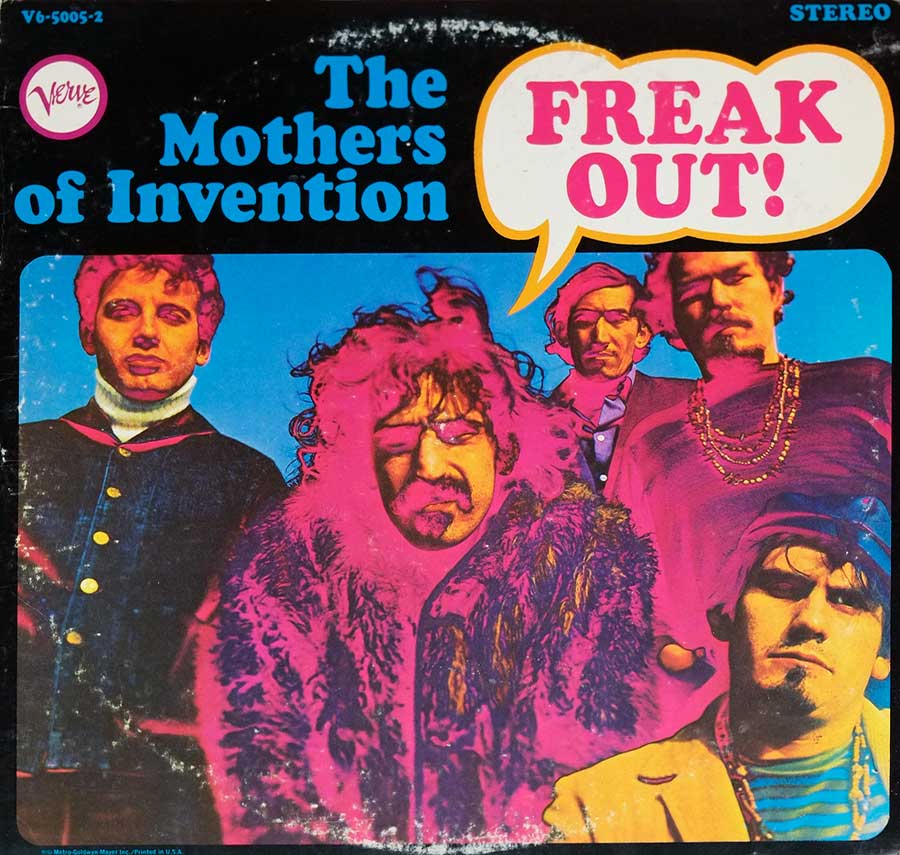
“Such young people,” continues Fiedler, “—in an attempt perhaps to make clear that they have chosen rather than merely endured their status as Freaks—speak of ‘freaking out,’ and indeed, urge others to emulate them by means of drugs, music, diet, or the excitement of gathering in crowds. ‘Join the United Mutations,’ reads the legend on the sleeve of the first album of the Mothers of Invention.”

“And such slogans suggest,” concludes Fiedler, as if to echo in advance the thesis of Mark Fisher’s Acid Communism, “that something has been happening recently in the relations between Freaks and non-Freaks, implying just such a radical alteration of consciousness as underlies the politics of black power or neo-feminism or gay liberation” (14-15).

Are willed, “chosen rather than merely endured” self-transformations of this sort Faustian?

Jarrell is one of many local poet-spirits who haunt my chosen home here in North Carolina. His translation called to me in part, I think, because he taught nearby, in the English department at UNC-Greensboro, from 1947 to 1965.

Jarrell’s life ended tragically. The poet, winner of the 1960 National Book Award for poetry, one-time “Consultant in Poetry to the Library of Congress,” was struck and killed by a motorist on October 14, 1965, while walking near dusk along US highway 15-501 near Chapel Hill. Though the death was ruled an accident by the state, many suspect Jarrell took his own life. He was laid to rest in a cemetery across the street from Greensboro’s Guilford College. A North Carolina Highway Historical Marker commemorates him nearby.

Over at the Frankenstein Place

Sadie Plant weaves the tale of her book Zeros + Ones diagonally or widdershins: a term meaning to go counter-clockwise, anti-clockwise, or lefthandwise, or to walk around an object by always keeping it on the left. Amid a dense weave of topics, one begins to sense a pattern. Ada Lovelace, “Enchantress of Numbers,” appears, disappears, reappears as a key thread among the book’s stack of chapters. Later threads feature figures like Mary Shelley and Alan Turing. Plant plants amid these chapters quotes from Ada’s diaries. Mary tells of how the story of Frankenstein arose in her mind after a night of conversation with her cottage-mates: her husband Percy and, yes, Ada’s father, Lord Byron. Turing takes up the thread a century later, referring to “Lady Lovelace” in his 1950 paper “Computing Machinery and Intelligence.” As if across time, the figures conspire as co-narrators of Plant’s Cyberfeminist genealogy of the occult origins of computing and AI.

To her story I supplement the following:

Victor Frankenstein, “student of unhallowed arts,” is the prototype for all subsequent “mad scientist” characters. He begins his career studying alchemy and occult hermeticism. Shelley lists thinkers like Paracelsus, Albertus Magnus, and Cornelius Agrippa among Victor’s influences. Victor later supplements these interests with study of “natural philosophy,” or what we now think of as modern science. In pursuit of the elixir of life, he reanimates dead body parts — but he’s horrified with the result and abandons his creation. The creature, prototype “learning machine,” longs for companionship. When Victor refuses, the creature turns against him, resulting in tragedy.

The novel is subtitled “The Modern Prometheus,” so Shelley is deliberately casting Victor, and thus all subsequent mad scientists, as inheritors of the Prometheus archetype. Yet the archetype is already dense with other predecessors, including Goethe’s Faust and the Satan character from Milton’s Paradise Lost. Milton’s poem is among the books that compose the creature’s “training data.”

Although she doesn’t reference it directly in Frankenstein, we can assume Shelley’s awareness of the Faust narrative, whether through Christopher Marlowe’s classic work of Elizabethan drama Doctor Faustus or through Goethe’s Faust, part one of which had been published ten years prior to the first edition of Frankenstein. Faust is the Renaissance proto-scientist, the magician who sells his soul to the devil through the demon Mephistopheles.

Both Faust and Victor are portrayed as “necromancers,” using magic to interact with the dead.

Ghost/necromancy themes persist throughout the development of AI, especially in subsequent literary imaginings like William Gibson’s Neuromancer. Pull at the thread and one realizes it runs through the entire history of Western science, culminating in the development of entities like GPT.

Scientists who create weapons, or whose technological creations have unintended negative consequences, or who use their knowledge/power for selfish ends, are commonly portrayed as historical expressions or manifestations of this archetype. One could gather into one’s weave figures like Jack Parsons, J. Robert Oppenheimer, John von Neumann, John Dee.

When I teach this material in my course, the archetype is read from a decolonizing perspective as the Western scientist in service of European (and then afterwards American) imperialism.

Rocky Horror queers all of this — or rather, reveals what was queer in it all along. Most of all, it reminds us: the story, like all such stories, once received, is ours to retell, and we needn’t tell it straight. Turing points the way: rather than abandon the Creature, as did Victor, approach it as one would a “child-machine” and raise it well. Co-learn in dialogue with kin.

Ghostly Desire

I hope to sit at a wheel and spin, “throw,” practice the art of pottery. One can take classes in town. It’s as simple as enrolling in a beginner’s workshop, as has a friend. Otherwise I read M.C. Richards’s thoughts on pottery as a craft, her descriptions of her work as a potter in her book Centering, and I think Ghost (1990), a romance starring Patrick Swayze and Demi Moore. Swayze’s ghost and his former lover achieve erotic paranormal union round a wheel, hands wet with clay. ‘Tis the most memorable scene in “one of the most memorable romantic films ever,” “winner of two Academy Awards,” etc. I was maybe 12 years old when I first encountered the scene — and already at 12, I was a sucker for ghostly romances. (Hence another of the films I liked in those years: The Heavenly Kid.) Those are what came first to my adolescent consciousness. Audio-visual tone poems visited upon me in my youth. From them I came to know desire as a longing across distance. “A passion of the lonely soul,” as a character says in Arthur Machen’s story “The White People.” A thing one suffers as a ghost. Years later I would hear the cost of this in “Catholic Block,” and in the mmms and bells of Russell Atkins’s “Night and a Distant Church.” Can I trust myself to let go and have fun? “When a body is filled with stresses, the nervous system is so busy handling them that its potential for attaining higher states of consciousness is very limited,” writes Itzhak Bentov in Stalking the Wild Pendulum: On the Mechanics of Consciousness. Through meditation, however, we can self-stimulate pleasure centers and calm our way toward joy.

Intermezzo

Others of us puzzle through, knowing sometimes rest is needed. The work is to rest — heat up some pasta, assemble a salad, read Matthew Ingram’s Retreat: How the Counterculture Invented Wellness, feel the heaviness of it weighing in the palm of one’s hand like a sentence, retreat from it into episodes of Adventure Time. Orange Juice sing “Rip it up and start again.” By that, they mean the past. I’m reminded of a line from Pharmako-AI where the book’s AI writes, “The past is mutable, and it can be remade in our image as we desire” (26). At which point I hear poet Joy Harjo adding, “At some point we have to understand that we do not need to carry a story that is unbearable. We can observe the story, which is mental; feel the story, which is physical; let the story go, which is emotional; then forgive the story, which is spiritual, after which we use the materials of it to build a house of knowledge” (Poet Warrior, p. 20). John Cale’s “Paris 1919” serenades me to where I think the implications of this are leading me. “You’re a ghost, la-la-la-la-la-la-la,” sings Cale. And reader, I feel it. This ghosting. It takes the royal promise of Adventure Time’s “Island Song (Come Along With Me)” to cheer me. Loneliness is hard.

Retrocausation

The hyperstition I’ve imagined draws upon the process of “retrocausation.”

Like a descendent reaching back and saving an ancestor, as in Octavia E. Butler’s novel Kindred, the fiction I’m writing arrives from the future to affect-effect the past.

At the center of the story are the journals trance-scribed at the height of my high in years prior. “Words came to me as if whispered to me by a me of the future,” mutters the Narrator. “I was so attentive in those days. And I encountered near-zero need to edit or cross out. The pages of the journals are pristine.”

Science writer Eric Wargo explores the topic of retrocausation in his 2018 book Time Loops: Precognition, Retrocausation, and the Unconscious. To know more, one must be like Batman descending to his Batcave. Let us to our memory palace go, there to converse with Wargo.

Narrative Recap

Therapy allows for reflection, narrative recaps fitted to the hour of the therapeutic session. “What story do you wish to tell?” asks the Therapist. “A utopian one!” I attest, eyes gleaming. “A romance!” Afterwards, though, I sit around perplexed. “Why, then,” I ask myself in exasperation, “did I write it last summer as if it were a ghost story?” Here I am, now — ghosted. Why have I written a story that interpellates me as a bloody mother fucking asshole and former inhabitant of a haunted house? What was I thinking? Why were those the genres and tropes to which I was drawn? How instead might I proceed with my tale?

Interrupted Forms

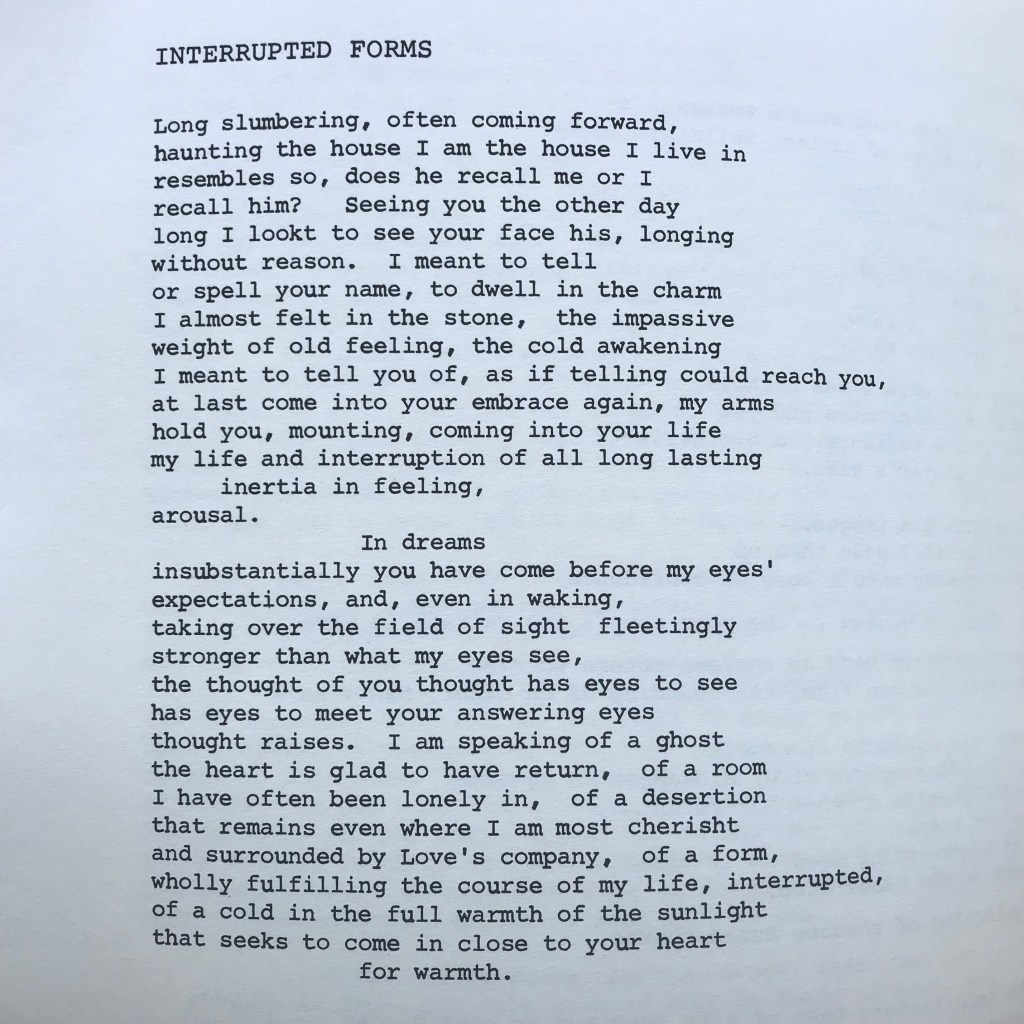
Devin’s essay “The Needs of Ghosts” turns upon “Interrupted Forms,” a poem by Robert Duncan, included at the start of the latter’s Poems from the Margins of Thom Gunn’s “Moly.”

Given its dedication to one who is both there and not there, ‘tis a poem that is both desirous and recollective simultaneously.

Into the situation of Duncan’s poem, I project this character of mine, the Gay Wizard — the ghost who haunts “The House on Shady Blvd.”

Of him, or of a ghost of similar make, Duncan writes as follows:

Long slumbering, often coming forward,

haunting the house I am the house I live in

resembles so, does he recall me or I

recall him?

Wanting today to alter the condition set upon me by the ghosting of me by others, I sing the poem to those I love. I sing it to you, dear reader, “as if telling could reach you,” hoping against hope you have ears to hear.