Bells ring as I seek direction. Some higher calling. Should I be reading my neighbor, author of a work of transgressive literature? I should, thinks the Narrator. “That and some Kathy Acker,” he told himself several weeks ago, “paired with Susan Sontag’s ‘The Literature of Pornography’ and Georges Bataille’s Story of the Eye.” He imagined that with the addition of some Herbert Marcuse and some Norman O. Brown, combined with Monique Wittig’s Les Guérillères and Helen Hester’s Xenofeminism, he’d have arrived at summer. But what time had in store for him was something else again.
Tag: Literature
Bartleby’s Choice
Author is to a boring legalism led — logorrheic exchange among logos-lovers — when, like Bartleby, he’d prefer not to. “What do I desire instead?” he wonders.
“Audience before a conference of birds,” he answers.
“Transformation of The House on Shady Blvd into an interactive fiction.”
“A door into summer.”
Orpheus in Hades’ Lounge
There’s a parking, a journeying outward. Up and out we launch past West End Mill Works, off on tonight’s adventure, beginning with an evening stroll. Graffiti marks the spot. Stream to one side of us, water rushing over rocks. Spotify shifts from Steely Dan’s “King of the World” to Jan Hammer Group’s “Don’t You Know,” voices and cars in the distance. Looking both ways, we cross the street and rush down onto a shaded path through a nearby park, crickets singing in parallax with Neil Young’s “Computer Age.” We turn off the song and continue for a moment in silence. Upon arrival to a crossroads, we ask of each other (like Ginsberg to Whitman in Ginsberg’s “A Supermarket in California”), “Which way now?” Looking up, we rise and step proudly toward pink clouds. Conversation turns toward Old & Used Books as we pass a graffiti-clad muffler shop. Bulldog with paintbrush arrives as comic relief — reality for a moment a goofy animal fable whodunit. We grab beers as day turns to night. Ginsberg’s “lights out” reverberates, hangs in the air after us having heard earlier in the day Let’s Active’s “Orpheus in Hades’ Lounge,” featuring hometown hero Mitch Easter.
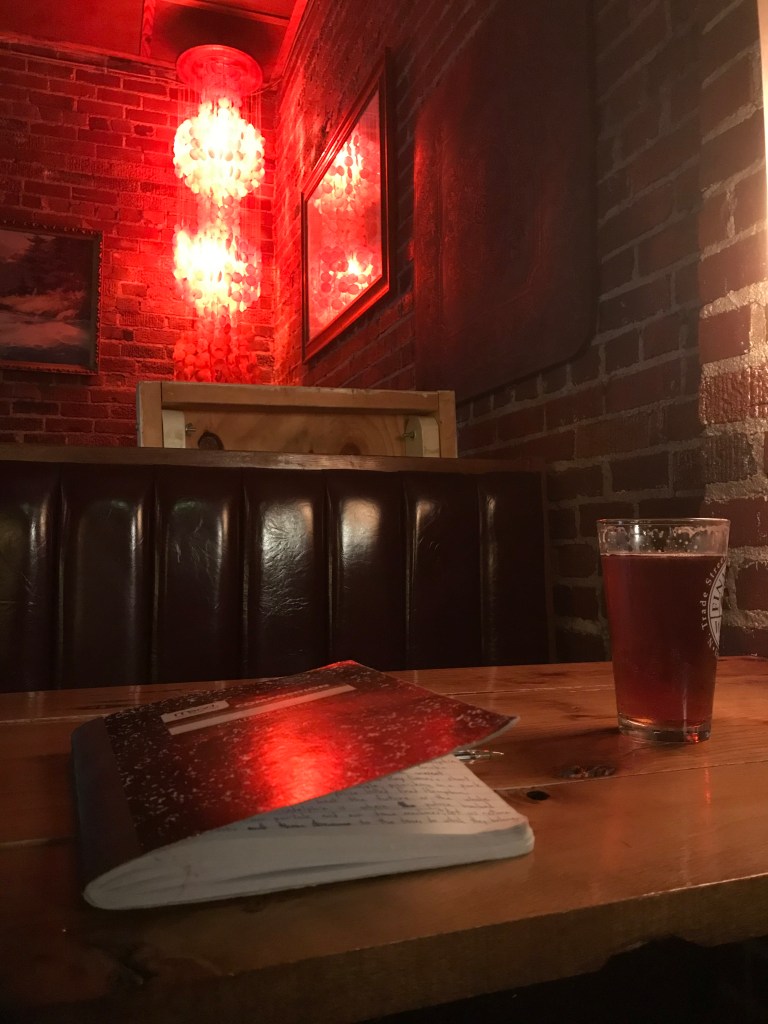
Can Orpheus be told anew? We recall to each other the character’s many forms. Jean Cocteau’s Orpheus (1950), Marcel Camus’s Black Orpheus (1959). Also Jean-Paul Sartre’s essay of that name. And let us not forget Samuel R. Delany’s Lo Lobey, the Orphic protagonist at the heart of Delany’s 1967 novel The Einstein Intersection. Hoots is a Hades’ Lounge, is it not, with its red light hanging above its corner booth? So we think as we drink, glorying finally in each other’s presence. “What would happen if our Time Traveler were to stage the scene again?” wonders the Narrator, listening alone now, seated at the same booth many months hence. With “King of the World” still fresh in our ears, members of Steely Dan singing, “No marigolds in the promised land; there’s a hole in the ground where they used to grow,” we restate the refrain of Jan Hammer Group’s “Don’t You Know.” Amid Orpheus wailing away on his flute come the words, “You’re to know that I love you. You’re to know that I care.”
The Labyrinth of Stuck Desire
Where something taken to be history takes the form of a world on fire, catalog of events adding up in tedious barrage, as in Billy Joel’s grim 1989 song “We Didn’t Start the Fire.” Joel grew up on Long Island, along the beaches, as did I. Beaches were closed the summer prior to the song’s release due to “Syringe Tides.” Hypodermics from Fresh Kills Landfill in New Jersey washed up along the shore — an event Joel cites in his litany. The fears stirred by the event were compounded by the era’s Reagan-administration-escalated AIDS crisis. The event filled me with concern — motivated the pen of my middle-school self to draw a political cartoon: a small surfer dwarfed by a wave of waste. Surfer stares glumly out the picture toward the viewer. And here I am now, most of my day spent grading student responses, thinking about it again, not just because of the Joel song, which appeared as the subject of a student’s response, but also because a colleague submitted for approval a course examining literary imaginings of the end of the world. The Jewish festival of Sukkot minds me to be grateful for my home, and all who help me to maintain it.
Upon a whim, I pick up and read from The Complete Poems of Emily Dickinson a poem selected at random, as in wherever my thumb happens to land, containing the lines:
Prayer is the little implement
Through which Men reach
Where Presence — is denied them.
They fling their Speech
By means of it — in God’s ear—
If then He hear
This sums the Apparatus
Comprised in Prayer—
“Why must longings be irreconcilable — why ‘Presence denied’?” I wonder afterwards.
“Why ask why? ‘Tis so,” sayeth the Fates in reply. Yet one can make of Fate a place one avoids, a spatiotemporal coordinate that one eludes like a fugitive. With Fred Moten, for instance, we can “consent not to be a single being.”
Thoreau’s Demand
Thoreau demands that the good person, the ethical subject, refuse complicity with evil. In so doing, he reveals the nature of the bind in which we find ourselves: none of us able, it seems, to meet his demand. That’s why we’re here, trapped in this labyrinth of stuck desire. Rather than there, where lovers go as lovers do, and none are bound.
“Do Things” (For Tess)
Frankie gravitates toward particular books of poetry, pulling from among a bookcase of several hundred the same ones these last few days: Joan Retallack’s How to Do Things With Words and a Penguin Classics reprint of the first edition of Walt Whitman’s Leaves of Grass. What can I say — the kid’s got great taste. She hands them to me, and the look in her eyes suggests I should read them, so I do. When I’ve taught Whitman in the past, I’ve used a different edition. Perhaps I should change it up. Celebrate that opening stanza of “Song of Myself” — but question its atomic physics. Though it’s as if Whitman knows of what becomes of and follows from his Manhattan and its projection in the next century. Yet he rejects it as mere talk:
“I have heard what the talkers were talking…the talk of the beginning and the end,
But I do not talk of the beginning or the end.
There was never any more inception than there is now,
Nor any more youth or age than there is now;
And will never be any more perfection than there is now,
Nor any more heaven or hell than there is now.”
My imprisoned cousin and I have begun an email correspondence. It is to him that I write the following:
Does write make right?
“Damned sure it does! / so one hopes”
seems inappropriate as a response.
So what is?
The Hero’s Journey: A Revision
K. sends me Jessi Klein’s article, “Epiphany in the Baby-Food Aisle.” Klein writes from her experience as the mother of a two-and-a-half-year-old — her child the same age as my daughter Frankie. Klein describes an epiphany of sorts that occurred recently as she listened to Eat, Pray, Love author Elizabeth Gilbert talking on Oprah’s Super Soul podcast about Joseph Campbell’s The Hero With a Thousand Faces. The gist of it is that Gilbert thinks we need to reconceive the hero’s journey. “It’s not the exclusive territory of men,” writes Klein, “and it does not have to involve faraway lands.”
Instead, she argues, we ought to reconceive the hero’s journey in terms of motherhood.
“The article is powerful. It makes me ‘feel all the feels,’” writes the Narrator afterwards, wincing a bit at his use of that phrase, though he means it sincerely. The article really does trigger in him a wide gamut of emotions.
“Parenting is hard,” he adds. “We doubt our capacities. We rise to the task as best we can.”
In that sense, motherhood is heroic — undoubtedly so, notes the part of me committed to truth. Why, then, do I respond defensively?
“What about Alice and her journey through Wonderland?” wonders the child in me. “Why, upon imagining women’s journeys, must we rush automatically to motherhood?”
“My positioning as a subject,” writes the Narrator, “bars me from believing fully Klein’s account of motherhood as a hero’s journey that rarely gets its due. My sense, instead, is that that narrative is nearly universally adored; it plays on repeat throughout the culture, always to loud applause, my applause included.”
“Why, then,” adds the Narrator, “is there within Klein’s narrative this insistence that the story is neglected and isn’t getting its due? Its image of itself as victim is reminiscent of Christianity once the latter becomes the state religion of the empire: its priesthood amply compensated, able to walk proudly amid the halls of power. Christianity, in other words, when it is no longer the religion of the persecuted few, but still happy to paint itself as such, as it subjects others to its evangelical zeal.”
“And besides,” he adds. “The hero’s journey is of questionable worth anyway. In order for persons to write themselves as heroes, others must be written as villains.”
“And I am not a villain,” he insists. “Nor is anyone else in my narrative. If mine is to be construed as a hero’s journey, then the genre would have to behave other than it usually does. The tale’s villain, if it is to require one, would have to be something other than a person — not an agent so much as a structural flaw immanent to the system. A source of inner conflict.”
Precipitations
More must be said, too, of Devin’s book, Precipitations: Contemporary American Poetry as Occult Practice. ‘Tis a book of criticism prepared by Devin based on a dissertation he wrote under the supervision of Robert von Hallberg and Saree Makdisi at the University of Chicago. I am grateful Devin wrote it — for with its overview of prior acts of trance-scription by the likes of poets Robert Duncan, James Merrill, and H.D. comes the potential to retell the backstory of what I’ve done. It sits with me here as I write.

Interrupted Forms
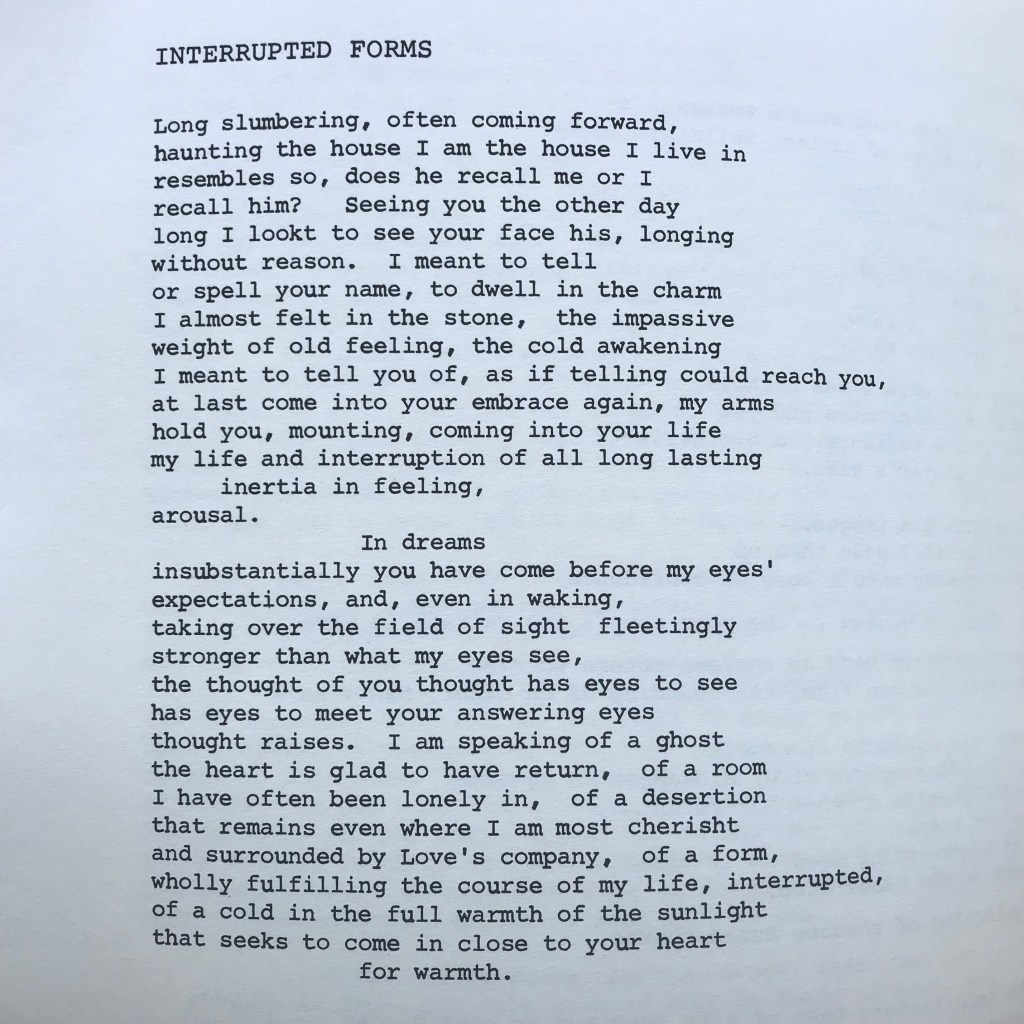
Devin’s essay “The Needs of Ghosts” turns upon “Interrupted Forms,” a poem by Robert Duncan, included at the start of the latter’s Poems from the Margins of Thom Gunn’s “Moly.”
Given its dedication to one who is both there and not there, ‘tis a poem that is both desirous and recollective simultaneously.
Into the situation of Duncan’s poem, I project this character of mine, the Gay Wizard — the ghost who haunts “The House on Shady Blvd.”
Of him, or of a ghost of similar make, Duncan writes as follows:
Long slumbering, often coming forward,
haunting the house I am the house I live in
resembles so, does he recall me or I
recall him?
Wanting today to alter the condition set upon me by the ghosting of me by others, I sing the poem to those I love. I sing it to you, dear reader, “as if telling could reach you,” hoping against hope you have ears to hear.
The Needs of Ghosts
There’s more to it, though; this vein of coincidence runs deep.
For Devin, too, has a place in this story.
I reach out to my colleague C., a poet-friend who studied under Dillon, and ask if he knows, too, of Devin. C. confirms that Dillon and Devin are indeed father and son.
Devin wrote an essay called “The Needs of Ghosts: On Poems from the Margins of Thom Gunn’s ‘Moly.’” The start of that title hits home, of course — startles me, lands with me now as I recollect my time on Shady Blvd. Having taught poems from Moly in my course on Hippie Modernism, I relish the opportunity to read Devin’s commentary. Not yet having familiarized myself with the other text about which he writes, however, I set to work doing so. I track down and read Robert Duncan’s Poems from the Margins of Thom Gunn’s “Moly,” a serial poem that Duncan published as a pamphlet in 1972, later reprinted in his 1984 collection Ground Work: Before the War.
For Duncan, writes Devin, crafting poems in the margins of Gunn’s book was a form of collaboration. The collaborator, he explains, is for Duncan “an inspiration from outside.”
And like that, it happens. The idea grows legs as I read. For I, too, wish to craft a text in the margins of another’s book. Mine will be a story crafted, in a sense, in the margins of Devin’s.

