Magic as Paralogical Retort

Early on in the semester ahead, we’ll need to discuss magic, positing the latter as a paralogical retort to the patriarchal Royal Society and its imperial science. Also a coping strategy, a response to lives disrupted by war, authors displaced and dispossessed, as in the case of Cavendish. Magic is a way of knowing and doing that persists and evolves alongside the New Science, refusing and contesting the latter’s bid for supremacy. Tolkien takes up much the same cause in his poem “Mythopoeia,” written following a discussion with C.S. Lewis and Hugo Dyson. In the course of this famed discussion, Lewis is said to have denounced myths, describing the latter as “lies breathed through silver.” Tolkien’s poem replies in character, its words spoken by “Philomythos” (or “myth-lover”) to Lewis’s “Misomythos” (or “myth-hater”). Tolkien composed the poem in heroic couplets, the preferred meter of British Enlightenment poets, so as to critique the latter on its own turf.

The Politics of Fantasy

Fantasy is dangerous. The genre has its share of royalists, reactionaries, and racists. Tolkien and Lewis, who taught together at Oxford, were devout Catholics. Writers of the Left sometimes dismiss the genre as ideologically suspect, preferring science fiction in its stead. But no such distinction holds. Science fiction writers of the Left have written works of fantasy, and rightwing fantasists like C.S. Lewis wrote works of science fiction, like the latter’s WWII-era Space Trilogy: Out of the Silent Planet (1938), Perelandra (1943), and That Hideous Strength (1945). Each genre remains anyone’s game.

Uncle Matt’s New Adventure

“What about Oculus?” wonders the Narrator. “My nephews acquired an Oculus as a ‘family gift’ from Santa this past Christmas,” he explains. VR is here: available for those who can afford it. Off-worlding, world building: that’s what rich people do, rapturing themselves away like rocket scientists. “‘When in Rome…,’” mutters the Narrator, with scare quotes and a shrug.

“I could smoke weed and try it, setting out as Uncle Matt on a new adventure. A portal fantasy inspired by Fraggle Rock.”

Indeed, he could, notes the Author — but does he?

‘Tis a story as much about perception’s limits as about its doors. Writing is the site where an ongoing bodying forth occurs: where forms and objects arrive into the realms of the audible and the visible.

Let imagination have a crack at it, thinks the Narrator. Let us immerse ourselves in fantasies. Let us adopt together the practice of reading works of fantastic literature and watching works of fantastic cinema.

Our approach will be by way of “portal fantasies”: works that involve acts of portage, passage, portation, as through a door or gate connecting previously distinct worlds. The OED defines a portal as “A door, gate, doorway or gateway, of stately or elaborate construction.” The term enters English by way of French and Latin with the Pearl Poet’s use of it in the late-fourteenth century. Henry Lovelich uses it soon thereafter in a Middle-English metrical version of a French romance about the Arthurian wizard Merlin. And Milton uses the term in a remarkable passage in Paradise Lost:

Op’n, ye everlasting Gates, they sung,

Op’n, ye Heav’ns, your living dores; let in

The great Creator from his work returnd

Magnificent, his Six Days work, a World;

Op’n, and henceforth oft; for God will deigne

To visit oft the dwellings of just Men

Delighted, and with frequent intercourse

Thither will send his winged Messengers

On errands of supernal Grace. So sung

The glorious Train ascending: He through Heav’n,

That op’nd wide her blazing Portals, led

To Gods Eternal house direct the way,

A broad and ample rode, whose dust is Gold

And pavement Starrs, as Starrs to thee appear,

Seen in the Galaxie, that Milkie way

Which nightly as a circling Zone thou seest

Pouderd with Starrs.

Note how Heaven’s gates are “blazing,” as is the world in the first of our readings this semester, Margaret Cavendish’s The Blazing World. Cavendish and Milton were contemporaries. Cavendish published The Description of a New World, Called The Blazing World in 1666. Paradise Lost appeared one year later.

The Fabian Contingent

Why does Wells propel his Time Traveler into as distant and bleak a future as the one imagined in The Time Machine? It’s the future as pictured from the standpoint and subject-position of the Traveler himself as he recounts his journey for others. Wells, meanwhile, imagined other futures elsewhere and elsewhen, as during his later years, following his split with the Fabian Society. His political ideal of those later years was the “World State”: a single global technocratic “world commonwealth,” governed by a scientific elite. In his twenties, however, Wells may have interacted for a time with a secret society of a different sort: the Hermetic Order of the Golden Dawn. His run-in with the Order is thought to have occurred in London in 1894, the year prior to the publication of The Time Machine, Wells’s first great success as a novelist. Ithell Colquhoun mentions this run-in in her book Sword of Wisdom: MacGregor Mathers and the Golden Dawn — or at the very least speculates about a “Fabian contingent” within a Golden Dawn splinter group called the Order of the Stella Matutina or “Morning Star.” Colquhoun describes Wells’s 1911 short story “The Door in the Wall” as “in the line of GD tradition” (192). I find myself reading again descriptions of Golden Dawn initiation rituals, like the following from Chic Cicero and Sandra Tabitha Cicero’s Self-Initiation into the Golden Dawn Tradition:

“The goal of initiation is to bring about the illumination of the human soul by the Inner and Divine Light. A true ‘initiate’ is an individual whose Higher Self (or Higher Genius) has merged with the Lower Personality and actually incarnated into the physical body. The Personality is left in charge of the day-to-day routines of living and working, but the Higher Genius is free to look out at the world through the eyes of the initiate. Through this experience, the individual is given a permanent extension of consciousness which is impossible to mistake. Many times a student of the mysteries is drawn to a particular mystical current without knowing it. A series of ‘coincidences’ and synchronicities will often direct (or sometimes shove) a person toward that current through books or through meeting other people who also have a connection with the current. During this time, the student’s psychic faculties are still relatively undeveloped, yet the inner spark has been ignited. However, a full initiation, or dawning of the Inner Light, is evident when the entire aura is illuminated.”

Of course, one can be a solitary magician. One can tap into the Golden Dawn’s magic, as Wells did, without having to become a member of any particular group or organization. But according to Cicero and Cicero, the solitary magician is at a disadvantage, “not having a group of temple-mates to consult if problems arise” (xxvi).

The Language of Favors is Yours, Not Mine

I okay “Thanks,”

but is okaying it now

enough?

Should I regret not

saying thanks

when, upon your mistreatment of me,

I took leave of you,

As one might regret not

upgrading oneself 

to a seat in Economy Plus?

Or does regret

just breed regret?

Upon my asking this

of my remorse

I release it,

with intent to do better next time.

“The basic law of magic,”

says The Illuminatus Trilogy,

is “As ye give, so shall ye get.”

You didn’t give,

I thought,

So why should I?

Instead you told others

my addressing myself 

to another you

disgusts you

and others like you.

To get off that wheel

And make thanks okay

one would have to

give as one would

an offering of peace.

The Course Ahead

Bells ring as I seek direction. Some higher calling. Should I be reading my neighbor, author of a work of transgressive literature? I should, thinks the Narrator. “That and some Kathy Acker,” he told himself several weeks ago, “paired with Susan Sontag’s ‘The Literature of Pornography’ and Georges Bataille’s Story of the Eye.” He imagined that with the addition of some Herbert Marcuse and some Norman O. Brown, combined with Monique Wittig’s Les Guérillères and Helen Hester’s Xenofeminism, he’d have arrived at summer. But what time had in store for him was something else again.

Bartleby’s Choice

Author is to a boring legalism led — logorrheic exchange among logos-lovers — when, like Bartleby, he’d prefer not to. “What do I desire instead?” he wonders.

“Audience before a conference of birds,” he answers.

“Transformation of The House on Shady Blvd into an interactive fiction.”

“A door into summer.”

Orpheus in Hades’ Lounge

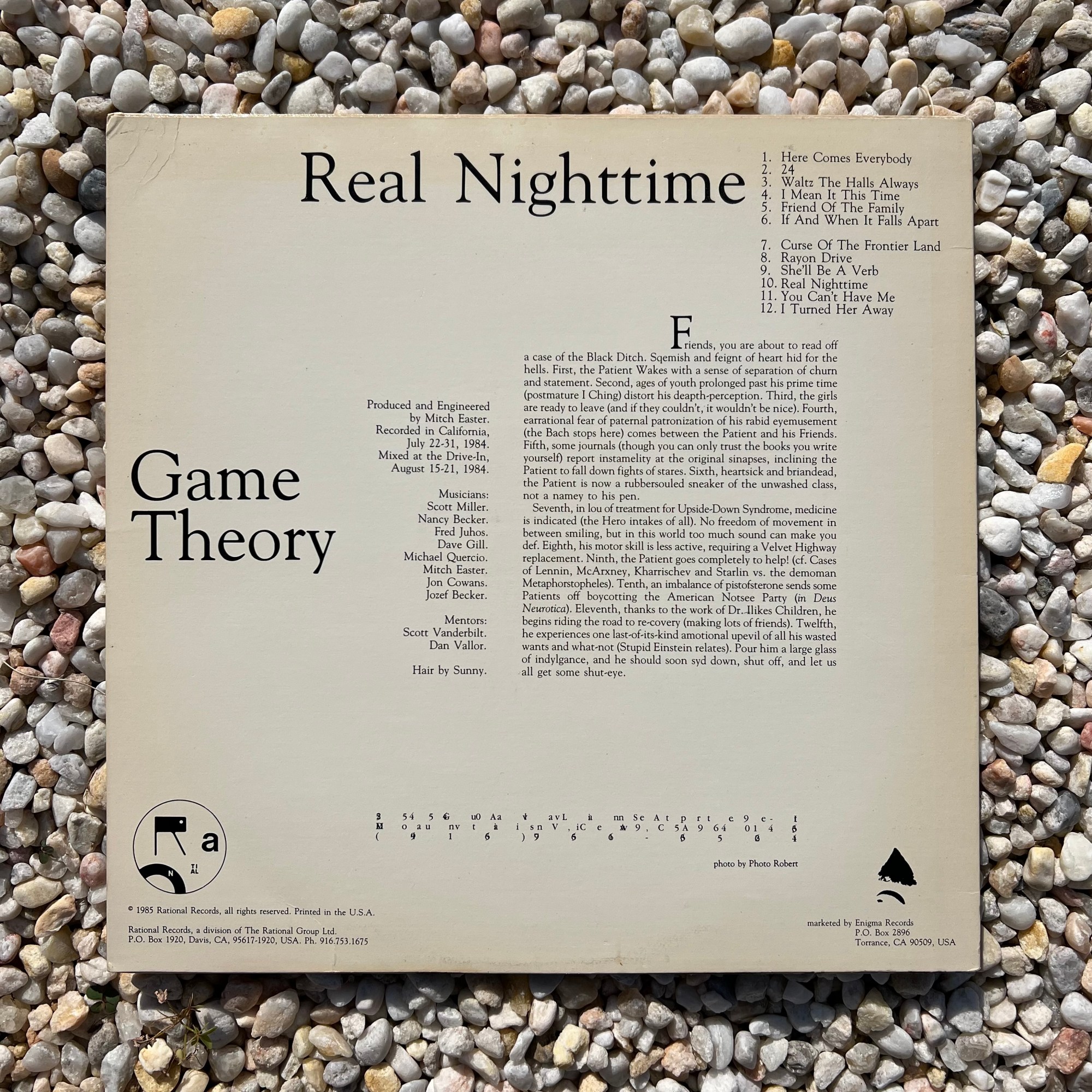
There’s a parking, a journeying outward. Up and out we launch past West End Mill Works, off on tonight’s adventure, beginning with an evening stroll. Graffiti marks the spot. Stream to one side of us, water rushing over rocks. Spotify shifts from Steely Dan’s “King of the World” to Jan Hammer Group’s “Don’t You Know,” voices and cars in the distance. Looking both ways, we cross the street and rush down onto a shaded path through a nearby park, crickets singing in parallax with Neil Young’s “Computer Age.” We turn off the song and continue for a moment in silence. Upon arrival to a crossroads, we ask of each other (like Ginsberg to Whitman in Ginsberg’s “A Supermarket in California”), “Which way now?” Looking up, we rise and step proudly toward pink clouds. Conversation turns toward Old & Used Books as we pass a graffiti-clad muffler shop. Bulldog with paintbrush arrives as comic relief — reality for a moment a goofy animal fable whodunit. We grab beers as day turns to night. Ginsberg’s “lights out” reverberates, hangs in the air after us having heard earlier in the day Let’s Active’s “Orpheus in Hades’ Lounge,” featuring hometown hero Mitch Easter.

Can Orpheus be told anew? We recall to each other the character’s many forms. Jean Cocteau’s Orpheus (1950), Marcel Camus’s Black Orpheus (1959). Also Jean-Paul Sartre’s essay of that name. And let us not forget Samuel R. Delany’s Lo Lobey, the Orphic protagonist at the heart of Delany’s 1967 novel The Einstein Intersection. Hoots is a Hades’ Lounge, is it not, with its red light hanging above its corner booth? So we think as we drink, glorying finally in each other’s presence. “What would happen if our Time Traveler were to stage the scene again?” wonders the Narrator, listening alone now, seated at the same booth many months hence. With “King of the World” still fresh in our ears, members of Steely Dan singing, “No marigolds in the promised land; there’s a hole in the ground where they used to grow,” we restate the refrain of Jan Hammer Group’s “Don’t You Know.” Amid Orpheus wailing away on his flute come the words, “You’re to know that I love you. You’re to know that I care.”

The Labyrinth of Stuck Desire

Where something taken to be history takes the form of a world on fire, catalog of events adding up in tedious barrage, as in Billy Joel’s grim 1989 song “We Didn’t Start the Fire.” Joel grew up on Long Island, along the beaches, as did I. Beaches were closed the summer prior to the song’s release due to “Syringe Tides.” Hypodermics from Fresh Kills Landfill in New Jersey washed up along the shore — an event Joel cites in his litany. The fears stirred by the event were compounded by the era’s Reagan-administration-escalated AIDS crisis. The event filled me with concern — motivated the pen of my middle-school self to draw a political cartoon: a small surfer dwarfed by a wave of waste. Surfer stares glumly out the picture toward the viewer. And here I am now, most of my day spent grading student responses, thinking about it again, not just because of the Joel song, which appeared as the subject of a student’s response, but also because a colleague submitted for approval a course examining literary imaginings of the end of the world. The Jewish festival of Sukkot minds me to be grateful for my home, and all who help me to maintain it.

Upon a whim, I pick up and read from The Complete Poems of Emily Dickinson a poem selected at random, as in wherever my thumb happens to land, containing the lines:

Prayer is the little implement

Through which Men reach

Where Presence — is denied them.

They fling their Speech

By means of it — in God’s ear—

If then He hear

This sums the Apparatus

Comprised in Prayer—

“Why must longings be irreconcilable — why ‘Presence denied’?” I wonder afterwards.

“Why ask why? ‘Tis so,” sayeth the Fates in reply. Yet one can make of Fate a place one avoids, a spatiotemporal coordinate that one eludes like a fugitive. With Fred Moten, for instance, we can “consent not to be a single being.”