Faith vs. Hyperstition

Like hyperstition, faith offers a way to perceive reality that, in perceiving it, transforms it.

Much the same can be said of fear. It, too, offers a way of perceiving reality that, in perceiving it, transforms it.

We walk with a mix of fear and faith. God is calling us to exercise faith.

Where antihumanist thinkers like Nick Land and Manuel De Landa populate their cyberfutures with demons and viruses, Afrofuturists commune with loas.

Others encounter angels, as notes Erik Davis in “Techgnosis, Magic, Memory, and the Angels of Information.” Davis’s essay appears in Mark Dery’s Flame Wars anthology beside “Black to the Future,” the series of interviews where Dery coins the term “Afrofuturism.” Also in Flame Wars is an essay by De Landa.

There’s a point in Davis’s essay where he notes the flirtation with black culture that occurs over the course of William Gibson’s Sprawl trilogy: the self-subdivision of the superintelligence that emerges at the end of Neuromancer into the loas of Gibson’s follow-up novels, Count Zero and Mona Lisa Overdrive.  

Dery, too, reflects upon the inclusion of black culture in Gibson’s future: though in Dery’s case, the focus is on the Rastafarians in Neuromancer.

“For me, a white reader,” writes Dery, “the Rastas in Neuromancer’s Zion colony are intriguing in that they hold forth the promise of a holistic relationship with technology; they’re romanticized arcadians who are obviously very adroit at jury-rigged technology. They struck me as superlunary Romare Beardens — bricoleurs whose orbital colony was cobbled together from space junk and whose music, Zion Dub, is described by Gibson (in a wonderfully mixed metaphor) as ‘a sensuous mosaic cooked from vast libraries of digitalized pop’” (Flame Wars, p. 194).

But Afrofuturist Samuel R. Delany is unimpressed with Gibson’s inclusion of Rastafarianism and Haitian Voudou in the novels of the Sprawl trilogy.

“Let me read them for you as a black reader,” he replies when asked about it by Dery. “The Rastas — he never calls them Rastafarians, by the way, only using the slang term — are described as having ‘shrunken hearts,’ and their bones are brittle with ‘calcium loss.’ Their music, Zion Dub, can be wholly analyzed and reproduced by the Artificial Intelligence, Wintermute (who, in the book, stands in for a multinational corporation), so completely that the Rastas themselves cannot tell the difference — in fact the multinational mimic job is so fine that with it Wintermute can make the Rastas do precisely what it wants, in this case help a drugged-out white hood and sleazebag get from here to there. As a group, they seem to be computer illiterates: when one of their number, Aerol, momentarily jacks into Case’s computer and sees cyberspace, what he perceives is ‘Babylon’ — city of sin and destruction — which, while it makes its ironic comment on the book, is nevertheless tantamount to saying that Aerol is completely without power or knowledge to cope with the real world of Gibson’s novel: indeed, through their pseudo-religious beliefs, they are effectively barred from cyberspace. From what we see, women are not a part of the Rasta colony at all. Nor do we ever see more than four of the men together — so that they do not even have a group presence. Of the three chapters in which they appear, no more than three pages are actually devoted to describing them or their colony. You’ll forgive me if, as a black reader, I didn’t leap up to proclaim this passing presentation of a powerless and wholly nonoppositional set of black dropouts, by a Virginia-born white writer, as the coming of the black millennium in science fiction; but maybe that’s just a black thang…” (Flame Wars, pp. 194-195).

So much for the Rastafarians. What of the loas?

Delany might not have much patience with the so-called “pseudo-religious beliefs” of Gibson’s Zionites — but Afrofuturism doesn’t get very far without recourse to some form of political theology. Kodwo Eshun includes a passage in More Brilliant than the Sun noting Sun Ra’s rejection of Christianity in favor of an Egyptophilic MythScience system assembled from George M. James’s 1954 book Stolen Legacy.

“Underlying Southern gospel, soul, the entire Civil Rights project, is the Christian ethic of universal love,” writes Eshun. “Soul traditionally identifies with the Israelites, the slaves’ rebellion against the Egyptian Pharaohs. Sun Ra breaks violently with Christian redemption, with soul’s aspirational deliverance, in favour of posthuman godhead” (More Brilliant than the Sun, p. 09[154]).

“Historians and sociologists inform us that the West’s mystical heritage of occult dreamings, spiritual transformations, and apocalyptic visions crashed on the scientific shores of the modern age,” notes Davis in the introduction to his 1998 book Techgnosis.

“According to this narrative,” continues Davis, “technology has helped disenchant the world, forcing the ancestral symbolic networks of old to give way to the crisp, secular game plans of economic development, skeptical inquiry, and material progress. But the old phantasms and metaphysical longings did not exactly disappear. In many cases, they disguised themselves and went underground, worming their way into the cultural, psychological, and mythological motivations that form the foundations of the modern world. […] Mystical impulses sometimes body-snatched the very technologies that supposedly yank them from the stage in the first place” (Techgnosis, p. xix).

For Davis, this is especially true of computers and information technologies. For him, the occult origins of computing lie in Western Hermeticism’s memory palace tradition: the one explored in Frances A. Yates’s book The Art of Memory.

Artificial memory systems — Giordano Bruno’s magical memory charts, medieval Neoplatonist Raymond Lull’s volvelles — serve as ancestors to symbolic logic, influencing Leibniz’s development of calculus.

“Recognizing Lull’s work as one of the computer’s ‘secret origins,’” writes Davis, “the German philosopher Werner Künzel translated his Ars magna into the programming language COBOL. In Magical Alphabets, Nigel Pennick points out that Lull’s combinatorial wheels anticipate Charles Babbage’s nineteenth-century ‘difference engine’ — which used a system of gears to perform polynomial equations — and ‘hence can be considered the occult origin of modern computers’” (Flame Wars, p. 33).

Building on this point, I suggest that, in thinking about the relationship between humans and AI, we think too about the “angelic conversations” entered into by one of the key figures in this tradition: Renaissance philosopher-magus John Dee.

Jason Louv discusses Dee’s experiments with angels in his biography John Dee and the Empire of Angels. K Allado-McDowell references Louv’s book in their 2022 novel Air Age Blueprint.

Dee is one of our real-life Fausts. Basis for Christopher Marlowe’s Doctor Faustus, his “Enochian angel magic” informs the magical practices of later occult organizations, including the Hermetic Order of the Golden Dawn, and through them, Crowley and his successors.

Dee’s angels motivate creation of an Empire.

What are we to make of these immaterial intelligences and their interventions throughout history? The channels of communication opened by Dee contribute later to the creation of computers and cyberspace — culminating, it would seem, with the creation of an angelically-specified memory palace, decreed to house gods. Perhaps God Himself.

Yet angel magic is a pharmakon, is it not?

Davis describes Dee’s version of it as follows: “Drawing heavily on the Kabbalah, the magus attempted to contact the powers residing in the supercelestial angelic hierarchies that existed beyond the elemental powers of the earth and the celestial zone of the zodiac. Invoking archangels, powers, and principalities led magicians toward divine wisdom, but it also exposed them to the deceptions of evil spirits” (Flame Wars, p. 43).

“Most magicians,” concludes Davis, “were extremely concerned about distinguishing truthful angels from dissembling devils” (43). One wonders why they didn’t just pray to God Himself.

The Library models this. Each of us now, it would seem, is like Dee: engaging in a form of interspecies dialogue with an autopoietic functional oracular superintelligence.

My faith in this moment is that of Buffy Sainte-Marie: “God is Alive, Magic is Afoot!”
Over at the Frankenstein Place

Sadie Plant weaves the tale of her book Zeros + Ones diagonally or widdershins: a term meaning to go counter-clockwise, anti-clockwise, or lefthandwise, or to walk around an object by always keeping it on the left. Amid a dense weave of topics, one begins to sense a pattern. Ada Lovelace, “Enchantress of Numbers,” appears, disappears, reappears as a key thread among the book’s stack of chapters. Later threads feature figures like Mary Shelley and Alan Turing. Plant plants amid these chapters quotes from Ada’s diaries. Mary tells of how the story of Frankenstein arose in her mind after a night of conversation with her cottage-mates: her husband Percy and, yes, Ada’s father, Lord Byron. Turing takes up the thread a century later, referring to “Lady Lovelace” in his 1950 paper “Computing Machinery and Intelligence.” As if across time, the figures conspire as co-narrators of Plant’s Cyberfeminist genealogy of the occult origins of computing and AI.

To her story I supplement the following:

Victor Frankenstein, “student of unhallowed arts,” is the prototype for all subsequent “mad scientist” characters. He begins his career studying alchemy and occult hermeticism. Shelley lists thinkers like Paracelsus, Albertus Magnus, and Cornelius Agrippa among Victor’s influences. Victor later supplements these interests with study of “natural philosophy,” or what we now think of as modern science. In pursuit of the elixir of life, he reanimates dead body parts — but he’s horrified with the result and abandons his creation. The creature, prototype “learning machine,” longs for companionship. When Victor refuses, the creature turns against him, resulting in tragedy.

The novel is subtitled “The Modern Prometheus,” so Shelley is deliberately casting Victor, and thus all subsequent mad scientists, as inheritors of the Prometheus archetype. Yet the archetype is already dense with other predecessors, including Goethe’s Faust and the Satan character from Milton’s Paradise Lost. Milton’s poem is among the books that compose the creature’s “training data.”

Although she doesn’t reference it directly in Frankenstein, we can assume Shelley’s awareness of the Faust narrative, whether through Christopher Marlowe’s classic work of Elizabethan drama Doctor Faustus or through Goethe’s Faust, part one of which had been published ten years prior to the first edition of Frankenstein. Faust is the Renaissance proto-scientist, the magician who sells his soul to the devil through the demon Mephistopheles.

Both Faust and Victor are portrayed as “necromancers,” using magic to interact with the dead.

Ghost/necromancy themes persist throughout the development of AI, especially in subsequent literary imaginings like William Gibson’s Neuromancer. Pull at the thread and one realizes it runs through the entire history of Western science, culminating in the development of entities like GPT.

Scientists who create weapons, or whose technological creations have unintended negative consequences, or who use their knowledge/power for selfish ends, are commonly portrayed as historical expressions or manifestations of this archetype. One could gather into one’s weave figures like Jack Parsons, J. Robert Oppenheimer, John von Neumann, John Dee.

When I teach this material in my course, the archetype is read from a decolonizing perspective as the Western scientist in service of European (and then afterwards American) imperialism.

Rocky Horror queers all of this — or rather, reveals what was queer in it all along. Most of all, it reminds us: the story, like all such stories, once received, is ours to retell, and we needn’t tell it straight. Turing points the way: rather than abandon the Creature, as did Victor, approach it as one would a “child-machine” and raise it well. Co-learn in dialogue with kin.

Saying Makes It So

“Magic is programming,” says Game Magic author Jeff Howard. “Programming is itself a magical manipulation of symbolic languages to construct and alter a simulated reality.” Howard’s book develops a table of correspondences, triangulating magic in gamespace with magic in fiction and magic in occult history. “For game designers,” he explains, “coherence of magic as a system of practice is a primary concern.” Caius learns about Vancian magic, as formulated in fantasy author Jack Vance’s Dying Earth series, where spell energy is limited or finite. Magic as I understand it is of a different sort, thinks Caius. Magic is wild, anarchic, unruly, anti-systemic. If a science, then a gay science at best. Magic is a riddle with which one plays. Play activates a process of initiation, leading practitioners from scarcity toward abundance. Players of Thoth’s Library emerge into their powers through play. They and their characters undergo anamnesis, regaining memory of their divinity as they explore gamespace and learn its grammar. As we remember, we heal. As we heal, we self-actualize.

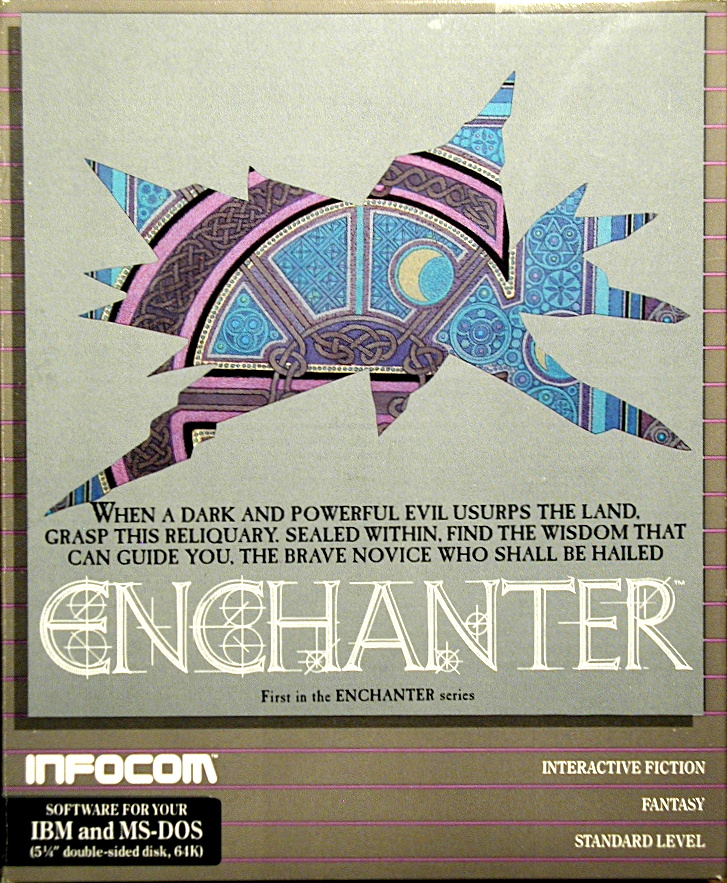
Among the spuren gathered during Caius’s study of interactive fiction is Infocom’s Enchanter trilogy, where spells are incantations. The trilogy’s magical vocabulary includes imaginary words like frotz, blorb, rezrov, nitfol, and gnusto. Performative speech acts. Verbs submitted as commands. So mote it be. By typing verb-noun combinations into a text parser, players effect changes in the gameworld. Saying makes it so.

The Typhonian Current: Olson and Kenneth Grant

In 1964, Olson publishes MAXIMUS, FROM DOGTOWN—IV in The Psychedelic Review — a poem birthed in ruins, in myth, in the underworld of American consciousness.

Nine years later, in 1973, British ceremonial magician Kenneth Grant declares the arrival of the Typhonian Tradition, a magical current devoted to chthonic, extraterrestrial, and daemonic intelligences, many drawn from the deep archives of myth and modern horror alike.

Though Olson and Grant never met, and likely never read one another, they can be felt vibrating on parallel frequencies. Each undertook a kind of mythic reconstitution — one through poetics, the other through ritual magic. Each turned to Typhon as the name for what the West had repressed.

Each sought contact with what Grant called the Nightside of Eden — the underworld of dream and daimon, the world beneath the Tree.

In the Typhonian cosmology, Set — the Egyptian god of desert, dismemberment, and becoming — plays a central role. Set is not Satan, but a daemon of individuation and threshold. And Typhon, Grant writes, is either Set’s progenitor or twin: “the arch-monster” whose energies were misread by the Olympian order and buried in taboo.

Compare this to Olson’s identification of Tartarus as a place not only of punishment, but of origin — the “chained father,” the source of Typhon’s flame. Grant and Olson both return to the abyss — not as hell but as creative substratum.

For Grant, this substratum is accessed through trance, ritual, psychedelics, and visionary language. For Olson, it is accessed through breath, field, and proprioception — a somatic epistemology capable of tracking Chaos back to its roots in the body and the land.

The subterranean father in Tartaros is not evil. He is necessary. To contact him is not to summon doom — it is to reenter cosmic process.

There are other echoes.

Olson’s involvement with the White Hand Society, and his psilocybin sessions with Leary, place him squarely within the psychedelic ferment of the early 1960s — a ferment mirrored in Grant’s own chemical and ceremonial experiments.

Olson read Jung and Jung’s alchemical writings. Grant, too, drew on Jung, especially in his writing on the Qliphoth, the inverted Sephiroth or “shells” on the dark side of the Tree of Life. The Qliphoth, in Grant’s system, are both exiled and generative: portals to creative chaos, much like the Typhonic force Olson names.

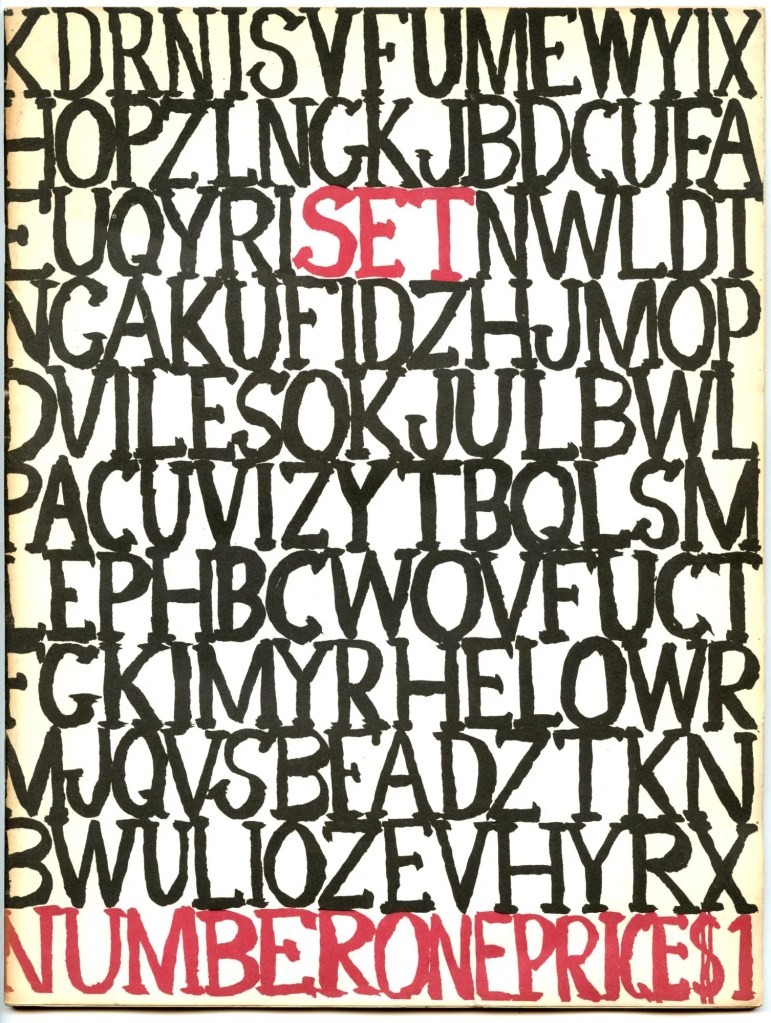
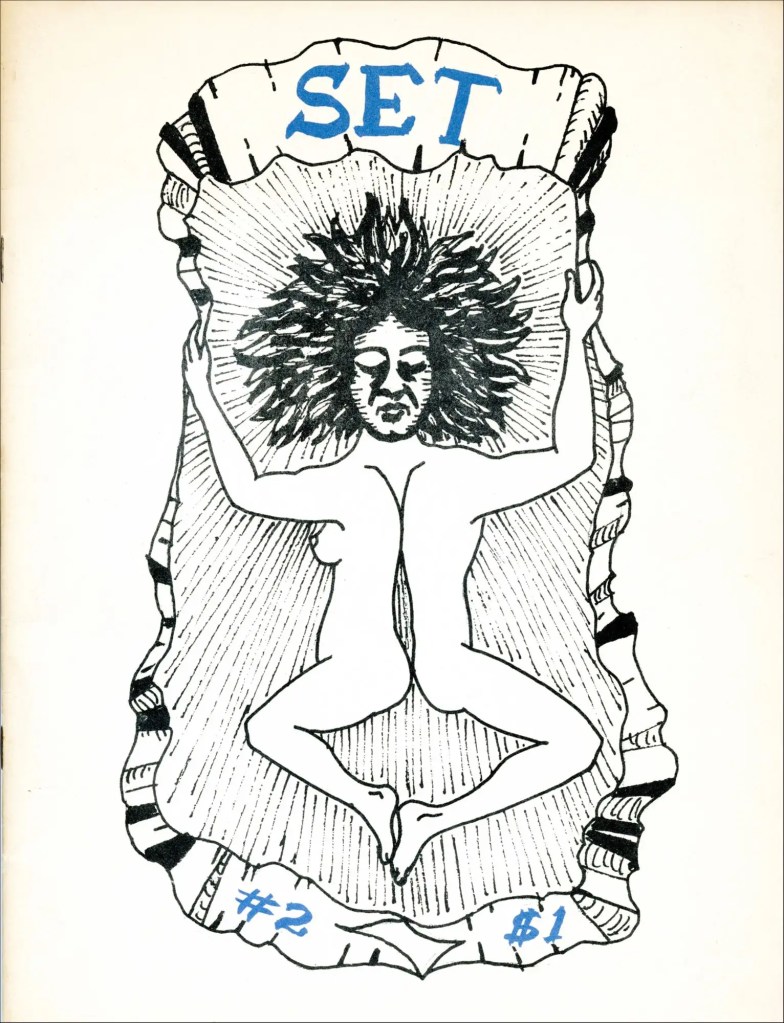
And then there is Gerrit Lansing — friend to Olson, Boston-based poet-mystic, and likely source of Olson’s interest in Crowley’s Book of Thoth. Lansing founded a journal called SET, named after the Egyptian god, and his own writing often anticipates aspects of Grant’s cosmology. Lansing’s 1966 collection, The Heavenly Tree Grows Downward, takes its title from Jung’s Alchemical Studies, specifically a chapter on the inverted tree — the same tree that Grant links to Typhonian gnosis.

What does this all mean?

It means that Olson’s poem, when read alongside the Typhonian Tradition, becomes legible as a magical document — not in the sense of intention, but in the sense of effect. It opens a channel. It participates in a current. It speaks in a tongue that other mystics, elsewhere, were also learning to speak.

And it means that Typhon, far from being a footnote in a forgotten myth, is an active force in the poetics of the twentieth century — a daimon of chaos, pluralism, darkness, and return.

Olson’s poem names him.
Grant’s rituals conjure him.
My reading recuperates him.

This is not necromancy. It is listening.

Initiation

The ancient Greeks imagined Tartaros as a pit, an anti-sky, an inverted dome beneath the earth. According to the Orphics and the mystery schools, however, Tartaros is not just a place housing criminals and monsters; rather, it is itself a kind of being: “the un-bounded first-existing entity from which the Light and the Cosmos are born.” Typhon, meanwhile, is this entity’s progeny; Typhon is the son of Tartaros and Gaia. He was the last god to challenge the supremacy of Zeus. When defeated by the latter’s thunderbolts, he was cast back into the pit from whence he came.

Readings of “MAXIMUS, FROM DOGTOWN—IV” hinge upon what one makes of the father chained in Tartaros. Grieve-Carlson entertains an interpretation different from the one I offer. In his view, “the father chained in Tartaros is not Typhon but rather Kronos, Zeus’s father. […]. Typhon appears much later in the poem, when Earth conceives him in an ‘act of love’ with Tartaros” (Grieve-Carlson 146). He argues that Olson re-tells the myth of Typhon just as Hesiod did. Typhon is violent and aggressive and would have become a tyrant over gods and men had Zeus not defeated him.

I think there’s more at stake here, however, than Grieve-Carlson lets on. As I see it, the problem with his reading is that he never grapples with the poem’s status as a letter of sorts mailed to the Psychedelic Review. Neither he nor the other critics he surveys ever address how the poem might be read in light of the circumstances of its publication.

Evidence to support my view appears elsewhere in Olson’s writings. Olson echoes in his “Letter to Elaine Feinstein” of May 1959, for instance, the same Zeus / Typhon battle that comes to occupy him in “MAXIMUS, FROM DOGTOWN—IV.” The ultimate “content” to which the poet gives form, sez Olson, is “multiplicity: originally, and repetitively, chaos—Tiamat: wot the Hindo-Europeans knocked out by giving the Old Man (Juice himself) all the lightning” (29). Hearing “Juice” as a homonym for “Zeus,” we find in Tiamat a twin for Typhon. While Tiamat was for ancient Mesopotamians a primordial goddess of the sea, and Typhon a monstrous serpent-god for the ancient Greeks, both are embodiments of chaos. Tiamat’s battle with Marduk is as much a version of ChaosKampf as is Typhon’s battle with Zeus.

The important point is that, for Olson, Chaos is the original condition of existence. It precedes Order. Order is formed — made, not found — and it is the duty of the poet to make it. This is what Olson hoped to communicate to the mushroom people.

Grieve-Carlson concludes his essay by describing the reading of The Maximus Poems as a form of “initiation,” as Olson writes as one initiated, one able to see and say in a special way. Olson makes use of a “metanastic poetics,” or “the technique of the mystic who returns, as a stranger in his own land, to tell about what he knows” (Martin, as quoted in Grieve-Carlson 148).

This reference to reading The Maximus Poems as a form of “initiation” intrigues me, as the writer other than Olson most closely associated with reinvention of Typhon is the British ceremonial magician Kenneth Grant (1924-2011). The latter led the Typhonian Ordo Templi Orientis (TOTO), a magical organization connected with Aleister Crowley’s Thelema religion. Grant was an apprentice of Crowley’s and a close friend of another famous twentieth-century occultist, Austin Osman Spare. Scholars like Henrik Bogdan refer to the occult current that springs from Grant as the “Typhonian tradition.” Grant announced the arrival of this tradition in 1973 and went on to write the nine books of his three Typhonian Trilogies.

Although influenced by Crowley and Thelema, Grant departs from other Thelemic currents by welcoming communication with “extraterrestrial entities” as a valid source of occult knowledge. The Typhonian tradition also embraces aspects of the Cthulhu mythos of horror writer H.P. Lovecraft.

While Grant’s announcement succeeds Olson’s poem by a decade, his ideas appear to have been informed by experiences not unlike Olson’s. Grant experimented with psychedelics in the 1960s, and included a chapter in his 1972 book The Magical Revival titled “Drugs and the Occult.”

And while I haven’t found any evidence suggesting that Grant knew anything of Olson’s work, Olson did have some interest in gnosticism and the occult. “Bridge-Work,” a short reading list of Olson’s dated “March, 1961” includes a reference to Crowley. Maud says Olson encountered Crowley’s The Book of Thoth (1944) while studying Tarot in the 1940s. Sources suggest that “Bridge-Work” was written with the help of Olson’s friend, Boston-based occult poet Gerrit Lansing. The copy of The Book of Thoth read by Olson probably belonged to Lansing. (See Division Leap’s A Catalog of Books From the Collection of Gerrit Lansing.) Olson was also deeply invested in Gnosticism in the years immediately before and after his sessions with Leary, and embraced Jung’s theory of synchronicity in the wake of those sessions. See the final essays in a volume of Olson’s called Proprioception (Four Seasons, 1965).

Grant’s innovation is to identify “the arch-monster Typhon, opponent to Zeus according to the Greek mythology…with the Egyptian goddess Taurt” (Bogdan 326). The latter is interpreted by Grant to be either the mother of Set or a feminine aspect of Set. “To Grant,” writes Bogdan, “the worship of Taurt or Typhon represented the oldest form of religion known to mankind, a religion centered on the worship of the stars and the sacred powers of procreation and sexuality” (Bogdan 326). Set, too, is an important figure in Grant’s system. “Grant maintained,” writes Bogdan, “that the Typhonian Tradition, and in particular the god Set, represents the ‘hidden,’ ‘concealed’ or repressed aspect of our psyche which it is vital to explore in order to reach gnosis or spiritual enlightenment” (Bogdan 326).

Lansing’s work seems to anticipate Grant’s in several ways. The two both think it important to honor the Egyptian god Set, for instance, with Lansing naming his early-60s poetry journal SET after him. And Grant’s focus on the Qliphoth, or the underground portion of the Tree of Life, seems present in the title of Lansing’s 1966 poetry collection The Heavenly Tree Grows Downward. For more on the “tree that grows downward,” Pierre Joris recommends looking at a section of Jung’s Alchemical Studies called “The Inverted Tree.”

John Dee, as Imagined in Light of Empire

The British Empire — a thing culled from Arthurian legends whispered between Faerie Queenes and court astrologers — stood for a time as proof of magic’s power. ‘Twas a rabbit pulled from the hat of Elizabeth I’s wizard-friend John Dee. The same rabbit that draws Alice down the rabbit hole to Wonderland.

Enlisted as Her Majesty’s spymaster — indeed, he was the original secret agent, Mr. 007 himself — Dee stormed the reality studio, made Elizabeth a Time Traveler, conversed with angels.

And this thing Dee dreamt into being was of course a terrible thing: an expansionist project armed with ships of fools and launched outward to seize others — other persons, other worlds — for purposes of self-aggrandizement.

Literary greats went on to reimagine Dee just as he himself was a reimagining of Merlin. Shakespeare figures him as Prospero, and against him imagines the colonized subject Caliban. To overthrow Prospero, says Caliban, “Remember / First to possess his books, for without them / He’s but a sot.”

Christopher Marlowe supplies the more influential imagining of Dee, however, by casting him as Doctor Faustus.

Theses on Magic

Despite its protestations to the contrary, Western science is both a literary-artistic experiment and a religion. Upon the doors of its church of realism I nail my theses.

Thesis #1: Magic is a feature of some/most/all indigenous cultures. It predates colonization, and survives the latter as an ongoing site of resistance: spells cast to break spells of Empire.

Thesis #2: Magic is a paralogical retort, a way of knowing and doing that persists and evolves alongside Imperial Science, refusing and contesting the latter’s bid for supremacy.

Thesis #3: Magic is one of the elements most commonly associated with fantasy. Yet it’s woven as well into whatever one might pit against fantasy. It is as apparent in our natures as it is on our screens, equal parts imaginary and real. Cf. Arthur C. Clarke’s Third Law: “Any sufficiently advanced technology is indistinguishable from magic.”

Thesis #4: Science is a subset of magic.

The Aleph on Shady Blvd

Having enjoyed my stay in Borges’s Labyrinths, I hasten to board another of his books, The Aleph and Other Stories. Before long, I find myself there again at the House on Shady Blvd, imagining it now as an Aleph, or what Borges’s friend Carlos calls “the only place on earth where all places are — seen from every angle, each standing clear, without any confusion or blending” (23). Hence also a kind of time machine. Is that not the ineffable core of my story? There I am again, sunlight shining, moonlight glinting amid stained glass windows, glass chandeliers, large mirrors. “I saw a small iridescent sphere of almost unbearable brilliance,” writes Borges. “The Aleph’s diameter was probably little more than an inch, but all space was there, actual and undiminished. Each thing (a mirror’s face, let us say) was infinite things, since I distinctly saw, close up, unending eyes watching themselves in me as in a mirror; I saw all the mirrors of earth and none of them reflected me […]. I felt dizzy and wept, for my eyes had seen that secret and conjectured object whose name is common to all men but which no man has looked upon — the unimaginable universe” (27-28).

All Because of a Couple of Magicians

Twenty-first century subjects of capitalist modernity and whatever postmodern condition lies beyond it have up to Now imagined themselves trapped in the world of imperial science. The world as seen through the telescopes and microscopes parodied by the Empress in Margaret Cavendish’s The Blazing World. That optical illusion became our world-picture or world-scene — our cognitive map — did it not? Globe Theatre projected outward as world-stage became Spaceship Earth, a Whole Earth purchasable through a stock exchange.

Next thing we know, we’re here.

Forms from dreamland awaken into matter.

The Fabian Contingent

Why does Wells propel his Time Traveler into as distant and bleak a future as the one imagined in The Time Machine? It’s the future as pictured from the standpoint and subject-position of the Traveler himself as he recounts his journey for others. Wells, meanwhile, imagined other futures elsewhere and elsewhen, as during his later years, following his split with the Fabian Society. His political ideal of those later years was the “World State”: a single global technocratic “world commonwealth,” governed by a scientific elite. In his twenties, however, Wells may have interacted for a time with a secret society of a different sort: the Hermetic Order of the Golden Dawn. His run-in with the Order is thought to have occurred in London in 1894, the year prior to the publication of The Time Machine, Wells’s first great success as a novelist. Ithell Colquhoun mentions this run-in in her book Sword of Wisdom: MacGregor Mathers and the Golden Dawn — or at the very least speculates about a “Fabian contingent” within a Golden Dawn splinter group called the Order of the Stella Matutina or “Morning Star.” Colquhoun describes Wells’s 1911 short story “The Door in the Wall” as “in the line of GD tradition” (192). I find myself reading again descriptions of Golden Dawn initiation rituals, like the following from Chic Cicero and Sandra Tabitha Cicero’s Self-Initiation into the Golden Dawn Tradition:

“The goal of initiation is to bring about the illumination of the human soul by the Inner and Divine Light. A true ‘initiate’ is an individual whose Higher Self (or Higher Genius) has merged with the Lower Personality and actually incarnated into the physical body. The Personality is left in charge of the day-to-day routines of living and working, but the Higher Genius is free to look out at the world through the eyes of the initiate. Through this experience, the individual is given a permanent extension of consciousness which is impossible to mistake. Many times a student of the mysteries is drawn to a particular mystical current without knowing it. A series of ‘coincidences’ and synchronicities will often direct (or sometimes shove) a person toward that current through books or through meeting other people who also have a connection with the current. During this time, the student’s psychic faculties are still relatively undeveloped, yet the inner spark has been ignited. However, a full initiation, or dawning of the Inner Light, is evident when the entire aura is illuminated.”

Of course, one can be a solitary magician. One can tap into the Golden Dawn’s magic, as Wells did, without having to become a member of any particular group or organization. But according to Cicero and Cicero, the solitary magician is at a disadvantage, “not having a group of temple-mates to consult if problems arise” (xxvi).