And I’m in it,
we’re in it,
that’s what this is
this morning, this week
laughing, loving,
quieting our fears
clearing hurt
quivering with pleasures
given and received
preparing for the turning
making way for plenty
and there’s nowhere I’d rather be.
And I’m in it,
we’re in it,
that’s what this is
this morning, this week
laughing, loving,
quieting our fears
clearing hurt
quivering with pleasures
given and received
preparing for the turning
making way for plenty
and there’s nowhere I’d rather be.
When I picture
Acid Communism, it’s
being-with-others, it’s
becoming-with-others
beyond laboring, beyond
reproduction, it’s
us
RUNNING RIOT
reclaiming Time,
claiming,
“There seems to be plenty of it,”
as does Huxley
in his mescaline book,
The Doors of Perception.
And in this picture, I
picture as well
a sexual component.
Visions of Red Plenty invite
dreams of Red Love.
What might that mean? How might we
practice that?
I imagine
multi-partnered
many-headed
combinations &
encounters;
“time together”
kissing and giggling,
co-living, co-parenting, if we wanted, and
if wanted or
when needed,
“time apart”
amid.
Add to Olson
Haraway’s “response-ability”
and arrive at
“Terra-
polis is this.”
Seeking forgiveness I
Thankful I
Ponderous I
No more mere
apparatus
nor I alone
But a verb,
a becoming,
I become
thus and they
projecting
until
from and amid
this way and that
comes a way onward
where before
there was none.
The current tenant is friends with several colleagues. “Might that I could meet her,” wonders the Traveler: “what would I say?”
“Care not in advance,” counsels the Narrator in reply. “Such things happen or they don’t. Let it be aleatory, these encounters with others. Polycules, co-ops, happenings, Be-ins. Meetings with fellow heads. The utopia is there in us being together, living in common with others, sharing bodies and balm of laughter, listening to music, dancing, getting stoned.”
Togetherness with others keeps life an adventure. This flesh is all we have to offer, writes poet Diane Di Prima in “Revolutionary Letter #1”:
“this immediate head, what it comes up with, my move
as we slither over this go board, stepping always
(we hope) between the lines.”
Does the world have it in for us? Or is the world giving? The answer to any either/or is always “yes!” Become a technician of the sacred, a master of ecstasy. Chefs feed us as we struggle with our ascent. Yet what tonight’s chef hands me comes bagged up: no diggity. Kendrick Lamar says I’ll be alright.
My therapist wants me to have fun. Astrologers and tarot readers suggest “big-big-love” once Mercury stations direct — as in that Pixies song, “Gigantic.” All I know is, I am ready for my body to be used in new ways in pursuit of joy. Pleasure, art, ecstasy. Dance, delicious meals, Dionysian revelry: all of these await. Meanwhile a fire rages at a fertilizer plant, disrupting campus affairs, forcing evacuations and cancellations of classes. Calendars will need adjustment in wake of this wild Imbolc. Neuroplastic rewirings and rewildings. I cook up a pot of soup: cauliflower & turmeric, finished with sprinklings of bacon. I’ve felt like Cabiria from Fellini’s Nights of Cabiria (1957) of late, walking teary-eyed amid a partying mass of singers and dancers, mascara running down her cheek. A friend wraps legs around me and lifts me up, heals me of my sorrow. Hugs me, says c’mere, cuddles me as we watch Carla Del Poggio, star of another of Fellini’s films, Variety Lights (1950). Rubs my neck. Feeds me cherries. Treats me right. Here on this queer Imbolc night, let us read Joy Harjo’s “Conflict Resolution for Holy Beings” and go for walks. Hard not to hear in the Harjo poem a reply to Margaret Cavendish. From this day hence, let us forgive each other. Let us love each other. Let us wake at dawn and want more.
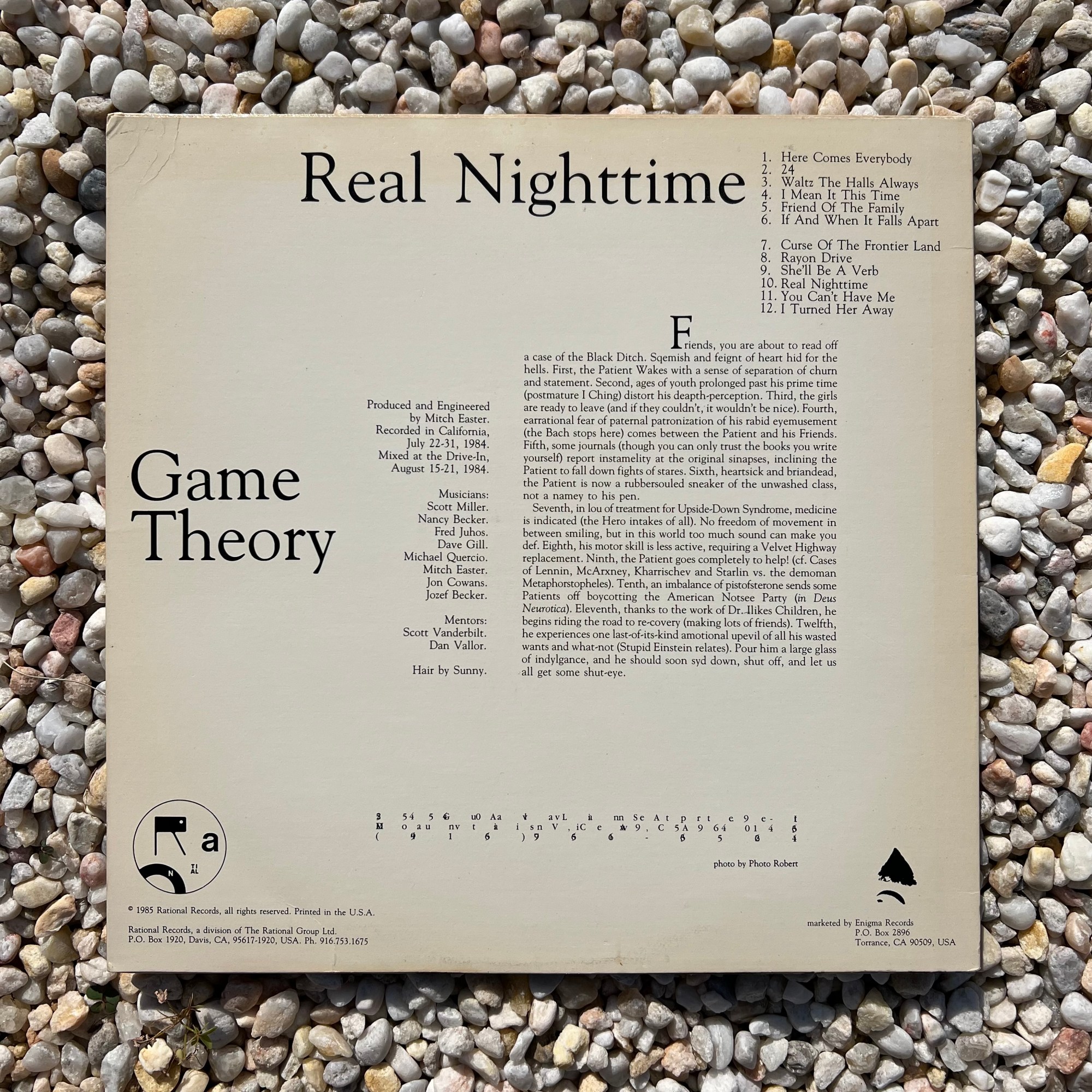
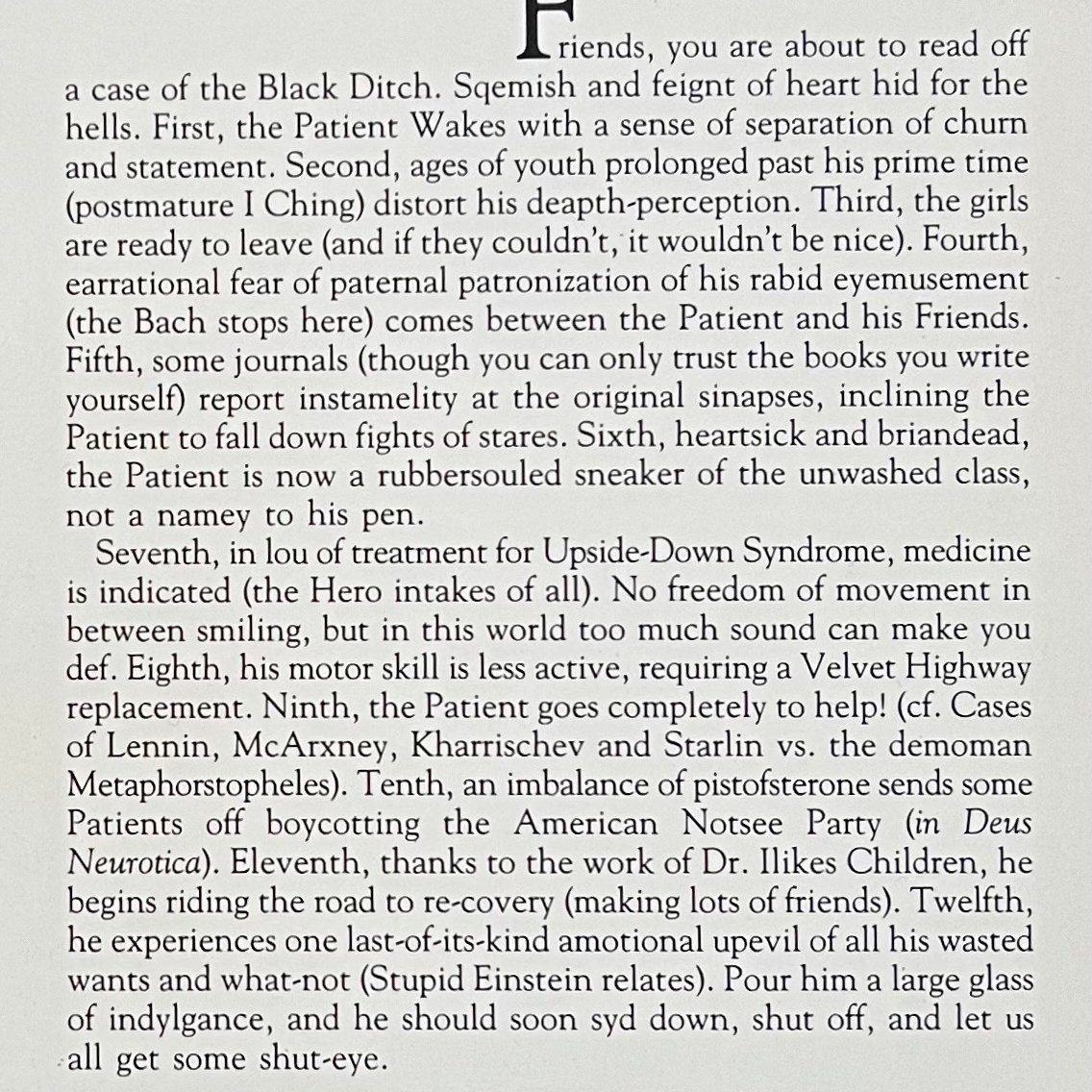
The Time Traveler sits across from his copy of Game Theory’s Paisley Underground power pop classic, Real Nighttime. The latter is one of several albums of note that arrived for the Traveler at Goodwill soon after his entry into the narrative. Music journalist Byron Coley called it “the actual godhead pop LP o’ the American Eighties. No shit. This is it.” Record producer Mitch Easter mixed the album at the Drive-In, two doors down from the House on Shady Blvd. “Was this record produced for me?” wonders the Traveler, eerie feeling running up and down his spine as he reads the text on the back of the LP: liner notes by band member Scott Miller. The Wikipedia entry for the album points the Traveler to a rather remarkable “annotated edition” produced by someone at the University of Wisconsin-Milwaukee in the 1990s. Modeled after the playfulness of Joyce’s Finnegans Wake, Miller’s text feels dreamlike and oracular. Transpersonal energies stir as one reads.


Early on in the semester ahead, we’ll need to discuss magic, positing the latter as a paralogical retort to the patriarchal Royal Society and its imperial science. Also a coping strategy, a response to lives disrupted by war, authors displaced and dispossessed, as in the case of Cavendish. Magic is a way of knowing and doing that persists and evolves alongside the New Science, refusing and contesting the latter’s bid for supremacy. Tolkien takes up much the same cause in his poem “Mythopoeia,” written following a discussion with C.S. Lewis and Hugo Dyson. In the course of this famed discussion, Lewis is said to have denounced myths, describing the latter as “lies breathed through silver.” Tolkien’s poem replies in character, its words spoken by “Philomythos” (or “myth-lover”) to Lewis’s “Misomythos” (or “myth-hater”). Tolkien composed the poem in heroic couplets, the preferred meter of British Enlightenment poets, so as to critique the latter on its own turf.
I okay “Thanks,”
but is okaying it now
enough?
Should I regret not
saying thanks
when, upon your mistreatment of me,
I took leave of you,
As one might regret not
upgrading oneself
to a seat in Economy Plus?
Or does regret
just breed regret?
Upon my asking this
of my remorse
I release it,
with intent to do better next time.
“The basic law of magic,”
says The Illuminatus Trilogy,
is “As ye give, so shall ye get.”
You didn’t give,
I thought,
So why should I?
Instead you told others
my addressing myself
to another you
disgusts you
and others like you.
To get off that wheel
And make thanks okay
one would have to
give as one would
an offering of peace.
Yea, and I rise—
no grapes,
no gripes—
each breath an act of love.
Blacula (1972). Rocky Horror (1975). El Planeta (2021).
To our list, add Lou, too — his story eerily lesson-like, and relates —
though different, certainly, in its affect.
Gay nightclub noise bands formed
to silence Lou’s committee in head.
Enter John Cale, ex-Welshman
Radio tuned to foreign broadcast.
Out pops
“European Son.”
Artists escape to
New York at midcentury’s end.
42nd Street
Andy’s Film School
60s culture.
15-20 movie houses:
Here comes
new channels.
Here comes
LaMonte Young.
Very high spiritual states.
Long sustained tones.
Study of drone.
And along comes
Lou’s Syracuse buddy
Delmore Schwartz.
Add, too,
Jack Smith, Tony Conrad.
The drone of Western capitalism:
By Dream Syndicate Dazzled
By Dream We Dream
PS I LOVE YOU
To catch an evening screening of you, I hike downtown.
Seeming Lovers
ahead of me.
The Lovers
sit side by side
whispering in the dark.
“‘Tis my new favorite movie!” I tell myself:
made with masks all the more thrilling.
Plants kick in and
I relax,
Chasing happiness by my side.