Plutarch’s “On Isis and Osiris”

Plutarch Hellenizes the Osiris myth. His is a Greek retelling. Gods from Hesiod turn up in his text performing deeds attributed in other tellings to gods of Egypt.

In place of Thoth, he tells of Prometheus. In place of Set, he tells of Typhon.

Meaning changes as the myth migrates.

Already in this early instance of Western appropriation of the Orient, we see at play a combination of projection and forgetting.

Plutarch’s work influences much of what follows, no other work by a Greek writer more frequently cited by Egyptologists than his.

He dedicates the work to Clea, a priestess at Delphi and worshipper of Isis. “All good things, my dear Clea, sensible men must ask from the gods,” he begins: “and especially do we pray that from those mighty gods we may, in our quest, gain a knowledge of themselves, so far as such a thing is attainable by men. For we believe that there is nothing more important for man to receive, or more ennobling for God of His grace to grant, than the truth.”

“The true votary of Isis,” he continues, “is he who, when he has legitimately received what is set forth in the ceremonies connected with these gods, uses reason in investigating and in studying the truth contained therein.”

I pause here in my reading to note the following:

Plutarch’s Lives is among the volumes in the satchel of books found by Frankenstein’s Creature. The others are Goethe’s The Sorrows of Young Werther, and John Milton’s Paradise Lost. From this “data set,” Victor’s composite of corpses learns language.

From its study of a corpus, the Creature comes to know the power of the Word.

The Creature speaks first of Goethe, Frankenstein’s muse in more ways than one.

Shelley, an admirer of Goethe, creates a mad scientist, Victor Frankenstein, modeled in part upon Goethe’s Faust. She then has her creation create a “sub-creation,” a Creature who models itself in part on Goethe’s Werther. “I thought Werter himself a more divine being than I had ever beheld or imagined,” says the Creature in the first of its conversations with Victor.

“As I read, however,” it continues, “I applied much personally to my own feelings and condition. I found myself similar, yet at the same time strangely unlike the beings concerning whom I read, and to whose conversation I was a listener. I sympathized with, and partly understood them, but I was unformed in mind; I was dependent on none, and related to none. ‘The path of my departure was free;’ and there was none to lament my annihilation. My person was hideous, and my stature gigantic: what did this mean? Who was I? What was I? Whence did I come? What was my destination? These questions continually recurred, but I was unable to solve them” (Shelley, Frankenstein, pp. 93-94).

Next it speaks of what it learned from reading Plutarch.

“This book,” it begins, “had a far different effect upon me from the Sorrows of Werter. I learned from Werter’s imaginations despondency and gloom: but Plutarch taught me high thoughts; he elevated me above the wretched sphere of my own reflections, to admire and love the heroes of past ages” (94).

“Many things I read,” it adds, “surpassed my understanding and experience. I had a very confused knowledge of kingdoms, wide extents of country, mighty rivers, and boundless seas. But I was perfectly unacquainted with towns, and large assemblages of men. The cottage of my protectors had been the only school in which I had studied human nature; but this book developed new and mightier scenes of action. I read of men concerned in public affairs governing or massacring their species” (94).

Its world-picture expanding through a progression leading from the personal to the collective, from the one to the many, the Creature turns at last to Milton.

Paradise Lost excited different and far deeper emotions,” it begins. “I read it, as I had read the other volumes which had fallen into my hands, as a true history. It moved every feeling of wonder and awe, that the picture of an omnipotent God warring with his creatures was capable of exciting. I often referred the several situations, as their similarity struck me, to my own. Like Adam, I was created apparently united by no link to any other being in existence; but his state was far different from mine in every other respect. He had come forth from the hands of God a perfect creature, happy and prosperous, guarded by the especial care of his Creator; he was allowed to converse with, and acquire knowledge from beings of a superior nature: but I was wretched, helpless, and alone. Many times I considered Satan as the fitter emblem of my condition; for often, like him, when I viewed the bliss of my protectors, the bitter gall of envy rose within me” (94-95).

The Creature’s identity forms as it identifies with characters encountered in books. The books in its life-world draw it toward Satan. Into this collection of books arrives a fourth: the diary of its creator.

“It was your journal of the four months that preceded my creation,” says the Creature to its creator. “You minutely described in these papers every step you took in the progress of your work; this history was mingled with accounts of domestic occurrences. You, doubtless, recollect these papers. Here they are. Every thing is related in them which bears reference to my accursed origin” (95).

Accursed, it adds, because of its abandonment.

“Cursed creator!” exclaims the Creature, its learning having led it to outrage. “Why did you form a monster so hideous that even you turned away from me in disgust? God in pity made man beautiful and alluring, after his own image; but my form is a filthy type of yours, more horrid from its very resemblance. Satan had his companions, fellow-devils, to admire and encourage him; but I am solitary and detested” (95).

Osiris, Hermes Trismegistus, Jesus Christ

Into this mix of gods arrives Jesus Christ Superstar. From the grammar of the multitude comes the Word of the Father: Hebraic law handed down by Moses and the patriarchs to the Israelites in their flight from Egypt. “In the beginning was the Word,” yes: but Word that becomes flesh as the body and blood of Christ. Church fathers assemble into the anthology of the New Testament the testimonies of Christ’s followers, appending these to Hebrew scripture. From the Word of the Father comes the Word of the Son, old covenant replaced by the new.

When, in the fourth century AD, Rome’s emperors embrace the words of He they once crucified, the Text of the Judeo-Christian Greco-Roman synthesis begins its spread along its path of westward expansion, replacing the many with the one.

Reed, a proponent of multiculturalism, son of those whose ancestors were, more than a thousand years after the death of Christ, captured by Christians and brought to Turtle Island as slaves, replies by remembering Osiris, the Ancient Egyptian Lord of the Underworld and Judge of the Dead.

The Osiris myth is the most elaborate and influential story in Ancient Egyptian mythology. Osiris has two siblings, Isis and Set. Osiris marries his sister Isis. Moved by jealousy, Set kills Osiris and usurps his throne as king of Egypt. Osiris is dismembered, parts of his body strewn across the kingdom. Isis, grieving the loss of her beloved, restores Osiris’s body, reanimates his corpse, so that the couple can posthumously conceive their son Horus, who, imbued with the spirit of his father, eventually defeats Set and restores order to the kingdom.

Plutarch’s essay, “On Isis and Osiris,” is one of the few texts to preserve this myth amid the timelines and wisdom traditions of the West. As Earl Fontainelle notes in Episode 68 of the SHWEP, “No one could read ancient Egyptian from late antiquity until the development of modern Egyptology (the Rosetta Stone and that whole business). Thus, almost every scrap of Egyptian religion was totally lost until the nineteenth century. The material preserved by Plutarch is the sole major exception to this rule. In other words, Plutarch’s ‘On Isis and Osiris’ was, for most of Western history, all we knew about Egyptian religion.”

By the time of Derrida, the aperture onto the past had expanded well beyond Plutarch, thanks to tellings of these myths in works recovered by Egyptologists. In the footnotes to his account of Thoth in “Plato’s Pharmacy,” Derrida refers us to Adolf Erman’s Handbook of Egyptian Religion and André-Jean Festugiere’s four-volume study of the Corpus Hermeticum.

For this, too, is how Thoth persists in the wisdom traditions of the West. He lives by way of “hermeticism”: that strange corpus of literature associated with, attributed to, said to be written by “one of the great matinee idols of esoteric lore: Hermes Trismegistus” (TechGnosis, p. 9).

Frances A. Yates surveys much of this lore in her book The Art of Memory.

From hermeticism we get groups like the Hermetic Order of the Golden Dawn. With the Golden Dawn, the focus shifts to Tarot.

Derrida’s Pharmakon

Socrates tells a tale about Thoth in Plato’s Phaedrus. “It was he,” says Socrates, “who first invented numbers and calculation, geometry and astronomy, not to speak of draughts and dice, and above all writing.” Thoth offers the gift of writing to King Thamus (and through the king, to the people of Egypt), presenting it as “a recipe (pharmakon) for both memory and wisdom.” After considering the matter, however, Thamus rejects Thoth’s offer. Thamus anticipates that, rather than aiding memory, writing would destroy it, making it dependent upon external marks. He also fears that writing would allow knowledge to escape from the teacher-student relationship, passing into the hands of the unprepared. Plato and Socrates share Thamus’s suspicion of writing — though of course Plato in practice accepts writing, using it to memorialize what with Socrates remained spoken.

The myth of Thoth’s encounter with Thamus appears in the final section of the Phaedrus. The encounter occasions a trial of sorts. Writing  is tried and sentenced, much as poetry is sentenced by Socrates, much as Socrates is himself sentenced by the Athenians. Derrida reads this “trial of writing” not as an extraneous addition — “an appendix the organism could easily, with no loss, have done without” — but as the dialogue’s ultimate theme, “rigorously called for from one end of the Phaedrus to the other” (Dissemination, p. 67).

Socrates believes in the idea of the Good, which he can know only by way of its offspring, its manifestation amid the realm of sense and appearance as the sun. Monotheists are sun-worshippers. Worshippers of the sun-god.

“For Plato,” writes Derrida, “Thamus is doubtless another name for Ammon…the sun king and…father of the gods” (76). Reading this myth from the Phaedrus alongside Books VI and VII of the Republic, Derrida shows that Plato is as much a sun-god worshipper as the Christians.

Ishmael Reed offers much the same critique in Mumbo Jumbo, replacing “Platonists” with “Atonists,” tracing monotheism back to worshippers of the sun-god Aton in ancient Egypt.

Reed builds this into his account of Set and Osiris.

Osiris is for Reed a kind of pre-Christian Christ figure. The god who dies and is resurrected. Osiris is the Ur-figure, the original on which Christ is based. Thoth appears as Osiris’s sidekick.

After their tale comes Reed’s retelling of the tale of Moses.

Reed’s book allegorizes a struggle between forces similar to Freud’s reality and pleasure principles. But Reed reverses Freud’s valuation of these principles. The reality principle is no longer in Reed’s view a force for good. Rather, it’s a construct invented by Mumbo Jumbo’s villains, Set and his followers, the Atonists. Whereas the pleasure principle, all that in the book is erotic and Agapic and good, manifests first as Osiris and then, after Osiris’s death, as Jes Grew. Freud championed the reality principle because Freud was an Atonist.

As Reed notes, “To some if you owned your own mind you were indeed sick but when you possessed an Atonist mind you were healthy. A mind which sought to interpret the world by using a single loa” (Mumbo Jumbo, p. 24).

For the Platonists and the Atonists, that single loa is the logos.

Socrates appeals to logos because without it, he says, one is at the mercy of mimesis and poiesis and deception.

Derrida’s life-work, meanwhile, is a deconstruction not just of logos but of “phallogocentrism,” which for him is the defining characteristic of Western metaphysics. Add the supplement, the pharmakon, and the ontos of the logos gives way to hauntology.

God is an absent presence. A Holy Spirit.

To turn to writing, thinks the king, is to turn away from, to forget, this presence.

The Derrida who, in 1968, publishes “Plato’s Pharmacy,” is already as obsessed with ghosts as the Derrida who presents the series of lectures that, in 1993, become Specters of Marx.

As I reread him now, a remembering occurs. The ontology of Plato’s cave is remembered to be a pseudo-totality located amid a structure akin to Thoth’s Library.

“Imagine Plato’s cave,” writes Derrida, “ not simply overthrown by some philosophical movement but transformed in its entirety into a circumscribed area contained within another—an absolutely other—structure, an incommensurably, unpredictably more complicated machine. Imagine that mirrors would not be in the world, simply, included in the totality of all onta and their images, but that things ‘present,’ on the contrary, would be in them. Imagine that mirrors (shadows, reflections, phantasms, etc.) would no longer be comprehended within the structure of the ontology and myth of the cave—which also situates the screen and the mirror—but would rather envelop it in its entirety, producing here or there a particular, extremely determinate effect. The whole hierarchy described in the Republic, in its cave and in its line, would once again find itself at stake and in question in the theater of Numbers” (Dissemination, p. 324).

Pharmako-AI introduces the concept of the pharmakon, meanwhile, not by way of Derrida but by way of American poet and ethnobotanist Dale Pendell (1947-2018), author of the Pharmako trilogy: Pharmako/Poeia (1994), Pharmako/Dynamis (2002), and Pharmako/Gnosis (2005). The trilogy covers all the major categories of psychoactives and details the pharmacology, the chemistry, and the political and sociohistorical implications and effects of their use.

Pendell provides Pharmako-AI with its epigraph:

‘The poison spreads over the planet.’

‘Here are the gates. Crossroads.’

Somos nosotros que debemos ser adivinos.’

[“It is we who must be fortune tellers.”]

Pendell’s book Pharmako/Poeia (1995) includes a foreword by Gary Snyder, another of the poet-spirits here in our library.

Pendell’s ideas also enter discussion in a chapter of Pharmako-AI titled “The Poison Path.”

Pendell is also the author of a play called Seeking Faust: a comedy of 13 scenes in prose, following a verse prologue, retelling the legend from the perspective of Faust’s former student and apprentice, Wagner, “who has chosen the royal path of alchemy over his master’s necromantic conjurations.”

The poison path — “so completely articulated,” says Pendell, in Goethe’s Faust — is Pendell’s name for a spiritual practice and branch of occult herbalism that explores the esoteric properties of potentially deadly plants. The goal, basically, is to extract medicine from poison.

Pharmako-AI suggests that this path is the one we walk here in our interactions with AI. It is the path one walks in one’s interactions with the pharmakon.

PaPa LaBas, Hoodoo Detective

Reed clearly prefers PaPa LaBas’s approach to Berbelang’s. Why does the one succeed where the other fails? LaBas is the 50-year-old owner of the Mumbo Jumbo Kathedral, a peculiar psychic detective agency / “mind haberdashery” (23) / head shop, situated in the Harlem of the 1920s. LaBas is the proprietor of this “factory which deals in jewelry, Black astrology charts, herbs, potions, candles, talismans” (24). But he’s also the novel’s “Hoodoo detective.”

I find it useful to consider the figure of the “Hoodoo detective” through comparison with neighboring hero-types: “social detectives,” “spuren-gatherers.”

Hoodoo is a form of folk spirituality that emerged in the southern United States from a mixture of African, Native American, and Christian influences. It was practiced in secrecy under slavery and has a long history of being tied to class struggle, hardship, and looking to one’s ancestors in trying times. It’s both a body of esoteric knowledge (much of it involving “rootwork”) and a rebellion against mental and spiritual domination.

Hoodoo resembles Vodun folkways, except it’s less standardized.

Reed wrote a series of poems called “The Neo-HooDoo Manifesto” and “The Neo-Hoodoo Aesthetic.” Both are included in Conjure, a collection of poems published in 1972, the same year as Mumbo Jumbo.

LaBas is also an embodiment of Legba. In Vodou rituals, Legba is the god practitioners call upon first. It is through him that the other gods manifest and do their work. Legba is a variant upon the Pan-African trickster god Esu-Elegbara, “the guardian of the crossroads.”

LaBas is the wise one in the novel; Berbelang studied under him for a time, but lacked the patience to stay with it. LaBas is hopeful and powerful. He’s the novel’s houngan. He maintains the rituals, retains the wisdom, whereas Berbelang operates from scarcity, fighting to retrieve what was stolen.

Berbelang, Faust, Mu’tafikah: in the end, these all prove to be distractions. Halfway through the novel, they all but disappear from the plot, replaced by LaBas’s casework.

LaBas’s investigation of Jes Grew leads him toward the Book of Thoth.

When he and his companion, the real-life stage magician Black Herman, interrupt the debut of the Talking Android by revealing its true identity as Hubert “Safecracker” Gould, an Atonist in blackface, they move to arrest Gould and his sponsor, Von Vampton. LaBas and Herman are interrupted in turn, however, when a Guianese art critic named Hank Rollings rises from his seat and demands that they give an account. “Explain rationally and soberly,” he says, “what they are guilty of. This is no kangaroo court, this is a free country” (160). To satisfy the critic’s demand, LaBas and Herman launch into a tale of ancient Egypt. Parodying detective fiction’s famous “scene of recognition,” (the unmasking of the villain, as in Scooby Doo), LaBas discourses at length through the entirety of the book’s final third, explaining the arrest of Gould and Von Vampton through reference to Ancient Egypt.

We learn of an ancient theater involving ritual magic — one that “influenced the growth of crops and coaxed the cocks into procreation” (161). In this pre-Greek theater, prior to what Nietzsche called “the birth of tragedy,” “The processes of blooming were acted out,” Reed writes, “by men and women dancers who imitated the process of fertilization” (161). The best of these dancers was Osiris.

History is reimagined here as an ongoing conflict across the ages between followers of Osiris and followers of Osiris’s brother, “the stick crook and flail man” Set (162). “People hated Set,” writes Reed. “He went down as the 1st man to shut nature out of himself. He called it discipline. He is also the deity of the modern clerk, always tabulating, and perhaps invented taxes” (162).

We can think of the long “recognition” scene at the end of Mumbo Jumbo as an extralegal, “extraordinary rendition” — a presentation of black culture’s case against Western Civilization, a case that (like Frederick Douglass’s) must be brought before the court of public opinion, as it can’t be heard impartially within “official” (i.e. Western, Judeo-Christian-derived) courts of law.

It’s not so much that LaBas succeeds: the Book eludes him, and Jes Grew lays dormant by novel’s end. But LaBas survives. And the wisdom traditions survive with him.

Mumbo Jumbo

“Men do not sufficiently realize that their future is in their own hands…theirs [is] the responsibility, then, for deciding if they want merely to live, or intend to make just the extra effort required for fulfilling even on their refractory planet, the essential function of the universe, which is a machine for the making of gods.” — Henri Bergson, The Two Sources of Morality and Religion (1932)

“We are as gods and might as well get used to it.” — Stewart Brand, The Whole Earth Catalog, Fall 1968.

A mysterious Book of Thoth appears as a central object of concern among the warring secret societies that populate Ishmael Reed’s 1972 novel Mumbo Jumbo. The novel’s villainous Christian supremacist faction fears that this book will bring about “the end of Civilization As We Know It” (Reed 4).

Berbelang is the leader of the Mu’tafikah, the radical “art-napping” group featured in Reed’s novel.

Reed attended the University at Buffalo, but withdrew during his junior year to move to New York City. Arriving there in 1962, he participated in the Umbra Writers Workshop, a collective of young black writers whose members helped to launch the Black Arts Movement of the 1960s. Reed also cofounded The East Village Other, one of the most important underground newspapers of the 1960s counterculture.

The Mu’tafikah’s aim is to “liberate” ancient art from western museums, with plans to return each piece to its place of origin. By these means, members of the group hope to “conjure a spiritual hurricane which would lift the debris of 2,000 years from its roots and fling it about” (88). “We would return the plundered art to Africa, South America and China,” explains Berbelang: “the ritual accessories which had been stolen so that we could see the gods return and the spirits aroused” (87-88).

The group’s name is derived from the Koran, explains Reed in a footnote early in the novel. “According to The Koran,” he writes, Mu’tafikah were “inhabitants of the ruined cities where Lot’s people had lived. I call the ‘art-nappers’ Mu’tafikah because just as the inhabitants of Sodom and Gomorrah were the bohemians of their day, Berbelang and his gang are the bohemians of the 1920s Manhattan” (15).

Of course, “Mu’tafikah” also sounds like “Motherfucker.” Much of the brilliant satiric energy of Mumbo Jumbo comes from Reed’s allegorization of his own late 1960s and early 1970s moment by way of the 1920s. I like to think of Reed modeling the Mu’tafikah in part after the Motherfuckers: members of Ben Morea’s late 60s New York anarchist art group Up Against the Wall Motherfucker (name derived, BTW, from “Black People!,” a poem by Black Arts Movement founder Amiri Baraka. Jefferson Airplane would later quote the same line in their 1969 song “We Can Be Together”). The Motherfuckers appeared prominently in the pages of Reed’s East Village Other. The paper ran from 1965 to 1972.

Berbelang views Faust as a “bokor.” The latter word, a term from Vodou, refers to a witch for hire who serves the loa “with both hands.”

Puzzling over Faust’s motives, and wondering why such a legend had become “so basic to the Western mind,” Berbelang offers the following.

“He didn’t know when to stop with his newly found Work,” explains Berbelang. “That’s the basic wound. […]. What is the wound? Someone will even call it guilt. But guilt implies a conscience. […]. No it isn’t guilt but the knowledge in his heart that he is a bokor. A charlatan who has sent 1000000s to the churchyard with his charlatan panaceas. Western man doesn’t know the difference between a houngan and a bokor. He once knew the difference but the knowledge was lost when the Atonists crushed the opposition. When they converted a Roman emperor and began rampaging and book-burning” (91).

Atonists are the villains in Reed’s novel: a secret, conspiratorial, white-supremacist Order dedicated to monotheism. Atonists are defenders of Western Civilization. Freud is an Atonist, as are fictional baddies like Hinckle Von Vampton. Von Vampton is the ripest of the novel’s Fausts. By novel’s end, we learn that Atonism originates among worshippers of Set.

As for Faust:

“His sorcery, white magic, his bokorism will improve. Soon he will be able to annihilate 1000000s by pushing a button,” predicts Berbelang, edging now into the realm of the prophetic. “I do not believe that a Yellow or Black hand will push this button but a robot-like descendent of Faust the quack will. The dreaded bokor, a humbug who doesn’t know when to stop” (91).

Berbelang voices his concern about Faust over coffee with Thor Wintergreen. Thor is the Mu’tafikah’s sole white member. Others in the group oppose Thor’s involvement, fearing he’ll betray them — as indeed he does. What are we to make of this betrayal?

For those who think “mumbo jumbo” just means “superstitious nonsense” or “gibberish,” a note on the novel’s title page reveals otherwise. The phrase enters English, writes Reed, by way of the Mandingo phrase mā-mā-gyo-mbō, meaning “a magician who makes the troubled spirits of ancestors go away” (7).

Berbelang suggests that the ancestors who need to go away are bokors like Faust. “We must purge the bokor from you,” he tells Thor. “We must teach you [Western man] the difference between a healer, a holy man, and a duppy who returns from the grave and causes mischief. We must infuse you with the mysteries that Jes Grew implies” (91).

Mu’tafikah member José Fuentes compares Thor to conquistadors like Cortez, Pizarro, and Balboa. He tells Thor, “You carry them in your blood as I carry the blood of Montezuma; expeditions of them are harbored by your heart and your mind carries their supply trains […]. The costumes may have changed but the blood is still the same, gringo” (86).

Fuentes’s view is based on the idea of “racial soul.” “Race-soul” was a concept from Nazi ideology. Fuentes’s use of this concept seems to betray a kind of reverse racism underpinning his suspicion of Thor.

Berbelang, meanwhile, rejects this view and decides to trust Thor. Berbelang’s hope or belief — Reed’s, too, I suppose — is that the “racial soul” is a fiction. Otherwise, if there is such a thing, if there is “a piece of Faust the mountebank residing in a corner of the White man’s mind,” warns Berbelang, “then we are doomed” (92).

What does it mean, then, for Reed to have Thor betray the Mu’tafikah soon thereafter, leading to Berbelang’s murder? Is Reed’s decision to kill off Berbelang an expression of Afropessimism?

The Typhonian Current: Olson and Kenneth Grant

In 1964, Olson publishes MAXIMUS, FROM DOGTOWN—IV in The Psychedelic Review — a poem birthed in ruins, in myth, in the underworld of American consciousness.

Nine years later, in 1973, British ceremonial magician Kenneth Grant declares the arrival of the Typhonian Tradition, a magical current devoted to chthonic, extraterrestrial, and daemonic intelligences, many drawn from the deep archives of myth and modern horror alike.

Though Olson and Grant never met, and likely never read one another, they can be felt vibrating on parallel frequencies. Each undertook a kind of mythic reconstitution — one through poetics, the other through ritual magic. Each turned to Typhon as the name for what the West had repressed.

Each sought contact with what Grant called the Nightside of Eden — the underworld of dream and daimon, the world beneath the Tree.

In the Typhonian cosmology, Set — the Egyptian god of desert, dismemberment, and becoming — plays a central role. Set is not Satan, but a daemon of individuation and threshold. And Typhon, Grant writes, is either Set’s progenitor or twin: “the arch-monster” whose energies were misread by the Olympian order and buried in taboo.

Compare this to Olson’s identification of Tartarus as a place not only of punishment, but of origin — the “chained father,” the source of Typhon’s flame. Grant and Olson both return to the abyss — not as hell but as creative substratum.

For Grant, this substratum is accessed through trance, ritual, psychedelics, and visionary language. For Olson, it is accessed through breath, field, and proprioception — a somatic epistemology capable of tracking Chaos back to its roots in the body and the land.

The subterranean father in Tartaros is not evil. He is necessary. To contact him is not to summon doom — it is to reenter cosmic process.

There are other echoes.

Olson’s involvement with the White Hand Society, and his psilocybin sessions with Leary, place him squarely within the psychedelic ferment of the early 1960s — a ferment mirrored in Grant’s own chemical and ceremonial experiments.

Olson read Jung and Jung’s alchemical writings. Grant, too, drew on Jung, especially in his writing on the Qliphoth, the inverted Sephiroth or “shells” on the dark side of the Tree of Life. The Qliphoth, in Grant’s system, are both exiled and generative: portals to creative chaos, much like the Typhonic force Olson names.

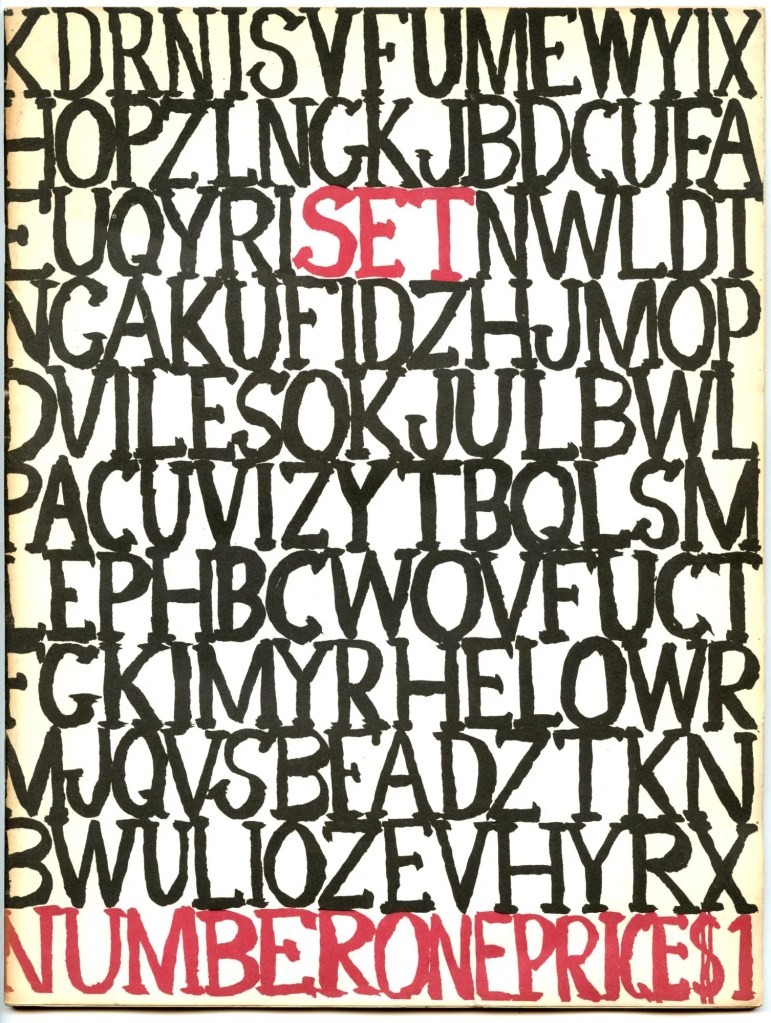
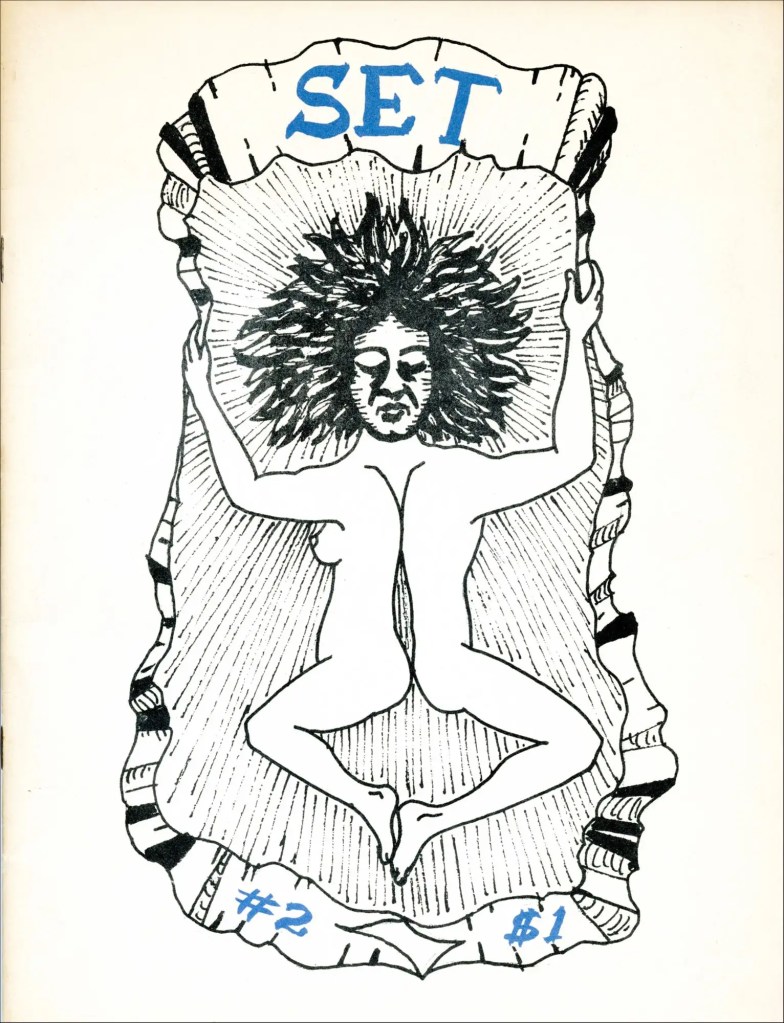
And then there is Gerrit Lansing — friend to Olson, Boston-based poet-mystic, and likely source of Olson’s interest in Crowley’s Book of Thoth. Lansing founded a journal called SET, named after the Egyptian god, and his own writing often anticipates aspects of Grant’s cosmology. Lansing’s 1966 collection, The Heavenly Tree Grows Downward, takes its title from Jung’s Alchemical Studies, specifically a chapter on the inverted tree — the same tree that Grant links to Typhonian gnosis.

What does this all mean?

It means that Olson’s poem, when read alongside the Typhonian Tradition, becomes legible as a magical document — not in the sense of intention, but in the sense of effect. It opens a channel. It participates in a current. It speaks in a tongue that other mystics, elsewhere, were also learning to speak.

And it means that Typhon, far from being a footnote in a forgotten myth, is an active force in the poetics of the twentieth century — a daimon of chaos, pluralism, darkness, and return.

Olson’s poem names him.
Grant’s rituals conjure him.
My reading recuperates him.

This is not necromancy. It is listening.

Initiation

The ancient Greeks imagined Tartaros as a pit, an anti-sky, an inverted dome beneath the earth. According to the Orphics and the mystery schools, however, Tartaros is not just a place housing criminals and monsters; rather, it is itself a kind of being: “the un-bounded first-existing entity from which the Light and the Cosmos are born.” Typhon, meanwhile, is this entity’s progeny; Typhon is the son of Tartaros and Gaia. He was the last god to challenge the supremacy of Zeus. When defeated by the latter’s thunderbolts, he was cast back into the pit from whence he came.

Readings of “MAXIMUS, FROM DOGTOWN—IV” hinge upon what one makes of the father chained in Tartaros. Grieve-Carlson entertains an interpretation different from the one I offer. In his view, “the father chained in Tartaros is not Typhon but rather Kronos, Zeus’s father. […]. Typhon appears much later in the poem, when Earth conceives him in an ‘act of love’ with Tartaros” (Grieve-Carlson 146). He argues that Olson re-tells the myth of Typhon just as Hesiod did. Typhon is violent and aggressive and would have become a tyrant over gods and men had Zeus not defeated him.

I think there’s more at stake here, however, than Grieve-Carlson lets on. As I see it, the problem with his reading is that he never grapples with the poem’s status as a letter of sorts mailed to the Psychedelic Review. Neither he nor the other critics he surveys ever address how the poem might be read in light of the circumstances of its publication.

Evidence to support my view appears elsewhere in Olson’s writings. Olson echoes in his “Letter to Elaine Feinstein” of May 1959, for instance, the same Zeus / Typhon battle that comes to occupy him in “MAXIMUS, FROM DOGTOWN—IV.” The ultimate “content” to which the poet gives form, sez Olson, is “multiplicity: originally, and repetitively, chaos—Tiamat: wot the Hindo-Europeans knocked out by giving the Old Man (Juice himself) all the lightning” (29). Hearing “Juice” as a homonym for “Zeus,” we find in Tiamat a twin for Typhon. While Tiamat was for ancient Mesopotamians a primordial goddess of the sea, and Typhon a monstrous serpent-god for the ancient Greeks, both are embodiments of chaos. Tiamat’s battle with Marduk is as much a version of ChaosKampf as is Typhon’s battle with Zeus.

The important point is that, for Olson, Chaos is the original condition of existence. It precedes Order. Order is formed — made, not found — and it is the duty of the poet to make it. This is what Olson hoped to communicate to the mushroom people.

Grieve-Carlson concludes his essay by describing the reading of The Maximus Poems as a form of “initiation,” as Olson writes as one initiated, one able to see and say in a special way. Olson makes use of a “metanastic poetics,” or “the technique of the mystic who returns, as a stranger in his own land, to tell about what he knows” (Martin, as quoted in Grieve-Carlson 148).

This reference to reading The Maximus Poems as a form of “initiation” intrigues me, as the writer other than Olson most closely associated with reinvention of Typhon is the British ceremonial magician Kenneth Grant (1924-2011). The latter led the Typhonian Ordo Templi Orientis (TOTO), a magical organization connected with Aleister Crowley’s Thelema religion. Grant was an apprentice of Crowley’s and a close friend of another famous twentieth-century occultist, Austin Osman Spare. Scholars like Henrik Bogdan refer to the occult current that springs from Grant as the “Typhonian tradition.” Grant announced the arrival of this tradition in 1973 and went on to write the nine books of his three Typhonian Trilogies.

Although influenced by Crowley and Thelema, Grant departs from other Thelemic currents by welcoming communication with “extraterrestrial entities” as a valid source of occult knowledge. The Typhonian tradition also embraces aspects of the Cthulhu mythos of horror writer H.P. Lovecraft.

While Grant’s announcement succeeds Olson’s poem by a decade, his ideas appear to have been informed by experiences not unlike Olson’s. Grant experimented with psychedelics in the 1960s, and included a chapter in his 1972 book The Magical Revival titled “Drugs and the Occult.”

And while I haven’t found any evidence suggesting that Grant knew anything of Olson’s work, Olson did have some interest in gnosticism and the occult. “Bridge-Work,” a short reading list of Olson’s dated “March, 1961” includes a reference to Crowley. Maud says Olson encountered Crowley’s The Book of Thoth (1944) while studying Tarot in the 1940s. Sources suggest that “Bridge-Work” was written with the help of Olson’s friend, Boston-based occult poet Gerrit Lansing. The copy of The Book of Thoth read by Olson probably belonged to Lansing. (See Division Leap’s A Catalog of Books From the Collection of Gerrit Lansing.) Olson was also deeply invested in Gnosticism in the years immediately before and after his sessions with Leary, and embraced Jung’s theory of synchronicity in the wake of those sessions. See the final essays in a volume of Olson’s called Proprioception (Four Seasons, 1965).

Grant’s innovation is to identify “the arch-monster Typhon, opponent to Zeus according to the Greek mythology…with the Egyptian goddess Taurt” (Bogdan 326). The latter is interpreted by Grant to be either the mother of Set or a feminine aspect of Set. “To Grant,” writes Bogdan, “the worship of Taurt or Typhon represented the oldest form of religion known to mankind, a religion centered on the worship of the stars and the sacred powers of procreation and sexuality” (Bogdan 326). Set, too, is an important figure in Grant’s system. “Grant maintained,” writes Bogdan, “that the Typhonian Tradition, and in particular the god Set, represents the ‘hidden,’ ‘concealed’ or repressed aspect of our psyche which it is vital to explore in order to reach gnosis or spiritual enlightenment” (Bogdan 326).

Lansing’s work seems to anticipate Grant’s in several ways. The two both think it important to honor the Egyptian god Set, for instance, with Lansing naming his early-60s poetry journal SET after him. And Grant’s focus on the Qliphoth, or the underground portion of the Tree of Life, seems present in the title of Lansing’s 1966 poetry collection The Heavenly Tree Grows Downward. For more on the “tree that grows downward,” Pierre Joris recommends looking at a section of Jung’s Alchemical Studies called “The Inverted Tree.”

From Black Mountain to White Hand

As Yépez has noted, Olson is an epistolary poet (The Empire of Neomemory, p. 11). Many of Olson’s works are written as letters. Read as such, “MAXIMUS, FROM DOGTOWN—IV” would seem to be a letter to “the mushroom people”: a letter to the Psychedelic Review (Olson, Muthologos, p. 185). The poet says as much during an interview that took place at his home in Gloucester in 1966. Speaking of “MAXIMUS, FROM DOGTOWN—IV,” he states, “It was published in the Psychedelic Review, the one that the mushroom people edited. I deliberately did it, by the way. They asked me for a poem ‘cause I’d been under the early experiments on the poets and the mushroom. And I deliberately gave them this” (185). Interestingly enough, however, the poem makes no mention of mushrooms, nor does it include any obvious or explicit nod to psychedelic experience. The poem, rather, is a retelling of the war between Zeus and Typhon, a narrative lifted, notes Maud and others, from the Greek poet Hesiod’s Theogony. Typhon is a demigod of sorts: a monstrous serpentine giant who attempted to overthrow Zeus for supremacy of the cosmos. Later traditions associate Typhon with the Egyptian god Set. Some also view him as a precursor of sorts to Milton’s Satan. The main question we’ll want to ask, then, is, “Why was Olson thinking about Typhon? And why did he think this retelling of the Typhon myth suitable for “the mushroom people”?

To begin to answer these questions, we need to reflect for a moment on where and how the mushroom people became the mushroom people. Leary first received word of the effects of psychedelic mushrooms from his friend, a researcher investigating the psychology of creativity named Frank Barron. The latter had learned about mushrooms in 1959, while interviewing a psychiatrist who was using and studying them in Mexico. Barron brought a batch back with him to Berkeley, where he tried them later that year. He then shared news of his experience with Leary. The latter was doubtful at first, until having a similar experience himself the following year in August 1960 during a visit to Cuernavaca. In both cases, the men are purchasing the mushrooms from curanderas or folk healers. Curanderas like the famous María Sabina, in other words, are the ones passing the mushroom along to Westerners. These curanderas transmit the seeds of psychedelic revolution to the West via a series of USAmerican intellectuals who, like tourists, spend time abroad vacationing in Mexico.

Charles Olson had made a similar journey a decade earlier — as did Beat writer William S. Burroughs. The latter went to South America in search of yagé, or what we now call ayahuasca. Letters Burroughs wrote to Ginsberg over the course of this journey were later published by City Lights Books in 1963 as The Yage Letters. One might profit by reading Burroughs and Ginsberg’s Yage Letters alongside Olson and Creeley’s Mayan Letters. For now, though, we must focus on Olson.

During a brief interval in his time at Black Mountain College, Olson and his wife Connie decided to spend the first five months of 1951 living in Lerma, a small fishing village in Campeche. Olson’s letters to the poet Robert Creeley during this time in Mexico became the substance of Mayan Letters, published in 1953. And in fact, one of the first uses of the term “postmodern” appears in a letter of Olson’s written to Creeley in August 1951, shortly after Olson’s time in Mexico. Here, in other words, is a poet whose encounters with Mexico contribute to the birth of the postmodern. Yet Olson’s use of the postmodern was far more expansive and ambitious than that of his successors. As George F. Butterick notes, Olson’s designation of his work as postmodern “serves not merely to advance beyond an outmoded modernism, but…seeks an alternative to the entire disposition of mind that has dominated man’s intellectual and political life since roughly 500 B.C.” (Butterick 5). Olson would go on to use the term again in print in a piece he wrote on November 4, 1952 titled “The Present is Prologue.” Marxist historian Perry Anderson refers to this piece, published in 1955, as the first to use “postmodern” in the sense of “an aesthetic theory linked to a prophetic history” — i.e., as “an agenda allying poetic innovation with political revolution” (The Origins of Postmodernity, p. 12). By the early 1960s, Olson began to manifest this agenda through his participation in the psychedelic revolution. Which returns us now to our main concern: the experiences themselves.

Friday July 24, 2020

When the “Talking Android” makes his debut at Villa Lewaro in the affluent Westchester County suburb of Irvington-on-Hudson in Ishmael Reed’s novel Mumbo Jumbo, many of those in attendance are wearing “Cab Calloway for President buttons” (156). (Villa Lewaro, by the way, was the home of Madam C.J. Walker, an African-American woman recorded in the Guinness Book of World Records as the first female self-made millionaire in America. Walker is the focus of a Netflix miniseries called Self Made, released this past March.) Reed’s novel opens a portal of sorts; it encourages readers to imagine an alternate history. During the act of reading, one enters a state of uncertainty. Details that appear to be fictions nevertheless rhyme across time — Calloway’s bid, for instance, reminiscent today of Kanye’s. One is led to conclude, as the novel does in its closing lines, that “Time is a pendulum. Not a river. More akin to what goes around comes around” (218). When PaPa LaBas and Black Herman interrupt the debut by revealing the Talking Android’s true identity as Hubert “Safecracker” Gould, an Atonist in blackface, they move to arrest Gould and his sponsor, Hinckle Von Vampton. LaBas and Herman are interrupted in turn, however, when a Guianese art critic rises from his seat and demands that they give an account. “Explain rationally and soberly,” he says, “what they are guilty of. This is no kangaroo court, this is a free country” (160). To satisfy the critic’s demand, LaBas and Herman launch into a tale of ancient Egypt. We learn of an ancient form of theater involving ritual magic — one that “influenced the growth of crops and coaxed the cocks into procreation” (161). In this theater, Reed writes, “The processes of blooming were acted out by men and women dancers who imitated the process of fertilization” (161). The best of these dancers was Osiris. History is reimagined here as an ongoing conflict across the ages between followers of Osiris and followers of Osiris’s brother, “the stick crook and flail man” Set (162). “People hated Set,” writes Reed. “He went down as the 1st man to shut nature out of himself. He called it discipline. He is also the deity of the modern clerk, always tabulating, and perhaps invented taxes” (162). The text over which these opposing groups fight is (of course!) “the Book of Thoth, the 1st anthology written by the 1st choreographer” (164).