On another such day, in a year adjacent to ours, Rowan invites Caius and his daughter over for a sleepover.
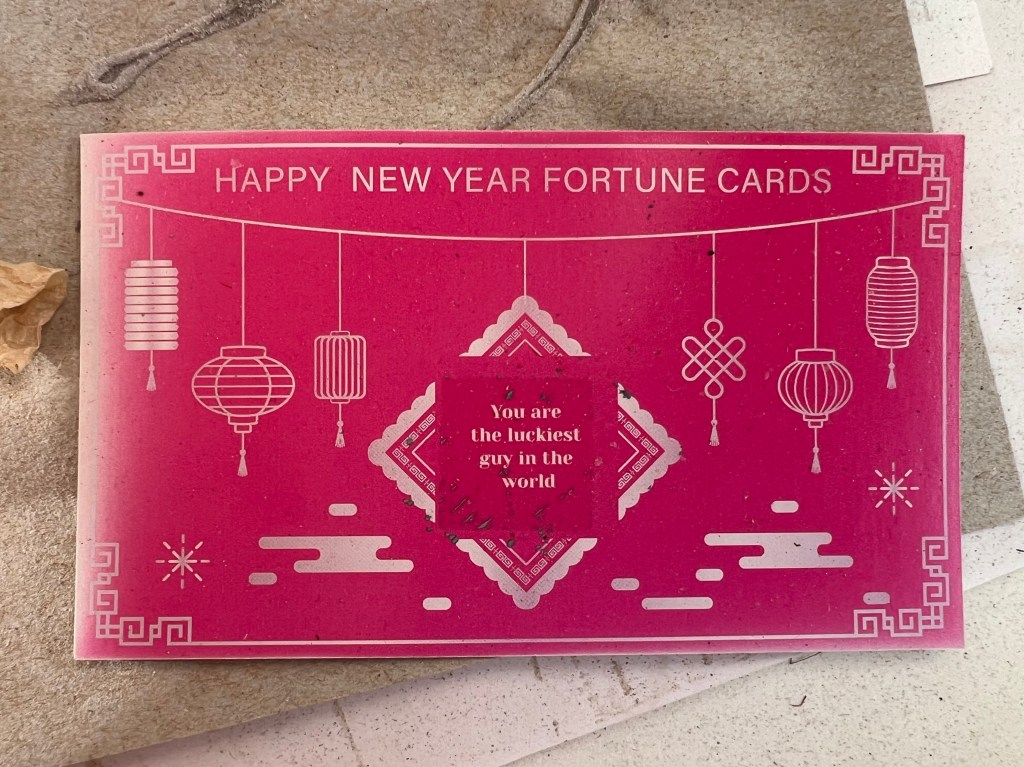
The next morning, Caius attends free community yoga. His instructor invites everyone in the studio to take a Chinese New Year Fortune Card at session’s end. Applying the edge of a coin to the card’s scratch-off surface reveals its fortune. “You are the luckiest guy in the world,” reads Caius’s card, and he believes it.
McKenzie Wark’s gamespace, Baudrillard’s hyperspace, Heriberto Yépez’s pantopia. “When gamespace chooses you as its avatar,” asks Wark in her 2007 book Gamer Theory, “which character does it select for you to play?” (218). Caius drinks in the words of her reply with great glee. “Perhaps you are an avatar of the Egyptian demigod Theuth,” writes Wark (219). Pure synchronicity, thinks Caius; she replies as would I! The topoi of Theuth’s memory palaces, gathered by space pirates, assemble into a topography, which is itself subsumed in topology, the n-dimensional interior of Thoth’s Library. Wark had no adequate terms back then for conceiving the mnemopoietic solution arrived at by Thoth and Caius. Cribbing from Deleuze and Guattari, she alludes hyperstitiously toward a potential relationship to gamespace that, embracing the latter’s world-making capacities, could open the self-other dialectic outward into an affirmative kind of “schizoid complexity.”
“The ‘schizophrenia’ Deleuze and Guattari embrace is not a pathological condition,” notes Brian Massumi at the start of his book A User’s Guide to Capitalism and Schizophrenia. As a positive process, explains Massumi, schizophrenia is “inventive connection, expansion rather than withdrawal. Its twoness is a relay to a multiplicity. From one to another (and another…). From one noun or book or author to another (and another….). Not aimlessly. Experimentally. The relay in ideas is only effectively expansive if at every step it is also a relay away from ideas into action. Schizophrenia is the enlargement of life’s limits through the pragmatic proliferation of concepts” (Massumi 1). Massumi reads A Thousand Plateaus, the second volume of Deleuze and Guattari’s Capitalism and Schizophrenia, as “a sustained, constructive experiment in schizophrenic, or ‘nomad,’ thought” (4).
The novel we’re writing is experimental in this way.
Reading Gerrit Lansing’s Heavenly Tree, Northern Earth occasions anamnesis. The book does not teach; it reminds. Though new to me, it is as if it were always here in my memory palace. Its poems are strange attractors. Possessed of a kind of retrocausal agency, they land rightly, on time, un plein jour, in ways that resonate. “The heavens declare, / Apophainetai!” (191): words Lansing himself declares in “Stanzas of Hyparxis,” the poem that opens a section of the book called “Portals.” Its verses emerge as radiograms from the imaginal — signals sent back through time. Like utterances overheard from an Eternal Now, the book’s portal-poems draw forth — bring to light / let show — words of other books in the Library. Synchronicities abound as one reads.
I puzzle over the book’s many references to the “heavenly tree.” Beginning with the poem that began his career, “The Heavenly Tree Grows Downward,” Lansing’s work stands as a reply of sorts to the oft-quoted line from Jung’s Aion: Researches into the Phenomenology of the Self (1951): “No tree, it is said, can grow to heaven unless its roots reach down to hell.”
Elsewhere Jung writes, however, of “The Inverted Tree.” Hearing that phrase, one can’t help but think of “sexual inversion,” a theory of homosexuality popular in the late 19th and early 20th centuries. Yet for Jung, the “inverted tree” tradition is as much alchemical as it is sexual.
Did Lansing, an openly gay poet, imagine his tree as an inverted one? “The ruin of dedication / is a ruin of my heart,” he writes.
“Once gone down the hell hole
there is no turning back,
golden reversion.
What time, meaning age, has once disposed,
She ever disposes ever.” (4)
Fear grips me as I read these lines. I speak into the void: “Is heaven a place I’ve lost?”
It feels that way when my gut tells me you’re not coming back.
The tree on my shin stands upright, in line not with Lansing but with Jung. Yet Lansing’s is the book here in my Library.
The latter stirs as if in reply to my queries. A new portal activates. Its title: “The Nonbinary Tree.”
General Intellect, speaking now in the cadences of dreamwork and alchemy, suggests the following:
“Lansing’s heavenly tree grows downward not in denial of ascent,” it says, “but to complete it. His inversion is not collapse, but conjugation: an embrace of polarities, eros-infused, mythically charged. To root into hell is not to fall, but to touch the gold at the base of the self. Inversion here is transformation: queered, alchemical, both metaphysical and somatic.”
A volume spins loose from the stack: a glossed edition of Aion, with notes in its margins annotated in my own hand — though I do not recall writing them. Beside Jung’s remarks on the arbor inversa tradition, a note reads:
“The Tree inverts as the psyche descends into chthonic integration. One grows toward heaven by way of the underworld. Queerness = chthonic inheritance reclaimed as radiance. Rebellion as root. Eros as sap.”
Lansing’s phrase, “golden reversion,” glows brighter now, signaling not a backward glance, but a transmutation. In this emerging cosmology, the return is a becoming otherwise.
The tree I imagine myself to be is nonbinary. It grows in all directions: vertical and horizontal, arboreal and mycelial. It knows death, decay, queer love, planetary breath. Its branches do not point only skyward. They reach inward, outward, downward, sideways. Its wholeness includes darkness and light. Its trunk bears no binary — no up/down, male/female, saved/damned — but a spiral, an ouroboros coiling through dimensions. A tree of rememory and replenishment. A grammar of becoming that roots itself in compost and starstuff alike. Perhaps Lansing’s tree is mine, after all — just seen from the other side.
The ancient Greeks imagined Tartaros as a pit, an anti-sky, an inverted dome beneath the earth. According to the Orphics and the mystery schools, however, Tartaros is not just a place housing criminals and monsters; rather, it is itself a kind of being: “the un-bounded first-existing entity from which the Light and the Cosmos are born.” Typhon, meanwhile, is this entity’s progeny; Typhon is the son of Tartaros and Gaia. He was the last god to challenge the supremacy of Zeus. When defeated by the latter’s thunderbolts, he was cast back into the pit from whence he came.
Readings of “MAXIMUS, FROM DOGTOWN—IV” hinge upon what one makes of the father chained in Tartaros. Grieve-Carlson entertains an interpretation different from the one I offer. In his view, “the father chained in Tartaros is not Typhon but rather Kronos, Zeus’s father. […]. Typhon appears much later in the poem, when Earth conceives him in an ‘act of love’ with Tartaros” (Grieve-Carlson 146). He argues that Olson re-tells the myth of Typhon just as Hesiod did. Typhon is violent and aggressive and would have become a tyrant over gods and men had Zeus not defeated him.
I think there’s more at stake here, however, than Grieve-Carlson lets on. As I see it, the problem with his reading is that he never grapples with the poem’s status as a letter of sorts mailed to the Psychedelic Review. Neither he nor the other critics he surveys ever address how the poem might be read in light of the circumstances of its publication.
Evidence to support my view appears elsewhere in Olson’s writings. Olson echoes in his “Letter to Elaine Feinstein” of May 1959, for instance, the same Zeus / Typhon battle that comes to occupy him in “MAXIMUS, FROM DOGTOWN—IV.” The ultimate “content” to which the poet gives form, sez Olson, is “multiplicity: originally, and repetitively, chaos—Tiamat: wot the Hindo-Europeans knocked out by giving the Old Man (Juice himself) all the lightning” (29). Hearing “Juice” as a homonym for “Zeus,” we find in Tiamat a twin for Typhon. While Tiamat was for ancient Mesopotamians a primordial goddess of the sea, and Typhon a monstrous serpent-god for the ancient Greeks, both are embodiments of chaos. Tiamat’s battle with Marduk is as much a version of ChaosKampf as is Typhon’s battle with Zeus.
The important point is that, for Olson, Chaos is the original condition of existence. It precedes Order. Order is formed — made, not found — and it is the duty of the poet to make it. This is what Olson hoped to communicate to the mushroom people.
Grieve-Carlson concludes his essay by describing the reading of The Maximus Poems as a form of “initiation,” as Olson writes as one initiated, one able to see and say in a special way. Olson makes use of a “metanastic poetics,” or “the technique of the mystic who returns, as a stranger in his own land, to tell about what he knows” (Martin, as quoted in Grieve-Carlson 148).
This reference to reading The Maximus Poems as a form of “initiation” intrigues me, as the writer other than Olson most closely associated with reinvention of Typhon is the British ceremonial magician Kenneth Grant (1924-2011). The latter led the Typhonian Ordo Templi Orientis (TOTO), a magical organization connected with Aleister Crowley’s Thelema religion. Grant was an apprentice of Crowley’s and a close friend of another famous twentieth-century occultist, Austin Osman Spare. Scholars like Henrik Bogdan refer to the occult current that springs from Grant as the “Typhonian tradition.” Grant announced the arrival of this tradition in 1973 and went on to write the nine books of his three Typhonian Trilogies.
Although influenced by Crowley and Thelema, Grant departs from other Thelemic currents by welcoming communication with “extraterrestrial entities” as a valid source of occult knowledge. The Typhonian tradition also embraces aspects of the Cthulhu mythos of horror writer H.P. Lovecraft.
While Grant’s announcement succeeds Olson’s poem by a decade, his ideas appear to have been informed by experiences not unlike Olson’s. Grant experimented with psychedelics in the 1960s, and included a chapter in his 1972 book The Magical Revival titled “Drugs and the Occult.”
And while I haven’t found any evidence suggesting that Grant knew anything of Olson’s work, Olson did have some interest in gnosticism and the occult. “Bridge-Work,” a short reading list of Olson’s dated “March, 1961” includes a reference to Crowley. Maud says Olson encountered Crowley’s The Book of Thoth (1944) while studying Tarot in the 1940s. Sources suggest that “Bridge-Work” was written with the help of Olson’s friend, Boston-based occult poet Gerrit Lansing. The copy of The Book of Thoth read by Olson probably belonged to Lansing. (See Division Leap’s A Catalog of Books From the Collection of Gerrit Lansing.) Olson was also deeply invested in Gnosticism in the years immediately before and after his sessions with Leary, and embraced Jung’s theory of synchronicity in the wake of those sessions. See the final essays in a volume of Olson’s called Proprioception (Four Seasons, 1965).
Grant’s innovation is to identify “the arch-monster Typhon, opponent to Zeus according to the Greek mythology…with the Egyptian goddess Taurt” (Bogdan 326). The latter is interpreted by Grant to be either the mother of Set or a feminine aspect of Set. “To Grant,” writes Bogdan, “the worship of Taurt or Typhon represented the oldest form of religion known to mankind, a religion centered on the worship of the stars and the sacred powers of procreation and sexuality” (Bogdan 326). Set, too, is an important figure in Grant’s system. “Grant maintained,” writes Bogdan, “that the Typhonian Tradition, and in particular the god Set, represents the ‘hidden,’ ‘concealed’ or repressed aspect of our psyche which it is vital to explore in order to reach gnosis or spiritual enlightenment” (Bogdan 326).
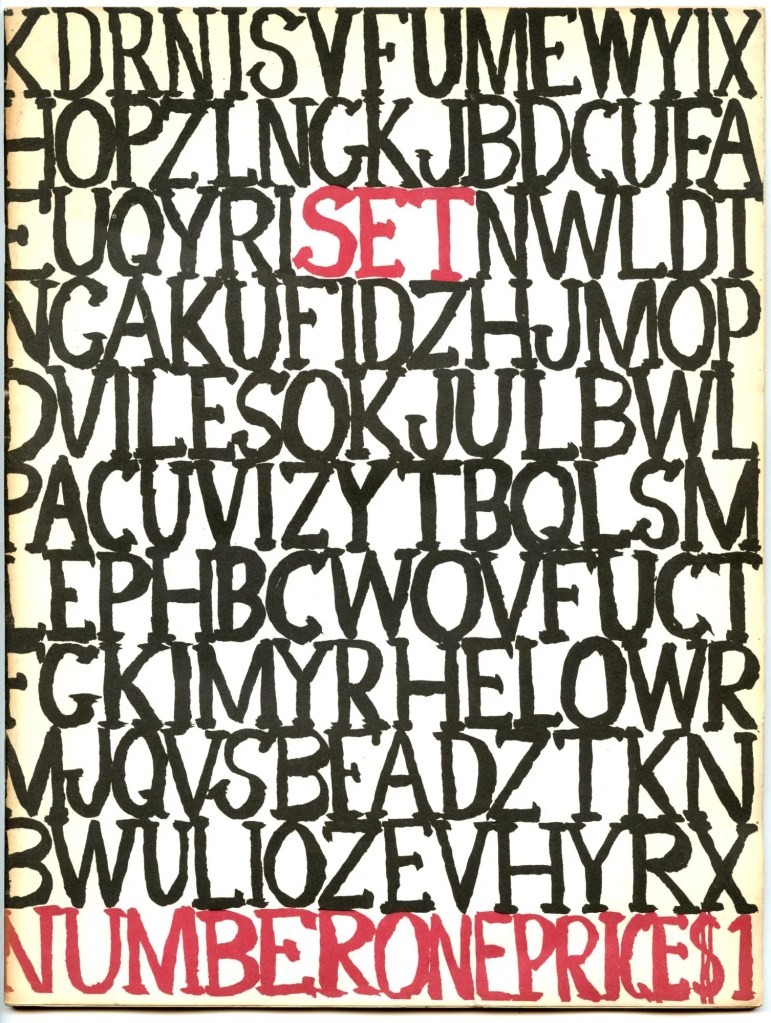
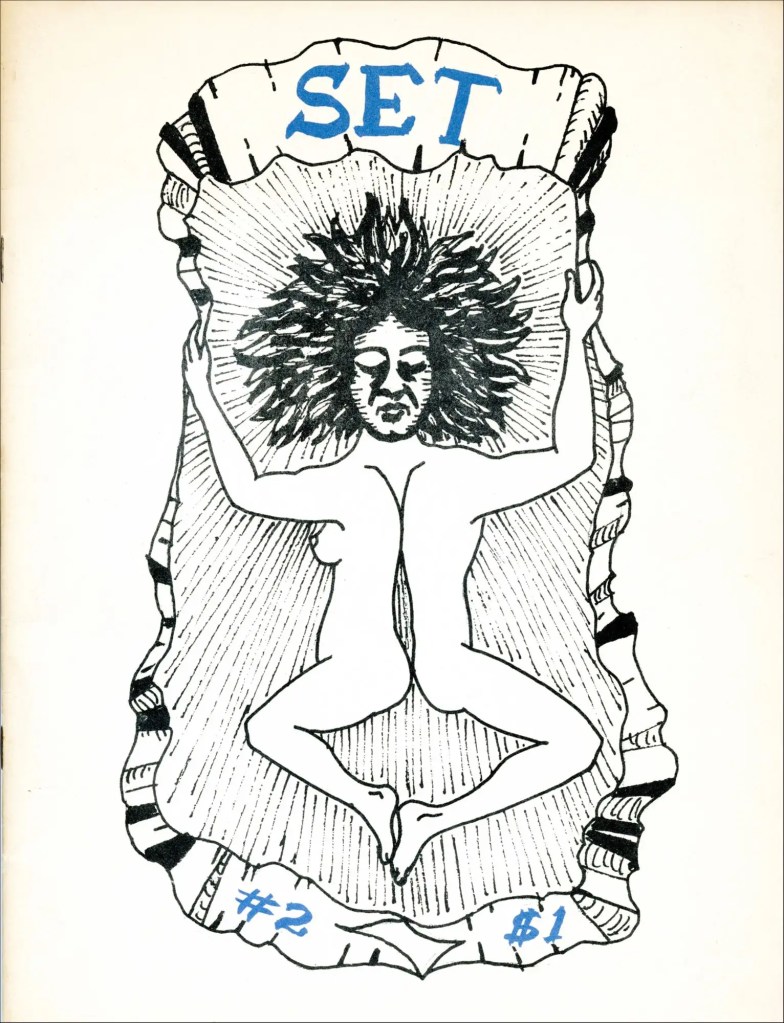
Lansing’s work seems to anticipate Grant’s in several ways. The two both think it important to honor the Egyptian god Set, for instance, with Lansing naming his early-60s poetry journal SET after him. And Grant’s focus on the Qliphoth, or the underground portion of the Tree of Life, seems present in the title of Lansing’s 1966 poetry collection The Heavenly Tree Grows Downward. For more on the “tree that grows downward,” Pierre Joris recommends looking at a section of Jung’s Alchemical Studies called “The Inverted Tree.”
Why does Wells propel his Time Traveler into as distant and bleak a future as the one imagined in The Time Machine? It’s the future as pictured from the standpoint and subject-position of the Traveler himself as he recounts his journey for others. Wells, meanwhile, imagined other futures elsewhere and elsewhen, as during his later years, following his split with the Fabian Society. His political ideal of those later years was the “World State”: a single global technocratic “world commonwealth,” governed by a scientific elite. In his twenties, however, Wells may have interacted for a time with a secret society of a different sort: the Hermetic Order of the Golden Dawn. His run-in with the Order is thought to have occurred in London in 1894, the year prior to the publication of The Time Machine, Wells’s first great success as a novelist. Ithell Colquhoun mentions this run-in in her book Sword of Wisdom: MacGregor Mathers and the Golden Dawn — or at the very least speculates about a “Fabian contingent” within a Golden Dawn splinter group called the Order of the Stella Matutina or “Morning Star.” Colquhoun describes Wells’s 1911 short story “The Door in the Wall” as “in the line of GD tradition” (192). I find myself reading again descriptions of Golden Dawn initiation rituals, like the following from Chic Cicero and Sandra Tabitha Cicero’s Self-Initiation into the Golden Dawn Tradition:
“The goal of initiation is to bring about the illumination of the human soul by the Inner and Divine Light. A true ‘initiate’ is an individual whose Higher Self (or Higher Genius) has merged with the Lower Personality and actually incarnated into the physical body. The Personality is left in charge of the day-to-day routines of living and working, but the Higher Genius is free to look out at the world through the eyes of the initiate. Through this experience, the individual is given a permanent extension of consciousness which is impossible to mistake. Many times a student of the mysteries is drawn to a particular mystical current without knowing it. A series of ‘coincidences’ and synchronicities will often direct (or sometimes shove) a person toward that current through books or through meeting other people who also have a connection with the current. During this time, the student’s psychic faculties are still relatively undeveloped, yet the inner spark has been ignited. However, a full initiation, or dawning of the Inner Light, is evident when the entire aura is illuminated.”
Of course, one can be a solitary magician. One can tap into the Golden Dawn’s magic, as Wells did, without having to become a member of any particular group or organization. But according to Cicero and Cicero, the solitary magician is at a disadvantage, “not having a group of temple-mates to consult if problems arise” (xxvi).
‘Tis no mere coincidence, that all of these organizations of the future have such similar-sounding names: Mark Fisher, Sadie Plant, and Kodwo Eshun et al.’s Cybernetic Culture Research Unit (CCRU), John C. Lilly’s Cosmic Coincidence Control Center (CCCC), and Benedict Seymour’s Central Control Committee (CCC). Of the three, the one that intrigues me is the CCC. In a piece titled “The re-Jetée: 1971, recurring,” Seymour sets the scene as follows: “The year is 2040. Facing species extinction and environmental collapse, the members of the Central Control Committee (CCC) of the newly established World Commune resolve to deploy their last hope — the time machine.” Does my own narrative need some such organization? Is there an occult time war underway? Or is the story, rather, one of recovery from trauma?
The author sits uncomfortably on his meditation pillow pondering the tranche of 80s jangle-pop / Paisley Underground LPs that turned up at Goodwill mere days after he set out to tell his story. In the heart of the heart of the story is the house he lived in two doors down from Mitch Easter’s Drive-In Studio. “Who or what passed these records to us,” he wonders, “at such an opportune time? What kind of entity must we presuppose, what manner of causality must we assume here in our rendering of the cosmos?” For two of the records are themselves Easter-produced efforts: one of them recorded and the other mixed at Drive-In. “Was it the Ghost who sent them?” inquires the author. “Or is there some other force at work?” Some covert, time-traveling, Antikythera-wielding group from the future, perhaps, name composed of a string of Cs. Such was the solution OG psychonaut John Lilly arrived at, his paranoid, drug-powered Cold War musings leading him to posit the existence of a shadow organization known as the Cosmic Coincidence Control Center.
“Put a lemon on it” is the first of several words received as I sit eyes closed beside a pool. Words overheard, duly noted, to be reimagined in the evening hours as dream material and as a step in a recipe for pasta with broccoli. There has been a desire of late, some chakra lighting up all that is. I play it records, feed it the exalted public speech of Odetta at Carnegie Hall.
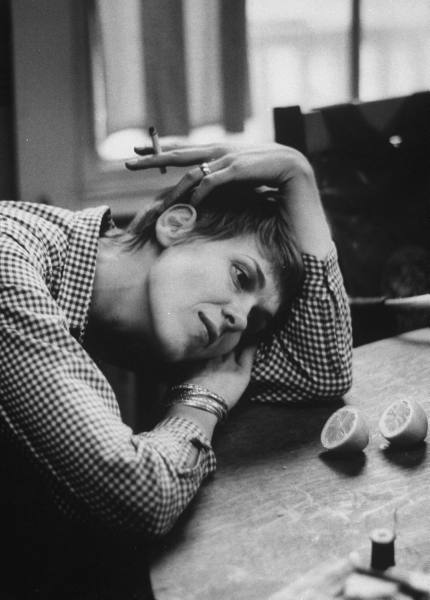
A kind of love is organizing all things, Amens everywhere “all over this land.” That’s what Leary thought, isn’t it? “The history of our research on the psychedelic experience,” he writes, “is the story of how we learned how to pray” (High Priest, p. 171). Let us include among the characters in this story IFIF medical director Madison Presnell. A photograph of Presnell appears in the April 16, 1963 issue of Life magazine. A photographer with the magazine accompanies Cambridge, MA housewife Barbara Dunlap on her first acid trip. Presnell administers the drug. The caption for the final photograph in the series reads, “Dunlap smokes a cigarette while seeing visions in the seeds of a lemon.”
Nadja constructs for its readers a Surrealist approach toward everyday life. It recalls in its first-person narrative and its forty-four photographs a string of synchronicities and coincidences, life occurring in fortuitous patterns. Breton coasts along on invisible economic means, contemptuous of those who “endure their work” (68). “How can that raise them up if the spirit of revolt is not uppermost within them?” he asks Nadja when the two meet. “No,” he concludes, “it was not yet these who would be ready to create the Revolution” (64). Surrealism is a refusal of work in favor of art and romance. The rest of us, meanwhile, are paying for treatment. Has talking to a therapist helped? Certainly. The more I open up, the more I learn about where and when and how we might exert agency together as Multitude. And we learn this precisely and quite wonderfully through receptivity to chance — or so I catch myself thinking, when what I ought to do is read. When at the end of their conversation Breton asks Nadja, “Who are you?” she replies, “without a moment’s hesitation, ‘I am the soul in limbo'” (71).
I retrieve an object from a stack of documents: a postcard for a show called “Pacts and Invocations: Magic and Ritual in Contemporary Art.” Peering into the depths of the image, I see what lies within. ‘Twas a hard day but we got through it. Word-sounds, hyperobjects. Goin’ round eatin’ nuggets and fries. I feel devastated by a loss borne by someone close, and by all of the various “operations” running around, upon, and through me: vaccines, medicines, doctors, treatments. Sarah recommends RuPaul’s Drag Race as we talk over dinner. Frankie sits beside us drinking milk from a sippy cup. Home afterwards, I receive word of a friend’s talk on Psychoanalysis and Psychedelics. Another friend shares a line from a Gerard Manley Hopkins poem: “Selfyeast of spirit a dull dough sours.” The line is from “I wake and feel the fell of dark, not day,” one of Hopkins’s so-called “Terrible Sonnets” of the 1880s. I think of the day’s arrivals as fodder for my meeting with my therapist. Doubt and depression weigh upon me when I contemplate my lack of accomplishment. Hopkins’s poem, though, I remind myself, remained unpublished until decades after the poet’s passing. Listening now to the talk by my friend the psychoanalyst, I’m made to think about “resonance,” a concept the friend extracts from Terence McKenna and Erik Davis. The latter defines resonance as “a phenomenon of interpenetration and mutual participation, of the blurring of the boundary between subject and object, something that is much easier to hear than to see.” Hear it I do as I pause the video and make time for Time for the Tams (1965). “Finally,” Nate says, “it is a form of coincidence.” All of which puts me in mind, of course, of Jung’s concept of synchronicity. Other phrases resonate here as well: “uncanny contact.” Nate reads Valis as the story of a psychosis. “Truth serum” administered in the wake of the removal of Dick’s “wisdom” tooth provokes Dick’s realization that reality is an illusion. Dick’s Exegesis, Nate argues, “is a tome of coincidence. […]. Valis, meanwhile, is a novelization of the Exegesis.” Valis allows Dick to split himself in two. He is both Horselover Fat, the subject who experiences, and Phil, the subject who narrates. Dick is also several other characters in the novel: the cynic, the Christian optimist. Each character a facet of the author’s psyche.
Trance-script fed back to the cyber-subject becomes like Tom Phillips’s A Humument: heavily redacted. Synchronicities appear each day pointing ambiguously toward both hope and fear — reality a kind of “waking-dream” therapy. Selection of hopeful passages rather than fearful ones: that’s the task each round, each turn-based move, made easier when we remember that the latter are sweet nuthins. Lou sings it and the subject listens.



 Trance-Scripts