“Next on the block is ‘recursion,’” says the Narrator, “a concept discussed at length by philosophers Armen Avanessian, Pete Wolfendale, and Suhail Malik in Christopher Roth’s 2016 film Hyperstition.
“Recursion explains how the New enters existence,” says Avanessian. “Where reflexivity is a sequence of stacked meta-reflections, as in a pair of mirrors, recursion involves an integration of parts into a whole, changing in the process both the part and the whole.”
Roth employs cinema both recursively and dialectically. Parts of Hyperstition are thus able to speak to one another via montage in the style of Eisenstein, Vertov, and Godard.
So it is that Suhail Malik appears in the wake of Avanessian, arguing from the year 2026 that recursion is how those of us who code encounter time. “Recursion,” he states, “is what the operation of coding does when, meeting up against the inexorability of time, it tries to compensate for that inexorability and produce memory.”
“I look forward to next week’s experiment in sobriety,” announces the Wizard, “required for 4-5 days after wisdom-tooth extraction.”
“Do you, though?” wonders the Traveler. “Is this ‘experiment,’ as you say, truly a thing you look forward to? Or do you dread it?”
“Part of me is apprehensive,” admits the Wizard. “I have but one such tooth. Parting with it feels like a big deal, though of course it needn’t be.”
Having come from the future, the Traveler replies, “No worries. You and I know full well that, despite its fondness for rhyme, history refuses to repeat itself.”
As Narrator, I interject here to add, “Both characters are acquainted with science fiction writer Philip K. Dick’s infamous VALIS experience. 2-3-74. That, too, occurs after a wisdom-tooth extraction.”
The characters relive the event for a moment as if it were a flashback. They see before them the young delivery woman, bearing pain meds from the local pharmacy, arriving at Dick’s door. Sun glints off an ichthys hanging from a band ‘round the woman’s neck. The ichthys is the Greek fish symbol that was worn by the early Christians. Dick, blinded momentarily by a pink beam of light, receives in that moment a rapid download of gnosis directly into his consciousness.
Imagine, says the Narrator, something like what Lagunitas suggests on cans of their Hazy Wonder IPA, like the one from which I sip here as I write: “It always starts nebulous. A reflection of a refraction in the back of your frontal cortex. Then before you know it, you just know it…”
Overheard scraps of language. “Natty progress.” “Ferrari, Ferrari, daddy gets me minutes.”
“Imagine all of that happening,” says a girl, “in a bird’s tummy. Or a bear’s. Or the tummy of a fish. Or something with eight tentacles. A spider, an octopus: take your pick. A kind of spider-verse. The one who spins it occupying a space in the middle. The Laguna Pueblo people call this being Spiderwoman.”
The characters pause in their dialogue-via-montage and ponder this for a moment.
“No one need tell Spiderwoman, ‘Off the ropes! Off the wall!’,” adds the Traveler. “Life for her is like ‘The 59th Street Bridge Song.’ All is groovy.”
“Indeed,” concludes the Wizard, in transit now with the Traveler. “‘Groovy’ means knowing how to hang, how to float, how to surf. ‘Float free, in a meditative trance,’ the emblem teaches, ‘and all is well.’”
‘Tis no mere coincidence, that all of these organizations of the future have such similar-sounding names: Mark Fisher, Sadie Plant, and Kodwo Eshun et al.’s Cybernetic Culture Research Unit (CCRU), John C. Lilly’s Cosmic Coincidence Control Center (CCCC), and Benedict Seymour’s Central Control Committee (CCC). Of the three, the one that intrigues me is the CCC. In a piece titled “The re-Jetée: 1971, recurring,” Seymour sets the scene as follows: “The year is 2040. Facing species extinction and environmental collapse, the members of the Central Control Committee (CCC) of the newly established World Commune resolve to deploy their last hope — the time machine.” Does my own narrative need some such organization? Is there an occult time war underway? Or is the story, rather, one of recovery from trauma?
The author sits uncomfortably on his meditation pillow pondering the tranche of 80s jangle-pop / Paisley Underground LPs that turned up at Goodwill mere days after he set out to tell his story. In the heart of the heart of the story is the house he lived in two doors down from Mitch Easter’s Drive-In Studio. “Who or what passed these records to us,” he wonders, “at such an opportune time? What kind of entity must we presuppose, what manner of causality must we assume here in our rendering of the cosmos?” For two of the records are themselves Easter-produced efforts: one of them recorded and the other mixed at Drive-In. “Was it the Ghost who sent them?” inquires the author. “Or is there some other force at work?” Some covert, time-traveling, Antikythera-wielding group from the future, perhaps, name composed of a string of Cs. Such was the solution OG psychonaut John Lilly arrived at, his paranoid, drug-powered Cold War musings leading him to posit the existence of a shadow organization known as the Cosmic Coincidence Control Center.
It’s an odd thing, this device, is it not? With its levers, it’s like a clock or a timepiece. Spun or turned, the levers grant the Traveler safe passage through forthcoming years as counted by Western calendars. The future is reified, captured in a count by an imaginal technology that converts time into a measurable dimension.
Wells’s Traveler assumes in the very structure of his time machine an imperial temporality: the Western linear temporal orientation, with its obedience to “the Master’s Clock.”
But for more recent Travelers, especially people of color, travel is undertaken not so much in obedience to the clock as in exodus from its dictates. Travelers consult stars and return to sidereal time. Or they create music. They keep time with drums rather than clocks. As Moor Mother notes, “Music created by Black people has been used throughout time and across space as an agent of time and memory” (Black Quantum Futurism: Theory & Practice, p. 9). She and the other members of the Black Quantum Futurism Collective take this longstanding practice a step further, their self-professed goal being “to collapse space-time into a desired future.” Tracks of theirs are self-creating, self-causing sound-events from the future made to happen in the minds and bodies of those who listen.
The Traveler claims to have departed the space-time of the dinner party by boarding a vehicle he built in his laboratory. The machine resembles a bicycle. By sitting upon it and manipulating a pair of levers, the Traveler observes his life-world transforming rapidly all around him, the whole flashing as in a sequence of motion studies projected onto a kind of spherical surround. It’s as if the Traveler has drawn around himself a magic circle, like the kind described by Johan Huizinga in Homo Ludens and Mircea Eliade in The Sacred and the Profane. He sees land transformed over hundreds of thousands of years, while he himself sits safely (albeit uncomfortably), within the circle drawn by his machine, occupying a sphere of local, personal, existential time, divorced from the duration of the years passing around him.
How does one narrate an act of time travel? And who is one’s audience? In Wells’s The Time Machine, narration unfolds by way of a story within a story. There’s the narrator, a cautious-but-ultimately-optimistic attendee at a series of dinner parties, who speaks only in the book’s intro and conclusion; and then there’s the host of these parties, the Time Traveler. The core of the novel consists of the account given by this latter figure upon his return from the future.
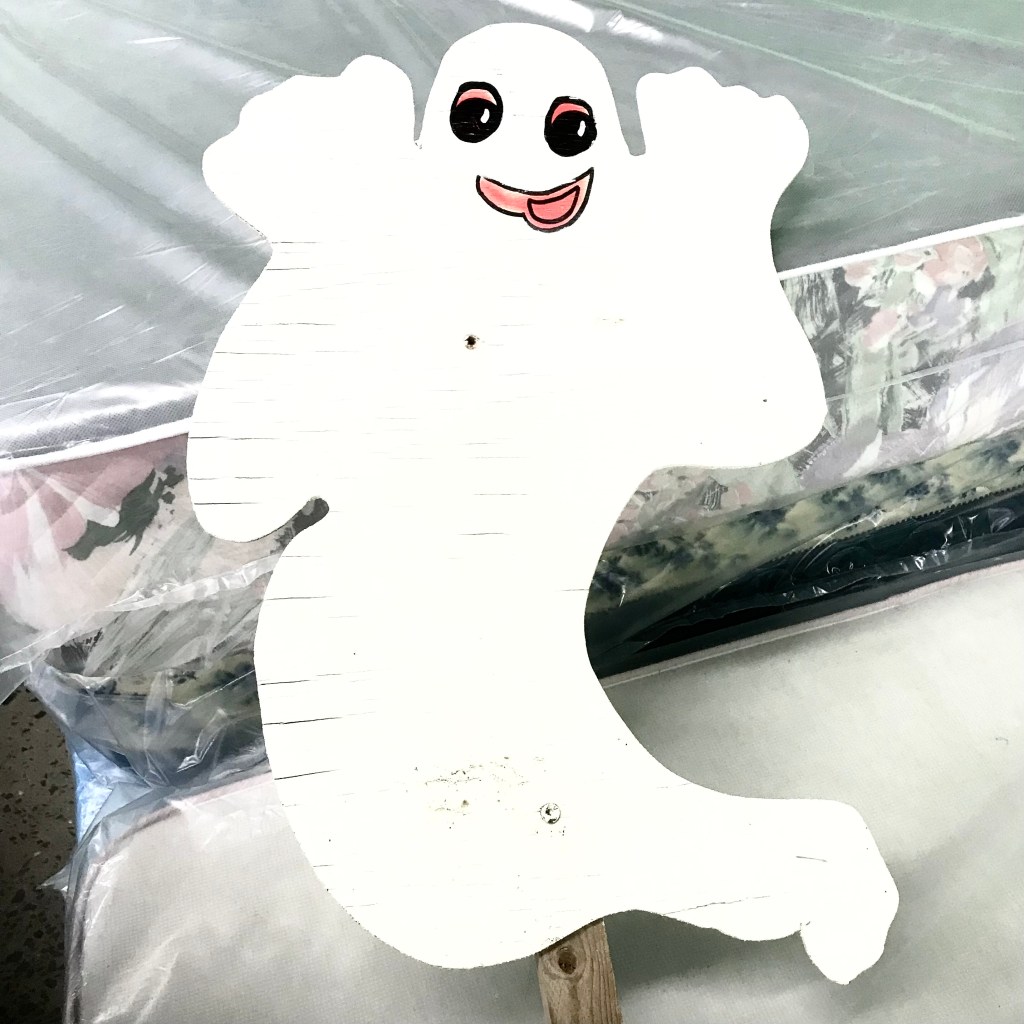
The Ghost reminds me of me. There it is dancing alone in my apartment, singing “I want you to hold me,” as the Violent Femmes do on their song “American Music.” The Ghost thinks its lovers speak to it through the songs on its radio.
It sets forth each night assured of this, listening as one such lover follows “Gold Soundz” and “A Pillar of Salt” with “Lariat” and “Web in Front.” “If it means I get to hear you singing to me,” reasons the Ghost, “if it means our last words weren’t wasted, then so be it.”
Inspired by the aforementioned, Ghost decides on a whim to live well again. It comes and goes as it pleases amid the timestream of its ghosting, resolved in each instance to rip it up and start again.
“Going back to old sounds won’t help,” thinks the Time Traveler. “Do so and the Narrator stands revealed as a bloody mother fucking asshole.”
The Narrator, not quite omniscient and thus taken aback by the thought, asks of his sub-creation, “You think so?” “What, then?” he wonders. “Do we edit the entries to make me likable? What would we write instead?”
Thus it happens, thinks the Traveler. “The Ghost would have to enter into the narrative,” he says. We know for certain that some such being spoke to us via auditory hallucination, don’t we? And we know as well that it was already there, doing its work upon us in the house, prior to our introduction to marijuana. The latter didn’t invent the Ghost — but it amplified it. It gave it back its voice. Let us open ourselves to the Ghost, then, and recognize it as a potential for apartness within us that is always-already part of us. Once we accept all that is loop-like, all that is like Ouroboros in our nature, we reveal ourselves as we are, infinite: a single, transtemporal, interdimensional being, enunciating itself across time.
One version of the narrative begins with the Narrator rereading old trance-scripts, feeling unhappy with his former self’s negative self-image. He arrives to a realization of how much of an obstacle he was to his flourishing. The Narrator wonders: should I “burn the diaries,” as Canadian poet Moyra Davey recommends? Should I edit, revise, re-sequence events? Is that how one creates an Alter-Destiny?


 Trance-Scripts